Waterborne Alkyd vs Traditional Alkyd
A chemist's head-to-head on waterborne alkyd vs alkyd: how each resin cures, which one yellows, cleanup, VOC limits, and a verdict by job.

The 30-Second Answer
For trim, doors, and cabinets in 2026, pick waterborne alkyd. It cross-links into an oil-hard film, levels brush marks the way traditional alkyd does, cleans up with water, and stays white instead of yellowing. Traditional solvent-borne alkyd still wins in two narrow cases: when the existing finish is oil and you can’t strip it, and in furniture refinishing where you want the hardest short-term film and have weeks to let it cure. For almost every occupied-home job, waterborne alkyd is the right answer.
At a Glance
| Waterborne alkyd | Traditional alkyd | |
|---|---|---|
| Film hardness (long term) | ✓✓ (hard, stays flexible) | ✓ (hard, then embrittles) |
| Leveling / brushing | ✓✓ | ✓✓ |
| Yellowing on white | ✓✓ (color-stable) | ✗ (ambers over years) |
| Cleanup | ✓✓ (soap and water) | ✗ (mineral spirits) |
| VOC compliance | ✓✓ (under 50 g/L) | ✗ (often 250–450 g/L) |
| Cost per gallon | $$ | $$ |
The Chemistry, Because That’s the Whole Story
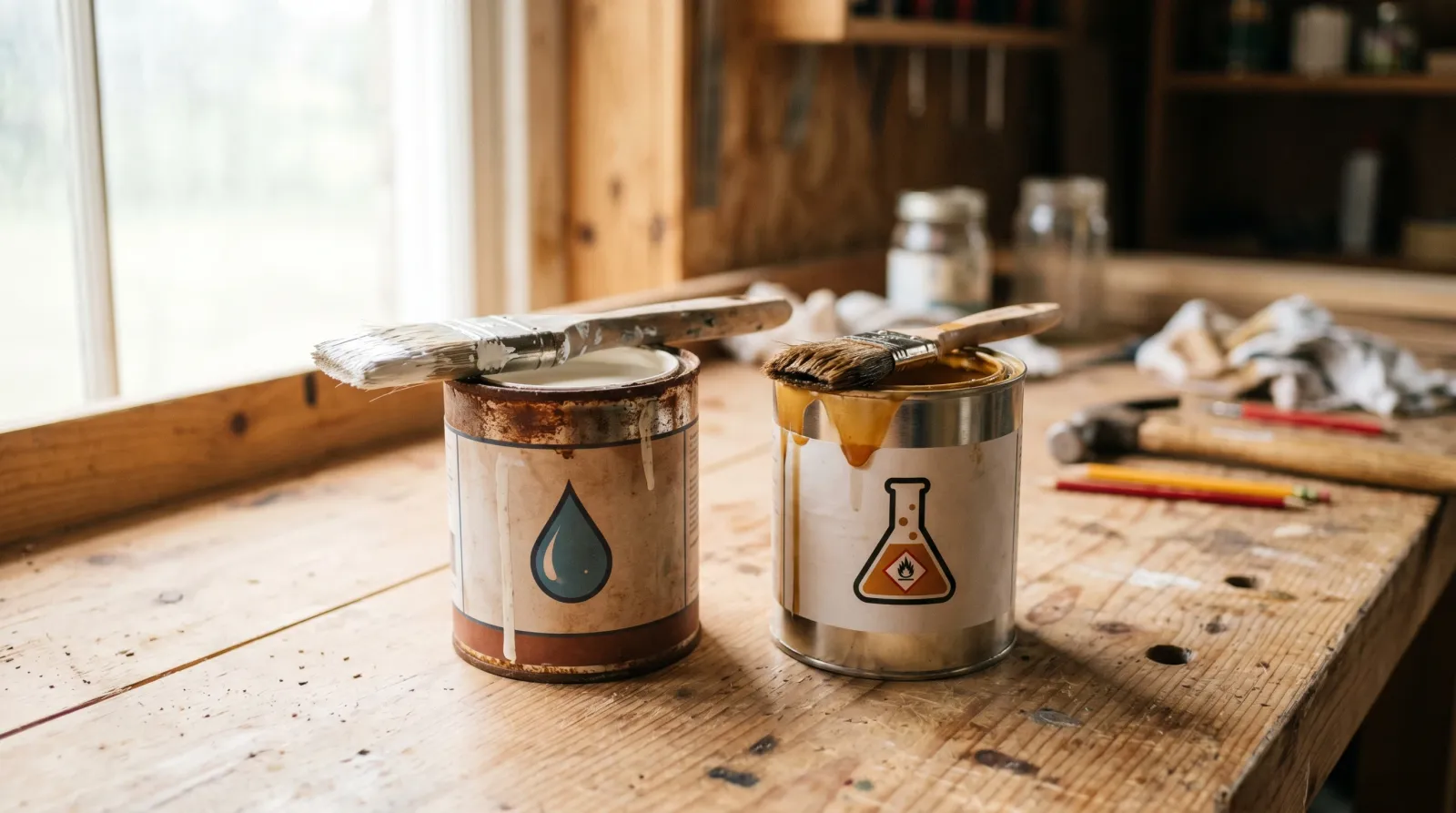
Most people meet the difference at the sink. You finish a coat of trim, go to clean the brush, and one paint rinses out under the tap while the other demands a jar of mineral spirits. That split at the sink is the surface clue to a deeper difference in how the two paints carry their binder.
Both paints use the same family of binder: an alkyd resin, which is an oil chemically reacted with a polyester backbone. Alkyd is the workhorse that gives oil-style paint its flow and its hardness. The reason for that hardness is oxidative cure: the resin pulls oxygen out of the air and the oil chains cross-link into a dense, tightly knit film. That reaction is what makes alkyd level like glass and dry rock-hard.
Here’s where the two part ways. Traditional alkyd dissolves the resin in petroleum solvent. The solvent keeps it liquid, then evaporates, and the resin oxidizes in place. Waterborne alkyd does something cleverer. It takes that same alkyd resin and emulsifies it into microscopic droplets suspended in water, the way oil and vinegar hold together in a shaken dressing. The water carries the paint, evaporates, the droplets coalesce, and then the same oxidative cross-linking happens. Same final chemistry. Different delivery vehicle.
That one swap, solvent for water, is why waterborne alkyd cleans up with soap, meets VOC limits, and skips most of the yellowing, while still curing into an oil-like film.
How to Tell Which One You Already Have
If trim is already painted and you’re deciding whether to recoat in kind, you mostly need to know whether the existing film is oil-class at all. Dab a cotton ball soaked in denatured alcohol on a hidden spot. A waterborne wall paint (acrylic) often softens and transfers a little color. A cured alkyd, waterborne or traditional, resists the alcohol and stays put. To separate the two alkyds from each other, look at age and color: traditional alkyd on a white door more than a couple of years old will show a warm amber cast, strongest behind furniture and in low-light corners. A clean, still-white trim film of similar age is almost certainly waterborne alkyd or acrylic.
Film Hardness Over Time
Both cure hard. The difference is what happens after.
Traditional alkyd never stops oxidizing. It feels hard in a week, reaches a peak in two or three months, then keeps cross-linking for years. Past a point, that over-cured film loses flexibility and turns brittle. It’s why old oil-painted trim chips in sheets when you knock it: the film has nowhere left to flex, so it fractures.
Waterborne alkyd is formulated to cross-link to a hard film and then largely stop. It hits roughly 90% of final hardness around 30 days and holds a degree of flexibility after that. On substrates that move with humidity and temperature (wood trim, MDF, doors that swell in summer), that retained flexibility is what keeps the film from cracking at joints.
Winner: Waterborne alkyd, on the strength of long-term durability. Traditional alkyd is harder at the three-month mark; waterborne alkyd is more durable at the three-year mark.
Leveling and Brushing
This is the dimension where waterborne alkyd had to earn its place. Standard acrylic wall paint dries fast and locks brush marks in if you don’t roll behind the brush. Traditional alkyd flows: the solvent buys open time, the resin self-levels, and brush marks melt out as it sets. That leveling is why pros reached for oil on trim and cabinet faces for decades.
Waterborne alkyd was engineered specifically to reproduce that flow. The emulsified resin and a slower-evaporating co-solvent package give it real open time, so it levels under a quality brush far closer to traditional alkyd than to wall paint. Benjamin Moore Advance and Sherwin-Williams Emerald Urethane are the two consumer products that hit this mark most cleanly.
It isn’t a dead heat in every condition. Traditional alkyd still has a slight edge on a hot, dry day or with a heavy load on a wide door, where its longer open time forgives more. But for the great majority of brush-and-roll trim work, the waterborne version levels well enough that the brush marks disappear.
Winner: Tie, with traditional alkyd holding a thin edge in extreme conditions.
Yellowing on White
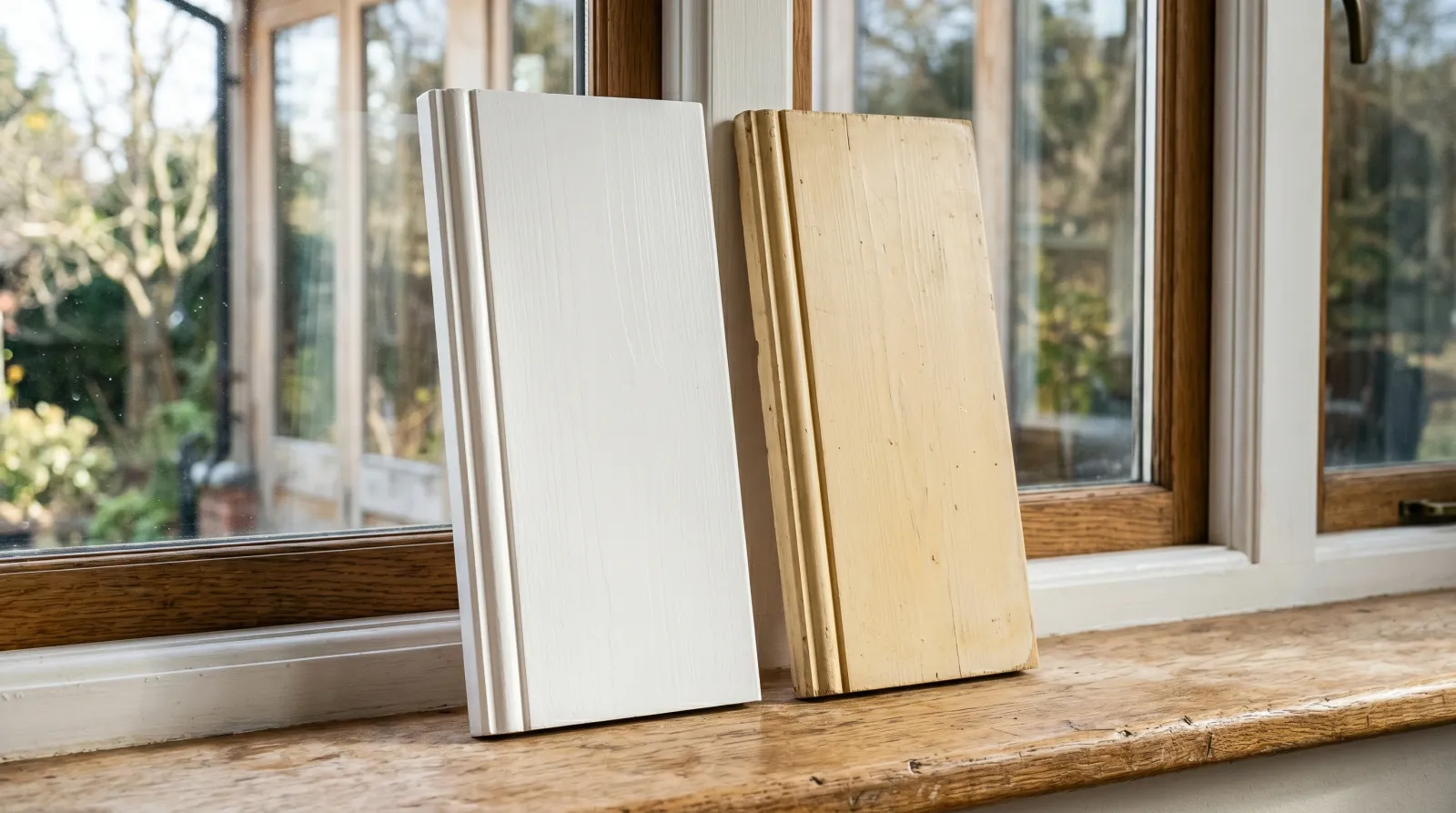 The same white, two binders: waterborne alkyd holds neutral while a traditional alkyd warms toward amber over the years.
Traditional alkyd yellows. Always, on white, given time. The same oxidative reaction that hardens the film also generates chromophores, color-bearing molecules that tint the resin amber. The effect is worst in low light, because UV exposure actually bleaches some of that yellowing back out. So the white trim in your dim hallway or behind the sofa ambers fastest, while a sunlit windowsill stays whiter. Two years in, it’s noticeable on north-facing trim. Five years, it’s obvious.
Waterborne alkyd is built with modified resins and light-stable additives that suppress those chromophores. It holds white close to neutral. You might catch a faint warming over a decade, but nothing like the amber shift a traditional alkyd shows in a fraction of that time.
If you’re painting white trim, white cabinets, or any pale color you want to stay true, this dimension alone decides it.
Winner: Waterborne alkyd, decisively.
Cleanup and VOC
Traditional alkyd cleanup is a process. Mineral spirits to break the resin, several rinse cycles until the solvent runs clear, then soap and water, then hazardous-waste disposal for the contaminated spirits. The VOC side is worse: as a traditional alkyd cures, the solvent flashes off into the room at 250–450 g/L, which is why the smell lingers for days and why most states now restrict it indoors. For the regulatory background, see VOCs explained.
Waterborne alkyd rinses out under the tap. VOC sits under 50 g/L, well within CARB and OTC limits, so it’s the version actually on the shelf in most of the country.
One safety note that applies to both, and matters more for traditional alkyd: rags soaked in oxidizing alkyd can self-heat as they cure and spontaneously combust. Lay them flat outdoors to dry, or seal them in a metal can with water. A pile of oily rags in a warm garage is a genuine fire risk, not a theoretical one.
Winner: Waterborne alkyd.
Cost and Availability
Per gallon, the two run close when you can find both — premium waterborne alkyds and the remaining traditional alkyds both sit in the upper tier. Coverage is similar.
Availability is the real divide. Traditional solvent-borne alkyd has largely left consumer retail in the US. Major brands converted their lines to waterborne to meet VOC rules nationwide, even in states where the law doesn’t require it, because maintaining two formulas isn’t worth it. To buy a true high-VOC traditional alkyd today you’ll often special-order from an industrial supplier. Read the technical data sheet, not the front of the can: plenty of products still say “alkyd” and “enamel” while being fully waterborne under 50 g/L.
Winner: Waterborne alkyd, on availability and compliance.
Verdict by Use Case
- Pick waterborne alkyd if: you’re painting trim, doors, baseboards, or cabinets in a home you live in. You want oil-like leveling, water cleanup, low odor, and white that stays white. This is the right answer for nearly all modern interior enamel work. For where it shines on woodwork, see the best interior trim paint round-up.
- Pick traditional alkyd if: the existing finish is oil and you can’t fully strip it, you’re refinishing furniture and want the hardest possible short-term film with weeks to cure, or you’re doing an industrial job outside this site’s scope. For the broader oil-versus-water decision, see oil vs water-based paint.
- It’s basically a tie when: you’re recoating older oil trim in a low-light, low-traffic room and color stability doesn’t matter. Either cures hard enough; pick on cleanup and smell, which favors waterborne anyway.
Common Mistakes
Treating waterborne alkyd like wall paint. It has longer open time and a thinner-feeling first coat. Brushing back over a setting area drags the leveling resin and leaves marks. Lay it on, tip off once, and leave it alone.
Recoating too soon. The recoat window runs longer than acrylic — often 4 to 16 hours. Go back over it at the two-hour mark out of habit and you’ll lift the half-set film. Read the data sheet and wait.
Skipping primer over old oil. Cured traditional alkyd is glossy and chemically closed. A waterborne film won’t grip it reliably without a scuff-sand and a bonding or shellac primer. Skip that and the new coat peels at door edges within months. Zinsser BIN over latent oil is the reliable call.
Reinstalling cabinet doors at full cure expectations on day three. Both alkyds keep hardening for weeks. Handle waterborne doors gently at 7–14 days; give traditional alkyd the full month before anything touches it hard.
Top Picks by Side
Going with waterborne alkyd? It’s the standard for modern trim and cabinet work. See the best interior trim paint round-up and the primer guide for switching off oil.
Need the oil-versus-water decision first? Start with oil vs water-based paint.