Peel-and-Stick Swatches vs Sample Pots
Samplize vs sample pots, tested side by side. Which gives the truest color, what each costs, and when a 12-by-12-inch peel-and-stick beats a brushed-out can.

The 30-Second Answer
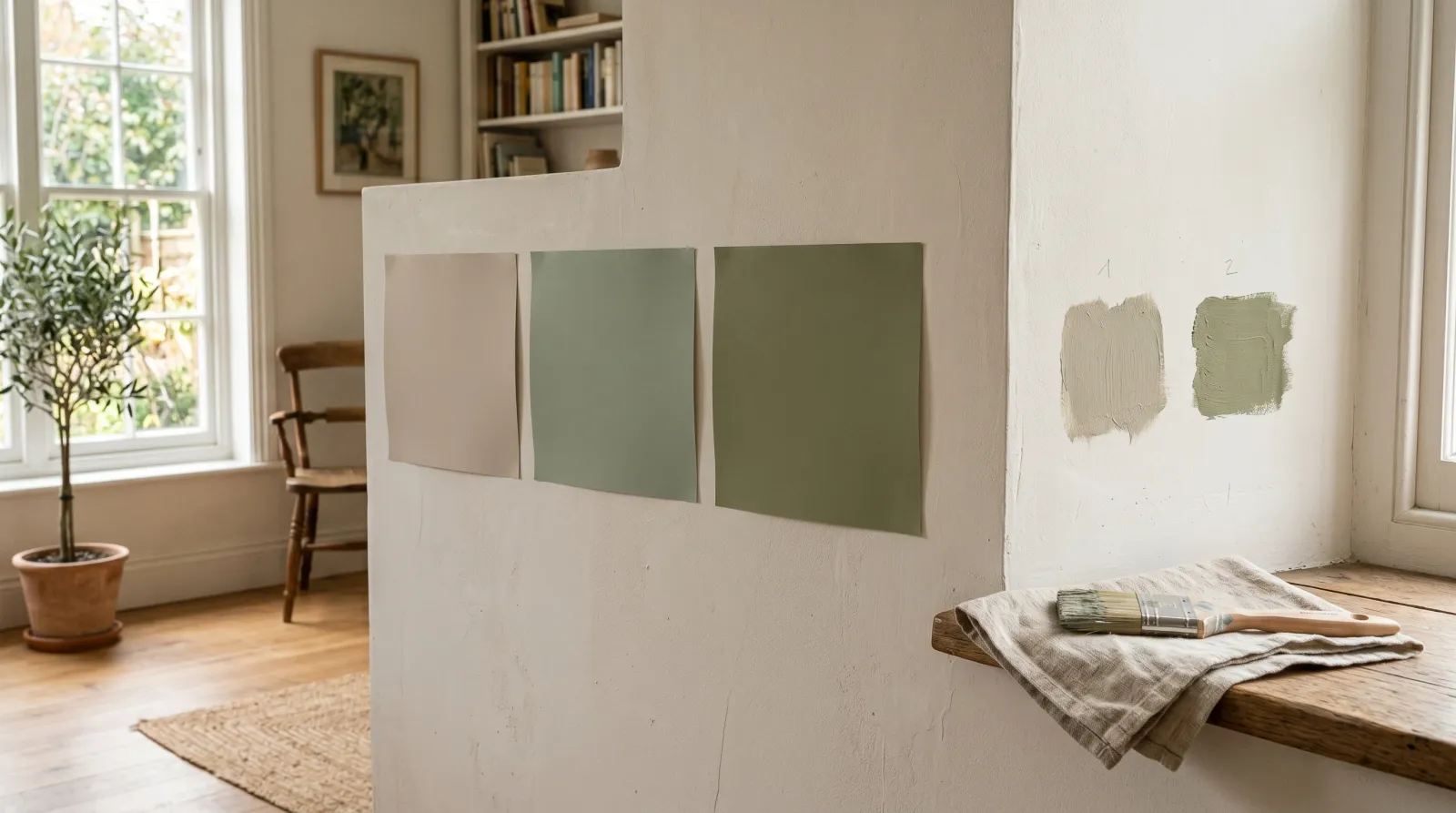
Shortlist with peel-and-stick swatches. Commit with a sample pot. The swatch wins on speed, mess, and comparing five colors across four walls in ten minutes with no dry time and nothing to clean up. The pot wins on truth: it’s the actual paint, in the actual sheen, going on over your actual wall, so it shows coverage and glare a swatch can’t fake. Most people waste money buying a pot for every color they’re curious about. Buy zero pots until you’ve used cheap swatches to get down to two finalists. Then one pot per finalist, brushed on the wall, decides it.
At a Glance
| Peel-and-stick swatches | Sample pots | |
|---|---|---|
| What it is | 12-by-12-inch sheet coated in 2 coats of real paint | 2-oz can of the mixed paint |
| Color accuracy | ✓✓ true hue and depth | ✓✓ identical (it’s the paint) |
| Shows real sheen | ✗ flat-ish only | ✓✓ exact finish ordered |
| Shows coverage | ✗ over white card stock | ✓✓ over your real wall |
| Cost each | ~$2-3 | ~$5-10 |
| Mess | ✓ none | ✗ brush, drips, dry time |
| Reposition across walls | ✓✓ peel and move | ✗ painted in place |
| Ready instantly | ✓✓ | ✗ 1-2 coats plus dry time |
| Best for | shortlisting many colors | final commit, sheen-critical rooms |
How to Tell Which One the Job Wants
Count your colors and check the room.
If you’ve got a Pinterest board with eight greiges and three sages and no idea where to start, that’s a swatch job. You need to kill six of them fast, and you’re not going to brush eight test patches on a Saturday. If you’re already down to “Repose Gray or Agreeable Gray” and you’re painting a bathroom in satin, that’s a pot job. The decision now hinges on sheen and how the color sits in steamy north light, and only the real paint shows you that. The fast test: are you exploring or deciding? Exploring is swatches. Deciding is pots. Bathrooms, trim, and any high-gloss surface skip straight to a pot because sheen is the whole question.
Color Accuracy
Both read color well, and that surprises people who assume the swatch is a cheat.
Samplize and the other peel-and-stick brands coat their sheets with two coats of the genuine brand paint. Benjamin Moore, Sherwin-Williams, Behr, Farrow & Ball. The hue, the pigment depth, the undertone that shows up in afternoon light. All of it reads true because it is the paint, just dried on a sheet instead of your wall. That’s the leap over a printed fan-deck chip, which is ink. A printed chip of a deep color reads a full shade lighter and flatter than the mixed gallon, and it’s lied to more homeowners than any other tool in the store.
The sample pot is the paint by definition, so its accuracy is perfect on hue. The catch is the substrate underneath. Brush a light greige over a wall that’s currently dark beige and the first coat reads muddy and warm. That’s not the color, that’s bleed-through. The swatch sidesteps this because its backing is neutral, which is cleaner for judging hue in isolation but less honest about what you’ll actually see on day one over your real wall.
So they tie on hue. The swatch is cleaner for isolating a color. The pot is more honest about what your specific wall does to it.
Winner: Tie. Both show true color. They lie in different directions.
True Finish and Sheen
This is the swatch’s hard limit and the pot’s clean win.
Peel-and-stick sheets come in one finish, a low flat-ish sheen, no matter what sheen you’d actually order. You cannot see how an eggshell catches the morning glare off a hallway wall, how a satin in a bathroom bounces the vanity light, or how semi-gloss trim reads against a matte wall. Sheen changes perceived color too. The same gray looks deeper in matte and lighter in semi-gloss because gloss reflects more light back at you. A swatch hides that whole conversation.
A sample pot, bought in the exact sheen you plan to order, shows all of it. You see the glare, the depth, the way satin makes a north-facing room feel slightly cooler. For a bathroom or a trim job, this isn’t a nice-to-have. The sheen guide walks through how much each step up the gloss ladder shifts both durability and look, and what eggshell actually does on a wall is a question a swatch can’t answer.
Winner: Sample pots. Decisively, for any room where sheen matters.
Cost
The swatch is cheaper per color and the gap compounds the more colors you test.
A peel-and-stick swatch runs about $2-3 each. A 2-ounce sample pot runs $5-10 depending on brand, with Benjamin Moore and Sherwin-Williams at the top of that range and store-brand pots at the bottom. Test five colors and swatches cost you maybe $12 shipped. Five sample pots cost $30-50 plus the brushes and the gas to the store. For the shortlist phase, where you’re killing most of the colors anyway, paying $7 a pot to eliminate a color you’ll reject in thirty seconds is a waste.
The math flips at the finalist stage. You’re down to two colors. Two pots at $8 is $16, and you’re buying the real paint to make a real decision on the real wall. That’s $16 well spent before you commit to $200 in gallons. The swatch saved you from buying six pots. The pot saves you from buying the wrong gallons.
Winner: Peel-and-stick swatches, for the shortlist. The per-color cost is a third of a pot’s.
Ease of Use and Speed
Swatches are faster and the difference is not close.
A peel-and-stick swatch is ready the second it arrives. Peel, stick, look. Move it to the next wall, look again. Tape four of them in a row and compare across a room in one glance, then carry them to the north bedroom and the south kitchen to see the same colors in different light. No brush, no second coat, no waiting. The repositioning is the underrated part. The same swatch checks a color in five locations in five minutes.
A sample pot is a small painting job. Stir it, brush two coats so the color reads true, wait for coat one to dry before coat two, then wait again before you judge it. Paint the patch in the wrong spot and you can’t move it. Most guides say to brush your sample onto a white poster board so you can reposition it, which is smart, but now you’ve added a craft step and the board’s edge casts a shadow that throws the read. Brushing technique matters too. A thin streaky coat reads lighter than two even coats, which is the same problem a brush vs a roller creates at full scale.
Winner: Peel-and-stick swatches. Instant, repositionable, zero dry time.
Cleanup and Mess
No contest.
Swatches generate one thing to throw away: the sheet. No brush to rinse, no drips on the baseboard, no skin of dried paint in a half-used can rolling around your garage for three years. You can test colors in a rental and leave zero evidence, which is the whole reason renters reach for them.
Sample pots leave a brush to clean, a patch on the wall to eventually prime over, and a graveyard of 2-ounce cans you’ll never reopen. None of it is a disaster. It’s just real cleanup on what’s supposed to be a quick test, and in a rental it’s a patch you have to cover before you move out.
Winner: Peel-and-stick swatches.
Verdict by Use Case
- Pick peel-and-stick swatches if: you’re early in the process with more than three colors in play, you rent and can’t paint test patches, you want to compare the same colors across rooms with different light, or you want zero mess and an instant read. This is the shortlisting tool.
- Pick a sample pot if: you’re down to one or two finalists, the room is sheen-sensitive (bathroom, kitchen, trim, anything in satin or semi-gloss), you need to see how the color covers over your existing wall, or you want to judge how the actual paint brushes out before buying gallons. This is the commit tool.
- It’s basically a tie when: you’re testing a single matte color on a wall that’s already a similar light tone. The swatch reads close enough to the matte finish, and the substrate won’t bleed through. Save the brush and use the swatch.
Top Picks by Side
Going with swatches? Samplize is the name most people know, and it stocks real-paint sheets for Benjamin Moore, Sherwin-Williams, Behr, Farrow & Ball, and more. Order three or four finalists, not the whole fan deck. The point is to narrow, not to collect.
Going with pots? Buy one 2-ounce pot per finalist color in the exact sheen you’ll order, brush two coats on the actual wall (or a white poster board you can move), and judge it in both morning and evening light. For sheen-sensitive rooms, read what satin paint does before you lock the finish, because the sheen decision often outranks the color decision in a bathroom.
FAQ
Are peel-and-stick swatches accurate enough to pick a final color? For narrowing a short list, yes. The good ones use two coats of real paint, so hue and depth read true. What they can’t show is sheen or how the paint covers your existing wall color. Brush a real sample pot of your finalist on the actual wall before you buy gallons. Use the swatch to get to two colors, the pot to choose between them.
Does Samplize use real paint or a print? Real paint. Samplize sheets are coated with two coats of the actual brand’s paint, so color and pigment depth match the can. A printed fan-deck chip is ink, and it reads lighter and flatter than the mixed paint, especially on deep colors.
How many sample pots do I need? One 2-ounce pot covers two to three 12-by-12-inch test patches with two coats, enough for one room. Buy one pot per finalist color, not per room. Most people over-buy and end up with a shelf of half-used cans.