What Is Eggshell Paint?
Eggshell reads 10–25 gloss units at 85°. It's the soft-glow finish that quietly runs most living rooms and bedrooms in America. Here's why.

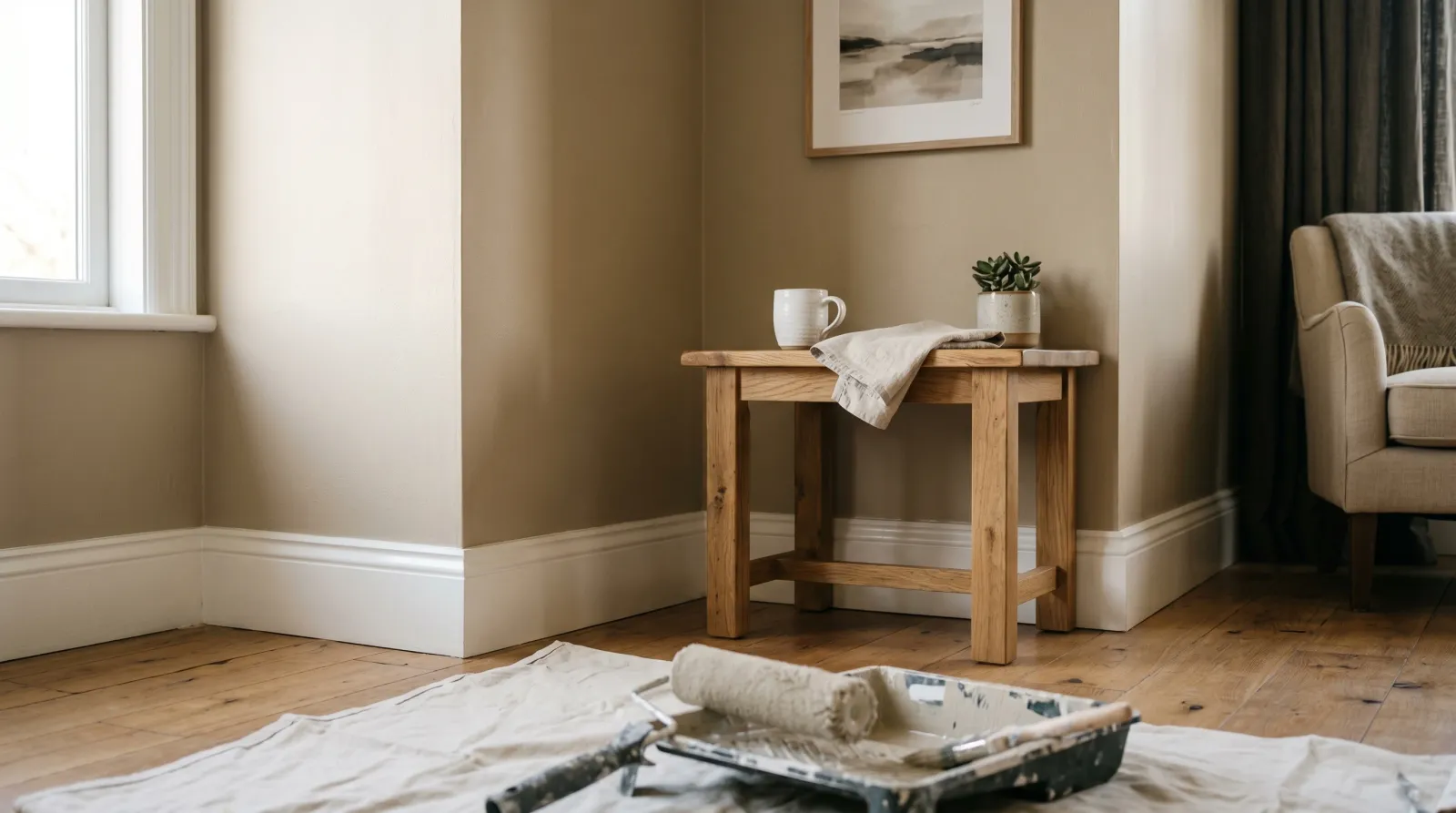
Step into most American living rooms on a Saturday afternoon and run a flashlight along the wall at a low angle. The paint isn’t dead flat. It isn’t shiny either. It has a quiet, even glow that catches the light without throwing it back at you. That’s almost always eggshell, and it’s the finish that quietly dominates wall paint in the country for a chemistry reason and a behavior reason that line up.
Eggshell paint reads 10 to 25 gloss units measured on a gloss meter at 85°. Matte sits below it at 5 to 10, flat at 0 to 5, and satin climbs to 15 to 35 measured at 60°. The two measurement angles overlap awkwardly at the seam, which is why the label always beats the number for everyday shopping. What matters is that eggshell occupies the slot where the dried film has just enough binder on top of the pigment to wipe a fingerprint, and not so much that the wall starts to read shiny under a table lamp. That slot has won the living room, the bedroom, the hallway, the dining room, and most of the rooms in between.
Where the Sheen Comes From
Sheen is a ratio, not an ingredient. The number that controls it is pigment volume concentration, or PVC. The binder is the clear polymer that forms the film. The pigment is the solid particles suspended in it. A high-PVC formula has more pigment than the binder can fully coat, so pigment particles stick up above the dried film and scatter light in every direction. Your eye reads that scatter as matte. Drop the PVC by adding more binder, and a thin layer of pure resin grows on top of the pigment. Light hits that resin layer and bounces more directionally. That’s gloss.
Eggshell lives at roughly 35 to 40% PVC. The resin layer is thin but continuous, which is the practical sweet spot. Thin enough that the wall reads soft, continuous enough that a damp cloth slides across without grabbing the pigment underneath. Flat paint at 45%+ PVC doesn’t have that continuous resin skin, which is why a wet rag on flat lifts color and leaves a stain. Eggshell wipes; flat smears.
Why Touch-Up Works on Eggshell
The single most underrated property of eggshell is touch-up forgiveness. Anyone who has tried to patch a satin or semi-gloss wall mid-panel knows the story — the repair always shows, even with paint from the same can. The reason is film thickness and binder coalescence. A second coat over an already cured first coat cures slightly glossier because the new binder has less competition for the substrate’s pull. In satin, that gloss delta is enough to read as a brighter patch in raking light. In eggshell, the gloss delta falls below the threshold your eye notices in normal room lighting.
That’s why eggshell is the finish a parent reaches for. The crayon mark above the couch, the dog’s wet-nose smudge near the door — you load a small roller from the touch-up can, feather the edges, and walk away. Satin doesn’t forgive that. Eggshell does.
Why It Holds Up to Kids
The scrubbability number tells the rest of the story. The ASTM D2486 test runs a weighted brush across a cured film and counts cycles until failure. Flat and matte fail at a few hundred cycles on most premium lines. Eggshell clears 400 to 800 on a 100% acrylic film, and the top-shelf eggshells (Benjamin Moore Aura, Sherwin-Williams Emerald, Behr Marquee) push past 1,000. That’s plenty for the wall behind a kid’s bed, the hallway where a scooter rolls in, the dining-room dado where chair backs touch.
It’s not the finish for a direct splash zone. The wall behind a bathroom sink, the kitchen splash arc above the stove — those want satin or semi-gloss. Eggshell is the everywhere-else finish, and “everywhere else” is most of the house.
When to Use Eggshell
Use it for:
- Living-room walls. Soft enough to flatter a sofa, wipeable enough to forgive a coffee splash.
- Bedroom walls, including kid rooms. The touch-up forgiveness is what makes the difference here.
- Dining rooms and hallways. Chairs touch, hands brush, bags scrape — eggshell takes it.
- Most interior walls in homes built after 1990 with reasonably smooth drywall.
When Not to Use Eggshell
Don’t use it for:
- Old-construction walls with visible roller stipple, seam ridges, or screw pops. Sheen catches raking light. Step down to matte or skim-coat first.
- Direct splash zones in a bathroom or kitchen. Step up to satin or use a dedicated bath product like Aura Bath & Spa.
- Ceilings. Sheen plus low grazing light equals every seam visible. Use flat or matte.
- Interior trim. Trim wants a noticeable step up in sheen so it reads as architecture. Satin or semi-gloss.
How Eggshell Compares
| Property | Matte | Eggshell | Satin | Semi-Gloss |
|---|---|---|---|---|
| Gloss units | 5–10 (85°) | 10–25 (85°) | 15–35 (60°) | 35–65 (60°) |
| Hides wall flaws | 🟢 Best | 🟢 Good | ⚪ Fair | 🟡 Worst |
| Scrubbability | 🟡 Light wipe only | ⚪ Good | 🟢 Strong | 🟢 Best |
| Touch-up forgiveness | 🟢 Best | 🟢 Excellent | 🟡 Poor | 🔴 Worst |
| Best room | Bedrooms, ceilings | Living, bedroom, halls | Kitchen, bath, halls | Trim, doors |
For the full ladder, see the sheen guide. For the close-neighbor decision, see eggshell vs satin.
Common Mistakes
- Treating eggshell as a splash-zone finish. It isn’t. The wall above a sink will burnish at the wipe line in a year. Step up to satin where water lives.
- Skipping primer on a patched wall. A porous patch pulls binder out of the wet paint and the dried film flashes duller in that spot. People blame the paint. The fix was upstream. Spot-prime the patch, then paint corner to corner.
- Trusting the label across brands. Behr’s eggshell runs near the top of the 10–25 range and reads almost like satin. Benjamin Moore’s sits closer to the middle. Paint a sample board in your actual light before committing the room.
- Washing at day three. Touch-dry is not cured. The acrylic binder needs 14 to 30 days to fully coalesce. Scrub early and you polish the spot, which reads brighter than the surrounding wall under a table lamp.
Where to Use It
Eggshell is the default for the room you sit in, sleep in, and walk through. Living rooms, bedrooms, hallways, dining rooms, kids’ rooms, home offices, stair walls. Anywhere the wall has to flatter a paint color, survive normal house traffic, and let you touch up a scuff next year without repainting the whole panel. Step up to satin where water hits. Step down to matte where the wall is rough. Everywhere else, eggshell is the answer.