Little Giant vs Gorilla Ladders
Little Giant vs Gorilla ladder, judged off a painter's truck: hinge hardware, leveling, weight, warranty, and price. Which one earns the garage space.

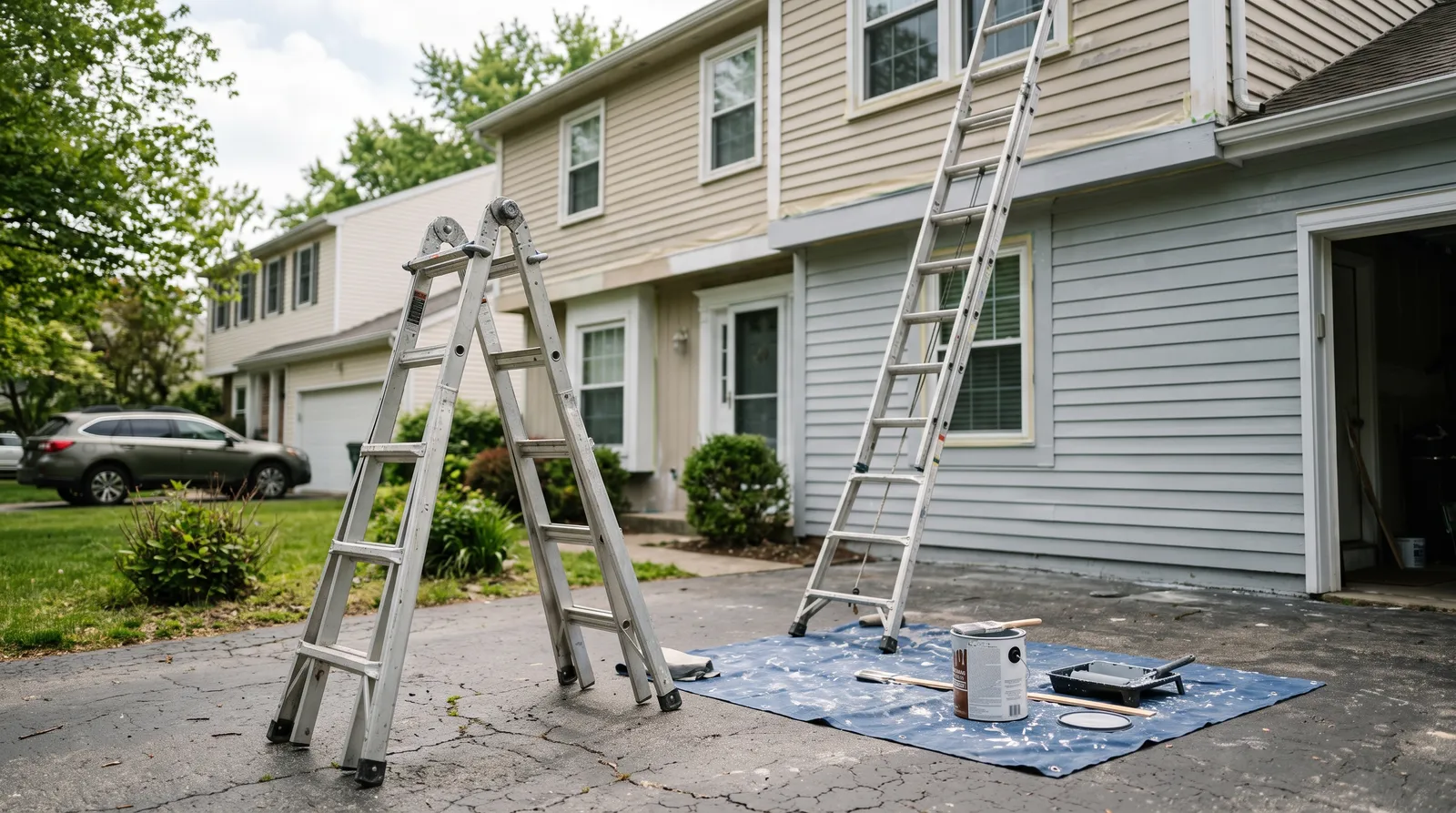
The 30-Second Answer
Buy the Gorilla if you’ll set up a ladder a dozen times a year and it lives in a garage between jobs. Buy the Little Giant if you’re on one every week, working stairwells, or dragging it to somebody else’s house. The extra $150 to $300 buys hinge hardware, adjustable legs, and a lifetime warranty. On a flat driveway against an open wall, both hold you up exactly the same.
Neither brand is a scam. They’re built for different frequencies of use.
At a Glance
| Little Giant | Gorilla Ladders | |
|---|---|---|
| Hinge & lock hardware | 🟢 Rock Lock tabs, heavy stampings | 🟡 lighter pins, more play after a season |
| Duty rating range | 🟢 mostly Type IA / IAA (300–375 lb) | 🟡 Type II to Type IA (225–300 lb) |
| Configurations | 🟢 A-frame, extension, stairway, trestle, 90-degree wall | 🟢 A-frame, extension, stairway, scaffold base |
| Leveling range on stairs | 🟢 deep independent leg adjustment | 🟡 shorter range on most models |
| Painting accessories | 🟢 work platform, standoff, wheels, trestle brackets | 🟡 project tray, few add-ons |
| Street price (multi-position) | 🔴 $300–600 | 🟢 $150–300 |
| Warranty | 🟢 lifetime on most models | 🟡 limited, varies by model |
| Where to buy | Lowe’s, Costco, direct | Home Depot shelf |
Read the Sticker Before You Read the Price Tag
Every ladder sold in the US carries an ANSI duty rating on the side rail. Type III is 200 pounds, Type II is 225, Type I is 250, Type IA is 300, Type IAA is 375. That number covers you plus everything you’re carrying, including the ladder-mounted paint tray, a full gallon, and your tool belt.
Do the math honestly. A 190-pound painter, a gallon of exterior acrylic at 11 pounds, a brush pail, and a stabilizer clears 210 without anybody flinching. A Type II ladder is at its ceiling and you haven’t reached over the rail yet.
Little Giant sells almost nothing below Type IA. Gorilla sells across the range, and the cheap end of their shelf is where homeowners get in trouble.
Build Quality and Hinge Hardware
The hinge is the whole argument. A multi-position ladder is two extension ladders joined by a pair of hinges that get slammed open and closed every setup, and that hinge decides how the ladder feels five years in.
Little Giant’s Rock Lock tabs are chunky stampings with a spring pin that seats with an audible click. The rails are thick-wall extrusion, the base is flared wide, and the whole frame has a dead, solid feel when it’s locked in the A-frame. No creak, no sway when you shift weight to one rail.
Gorilla’s hinge does the same job with lighter parts. Out of the box it’s tight. After a season of real use, most owners report a little play in the joint and more flex in the rails at full extension. It isn’t unsafe. It just talks to you more when you’re leaning to cut in a ceiling line, and a ladder that talks is a ladder you don’t fully trust.
Winner: Little Giant.
Configurations and Reach
Both do the four positions everybody buys a multi-position ladder for: A-frame, extension, stairway, and 90-degree against a wall. Both also convert into a pair of trestles for a plank, which is the setup that makes long hallway ceilings tolerable.
Little Giant goes further on the specialty end. The King Kombo folds a step ladder, an extension ladder, and a rotating wall standoff into one unit, and that standoff is why it lives on exterior repaints. It holds you off the gutter, keeps your body away from the wall, and lets you run a full brush length of fascia without the top rails denting aluminum coil stock. The SumoStance flares the base for soft ground. The Revolution XE adds a wider rung and tip-and-glide wheels.
Gorilla’s lineup is narrower but covers the common ground. The MPX multi-position handles the four core positions, the tri-fold with a project tray is a genuinely good in-house step ladder, and the hybrid leaning ladder is a smart shape for a stairwell wall.
Winner: Little Giant on range. Gorilla’s tri-fold project tray is the single best small-ladder feature either brand makes.
Weight and Handling
This one’s closer than the price difference suggests. At the same length, a Little Giant and a Gorilla multi-position land within a few pounds of each other. A 22-foot aluminum multi-position from either brand is a mid-40-pound object, and there’s no clever way to carry it up a driveway alone.
The difference is in how the weight moves. Little Giant’s tip-and-glide wheels on the Revolution and Velocity let you tilt and roll the ladder to the next setup instead of lifting it. On an exterior repaint you move a ladder thirty times a day. Thirty lifts versus thirty rolls is the difference between finishing at four and finishing at six.
If pure carry weight is your problem, neither multi-position is the answer. Little Giant’s Xtra-Lite and HyperLite fiberglass step ladders are the light options, and they’re a different purchase.
Winner: Little Giant, on wheels rather than pounds.
Leveling on Stairs and Uneven Ground
Very few houses sit on level dirt. Flower beds settle, driveways pitch, and the ground under a downspout is always soft.
Little Giant’s independently adjustable legs are the reason the brand exists. Set one side four rungs shorter than the other and the frame sits square on a staircase. Add the ratchet levelers and you can dial in a few inches of correction on a slope without stacking scrap plywood under a foot. Stacking plywood under a ladder foot is how people fall.
Gorilla multi-position ladders adjust too. The range is shorter on most models, which handles a mild slope but runs out of travel on a standard stair rise. For a two-story stairwell ceiling, that gap decides the job.
Winner: Little Giant, and it isn’t close.
Accessories That Matter to Painters
Little Giant sells a work platform that clips across the rungs and turns the A-frame into a place to stand with a bucket, plus trestle brackets, a wall standoff, and a ladder rack. The sockets are molded into the frame, so the parts fit without hose clamps.
Gorilla’s accessory list is short. The project tray on the tri-fold is good. Past that you’re buying generic bolt-on stabilizers and pail hooks, which work fine and never sit quite right.
One caution for both: a ladder-mounted paint tray encourages you to reach. Reaching is how you get a holiday in the cut line and how you go off the side. Move the ladder.
Winner: Little Giant.
Price, Availability, and Warranty
Street prices as of mid-2026: a Gorilla multi-position runs roughly $150 to $300 depending on length and duty rating. A comparable Little Giant Velocity or Revolution runs $300 to $600, and the King Kombo Pro sits at the top of that. Step stools and short step ladders narrow the gap. Gorilla’s steel two-step and three-step stools are $40 to $70 and there’s nothing wrong with them.
Availability splits by store. Gorilla is Home Depot’s house brand, so it’s on the shelf today, and you can return it to the same store next Saturday. Little Giant shows up at Lowe’s, Costco (usually a bundled Velocity around the holidays), and direct.
Warranty is the quiet part. Little Giant carries a lifetime warranty on most of its ladder line. Gorilla’s is a limited warranty that varies by model, so check the box rather than the brand. Over twenty years that difference is worth more than the sticker gap.
Winner: Gorilla on price and availability. Little Giant on warranty.
Verdict by Use Case
- Pick Little Giant if: you paint for a living, you work stairwells and split-levels, your exterior work sits on graded lots, or you want to buy one ladder in your thirties and still own it in your fifties. The King Kombo for exteriors, the Velocity for general work, the Safety Step for interior cut-in.
- Pick Gorilla if: you’re painting a room or two a year, the ladder lives in the garage, and $400 for a ladder feels absurd for a tool you’ll use six weekends. Buy the Type IA multi-position, not the Type II, and the tri-fold for indoor work.
- It’s basically a tie when: you need a step stool. A three-step steel Gorilla and a comparable Little Giant do the identical job at a $30 difference, and nobody has ever worn out a step stool.
- Buy neither when: the job is a full two-story exterior with a lot of cut-in. Rent a pump jack or staging. A ladder is the wrong platform for eight hours of brushwork at 20 feet, and no brand fixes that.
Where to Shop by Side
Going Little Giant or Gorilla? Both are covered with current picks and duty ratings in the best ladders for painting round-up, sorted by the work you’re actually doing.
Prepping siding before you climb? Washing comes first. The pressure washers for paint prep guide covers what pressure and tip won’t drive water behind the lap.
Still deciding whether the premium tool is worth it? The tool cost-per-year math applies to ladders the same as brushes, and it settles this argument better than brand loyalty does. How you apply the paint once you’re up there is a separate call, covered in brush vs spray.
What’ll Bite You in Two Years
Aluminum doesn’t rot, so people stop inspecting ladders. Two things fail quietly.
First, the hinge pins and rung locks. Grit from exterior prep gets into the mechanism, the spring loses its snap, and one day a lock doesn’t seat all the way. You’ll feel it as a soft click instead of a hard one. Blow the hinges out with air and hit them with a dry lubricant twice a season. Not grease. Grease holds sand.
Second, the feet. The rubber shoes wear flat and glaze over, and a glazed foot on a smooth concrete garage floor slides. Both brands sell replacement shoes for under $30. Nobody buys them until after the slide.
And if you left a ladder leaned against the house through a winter, check the rails where they contacted the siding. You’ll usually find a stripe of failed paint underneath, which is a prep problem now, not a ladder problem. The peeling exterior paint fix walks that repair.