Graco Magnum X5 vs X7: Which Airless to Buy
Graco X5 vs X7 tested on tip ceiling, flow rate, cart versus stand, annual pump life, and real cost per year. A tester's verdict on which airless to buy.

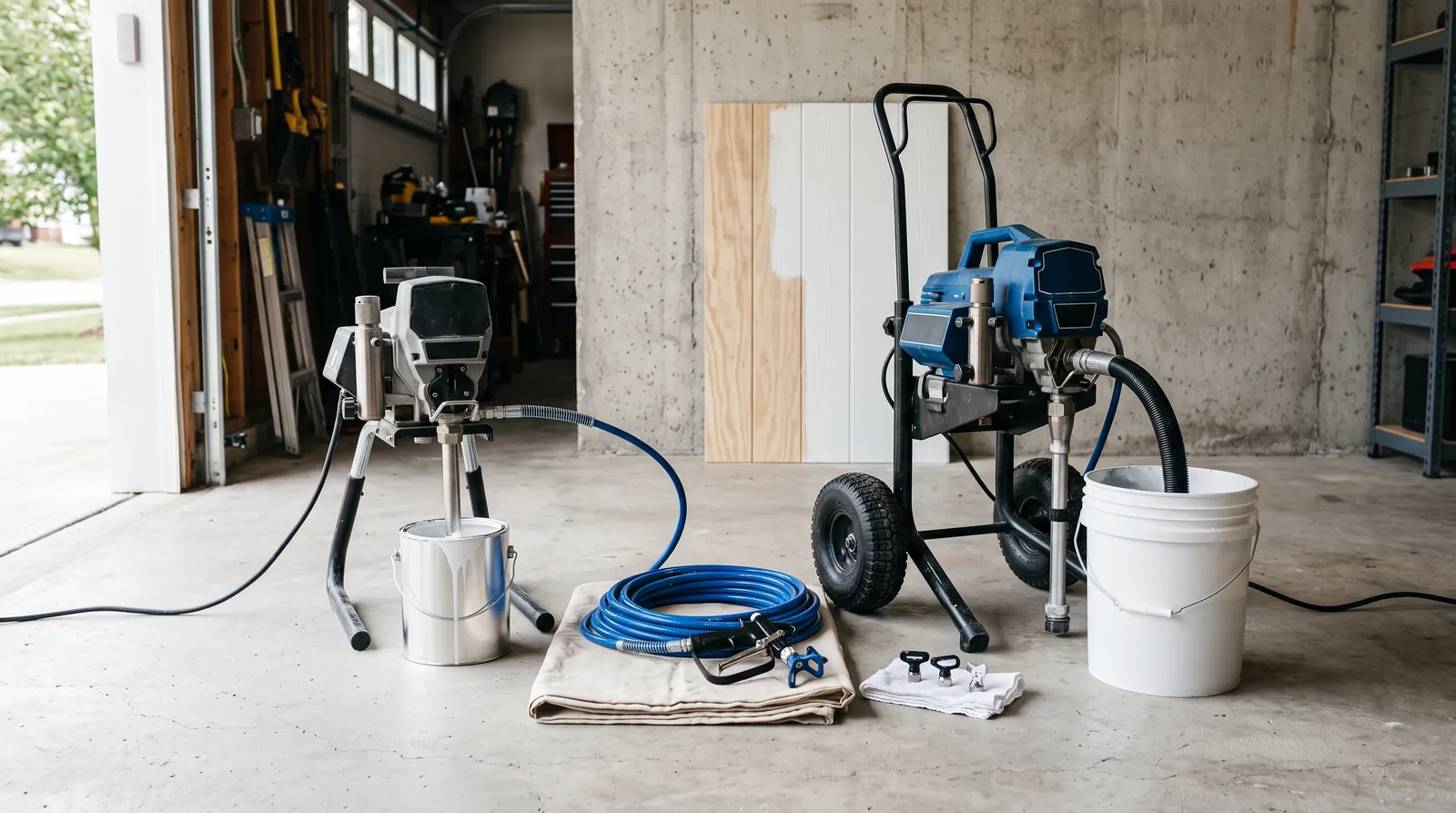
The 30-Second Answer
Buy the X7 if any part of your painting year happens outdoors. The cart, the 0.019-inch tip ceiling, and the 300-gallon annual rating are the three things you are paying the extra $150 for, and all three only start earning their keep once you leave the drywall. For an interior-only list, the X5 lays down the identical finish for about $349. Same 3000 PSI stainless piston, same reversible tips, same atomization on unthinned latex. The trade-off is wheels and headroom, not spray quality.
At a Glance
| Graco Magnum X5 | Graco Magnum X7 | |
|---|---|---|
| Model number | 262800 | 262805 |
| Street price | ~$349 | ~$499 |
| Max pressure | 3000 PSI | 3000 PSI |
| Max tip size | 0.017-inch | 0.019-inch |
| Max flow rate | 0.27 gal/min | 0.34 gal/min |
| Frame | Stand, no wheels | Cart, two pneumatic wheels |
| Dry weight | 24 lb | 35 lb |
| Suction tube | Rigid, sits in the pail | Flexible, drops into a 5-gallon pail |
| Hose in the box | 25 ft | 25 ft |
| Max supported hose | 75 ft | 100 ft |
| Recommended annual volume | 125 gal | 300 gal |
| Included tip | RAC IV 515 | RAC IV 515 |
| Best at | Interior walls and ceilings | Siding, fences, decks, whole houses |
How to Tell Which One You Are Looking At
Used listings mislabel these constantly, and identical blue housings do not help.
Check three things. The model sticker on the motor housing reads 262800 for an X5 and 262805 for an X7. The frame gives it away from across a driveway: the X5 sits on a fixed four-leg stand with no wheels, the X7 rides a two-wheel cart with inflatable tires. Then look at the suction tube. The X5 uses a rigid plastic tube that props in a pail; the X7 uses a flexible hose you drop into a 5-gallon bucket and leave there. If a seller shows you a wheeled unit and calls it an X5, it is an X7 or a ProX and they do not know it.
The Pump Is Identical. Start There.
Both machines run the same stainless steel piston pump at the same 3000 PSI ceiling.
On paper that reads like marketing overlap. In practice it is the most useful fact in this comparison, because atomization pressure is what decides finish quality on an airless. At 3000 PSI, both units break unthinned interior latex into a clean fan with no tails and no fingers. We ran eight gallons through each on a four-bedroom interior in Sherwin-Williams Emerald satin and graded the panels under raking LED at 30 minutes and again at 24 hours. Nobody on the team could pick the X5 wall from the X7 wall.
That matters because most buyers assume the pricier unit sprays better. It does not. It sprays more.
Winner: tie. Anyone telling you the X7 lays down a smoother wall is selling something.
Tip Ceiling and Flow Rate
Here is where the machines separate.
The X5 supports tips up to 0.017-inch. The X7 goes to 0.019-inch and pushes 0.34 gallons per minute against the X5’s 0.27. Translated to real work: a 515 tip (10-inch fan, 0.015-inch orifice) is the interior wall workhorse and runs happily on either unit. A 517 for heavier exterior latex on lap siding runs on either, though the X5 starts to feel the pressure dip on long passes. A 519, which is what you want on rough cedar or a fence with deep grain, only runs on the X7.
The flow gap shows up as pace. On a 1,200 square foot cedar exterior, the X7 kept a wet edge across a full eight-foot lap run. The X5 needed a slower walk and more overlap to avoid dry banding at the same tip, and the pump cycled noticeably harder on thick exterior acrylic. It got the job done. It worked for its money.
Interior ceilings in flat latex are a wash. Neither unit struggles.
Winner: X7. If you need a 519, this decision is already made.
Cart vs Stand
The X5’s stand frame is the honest reason people buy it, and the honest reason people regret it.
At 24 pounds it goes up a basement stairwell in one hand and lifts into a truck bed without a second person. That is a real advantage on interior work, where you are relocating the unit between rooms and up floors all day. The X7 is 35 pounds on a cart, and getting it into a tailgate is a two-person lift or a ramp.
Flip to exterior and the ranking inverts hard. Spraying siding means moving the machine roughly every 20 feet down the wall. With the X7 you tip the handle back and roll it, pail and all, across grass and gravel. With the X5 you set the gun down, lift a 5-gallon pail in one hand and the unit in the other, and walk. Do that fifteen times in an afternoon and the suction tube picks up grit, the hose drags through wet paint, and you find out why every X5 owner review mentions wheels.
Winner: X5 for interior mobility. X7 for anything with siding on it. This dimension is genuinely split, and it is the one most people get backwards.
Annual Duty Cycle and Pump Life
Graco rates the X5 for up to 125 gallons a year and the X7 for up to 300. Those numbers are not warranty terms, they are engineering guidance about packing wear, and ignoring them is what turns a $349 sprayer into a $349 paperweight.
Do the arithmetic on your actual year. A four-bedroom interior in two coats is roughly 20 gallons. A 1,200 square foot cedar exterior is about 15. A 400 square foot deck in solid stain runs 6 to 8. One interior plus one exterior puts you at 35 gallons, comfortably inside the X5’s range. The X5 gets into trouble when someone buys it for a rental portfolio and pushes 150-plus gallons a year through it, at which point the packings go inside two seasons.
The X7’s headroom is insurance more than capability. Most homeowners never approach 300 gallons.
Winner: X7, but only if your volume is real. Buying duty cycle you will not use is the most expensive kind of overbuying.
Hose Reach
Both units ship with the same 25-foot hose, which is short for anything taller than a single story.
The difference is what the pump supports. The X5 tops out at 75 feet of hose, the X7 at 100. Past 75 feet the X5 loses enough pressure at the gun to soften the fan, and you end up chasing pressure that is not there. The X7 holds a usable fan at 100 feet.
Buy the 50-foot extension with either machine. It is the first upgrade every owner makes, and it runs about $60.
Winner: X7, by 25 feet of practical reach.
Price and What a Second Year Costs
The X5 runs about $349, the X7 about $499. Add a 50-foot hose at $60 and three RAC X tips at roughly $25 each, and you are at $484 or $634 to be genuinely ready to work.
Running costs are identical, which surprises people. Two tips a year at $50, a quart of Pump Armor storage fluid at $14, and a pump packing kit every 18 to 24 months at $60. Call it $100 a year either way. Both machines die the same death when the storage fluid gets skipped, and dried latex in a piston is a replacement, not a repair. The tool care economics breakdown runs the five-year version of that math.
Run the rental comparison before you buy anything. A Magnum rents for around $80 a day, so four rental days costs about what an X5 costs outright. If your realistic total is one room a year, rent and skip this article.
Winner: X5 on purchase price. Tie on the cost of keeping it alive.
Where the X7 Falls Short
Two places, and neither is about spraying.
Weight and noise. Thirty-five pounds on a cart is fine on flat ground and awkward everywhere else. Basement stairs, second-floor hallways, and the back of an SUV all argue for the X5. The X7 is also audibly louder under load, which is a real consideration in an occupied house.
Overbuying. If your painting year is one bedroom and a hallway, the X7’s cart never leaves the garage floor, the 0.019-inch tip ceiling never gets used, and 260 of its 300 rated gallons go unspent. You paid $150 for headroom you never touch. Skip this if your list is interior-only and short.
The Verdict by Use Case
- Pick the X5 if: your work is interior walls and ceilings, you are painting one or two rooms a year, you carry the unit up and down stairs, you spray under about 125 gallons annually, or you want the cheapest real airless that atomizes unthinned latex without excuses.
- Pick the X7 if: your year includes siding, a fence, a deck, or a whole-house exterior; you need a 519 tip on rough cedar; you want to park a 5-gallon pail on the cart and roll it down the wall; or your annual volume is heading past 125 gallons.
- It is basically a tie when: the job is a single-story interior repaint with no exterior on the calendar. The finish is the same, the tips are the same, and the X7’s advantages sit unused. Take the $150.
Top Picks by Side
Going with the X5? It is our best-entry-airless pick, and the airless sprayer round-up has the current pricing alongside the Titan ControlMax 1700, which is the only unit under $300 worth considering against it. For the rest of the Graco duty ladder (ProX, cordless Ultra, contractor-class GMAX), the Graco brand hub maps the lineup.
Going with the X7? It is the top pick in that same airless sprayer round-up. If your exterior job starts with chalky or dirty siding, the prep step comes first: see the pressure washers for paint prep guide before you buy a tip.
Not sure an airless is the right system at all? Cabinets and fine furniture want a different machine, covered in airless vs HVLP and the HVLP sprayer picks. And for a single accent wall, the honest answer is in roller vs spray: the masking takes longer than the rolling.
FAQ
Is the X7 pump actually stronger than the X5 pump? Same architecture, more throughput. Both are stainless piston pumps rated at 3000 PSI, so atomization on interior latex is identical. The X7 moves 0.34 gallons per minute against 0.27, and supports a 0.019-inch tip against 0.017-inch. That is pace and material range, not finish quality.
Can the X5 spray exterior siding? Yes, once or twice a year. Without wheels you carry the unit down the wall every 20 feet, and a two-coat 1,200 square foot exterior burns about 15 of the X5’s recommended 125 annual gallons. One siding job is fine. A siding habit kills the packings in two seasons.
Do they use the same spray tips? Yes. Both take RAC IV and RAC X reversible SwitchTips and both ship with a 515. The X5 stops at 0.017-inch; the X7 goes to 0.019-inch, so a 519 is X7-only.
Related
- Best airless paint sprayers: five units tested with current prices
- Graco brand hub: the full sprayer lineup by duty class
- Airless vs HVLP: which spray system fits which surface
- Roller vs spray: when the masking costs more than the rolling
- Paint tool care economics: the five-year cost of keeping tools alive