Bates vs Purdy: Budget Brushes vs the Pro Standard
Bates vs Purdy brushes tested on cut line, shed rate, paint release, and cost per use. Which cheap brush is worth buying, and where Purdy earns its price.

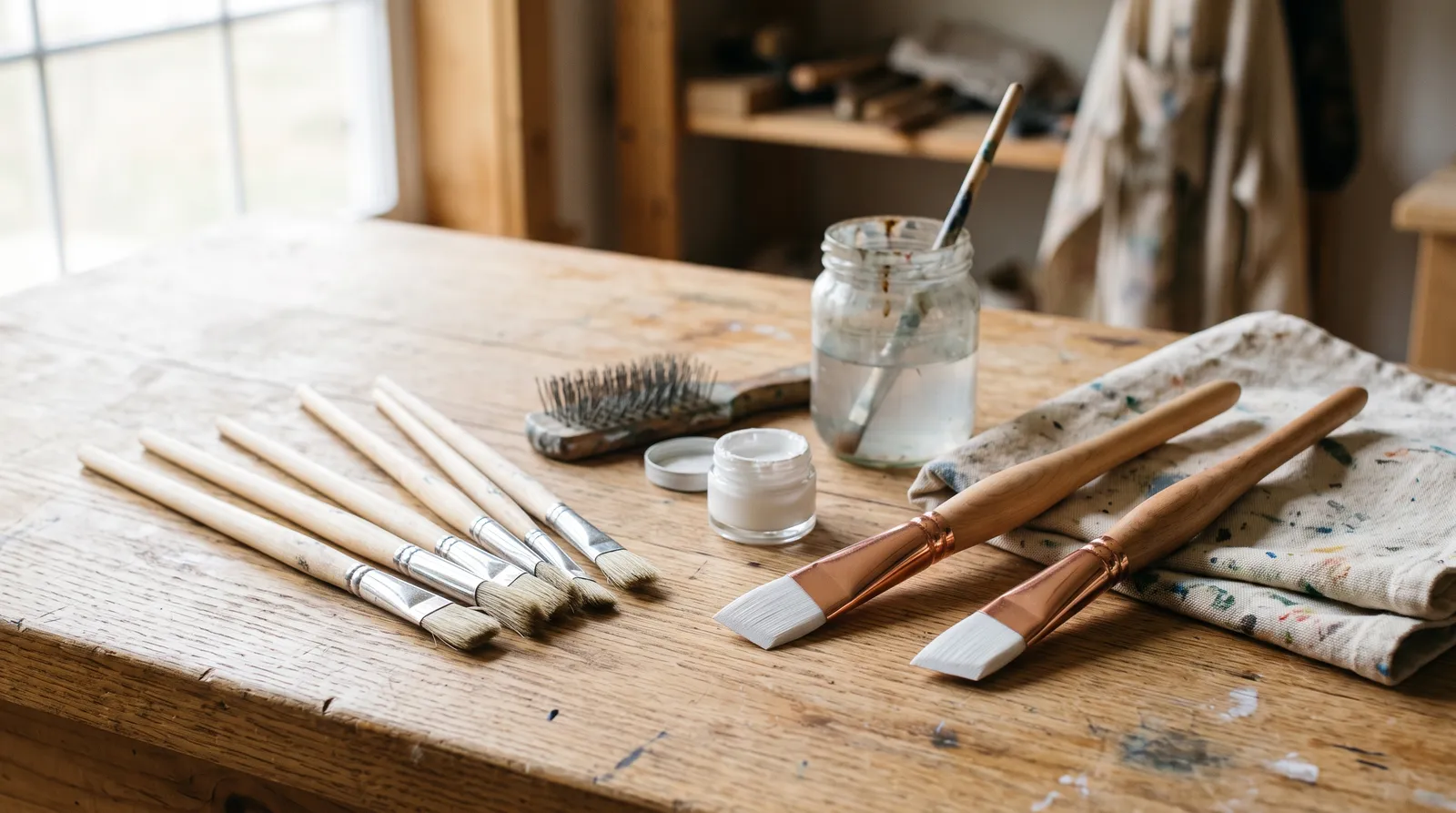
The 30-Second Answer
Top pick for any surface people will look at: Purdy. A 2.5-inch Clearcut Elite Glide holds its chisel through dozens of jobs, lays waterborne enamel flat, and still cuts a straight ceiling line in year three. Runner-up, and a smarter buy more often than brush snobs admit: Bates. A five-pack costs less than one Purdy. For shellac primer, deck stain, epoxy, and multi-color furniture work, a brush you throw away beats a brush you ruin. Purdy wins the finish. Bates wins the jobs where the finish doesn’t show and the cleanup isn’t worth the hour.
At a Glance
| Bates | Purdy | |
|---|---|---|
| Typical purchase | 5-piece synthetic set, $12-16 | Single brush, $15-25 |
| Cost per brush | $2.50-3.20 | $15-25 |
| Filament | Unbranded synthetic blend | Tynex nylon, Orel polyester, Chinex, China bristle |
| Chisel | Machine-cut, softens after one gallon | Hand-trimmed, holds for dozens of jobs |
| Shed, straight out of the wrapper | 🔴 6-11 loose filaments | 🟢 0-1 |
| Waterborne enamel on trim | 🔴 Visible brush marks | 🟢 Clearcut is built for it |
| Latex wall paint, cut-in | 🟡 Workable, wanders late in the wall | 🟢 XL Glide, best in class |
| Shellac, oil primer, epoxy | 🟢 Use once, bin it | 🟡 Works, but you owe it a solvent wash |
| Stain and sealer | 🟢 Good enough | 🟢 Nylox and Syntox |
| Ferrule and handle | Thin crimped stainless, plain wood | Stainless or copper, sanded alder |
| Realistic working life | 1-3 jobs | 50-100 jobs with a comb |
| Where you buy it | Online sets, 2-day shipping | Paint stores and big boxes, same day |
How to Tell Whether Your Brush Is the Problem
Three checks, thirty seconds, before you blame the paint.
Bend the filaments back against your palm and let go. A brush with a live chisel springs back into one clean tapered edge. A dead one stays fanned, and every stroke after that is two strokes wide at the tip. Next, drag the dry brush across a scrap of cardboard: a ragged feathery mark instead of a defined line is what your ceiling cut is going to look like. Last, pinch the filament near the tip and tug. Anything that comes out in your fingers was going to come out in your topcoat.
If your cut lines have been drifting and you’ve been buying more tape to compensate, the brush is usually the reason, not your hand.
Cut Line and Chisel Hold
This is the gap that costs the most money, and it isn’t close.
Purdy hand-trims the filament into a chisel, a tapered edge where the outer filaments are shorter than the center. That taper is what lets the brush land a line rather than smear one. On a 2.5-inch angular sash, the working edge stays defined long after the brush looks used, because the trim is cut into the filament block rather than pressed into the tips.
Budget brushes are cut flat and lightly tapered on a machine. On paper they look chiseled in the package. In practice the tips lose definition partway through the first gallon and the cut line widens from a crisp quarter-inch band to a fuzzy half-inch one. You notice it on the second wall, when your ceiling line stops being straight and you start reaching for the tape.
Winner: Purdy. Not by a little.
Filament Quality and Shed Rate
Purdy names its filaments, which tells you they’re buying a spec instead of a price. XL runs a Tynex nylon and Orel polyester blend: nylon carries paint, polyester holds the shape. Clearcut runs Chinex, a stiffer modified nylon engineered for high-solids waterborne enamels and hot-weather work, which is why cabinet painters live on it. Nylox handles stains. Black Bristle and Monarch Elite cover oil.
Bates brushes are an unbranded synthetic blend, and the variation inside one five-pack is visible with the naked eye. One brush in the set will be noticeably better than the other four.
Shedding is the practical difference. Flexed, combed, and tugged straight out of the wrapper, a fresh budget 2-inch gave up six to eleven loose filaments in our bench check. A Purdy XL Glide gave up zero or one. One hair standing up in cured enamel means sanding and recoating that panel, which is why the pre-flight flex and comb on a cheap brush is not optional.
Winner: Purdy.
Paint Pickup and Release
A good brush is a reservoir. Purdy’s filament is flagged and tipped so it holds a real load and then meters it out at a steady rate across the whole stroke, which is what lets you keep a wet edge on a long wall without running back to the pot every eight feet.
Cheap filament dumps most of its load in the first third of the stroke and runs dry for the last third. You compensate by pressing harder, pressing harder splays the tip, and the splayed tip leaves the ragged line from the section above. Wall paint is forgiving enough that you’ll get through it. Thick waterborne enamel is not.
The gap narrows sharply on thin material. Deck stain, sealer, and shellac primer flow off almost any filament, because the coating is doing the leveling instead of the brush. Bates does fine there, which is exactly where it belongs.
Winner: Purdy on anything with body. Tie on thin stains and sealers.
Cleanup and Reuse Life
Purdy brushes are built to be washed. Comb the paint out of the heel, rinse until the water runs clear, spin the brush dry, then slide it back into the cardboard keeper. The keeper re-forms the chisel while the filament dries, which is the whole reason not to throw it away. Fifty to a hundred jobs is normal for a brush treated that way. Let paint dry at the base once and it’s done, because the hardened film wedges the filaments apart permanently.
Budget brushes flare after two washes no matter how careful you are, and the thin crimped ferrule starts letting go of the block around the same time. Two usable jobs is the honest number.
That flips on solvent work. Cleaning a Purdy after shellac means denatured alcohol, after oil primer it means mineral spirits, and both cost more per quart than the entire budget set. The economics of cleaning versus replacing is the real decision here, and it lands differently depending on what’s in the can.
Winner: Purdy on working life. Bates on anything you’d need solvent to rescue.
Price per Brush and Cost per Use
Here’s the math nobody runs.
A 2.5-inch Clearcut Elite Glide at $22, cleaned properly, gets sixty jobs. That’s about $0.37 per use. A budget 2-inch at $2.80 gets two jobs, which is $1.40 per use. The expensive brush is nearly four times cheaper per job, before you count the touch-up hour you didn’t spend picking filaments out of a door panel.
Now change one variable. The primer is shellac and three people are working. Three Purdys cost $66 plus a pint of denatured alcohol. A five-pack costs $14, you bin them at lunch, and nobody stands at a sink for forty minutes. The trade-off reverses completely. Same story on a furniture weekend with four chalk-paint colors going at once: one brush per color, no washing between coats, under $15 total.
Winner: Purdy on repeat interior and trim work. Bates on solvent, disposable, and multi-color jobs.
Size Range and Availability
Purdy fields a full ladder: 1-inch through 4-inch, angular sash, flat trim, and wall blocks, in four filament families, plus stubby-handled sash brushes for tight cabinet boxes. Budget sets top out around 3 inches and skip the specialty shapes. Bates covers the sizes most people actually use, and the same maker’s roller frames and tray kits are a fair value if you want one order to arrive with everything. On the roller side, nap and core matter more than the brand on the handle, which the roller cover round-up sorts out.
Availability is the quiet advantage for Purdy. Ruin a brush at 2pm on a Saturday and a paint store fixes it in twenty minutes. Online sets fix it Tuesday.
Winner: Purdy.
Where Purdy Loses
Three situations, and none of them are edge cases.
Solvent jobs you won’t clean. If the can says shellac, oil primer, or epoxy, and you know yourself well enough to admit the brush is going in the trash either way, spending $22 to throw away $22 is not discipline.
Crews and helpers. Hand a $20 brush to a friend who’s helping for beer and it comes back standing bristle-down in a paint tray.
Multi-color days. Furniture painting, sample boards, and stenciling go faster with five brushes and zero washing between colors, and the furniture paint round-up covers the paints that make that workflow worth it. Deck work follows the same logic, since the coating is thin and the brush bakes in the sun all afternoon. The picks are in the deck stain guide.
Verdict by Job Type
- Pick Purdy if: you’re cutting in walls, painting trim, doors, or cabinets, working in waterborne enamel, painting for more than three hours at a stretch, or you paint anything at all more than twice a year. Get the 2.5-inch angular sash first. Clearcut Elite Glide for enamel, XL Glide for latex walls.
- Pick Bates if: the coating is shellac, oil primer, epoxy, or solvent stain; the job needs four brushes at once for four colors; you’re outfitting helpers; or the surface is a garage floor, a fence, or a shed where nobody will inspect the brush marks. Flex and comb each one before the first dip.
- It’s basically a tie when: you’re priming raw drywall patches with water-based primer before a roller pass. The primer is thin, the surface gets covered, and the brush touches maybe ten linear feet. Buy the cheaper one.
What to Buy on Each Side
Going with Purdy? Start with the 2.5-inch angular sash and add a 1.5-inch for mullions later. Buy the brush comb at the same time, because without it the cost-per-use math above never happens. The full lineup and the filament-to-paint pairings live on the Purdy brand hub, and the head-to-head against Wooster and the rest is in the best paint brushes round-up.
Going with Bates? Buy the five-piece set rather than singles, keep it in a different drawer from the good brushes, and treat every one as a consumable. It’s your shellac-and-stain kit, not your everyday brush.
If the real problem is that brushing a whole room eats your weekend, the answer is a tier up. The brush versus spray comparison covers what a sprayer takes off the brush and what it costs you in masking.
FAQ
Are Bates brushes good enough for trim and cabinets? No. Enamel on trim sits at eye level in raking light and holds every brush mark for a decade. Budget filament loses its chisel inside the first gallon and starts leaving tram lines. Use a 2.5-inch Clearcut Elite Glide and spend the $22.
Do cheap brushes really shed? Yes. We pulled six to eleven loose filaments out of a fresh budget 2-inch before it touched paint, against zero or one from a Purdy XL Glide. Flex and comb every cheap brush before the first dip.
Is it worth cleaning a three-dollar brush? With water-based paint, yes, it takes two minutes and buys another job. With shellac or oil, no. The solvent costs more than the whole set.
Related
- Best paint brushes: every brush ranked, sash through wall block
- Purdy brand hub: XL, Clearcut, Nylox, and which line fits which paint
- Paint tool care economics: what to clean, what to throw away
- Best paint rollers: nap, core, and the covers worth rewashing
- Brush vs spray: when the brush is still the faster tool
- Best deck stain: the thin coatings where a disposable brush is fine
Frequently asked questions
Are Bates brushes good enough for trim and cabinets?+
How long does a Purdy brush actually last?+
If I only buy one Purdy, which one?+
Do cheap brushes really shed, or is that a repainting myth?+
Is it worth cleaning a three-dollar brush?+
- Best paint brushes: every brush ranked, from cut-in sash to wall block
- Purdy brand hub: XL, Clearcut, Nylox, and which line fits which paint
- Paint tool care economics: what to clean, what to throw away
- Best paint rollers: nap, core, and the covers worth rewashing
- Brush vs spray: when the brush is still the faster tool