Wood Stove and Fireplace Insert Paint: Specifier's Guide (2026)
Wood stove paint specified by chemistry, DFT, and prep. Silicone high-heat systems for cast-iron stoves, steel inserts, and stovepipe, rated to 1200F with a contractor path.

Disclosure: Affiliate links to retailers and manufacturer-direct programs. Recommendations are spec-driven, not commission-driven.
Use Case
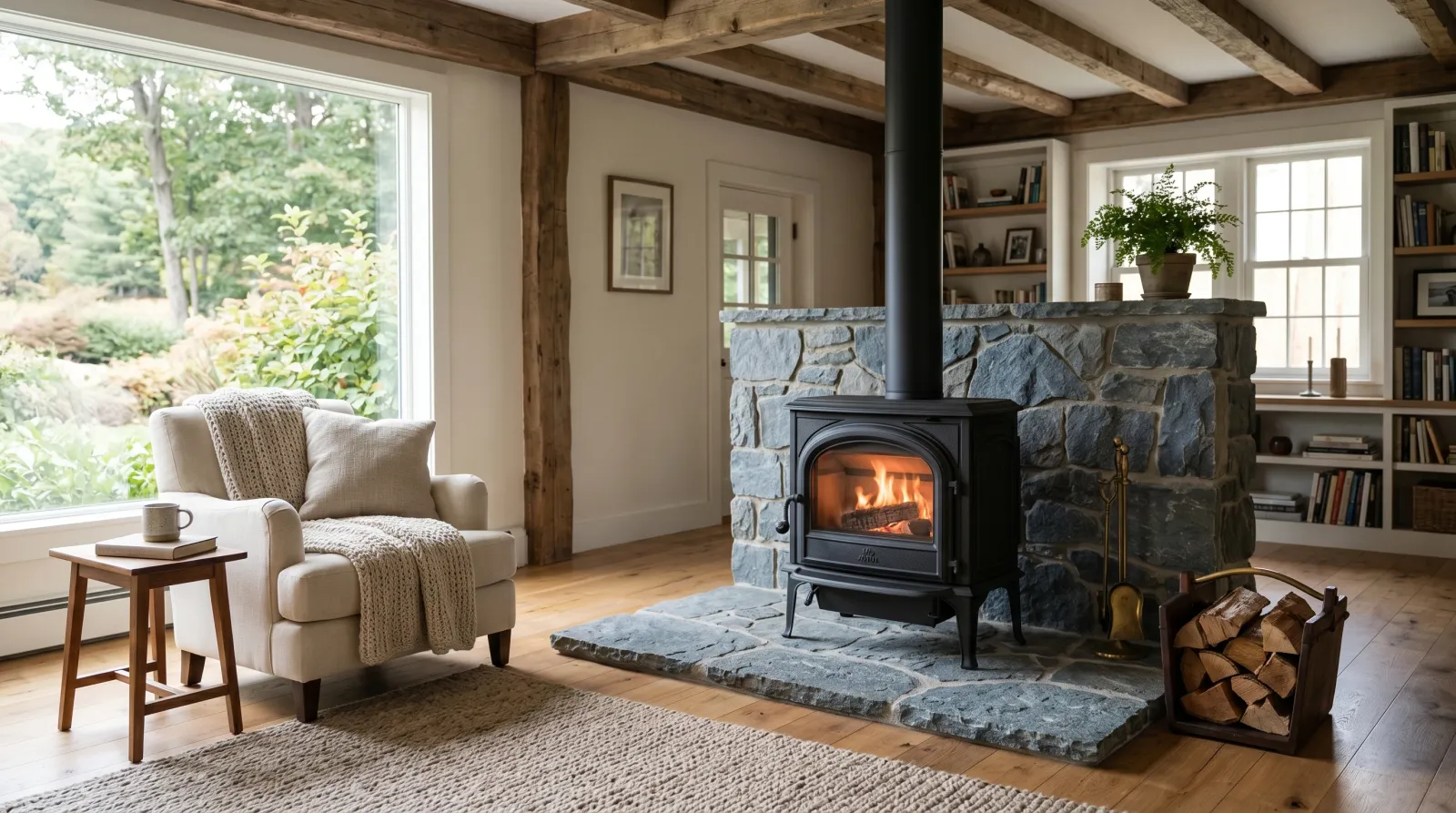
Wood stove paint is the silicone high-heat finish that holds color and corrosion protection on the external metal of a wood-burning appliance. The asset is a cast-iron or welded-steel stove body, a fireplace insert shell, the cast legs and top plate, and the single- or double-wall stovepipe that carries flue gas to the chimney. The metal runs hot. A stove body radiates at 400°F to 900°F across a burn, with the stovepipe near the collar swinging higher, and the whole assembly cycles from cold to hot and back every time the fire is lit and dies down. A finish that survives that has to be silicone-based; alkyd, epoxy, and standard enamel char and burn off somewhere between 250°F and 400°F.
The reason buyers come to this category is almost always refinish, not new construction. A cast-iron stove ten or twenty years into service shows surface rust on the top plate, a chalking dull-grey film where the original finish has burned thin, and rust bloom around the legs and door frame. The repaint restores the matte-black appearance and re-establishes the corrosion barrier on the casting. The same job covers stove dealers refinishing trade-in units, hearth shops prepping inserts for resale, and property managers maintaining stoves in cabins and light-commercial lodges.
Service life on a stove finish runs 5 to 10 years before the appearance dulls enough to warrant a recoat, longer on a stove that burns moderately and shorter on one run hard every winter night. The finish rarely fails structurally the way an industrial stack coating does; it fades, chalks, and thins at the hottest zones. The premature failures that do happen trace to three causes: a greasy or chalking surface that was painted over, a film built too thick that checked on the first fire, and a stove that was painted and fired to full heat in one step before the binder could off-gas. Each is preventable in the prep and the cure.
Spec Requirements
The spec block, before product names. A stove is light-commercial relative to a refinery stack, but the silicone chemistry and the numbers behave the same way.
| Spec | Value |
|---|---|
| Continuous service temp | 1000–1200°F silicone enamel; verify the SKU rating against the appliance’s published surface temperature |
| Dry film thickness (DFT) | 1.0–1.5 mils per coat; 2.0–3.0 mils total over a 2-coat system |
| Coverage @ spec’d DFT | 250–400 sq ft/gal at 1.5 mils; high apparent coverage on a thin film. A 12 oz aerosol covers roughly 10–15 sq ft in 2 coats |
| VOC | Aerosols under SCAQMD Rule 1143; bulk silicone 340–520 g/L; confirm SKU compliance for CA and OTC states |
| Standards | ASTM D2485 heat resistance; ASTM D4541 / D3359 adhesion; ASTM D522 flexibility |
| Substrate prep — maintenance refinish | SSPC-SP3 power-tool clean; strip rust, ash, creosote, and chalking old finish; degrease |
| Substrate prep — shop refinish | SSPC-SP6 commercial blast where a refinish shop has blast capability |
| Service surfaces | Stove body, legs, top plate, insert shell, stovepipe exterior only. Not the firebox interior, glass, or gaskets |
| Ambient at application | 50°F to 90°F; relative humidity below 85%; substrate dry and at least 5°F above dew point |
| Recoat window | 30 minutes to a few hours between coats per the TDS; do not exceed the maximum or the second coat lifts |
| Cure to service | Air-dry to handle in 1–2 hours; full cure on the first 2–3 break-in fires to operating temperature |
Three things decide the result on a stove: the surface is clean and degreased down to sound metal, the film stays thin enough to flex through the heat cycle, and the break-in cure happens in stages instead of one hard fire. A heavy two-coat build on a stove top checks and flakes on the first burn the same way an over-applied silicone does on any hot steel. Thin, clean, and cured in stages is the whole spec.
System Chemistry Compared
The chemistries that apply to a wood stove are narrower than an industrial high-heat spec, because immersion, corrosion under insulation, and chemical exposure are not in play. The choice comes down to how the metal is prepped, whether a brushed or sprayed finish is wanted, and the temperature ceiling.
| Chemistry | Continuous service temp | Application | UV / color hold | $/sq ft installed | Best for |
|---|---|---|---|---|---|
| Single-component silicone aerosol | 1000–1200°F | 🟢 Spray can, fast | 🟡 Color softens at the hottest zones | $1–3 | Homeowner and dealer refinish of stove bodies, legs, stovepipe |
| Bulk silicone enamel (brush/spray) | 1000–1200°F | 🟢 Brush or HVLP for volume | 🟢 Good matte hold | $1.50–4 | Shop refinish, multiple units, color-matched batches |
| Industrial selective-black silicone | 1000°F+ | 🟢 Spray, spec-documented | 🟢 Excellent | $3–7 | Coating shops, warranty work, solar-absorptive black finishes |
| Modified silicone-acrylic | 400–650°F | 🟢 Brush or spray | 🟢 Best color/gloss hold | $2–4 | Decorative low-temp surfaces only; not a firebox-adjacent stove top |
Single-component silicone aerosol is the default for a stove refinish, because the asset is small, the geometry is awkward to brush, and an aerosol lays a thin even film. Bulk silicone enamel earns its place when a dealer or hearth shop is refinishing volume and wants a consistent batch color across units. Industrial selective-black silicone (Thurmalox 270) is the spec when a coating shop is doing warranty work or a black solar-absorptive finish. Modified silicone-acrylic holds color best but tops out near 650°F, which makes it wrong for the hot top plate of a wood stove and right only for cooler decorative surfaces. Match the temperature rating to the hottest zone on the appliance, not the average.
Recommended Systems
Three systems at different price-performance points. System A is the homeowner and dealer aerosol refinish. System B is the bulk-applied shop refinish for volume and color matching. System C is the industrial selective-black silicone for coating shops and warranty work. Verify the temperature rating on the current TDS and keep every coat thin.
System A — Forrest Paint Stove Bright (aerosol Refinish)
| Layer | Product | DFT |
|---|---|---|
| Surface prep | SSPC-SP3 power-tool clean; strip rust, ash, chalking finish; degrease with denatured alcohol | — |
| Coat 1 | Stove Bright high-temp silicone enamel | 1.0–1.5 mils |
| Coat 2 | Stove Bright high-temp silicone enamel, second light pass | 1.0–1.5 mils |
| Total | 2.0–3.0 mils |
Service life 7–10 years on a moderately burned stove. Stove Bright is the volume aerosol on the hearth-shop shelf, rated to roughly 1200°F and self-priming on prepared metal. The discipline here is two thin passes, not one heavy one; the most common refinish failure is a homeowner laying on a wet coat to “cover faster” and watching it check on the first fire. Run the break-in cure in stages before judging the finish. Stove Bright high-temp paint product page.
System B — Rutland High Temperature Stove and BBQ Paint (shop/volume Refinish)
| Layer | Product | DFT |
|---|---|---|
| Surface prep | SSPC-SP3 power-tool clean; wire-wheel rust and loose scale; alcohol wipe | — |
| Coat 1 | Rutland high-temp silicone enamel (brush, HVLP, or aerosol) | 1.0–1.5 mils |
| Coat 2 | Rutland high-temp silicone enamel, second pass | 1.0–1.5 mils |
| Total | 2.0–3.0 mils |
Service life 5–8 years. Rutland is the workhorse for a shop refinishing several units to a matched matte-black batch, available in bulk for HVLP as well as aerosol for touch-up. It is rated to 1200°F and goes straight onto SSPC-SP3 metal. For a dealer prepping trade-ins or a property manager maintaining a fleet of cabin stoves, the bulk grade is the cost-effective path. Rutland high-temp paint product page.
System C — Dampney Thurmalox 270 (industrial Selective-Black Silicone)
| Layer | Product | DFT |
|---|---|---|
| Surface prep | SSPC-SP6 commercial blast (shop) or SSPC-SP3 (in-place); 1–1.5 mil profile | — |
| Coat 1 | Thurmalox 270 single-component silicone | 1.0–1.5 mils |
| Coat 2 | Thurmalox 270 second pass | 1.0–1.5 mils |
| Total | 2.0–3.0 mils |
Service life 8–12 years on a shop-prepped casting. Thurmalox 270 is the industrial-grade selective-black silicone Dampney built for stoves, solar collectors, and hot exterior steel, with documented heat resistance and a true blast-prep spec when a shop can deliver it. This is the system for a coating shop doing warranty refinish, a solar-absorptive black requirement, or any job where the finish has to carry a documented spec rather than a hardware-store rating. Higher per square foot, and the right call where the warranty depends on the prep. Dampney Thurmalox 270 product page.
Systems Compared
| System | Total DFT | $/sq ft installed | Service life | Best for |
|---|---|---|---|---|
| A — Stove Bright aerosol | 2.0–3.0 mils | $2–5 | 7–10 years | Homeowner and dealer single-stove refinish |
| B — Rutland bulk/aerosol | 2.0–3.0 mils | $1.50–4 | 5–8 years | Shop volume, matched batches, cabin-stove fleets |
| C — Thurmalox 270 | 2.0–3.0 mils | $3–7 | 8–12 years | Coating-shop warranty work, selective-black spec |
Pricing assumes the small-asset reality of a stove refinish: a single stove body, legs, top, and a few feet of pipe runs 15–30 sq ft, so material cost is low and the labor is in the prep. The aerosol systems carry the lowest material cost and the bulk systems win once a shop is spraying volume. Over a 10-year horizon the differences are small in absolute dollars on one stove; the real cost driver is whether the prep was done right the first time, because a peeling refinish means stripping the whole casting and starting over.
Application and Contractor Path
A wood stove refinish is the rare commercial-pillar coating that genuinely sits within a careful in-house or homeowner scope. The asset is small, the aerosol grades are self-priming, and the silicone is forgiving to spray. The honest small-scope answer is that a property manager, a hearth-shop tech, or a careful owner can strip, prep, and refinish a stove body to SSPC-SP3 and lay two thin coats without a coatings contractor. The work that separates a finish that lasts from one that peels is the prep and the staged cure, not spray technique.
Do the prep in this order:
- Cool the stove completely and pull it off the hearth if access is tight. Remove or mask the door glass, gasket, handles, and any catalytic combustor.
- Strip loose rust, flaking paint, ash, and creosote film with a wire wheel or power tool to SSPC-SP3. Take pitted rust down to bright metal.
- Degrease the entire surface with denatured alcohol and let it flash off. A greasy or chalking surface is the single most common reason a refinish peels.
- Spray two thin coats, 1.0–1.5 mils each, holding the can far enough back to avoid runs on the vertical faces. Respect the recoat window on the can.
The contractor path applies in two cases. A coating shop doing volume warranty refinish on traded-in stoves or inserts runs the Thurmalox or bulk-Rutland tier through a spray booth with documented prep, and there the relevant qualification is general industrial coating competence rather than an SSPC-QP certification scaled for a small appliance. The second case is a stove that needs more than a finish: a cracked casting, a failed door seal, a flue-clearance question. That is appliance work for a certified hearth technician (NFI or CSIA credentialed), not a paint job, and the finish goes on after the repair is signed off.
The manufacturer support path is straightforward. Forrest Paint, Rutland, and Dampney all publish data sheets with the cure schedule and the prep spec, and Dampney’s technical group will confirm the right Thurmalox grade for a documented or solar-absorptive requirement. Match the SKU’s temperature rating to the appliance’s hottest surface before buying.
Failure Modes and How to Prevent Them
Five failures account for nearly every stove-paint complaint.
- Peeling over a greasy or chalking surface. Cause: the old finish was chalking and the casting carried cooking grease or hand oil, and the new silicone could not bond through it. Prevention: degrease with denatured alcohol after the mechanical prep, and strip the chalking film to sound metal rather than painting over it.
- Checking and flaking from a film built too thick. Cause: a heavy single coat or two wet coats laid for fast coverage. The rigid silicone film cannot flex with the casting’s thermal expansion and checks on the first fire. Prevention: two thin coats at 1.0–1.5 mils each; keep the can moving and back from the surface.
- Smoke, odor, and a soft film that never cured. Cause: the stove was fired to full heat in one step, or never reached cure temperature, so the binder never fused. Prevention: run the break-in cure in two or three increasing burns with the room ventilated; the smoke and smell on those first fires is the cure completing, not a defect.
- Early dulling and color loss at the hottest zones. Cause: the top plate and stovepipe collar run hottest and the pigment softens there first. This is cosmetic and normal on silicone, not a coating failure. Prevention: judge the finish by adhesion and rust protection, not color; recoat the hot zones on appearance when the owner wants it, not on a schedule.
- Paint applied where it does not belong. Cause: overspray onto the door glass, the gasket, the catalytic combustor, or the firebox interior. Inside the firebox the binder sits against flame and smokes every burn; on the gasket it ruins the seal. Prevention: mask the glass and gasket, keep the coating to external surfaces, and never coat the combustion chamber.
The two that cost a redo are the greasy-surface peel and the over-thick check. Both are prep-and-application discipline, settled before the can is even shaken, and both are invisible until the first fire reveals them.
Where to Buy / Spec
| Channel | Best for | Path |
|---|---|---|
| Amazon Business | Single-stove refinish, aerosol stocking, touch-up shelf | Search Stove Bright high-temp paint on Amazon |
| Hearth-shop / dealer | Color-matched aerosol and bulk, refinish advice | Local hearth and stove dealer carrying Stove Bright or Rutland |
| Dampney technical (Thurmalox) | Documented spec, selective-black, warranty refinish | Dampney Thurmalox 270 page |
| Industrial distributor | Bulk silicone for shop spray, contractor accounts | Distributor account with bulk Rutland or Thurmalox pricing |
Amazon Business and the local hearth dealer cover almost every stove refinish, because the asset is small and the chemistry choice is already settled by the appliance. Manufacturer-direct matters at the shop tier, where Dampney’s technical group confirms the Thurmalox grade for a documented spec or a solar-absorptive black. Match the can rating to the hottest surface on the stove and the channel is a convenience decision, not a performance one.
FAQ
The questions a buyer actually asks live in the frontmatter faq block above: whether the paint cures on the first burn, what prep the spec calls for, whether the hardware-store can is the same product, whether it clears California VOC limits, and whether the firebox interior can be painted. Each answer is keyed to the systems above.