Industrial Pipe Coating: Specifier's Guide for 2026
Industrial pipe coating compared by DFT, service temp, and chemistry. SSPC-SP prep grades, ASTM specs, CUI prevention, and the contractor path for carbon steel pipe.

Disclosure: Affiliate links to retailers and manufacturer-direct programs. Recommendations are spec-driven, not commission-driven.
Use Case
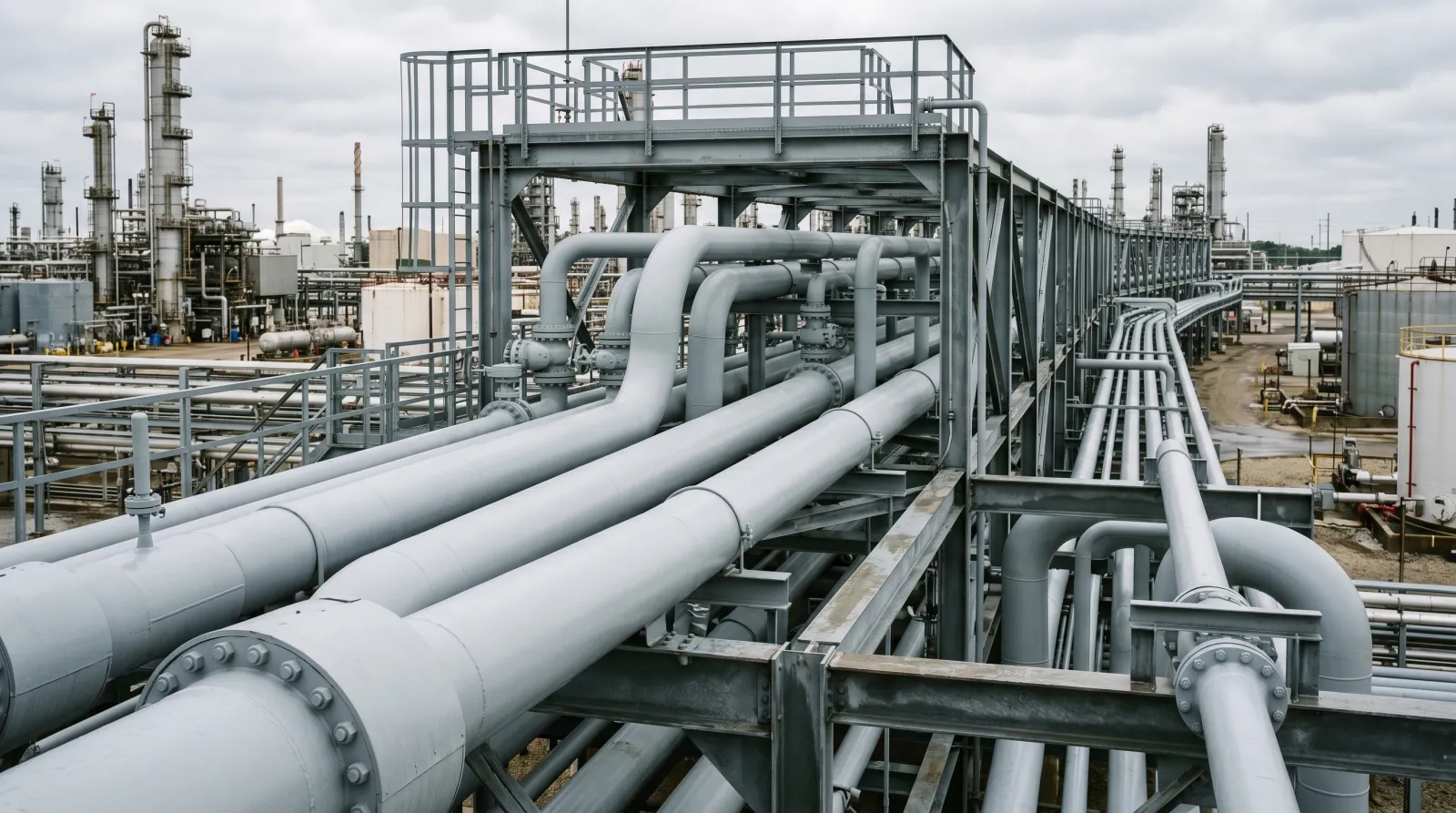
Industrial pipe coating protects carbon and alloy steel pipe from the corrosion that ends its service life: atmospheric oxidation on exposed racks, chloride attack near coastal and process environments, soil-side corrosion on buried lines, and corrosion under insulation on hot service. The asset is the pipe itself, but the spec is written around the operating temperature, the exposure, and whether the line is insulated. Those three variables decide the chemistry before any product gets named.
The coating gets specified across refineries, chemical plants, water and wastewater facilities, power generation, food and beverage process lines, marine and offshore structures, and the pipe racks that connect them. Exposed atmospheric pipe at ambient temperature is the simplest case: a zinc-rich or epoxy primer, a high-build epoxy intermediate, and an aliphatic polyurethane topcoat for color retention and UV. Hot service from 200°F to 1000°F moves the spec to inert multipolymer matrix or silicone-based high-temp coatings. Insulated pipe in the 140°F to 350°F band is the corrosion-under-insulation problem, the most expensive failure mode in the category and the one most often under-specified.
Service life depends almost entirely on surface prep and DFT. An exposed-pipe epoxy-urethane system on an SSPC-SP10 near-white blast delivers 15 to 25 years in a moderate atmospheric environment. The same system on an under-prepped SSPC-SP3 hand-tool surface fails in 3 to 5 years from disbondment and underfilm corrosion. Buried pipe with fusion-bonded epoxy to AWWA C213 runs 30 to 50 years when the holiday inspection passes clean at install. Hot-service inert multipolymer matrix coatings carry 10 to 20 years through thermal cycling. The number that governs all of them is the prep grade the spec calls for, and the discipline to hold it in the field.
Spec Requirements
The spec block, before naming product. Values shift by service temperature and exposure; the categories do not.
| Spec | Value |
|---|---|
| Dry film thickness (DFT), total system | 8–30 mils (atmospheric); 16–40 mils (immersion / buried); 4–12 mils (high-temp inert matrix) |
| Coverage at spec’d DFT | 150–300 sq ft/gal per coat at high-solids, varies with build coat |
| VOC limit | <340 g/L solvent-borne high-solids epoxy (SCAQMD Rule 1113 industrial maintenance); <100 g/L waterborne; CARB SCM-compliant SKUs available |
| Standards | ASTM D4541 adhesion, ASTM B117 salt spray, ASTM G8 cathodic disbondment (buried), ASTM D5162 holiday detection, ASTM D522 flexibility; AWWA C210/C213 for water pipe; API RP 5L2 for gas transmission |
| Substrate prep (exposed atmospheric) | SSPC-SP6 commercial blast minimum; SSPC-SP1 solvent clean first |
| Substrate prep (immersion / buried / CUI / zinc primer) | SSPC-SP10 near-white metal blast; 2–3 mil angular anchor profile |
| Surface profile | 1.5–3.5 mils angular per the primer TDS; verify with replica tape (Testex) |
| Service temperature (cured) | Ambient systems to 250°F; high-temp inert matrix to 400°F continuous; silicone to 1000°F |
| Cure to service | 7 days at 70°F for immersion; 24–48 hours to handle on atmospheric |
| Pot life | 2–4 hours at 70°F for high-solids epoxy; drops sharply above 90°F |
| Ambient at application | 50°F to 100°F; relative humidity <85%; substrate ≥5°F above dew point |
| Holiday / continuity inspection | ASTM D5162 high-voltage on immersion and buried linings; wet-sponge low-voltage on thin film |
Three numbers govern pipe coating service life: the SSPC prep grade, the anchor profile under the primer, and the substrate temperature relative to dew point during application. Miss the prep grade and the system disbonds. Miss the profile and the primer has nothing to key into. Apply below dew point and you trap condensation under the film, which blisters within the first year.
System Chemistry Compared
Pipe service splits cleanly by operating temperature and exposure. The chemistry-class comparison every specifier should run before a product name enters the conversation:
| Chemistry | Pot life | Recoat window | Service temp | UV stability | $/sq ft band | Best for |
|---|---|---|---|---|---|---|
| Zinc-rich primer + epoxy + polyurethane | 2–4 hr | 8–24 hr | up to 250°F | 🟢 with PU topcoat | $3–8 | Exposed atmospheric pipe racks, marine atmospheric |
| High-build epoxy (immersion grade) | 1–3 hr | 8–16 hr | up to 200°F immersion | 🔴 chalks without topcoat | $4–9 | Water pipe interiors, immersion, buried with FBE |
| Epoxy phenolic / novolac | 2–4 hr | 12–24 hr | up to 350°F | ⚪ topcoat for UV | $6–12 | Hot process pipe, chemical immersion, CUI band |
| Inert multipolymer matrix (high-temp) | varies | per TDS | -50°F to 400°F | 🟢 UV-stable | $7–14 | Corrosion under insulation, cyclic hot-cold service |
| Silicone / inorganic high-heat | varies | dry-to-touch fast | up to 1000°F | 🟢 stable | $5–10 | Exhaust stacks, steam lines, fired-heater pipe |
The epoxy-urethane stack covers the bulk of exposed atmospheric pipe. Immersion-grade epoxy and fusion-bonded epoxy own the water and buried categories. Epoxy phenolic and inert multipolymer matrix coatings are the corrosion-under-insulation answer. Silicone is the only chemistry that survives above 400°F. Specifying the ambient epoxy stack on a 600°F steam line is the classic mismatch: the binder degrades, the film cracks, and the steel underneath corrodes at the cracks.
Recommended Systems
Three full multi-coat stacks for exposed atmospheric pipe at different price-performance points. All three reference the same SSPC-SP6 minimum prep (SP10 where a zinc primer is used) and the same dew-point rule. For immersion, buried, or high-temp service, the chemistry changes and the manufacturer rep should size the system to the operating temperature.
System a — Carboline Thermaline / Carboguard (premium Atmospheric / Marine)
| Layer | Product | DFT |
|---|---|---|
| Primer | Carbozinc 859 inorganic zinc OR Carboguard 893 epoxy | 3–5 mils |
| Intermediate | Carboguard 893 SG high-build epoxy | 4–8 mils |
| Topcoat | Carbothane 134 HG aliphatic polyurethane | 2–3 mils |
| Total | 9–16 mils |
Service life 15–25 years on exposed atmospheric and marine atmospheric pipe. The inorganic zinc primer gives galvanic protection that keeps a scratch from undercutting; the polyurethane topcoat holds color and gloss against UV for a decade-plus. Carboline’s Thermaline line extends the same stack into hot service when the operating temperature pushes past the epoxy’s ceiling. Carboline protective coatings.
System B — Sherwin-Williams Macropoxy 646 (workhorse Industrial Standard)
| Layer | Product | DFT |
|---|---|---|
| Primer | Zinc Clad III HS inorganic zinc OR Macropoxy 646 self-priming | 3–5 mils |
| Intermediate / build | Macropoxy 646 Fast Cure Epoxy | 5–10 mils |
| Topcoat | Acrolon 218 HS acrylic polyurethane | 3–4 mils |
| Total | 11–19 mils |
Service life 12–20 years. Macropoxy 646 is the most-specified industrial maintenance epoxy in North America, and the reason is field tolerance: it cures down to 35°F, it goes on at high build in one pass, and it is self-priming over an SP6 blast when a separate primer is not in the budget. The Acrolon 218 topcoat adds the UV and color retention the bare epoxy lacks. Sherwin-Williams Macropoxy 646.
System C — PPG Amerlock 2 / Amercoat (budget High-Solids Retrofit)
| Layer | Product | DFT |
|---|---|---|
| Primer | Dimetcote 9 inorganic zinc OR Amerlock 2 epoxy | 3–6 mils |
| Intermediate | Amerlock 2/400 high-solids epoxy | 4–8 mils |
| Topcoat | Amercoat 450H aliphatic polyurethane | 2–3 mils |
| Total | 9–17 mils |
Service life 10–18 years. Amerlock 2 is a surface-tolerant high-solids epoxy that bonds over marginally prepped or tight-rust surfaces better than most, which makes it the retrofit answer when a full SP10 blast on in-service pipe is not feasible. It is not a license to skip prep; it is a margin against the realities of recoating live pipe in a running plant. PPG Amerlock 2.
Systems Compared
| System | Total DFT | $/sq ft installed | Service life | Best for |
|---|---|---|---|---|
| A — Carboline Thermaline / Carboguard | 9–16 mils | $7.00–11.00 | 15–25 years | Marine atmospheric, refinery racks, long-cycle exposure |
| B — SW Macropoxy 646 | 11–19 mils | $5.50–9.00 | 12–20 years | General industrial, water and wastewater, cold-weather application |
| C — PPG Amerlock 2 / Amercoat | 9–17 mils | $5.00–8.50 | 10–18 years | In-service retrofit, surface-tolerant recoat, budget projects |
Installed pricing assumes a several-thousand-square-foot scope of pipe surface through a manufacturer-rep certified contractor with abrasive blast prep included. Small valve-and-fitting scopes and live-plant work with scaffolding and containment run 40–100 percent higher per square foot. Pricing also excludes insulation removal and re-jacketing on CUI work, which often costs more than the coating itself.
Application & Contractor Path
Most industrial pipe coating is not a do-it-yourself product. The prep grade, the anchor profile, and the holiday inspection on immersion and buried linings require equipment and certification a general crew does not carry. Spec a contractor with the following:
- SSPC-QP1 certification for industrial coatings field application, QP2 if the work involves hazardous-material removal of existing lead or chromate coatings.
- An AMPP (formerly NACE) Coating Inspector Program Level 2 inspector on staff or sub-contracted for DFT logs, profile checks, and holiday detection on immersion and buried linings.
- Manufacturer applicator approval on the specific product line for any warranted system.
Three contractor-qualifying questions before signing:
- What SSPC prep grade and anchor profile will you hold, and how do you verify it? The answer should name the grade (SP6 atmospheric, SP10 immersion), the target profile in mils, and replica-tape verification. A contractor who treats prep as a single bid line without a grade is the wrong contractor.
- What is the dew-point and surface-temperature protocol? The steel must sit at least 5°F above dew point during application. A crew without a sling psychrometer or surface thermometer in continuous use will trap condensation under the primer.
- Who runs holiday detection on the linings, and to what standard? ASTM D5162 high-voltage on immersion and buried, wet-sponge low-voltage on thin film. No holiday report, no closeout on a containment-critical line.
The manufacturer-rep network on Carboline, Sherwin-Williams, and PPG includes a pre-bid coating survey: operating-temperature confirmation, existing-coating compatibility, prep-grade recommendation, and a written system spec keyed to the service. Use it. A wrong chemistry choice caught at the survey costs an hour; caught after the pipe is back in service, it costs a shutdown.
Failure Modes & How to Prevent Them
Five failures cover the bulk of pipe coating warranty claims and audit rejections. Prevent these and the system delivers its rated service life.
- Corrosion under insulation (CUI). Cause: water enters the insulation jacket and sits against under-coated steel in the 140°F to 350°F band, corroding out of sight. Prevention: spec an inert multipolymer matrix or high-temp epoxy phenolic rated for the operating temperature, applied to SP10 near-white blast under continuous insulation, with a sound jacket and proper sealing at penetrations. CUI is a design problem before it is a coating problem.
- Disbondment from under-prepped surface. Cause: the field dropped from the spec’d SP10 or SP6 to a hand-tool SP3 grade, or skipped the SP1 solvent clean and blasted over oil. Prevention: written prep grade in the spec, replica-tape profile verification, and an inspector who fails the surface before the primer goes on. This is the most common premature failure I see.
- Underfilm corrosion at holidays and edges. Cause: pinholes, missed spots, and thin film at welds, flanges, and pipe shoes that holiday detection would have caught. Prevention: stripe-coat all edges, welds, and bolt heads by brush before the spray pass; run ASTM D5162 holiday detection on immersion and buried linings.
- Blistering from application below dew point. Cause: substrate within 5°F of dew point, condensation trapped under the primer, osmotic blistering inside the first year. Prevention: continuous psychrometer monitoring, heat the steel above dew point, stop work when the gap closes.
- Coating cracking on hot service. Cause: an ambient epoxy stack specified on a line running above its 200°F to 250°F ceiling; the binder degrades and the film cracks at thermal cycles. Prevention: match the chemistry to the operating temperature. Inert multipolymer matrix to 400°F, silicone above that. Confirm the maximum continuous and intermittent service temperatures with the process engineer, not the optimistic nameplate.
Surface prep and CUI account for most of the field failures in this category. Both are preventable in the specification and pre-construction phase, not the application phase.
Where to Buy / Spec
| Channel | Best for | Path |
|---|---|---|
| Amazon Business | Small valve-and-fitting touch-up, fleet stocking of single-component primers | Business account, bulk and tax-exempt pricing |
| Manufacturer-direct (Carboline, SW Protective & Marine, PPG PMC) | Spec’d projects with rep survey and system warranty | SW Macropoxy 646 · Carboline · PPG Amerlock 2 |
| Industrial distributor (KTA-Tator, Rawlins Paints US, ICA) | Multi-manufacturer bids, mixed-system projects | Distributor account with project pricing |
| Pro retail (SW or BM Pro store) | Local pickup, contractor pricing on ambient maintenance coatings | Walk-in, account-holder pricing |
Manufacturer-direct is the recommended channel on any spec’d project above a few thousand square feet of pipe surface, and on every immersion, buried, or high-temp job. The rep survey catches the operating-temperature mismatch and the prep-grade question before the bid, which is worth more than any retail discount on the can.
FAQ
See the frontmatter for the full Q&A: contractor requirements, corrosion under insulation, surface prep grades, NSF/ANSI 61 compliance for potable lines, and warranty terms.