Petroleum Tank Coatings: Internal Lining & External Specifier's Guide (2026)
Petroleum tank coating systems compared for steel ASTs: API 652 internal linings, external CUI protection, DFT by zone, SSPC-SP prep, holiday inspection, and the contractor path.

Disclosure: Affiliate links to retailers and manufacturer-direct programs. Recommendations are spec-driven, not commission-driven.
Use Case
A petroleum storage tank corrodes from two directions at once, and the coating spec has to answer both. On the outside, the steel shell and roof face atmospheric corrosion, UV, and on insulated tanks the corrosion-under-insulation (CUI) that hides under a clean-looking jacket until the plate is paper. On the inside, the bottom plate sits in the worst service in the whole asset: condensed water and any settled water drop out of the product and pool against the floor, and water-phase corrosion pits the steel from below where nobody sees it until the next internal inspection.
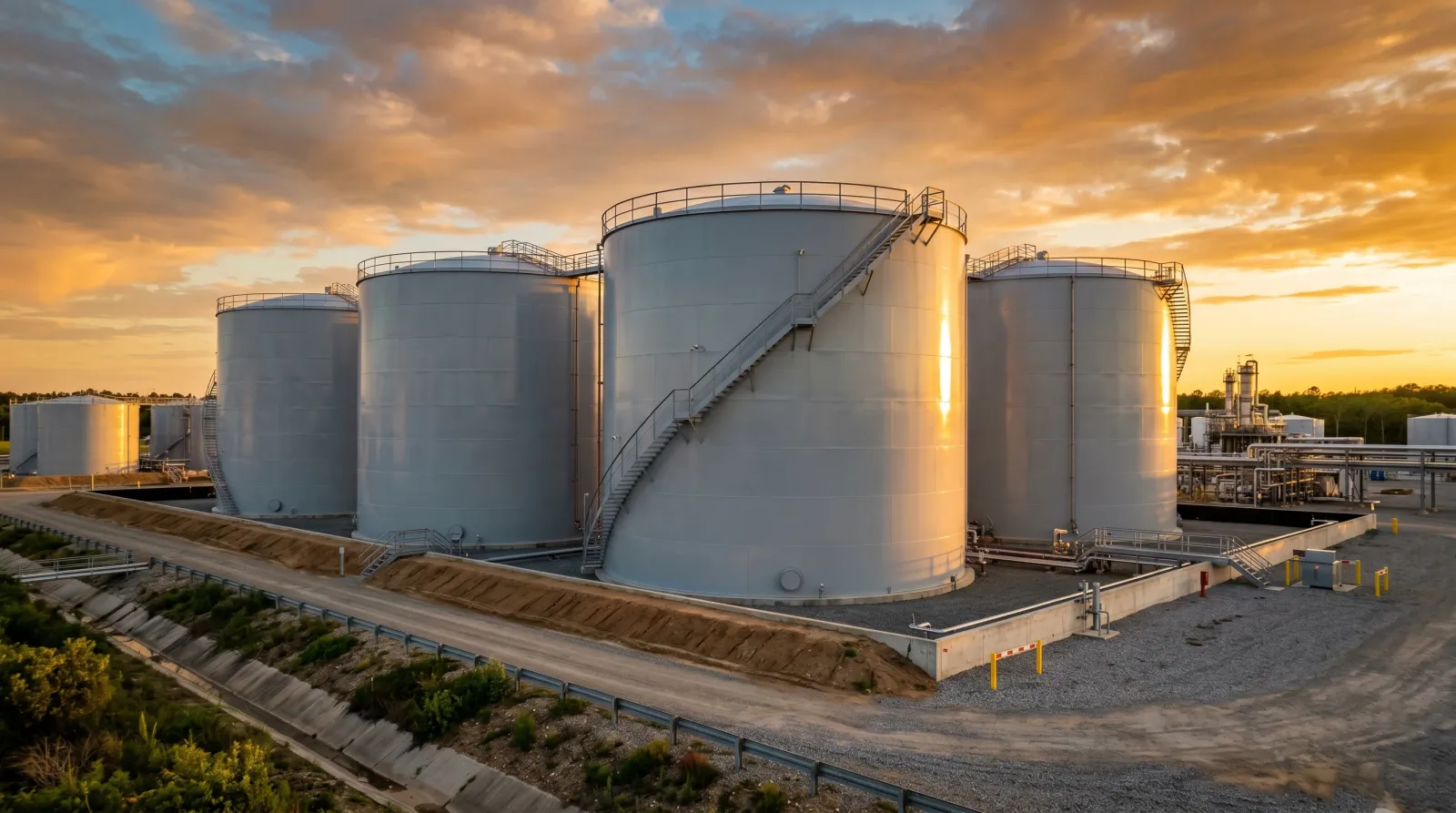
The spec gets written for aboveground storage tanks (ASTs) in tank farms, terminals, refineries, fuel depots, airports, and standby-generator and fleet-fueling sites. Product ranges from clean refined gasoline, diesel, jet fuel, and heating oil to sour crude and high-water-content slop. API 652 is the governing standard for aboveground tank-bottom linings; API RP 5L2 covers internal coating practice. The bottom plate and the lower shell carry the immersion lining. The external shell, roof, and stairs carry an atmospheric system.
Service life expectations split by zone. An internal immersion lining over near-white prep runs 15 to 25 years on clean product, less on sour or wet service. The external three-coat zinc-epoxy-polyurethane system runs 20 to 30 years on the shell. The roof and any insulated courses wear faster, and the CUI zone is the first thing to fail on a tank that looks fine from the berm.
The reader writing this spec has to defend two coating choices in one procurement package, prove the prep grade, and show a holiday-inspection record before the tank goes back to product. Get the prep grade, the DFT, and the dew-point window right, and the lining outlives the next two inspection cycles. Miss any one and the bottom plate gets cut out at the first API 653 internal.
Zoned Recommendation Matrix
A storage tank is not one environment. The bottom plate sees immersion; the roof sees UV and standing rain; the insulated mid-shell hides CUI. One product across the whole tank over-specs the dry zones and under-specs the wet ones.
| Zone | Environment | Recommended system | Why |
|---|---|---|---|
| Bottom plate + lower shell (to liquid line) | Continuous immersion, water-phase corrosion | Internal immersion lining (System A or B), 16–40 mils | Anchors to SP10 profile; holiday-tested; the high-corrosion zone |
| Internal shell above liquid line + underside of roof | Vapor-phase, condensation, sour-gas exposure | Vapor-space lining, often the same novolac epoxy | Sour vapor attacks unlined steel faster than the liquid does |
| External shell (clean, uninsulated) | Atmospheric, UV, rain | 3-coat zinc/epoxy/polyurethane (System A/B/C external) | Long-cycle atmospheric protection; reflective topcoat |
| Insulated shell course (CUI zone) | Trapped moisture under jacket, 120–350°F | High-temp CUI epoxy or inert multipolymeric matrix, 18–30 mils | CUI is the leading hidden-failure mode on insulated tanks |
| Roof, stairs, handrails, walkways | UV, foot traffic, ponding | Zinc/epoxy/polyurethane; anti-slip aggregate on walking surfaces | Mechanical wear plus weather; aggregate where crews walk |
For a single small uninsulated tank in clean diesel service, the spec collapses to two systems: one immersion lining on the bottom courses and one atmospheric system on the outside. The five-zone breakdown is the rule for terminal-scale insulated tanks and any sour or aviation-fuel service.
Spec Requirements
The spec block earns the trust on this pillar. Numbers vary by product and product service; the categories do not.
| Spec | Value |
|---|---|
| DFT — internal immersion lining | 16–40 mils total, typically 2 coats at 8–10 mils each per manufacturer data sheet |
| DFT — external atmospheric | 8–14 mils total (zinc primer 3 mils, epoxy 4–7 mils, polyurethane 2–4 mils) |
| DFT — CUI zone | 18–30 mils high-temp epoxy or inert matrix |
| Coverage @ DFT | 80–130 sq ft/gal per coat at spec’d mils, before mix and application loss |
| VOC | <340 g/L high-solids lining epoxy under SCAQMD Rule 1113; <250 g/L waterborne external topcoats; solvent-borne linings run higher and are restricted in CARB/OTC districts |
| Standards | API 652 (tank-bottom lining), API RP 5L2 (internal coating), ASTM D5162 (holiday), ASTM D4541 (adhesion) |
| Substrate prep — internal immersion | SSPC-SP10 near-white blast; SP5 white metal for sour/aviation; 2–4 mil angular profile (replica tape) |
| Substrate prep — external | SSPC-SP6 commercial blast minimum; SP10 for aggressive coastal service |
| Edge/weld treatment | SSPC-SP11 or grind to radius; brush-stripe coat at all welds, nozzles, and edges before full coats |
| Service temp — product | Lining rated to product service; sour and high-temp service narrows the product list |
| Cure to service | 5–7 days at 70°F before product return; longer for full immersion cure |
| Dew point / humidity ceiling | Steel ≥5°F above dew point; RH <85% during application and cure |
| Holiday detection | ASTM D5162 high-voltage spark test, 100% of lined area |
| DFT measurement protocol | SSPC-PA 2, magnetic gauge, spec’d readings per area |
Three numbers govern whether the lining survives: prep grade and profile, DFT against the immersion minimum, and the dew-point margin during application. A lining applied to SP6 instead of SP10 disbonds in immersion. A lining at 12 mils where the spec calls for 16 telegraphs every pit. A coat applied with the steel inside the dew-point margin flash-rusts under the film and blisters within a service cycle.
System Chemistry Compared
Tank-lining chemistry is a smaller field than floor coatings, because immersion in hydrocarbons and water-phase chloride rules out most binders. Pick the chemistry against the product service first.
| Chemistry | Pot life @ 70°F | Recoat window | Service / product | UV stability | $/sq ft band | Best for |
|---|---|---|---|---|---|---|
| Amine-cured epoxy lining | 2–4 hr | 8–24 hr | Refined fuels, water-bottom immersion | 🔴 Internal only (chalks outdoors) | $3–7 | Gasoline, diesel, jet fuel, water bottoms |
| Novolac (phenolic) epoxy | 1–3 hr | 8–24 hr | Sour crude, ethanol blends, high-temp | 🔴 Internal only | $5–10 | Sour service, ethanol, aggressive product |
| Zinc-rich + epoxy + polyurethane (external) | 2–4 hr each | varies by coat | Atmospheric shell and roof | 🟢 Excellent (aliphatic topcoat) | $4–9 | External shell, roof, stairs |
| High-temp / inert CUI matrix | 1–2 hr | per data sheet | Insulated shell, 120–350°F | 🟢 Under jacket | $6–12 | Corrosion-under-insulation zones |
Amine-cured epoxy is the workhorse internal lining for clean refined product and water bottoms. Novolac epoxy is the upgrade for sour service, ethanol-blended fuels, and any product that crosses the line into chemically aggressive. The external system is a zinc-epoxy-polyurethane stack, the same atmospheric architecture used across protective coatings, chosen here for the reflective polyurethane topcoat that cuts heat gain on light fuels. The CUI matrix is a separate spec entirely, written only for insulated courses, and ignoring it is how insulated tanks fail under a jacket that looks new.
Recommended Systems
Three full multi-coat stacks at different price-performance points. Each pairs an internal immersion lining with an external atmospheric system, because a tank spec covers both. Verify the specific product against the product service and the API 652 lining class before bid.
System A — Tnemec Series 61 Lining + Series 73 Exterior
| Layer | Product | DFT |
|---|---|---|
| Internal stripe coat | Series 22 Epoxoline brush-stripe at welds, nozzles, edges | 2–4 mils |
| Internal lining (2 coats) | Series 61 Tneme-Liner amine-cured epoxy | 8–10 mils per coat |
| External primer | Series 1 zinc-rich primer | 3 mils |
| External topcoat | Series 73 Endura-Shield aliphatic polyurethane | 2–3 mils |
| Total | internal 18–24 mils / external 5–6 mils |
Service life 18–25 years internal on refined product, 25–30 years external. Tnemec’s Series 61 has one of the longest installed tank-lining track records in North American terminal service, and the Tnemec rep network does a pre-bid review of the tank drawings against API 652. Tnemec protective coatings. Spec System A when the owner wants the longest-track-record lining and a single-manufacturer warranty chain from lining to exterior.
System B — Carboline Phenoline 187 Lining + Carbothane Exterior
| Layer | Product | DFT |
|---|---|---|
| Internal lining (2 coats) | Phenoline 187 novolac epoxy | 8–12 mils per coat |
| External primer | Carbozinc 859 inorganic zinc | 3 mils |
| External intermediate | Carboguard 890 epoxy | 4–6 mils |
| External topcoat | Carbothane 134 HG aliphatic polyurethane | 2–3 mils |
| Total | internal 16–24 mils / external 9–12 mils |
Service life 15–25 years internal, 25–30 external. Phenoline 187 is a novolac lining, so System B is the answer for sour crude, ethanol-blended gasoline, and any product that an amine-cured epoxy can’t hold. The full three-coat external stack (inorganic zinc, epoxy, polyurethane) is the heavier exterior of the three systems here, chosen for coastal terminals and high-chloride exposure. Carboline protective coatings. Spec System B for aggressive or sour product service.
System C — Sherwin-Williams Dura-Plate Lining + Acrolon Exterior
| Layer | Product | DFT |
|---|---|---|
| Internal lining (2 coats) | Dura-Plate 235 epoxy (or Cor-Cote HCR for sour service) | 8–10 mils per coat |
| External primer | Zinc Clad III zinc-rich primer | 3 mils |
| External intermediate | Macropoxy 646 epoxy | 5–7 mils |
| External topcoat | Acrolon 218 HS aliphatic polyurethane | 3–4 mils |
| Total | internal 16–20 mils / external 11–14 mils |
Service life 15–22 years internal, 25–30 external. Sherwin-Williams Protective & Marine has the widest store and distribution footprint of the three, which shortens lead time and rep response on a tank that has to come back online fast. Macropoxy 646 is one of the most-specified industrial epoxies in North America. Sherwin-Williams Protective & Marine. Spec System C when distribution reach and rep availability drive the schedule, and review the Sherwin-Williams industrial lines before locking the product.
Systems Compared
| System | Internal / External total DFT | $/sq ft installed | Service life | Best for |
|---|---|---|---|---|
| A — Tnemec Series 61 / 73 | 18–24 / 5–6 mils | $5–11 | 18–25 yr internal | Longest track record, single-mfr warranty chain |
| B — Carboline Phenoline 187 | 16–24 / 9–12 mils | $6–13 | 15–25 yr internal | Sour crude, ethanol, aggressive product, coastal |
| C — Sherwin-Williams Dura-Plate | 16–20 / 11–14 mils | $5–12 | 15–22 yr internal | Distribution reach, fast rep response, schedule-driven |
Pricing assumes a tank above 50,000 gallons through an SSPC-QP1 contractor with abrasive blasting, containment, and confined-space entry included. Small-tank and tight-access work runs 30–80% higher per square foot. The installed cost is dominated by surface prep and confined-space logistics, not by the coating itself; the can is a fraction of the job.
Application & Contractor Path
Internal immersion linings are not in-house maintenance work. The work happens inside a confined space under OSHA 1910.146, requires abrasive blasting to SP10 with controlled dew point and humidity, and closes out with documented holiday detection. Specify a contractor carrying:
- SSPC-QP1 certification for industrial coatings field application (QP2 if hazardous-substance removal is in scope).
- An AMPP (formerly NACE) Coating Inspector on staff or sub-contracted, CIP Level 2 minimum, for DFT and holiday inspection.
- A documented confined-space entry program: attendant, ventilation, atmospheric monitoring, and rescue plan.
Three contractor-qualifying questions before signing:
- What prep grade and profile will you hit, and how will you verify it? The answer is SP10 with a 2–4 mil profile confirmed by replica tape, or the bid is wrong for an immersion lining.
- Who runs the holiday detection, and at what voltage? ASTM D5162 high-voltage spark at 100% of the lined area. A contractor who can’t describe the gauge and the acceptance criteria should not be on the list.
- How do you control dew point inside the tank during application and cure? Dehumidification and continuous psychrometer readings. Steel within 5°F of dew point flash-rusts under the film, and inside a closed tank the dew-point margin moves fast.
External shell recoating on accessible lower courses can sometimes be handled by an in-house industrial crew with proper SP6 prep and a sprayer. The immersion lining is contractor-only. The manufacturer-rep network on all three systems does a free pre-bid review of the tank drawings, the API 652 lining class, and the product-service compatibility. Use it. A wrong lining class caught at the drawing stage costs an afternoon; caught after the tank is blasted and half-lined, it costs the whole re-line plus a second out-of-service window.
Failure Modes & How to Prevent Them
Five failures cover the bulk of tank-lining rejections and early-life warranty claims.
- Disbondment from under-prep. The lining lets go in sheets at the first internal inspection, usually starting at the bottom plate. Cause is prep below SP10, an inadequate profile, or soluble salts left on the steel before coating. Prevention is SP10 near-white blast, a 2–4 mil profile confirmed by replica tape, and a soluble-salt test on existing tanks before the first coat.
- Holidays and pinholes in service. Bare-steel pinpoints corrode from the inside and seed under-film blisters that spread. Cause is a missed thin spot, a skipped stripe coat at a weld, or a holiday the spark test should have caught. Prevention is the brush-stripe coat at every weld, nozzle, and edge before full coats, and 100% holiday detection per ASTM D5162 with every flagged spot repaired and re-tested.
- Osmotic blistering under immersion. Blisters form in the immersed zone weeks to months after return to service, filled with fluid. Cause is application near or below the dew point, soluble contamination under the film, or a coat applied before the previous one cured. Prevention is dew-point control and dehumidification during application and cure, a clean substrate, and respecting the recoat window. The coating-blister diagnosis guide walks the failure pattern in detail.
- Corrosion under insulation (CUI). The insulated shell course corrodes under an intact-looking jacket and isn’t found until the jacket comes off. Cause is moisture trapped against uncoated or under-coated steel at 120–350°F, where standard epoxy degrades. Prevention is a high-temp CUI epoxy or inert matrix on insulated courses, not the atmospheric topcoat, and a jacket-inspection interval written into the asset plan.
- External chalk and rust-through on the roof and CUI zone. The shell looks fine from the berm while the roof and insulated courses are the first to fail. Cause is an aliphatic topcoat skipped on the roof, or the atmospheric system carried onto insulated steel it was never rated for. Prevention is zoning the spec (see the matrix), the polyurethane topcoat on every UV-exposed surface, and CUI-rated product on every insulated course. For rust already present on an existing tank, the rusted-steel prep guide covers the blast-and-prime sequence before any lining or atmospheric coat.
Disbondment from under-prep is the most common failure I review, and it’s fully preventable in the prep spec. CUI is the most expensive, because it’s invisible until the jacket is pulled and by then the plate may need replacement.
Where to Buy / Spec
| Channel | Best for | Path |
|---|---|---|
| Tnemec rep network | API 652 tank linings, single-manufacturer warranty chain | Tnemec |
| Carboline rep network | Sour/aggressive product linings, coastal terminals | Carboline |
| Sherwin-Williams Protective & Marine | Schedule-driven projects, wide distribution, fast rep response | SW Protective & Marine |
| Industrial distributor (KTA-Tator, Rawlins Paints US dealers) | Multi-manufacturer bids, mixed-system terminal work | Distributor account with project pricing |
Manufacturer-direct is the recommended channel on any tank above 50,000 gallons. The rep network includes the pre-bid drawing review, the API 652 lining-class match, and the product-service compatibility check. Those services are worth more than any retail discount on the pail, because a wrong lining class is a six-figure re-line, not a return.
FAQ
See the frontmatter for the full Q&A: internal-vs-external lining, SP10 prep, holiday detection, service life, and the certified-contractor requirement.