HVAC Duct Paint: Specifier's Guide for Galvanized Ductwork (2026)
HVAC duct paint compared by DFT, anti-condensation rating, and adhesion over galvanized steel. Self-etching primers, anti-sweat coatings, washdown topcoats, and the contractor path.

Disclosure: Affiliate links to retailers and manufacturer-direct programs. Recommendations are spec-driven, not commission-driven.
Use Case
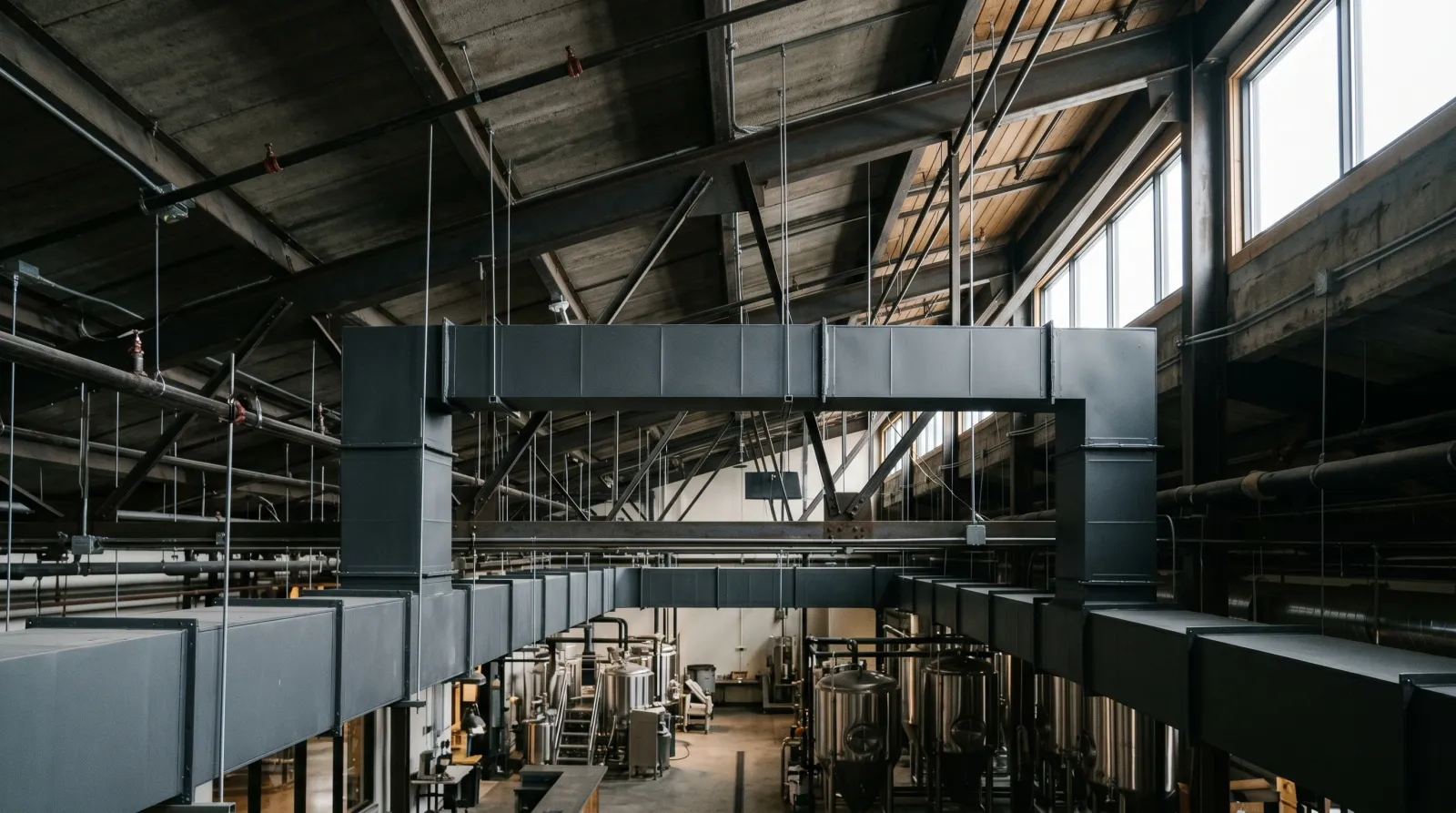
HVAC duct paint covers three different jobs that get filed under one search term, and the spec changes with the job. The first is appearance: exposed galvanized supply and return duct in a loft office, brewery, retail buildout, or restaurant ceiling that the architect wants painted matte black or charcoal instead of left mill-finish silver. The second is corrosion protection on duct that sees moisture, washdown, or coastal salt air, where bare or scratched galvanized starts throwing white rust. The third is anti-condensation, where a cold supply duct running through warm humid space sweats, drips onto the ceiling tile below, and stains it. Each of those is a different coating class. The mistake that fills my inbox is treating all three as a paint problem when two of them are a substrate-chemistry problem and a thermal problem.
The substrate is the constant. Almost all commercial duct is galvanized sheet steel (G60 or G90 zinc coating), and zinc is the reason ordinary paint fails on it. The asset is the building’s air-distribution system, the environment ranges from conditioned office plenum to coastal rooftop unit to commercial-kitchen exhaust, and service-life expectations track the use. An exposed decorative repaint in a conditioned space should hold 8 to 12 years before it dulls enough to recoat. A corrosion-protection system on rooftop or washdown duct should run 10 to 15 years. An anti-condensation insulating coat, installed correctly with a vapor barrier, lasts the service life of the duct itself.
The spec writer’s first decision is which of the three jobs the duct actually needs, because the wrong call wastes money in both directions. Spec a 4-mil decorative DTM where the duct is sweating and the ceiling tile still drips. Spec an 80-mil insulating coat where the owner only wanted black duct and the budget triples. Read the duct before reading the data sheet.
Zoned Recommendation Matrix
A commercial HVAC system is not one environment. The duct that runs across a conditioned open office sees nothing harsh; the same trunk where it penetrates the roof curb sees weather and salt. Map the system by zone before writing one spec across all of it.
| Zone / duct run | Condition | Recommended system | Why |
|---|---|---|---|
| Exposed supply / return in conditioned space | Dry, climate-controlled, visible | System A (acrylic DTM) | Appearance and washability; lowest cost; Class A for plenum |
| Cold supply duct in warm humid space | Sweating, condensation, drip staining | System C (anti-condensation insulating coat) | Raises skin above dew point; vapor barrier stops drip |
| Rooftop / outdoor duct and curb penetrations | UV, rain, salt, thermal cycling | System B (DTM epoxy + polyurethane topcoat) | Corrosion protection and UV-stable finish |
| Commercial-kitchen and process exhaust | Grease, heat, washdown | System B (epoxy) with NSF/ANSI 2 topcoat where it passes food zones | Chemical and grease resistance; cleanable |
| Return-air plenum (concealed) | Air-handling, fire-code controlled | System A, Class A listed | ASTM E84 flame spread 25 or under is mandatory here |
A single decorative scope in one conditioned office is a single-zone job; write System A across it and move on. Any building with rooftop units, kitchen exhaust, or basement mechanical rooms running cold supply through warm space is multi-zone, and one spec across the whole system either over-builds the easy runs or under-protects the hard ones.
Spec Requirements
The spec block before any product name. The categories hold across manufacturers; the numbers shift with the coating class.
| Spec | Value |
|---|---|
| Dry film thickness (DFT) — decorative / corrosion | 4–10 mils total (primer 2.5–6 mils + topcoat 2–4 mils) |
| Dry film thickness — anti-condensation insulating | 30–80 mils wet-sprayed in multiple passes, plus vapor-barrier finish |
| Coverage @ DFT (DTM acrylic) | 200–300 sq ft/gal at 4 mils dry on smooth galvanized |
| VOC | under 100 g/L waterborne acrylic DTM; under 340 g/L solvent alkyd under SCAQMD Rule 1113 |
| Standards | ASTM D3359 / D4541 adhesion, ASTM B117 salt spray, ASTM D2247 humidity, ASTM E84 Class A in plenum |
| Substrate prep — galvanized | SSPC-SP1 solvent/detergent wipe, then SSPC-SP3 power-tool clean of white rust and weld scale |
| Substrate prep — weathered / coastal galvanized | SSPC-SP7 brush-off blast to anchor profile where adhesion testing fails SP3 |
| Self-etching / galvanized-rated primer | Required — acrylic DTM or epoxy mastic formulated for zinc; no straight alkyd |
| Service temp (exposed duct, painted) | -20°F to 200°F continuous for standard DTM; verify higher for exhaust |
| Ambient at application | 50°F to 100°F; relative humidity under 85%; substrate at least 5°F above dew point |
| Cure to handle | 1–4 hours touch; 24–72 hours to washdown / full service (waterborne, 70°F) |
| Adhesion acceptance | ASTM D3359 cross-hatch 4B or better; ASTM D4541 pull-off above 250 psi |
Three numbers govern a decorative or corrosion job: the primer chemistry against the zinc, the surface prep that removes white rust and oil, and the dew-point margin during application. The anti-condensation job adds a fourth, the wet-sprayed DFT needed to lift the skin above dew point, and that number comes from the manufacturer’s thickness chart keyed to the temperature delta and ambient humidity, not from a paint can.
A note on flame spread, because it gets missed. The International Mechanical Code treats a return-air plenum as a space where exposed materials must meet ASTM E84 Class A under UL 723: flame spread 25 or under, smoke developed 50 or under. A decorative coating on duct inside that plenum is an exposed material. Verify the Class A line on the SDS before specifying any product for plenum-rated space, because a coating that passes the eye test fails the fire inspector.
System Chemistry Compared
Three chemistry classes cover commercial duct. Pick the class for the job, then the brand.
| Chemistry | Recoat window | Service temp | UV stability | $/sq ft installed | Best for |
|---|---|---|---|---|---|
| Waterborne acrylic DTM | 2–4 hr | -20°F to 200°F | Good (interior); fair outdoors without topcoat | $0.80–1.80 | Exposed decorative duct, washdown, plenum (Class A) |
| DTM epoxy + polyurethane topcoat | 8–24 hr | -20°F to 250°F | Excellent with aliphatic urethane topcoat | $2.00–4.50 | Rooftop, coastal, kitchen exhaust, washdown corrosion |
| Anti-condensation insulating (foam-acrylic / ceramic-filled) | 1–4 hr between passes | -40°F to 300°F (product-dependent) | Topcoat for UV | $4.00–9.00 | Sweating cold supply duct, drip prevention, energy loss |
Acrylic DTM is the right answer for almost every visible-duct appearance job and for washdown duct that does not see UV. It primes and topcoats galvanized in a compatible chemistry, carries low VOC, and the Class A grades meet plenum fire code. Epoxy with a polyurethane topcoat is the corrosion answer: a duct on a rooftop, in a coastal mechanical room, or carrying greasy kitchen exhaust earns the epoxy’s chemical resistance and the urethane’s UV-stable finish. The insulating class is not a paint at all in the way the other two are. It is a sprayed mastic that adds thickness and thermal break to stop condensation, and it solves a problem that no amount of decorative film can touch.
Recommended Systems
Three full systems at three price-performance points. System A is the decorative and washdown workhorse, System B the corrosion and exhaust answer, System C the anti-condensation fix. Verify the current SDS and Class A listing against your project before bid.
System a — Sherwin-Williams Pro Industrial DTM Acrylic (decorative / Washdown)
| Layer | Product | DFT |
|---|---|---|
| Surface prep | SSPC-SP1 solvent wipe, SSPC-SP3 power-tool clean of white rust and weld scale | — |
| Primer / build | Pro-Cryl Universal Acrylic Primer (self-etching over galvanized) | 2.5–3.5 mils |
| Topcoat | Pro Industrial DTM Acrylic, semi-gloss | 2.5–4 mils |
| Total | 5–7.5 mils |
Service life 8–12 years on conditioned interior exposed duct. Pro-Cryl is the galvanized-compatible primer that makes this stack work; it bonds to zinc where a wall alkyd would saponify and peel. The DTM topcoat carries an ASTM E84 Class A listing in the standard grades, which clears it for plenum-rated space, and the semi-gloss cleans with a washdown. This is the system for black-duct loft buildouts, restaurant ceilings, and washable supply duct in food and retail space. Sherwin-Williams Pro Industrial Multi-Surface Acrylic product page · Search on Amazon.
System B — Rust-Oleum 9100 DTM Epoxy + Polyurethane (rooftop / Exhaust / Coastal)
| Layer | Product | DFT |
|---|---|---|
| Surface prep | SSPC-SP1 degrease, SSPC-SP3 clean; scuff-sand glossy galvanized | — |
| Primer / build | 9178 System DTM Epoxy Mastic | 4–6 mils |
| Topcoat | 9800 System Aliphatic Acrylic Polyurethane | 2–3 mils |
| Total | 6–9 mils |
Service life 10–15 years on exterior and washdown exposure. The 9178 epoxy mastic tolerates marginal hand-tool prep better than most epoxies, which matters on rooftop duct where blasting is not practical, and it carries the salt-spray resistance (ASTM B117) that coastal and rooftop runs need. The 9800 aliphatic polyurethane is the UV-stable finish; without it, an epoxy chalks within two summers of direct sun. Specify this stack for rooftop duct, curb penetrations, commercial-kitchen exhaust (with an NSF/ANSI 2 topcoat where the duct passes a food-prep zone), and any duct that gets pressure-washed. Rust-Oleum 9100 System product page · Search on Amazon.
System C — Foster 30-80 Sealfas Anti-Condensation Insulating Coat (sweating Duct)
| Layer | Product | DFT |
|---|---|---|
| Surface prep | Clean and dry galvanized or insulated duct; verify substrate above dew point | — |
| Anti-condensation coat | Foster 30-80 Sealfas waterborne insulating mastic | 30–60 mils (multiple wet passes) |
| Vapor-barrier finish | Foster 30-65 vapor-barrier mastic (high-humidity zones) | 15–30 mils |
| Total | 45–90 mils |
Service life matches the duct. This is the fix for the duct that sweats and drips. The Sealfas mastic builds a thick insulating film that raises the duct skin above the room dew point, and the 30-65 vapor-barrier finish stops moisture from migrating back to the cold surface. Mascoat DTI is the comparable ceramic-filled alternative and applies the same way. The DFT comes from the manufacturer’s chart for your temperature delta and humidity, not from a fixed number; a duct 25°F below room dew point needs more build than one 10°F below. A decorative topcoat can go over the cured mastic for appearance. Foster Products by H.B. Fuller.
Systems Compared
| System | Total DFT | $/sq ft installed | Service life | Best for |
|---|---|---|---|---|
| A — SW Pro Industrial DTM Acrylic | 5–7.5 mils | $0.80–1.80 | 8–12 years | Decorative interior duct, washdown, plenum Class A |
| B — Rust-Oleum 9100 Epoxy + Urethane | 6–9 mils | $2.00–4.50 | 10–15 years | Rooftop, coastal, kitchen exhaust, pressure-wash |
| C — Foster 30-80 Sealfas Anti-Condensation | 45–90 mils | $4.00–9.00 | Life of duct | Sweating cold supply duct, drip and energy loss |
Pricing assumes accessible exposed duct, material plus labor through a coatings contractor, on scopes above 2,000 sq ft of duct surface. Tight ceiling-cavity access, lift work, and small touch-up scopes run 30–80% higher per square foot. The anti-condensation band is wide because the wet-sprayed thickness, and therefore the material draw, scales with the temperature delta the duct has to overcome.
Application and Contractor Path
The honest split: appearance repaints of accessible exposed duct in a non-plenum space are within reach of a competent in-house maintenance crew or a commercial painting contractor, provided they prep the galvanized correctly. The galvanized prep is the part crews get wrong. The spec calls for an SSPC-SP1 solvent or detergent wipe to strip mill oil and fingerprints, then an SSPC-SP3 power-tool clean to knock down white rust and weld scale, then a galvanized-rated DTM primer. Skip the primer or use a standard wall paint and the film peels in sheets within a season, every time.
Three scopes are a certified-contractor job, not a maintenance call:
- Anti-condensation spray work. Wet-spraying 30 to 80 mils of insulating mastic in multiple passes is spray-rig work with thickness verification, and getting the DFT wrong leaves the duct still sweating.
- Plenum and concealed-space coating. Class A flame-spread compliance, confined-space entry under OSHA 1910.146, and air-handling shutdown coordination put this outside a painting crew’s lane.
- Coating inside ductwork. Interior duct lining for corrosion or microbial control is confined-space entry plus respirator program (1910.134) plus airflow lockout. Spec an industrial coatings contractor.
For those, specify a contractor with SSPC-QP1 certification for industrial coatings, plus a manufacturer applicator approval on the specific anti-condensation product where System C is in scope. The manufacturer rep network on all three lines (Sherwin-Williams Pro Industrial, Rust-Oleum Industrial, Foster) will do a pre-job substrate review and a primer-compatibility confirmation against your galvanized; use it before bid, not after the first peel.
Failure Modes & How to Prevent Them
Five failures cover the bulk of duct-coating callbacks.
- Saponification peeling on galvanized. The film lifts in long sheets, clean off the zinc, within months. Cause: a standard alkyd or wall paint applied over bare galvanized, where the zinc reacts with the binder and breaks the bond. Prevention: a galvanized-rated DTM acrylic or epoxy mastic primer (Pro-Cryl, Rust-Oleum 9178) over an SP1 wipe and SP3 clean. Never straight alkyd on zinc.
- White-rust bond failure. Paint adheres at first, then flakes off in patches where the duct had a powdery gray bloom. Cause: stored or weathered galvanized develops white rust (zinc oxide) that is not removed before painting; the paint bonds to the loose oxide, not the metal. Prevention: SSPC-SP3 power-tool clean of all white rust to bright zinc before priming; SSPC-SP7 brush-off blast where the bloom is heavy.
- Condensation drip that paint never stops. The duct still sweats and drips after a decorative repaint, staining ceiling tile below. Cause: a 4-mil paint film was specified for a thermal problem; it has no insulating value and cannot lift the skin above dew point. Prevention: read the symptom before specifying. Sweating duct is a System C insulating-coat job, not a paint job.
- Topcoat chalking on rooftop duct. An epoxy-coated rooftop run turns chalky and powders on a finger swipe within two summers. Cause: an epoxy was left exposed to UV without an aliphatic polyurethane topcoat. Prevention: always topcoat exterior epoxy with a UV-stable urethane (Rust-Oleum 9800, or equivalent), and verify the run sees direct sun before deciding it can skip the topcoat.
- Dew-point and dust bond failures at application. Patchy adhesion across an otherwise sound coat. Cause: paint applied with the substrate within 5°F of dew point, trapping condensation under the film, or over a dust layer that acted as a bond breaker. Prevention: a sling psychrometer or surface thermometer in use during application, substrate at least 5°F above dew point, and a final clean wipe-down of HVAC fines before the primer coat.
The galvanized chemistry failures are the ones I see most, and they are entirely preventable in the prep spec. The condensation failure is the most frustrating because the building keeps paying for repaints that can never fix a thermal problem.
Where to Buy / Spec
| Channel | Best for | Path |
|---|---|---|
| Manufacturer-direct (SW Pro Industrial, Rust-Oleum Industrial, Foster) | Spec’d projects, rep substrate review, bulk 5-gal pricing | SW Pro Industrial · Rust-Oleum 9100 |
| Industrial distributor (anti-condensation coatings, insulation mastics) | Foster / Mascoat insulating mastics, vapor-barrier finishes | Distributor account with project-specific pricing |
| Pro retail (Sherwin-Williams stores) | Local 5-gal pickup, contractor pricing on DTM | In-store contractor account |
| Amazon Business | Small touch-up scopes, single-can decorative repaints | Quart and gallon stocking |
Manufacturer-direct is the recommended channel on any anti-condensation scope and any plenum-rated work. The rep review catches the two failures that cost the most: a primer that is wrong for the zinc, and an insulating DFT that is too thin to lift the duct above dew point. Those are cheap to fix on paper and expensive to fix after the first peel or the first drip.
FAQ
Why does paint peel off galvanized HVAC duct in sheets? Galvanized sheet metal carries a zinc surface that reacts with conventional alkyd and oil-based paints. The zinc saponifies the binder, the bond fails, and the film peels in long sheets within months. The fix is a self-etching or acrylic DTM primer formulated for galvanized over an SSPC-SP1 wipe and SSPC-SP3 clean. Never put a standard wall alkyd on bare galvanized duct.
Will paint stop my HVAC ducts from sweating? Decorative DTM paint will not. Condensation forms when the duct skin drops below the dew point of the surrounding air, and a 4-mil film has almost no insulating value. Sweating ducts need a sprayed anti-condensation coating (Foster 30-80, Mascoat DTI) at 30 to 80 mils that raises the surface above dew point and adds a vapor barrier.
Is HVAC duct paint required to be fire-rated? In a return-air plenum or any concealed space used to move air, exposed coatings must meet ASTM E84 Class A under UL 723: flame spread 25 or under, smoke developed 50 or under. Most waterborne industrial DTM coatings carry a Class A listing; verify the specific product SDS before specifying it for plenum space.
Can our in-house maintenance crew paint exposed ductwork? For appearance-only repaints of accessible exposed duct in a non-plenum space, yes, if they prep the galvanized correctly. Anti-condensation spray coatings, plenum-rated work, and any coating applied inside ductwork are a contractor scope with confined-space and respirator requirements. Spec an SSPC-QP1 contractor for those.
Does the duct have to be cleaned before painting? Yes. Dust and HVAC fines act as a bond breaker. The spec calls for an SSPC-SP1 solvent or detergent wipe to remove oil, then a clean wipe to remove dry fines, then an SSPC-SP3 power-tool clean of any white rust. In-service duct also needs degreasing where exhaust has left a film.