Gym Floor Paint: Specifier's Guide for Wood and Concrete Courts (2026)
Gym floor paint compared by DFT, slip resistance, and game-line durability. Wood-court polyurethane vs concrete epoxy, MFMA prep, and the contractor path that survives a season.

Disclosure: Affiliate links to retailers and manufacturer-direct programs. Recommendations are spec-driven, not commission-driven.
Use Case
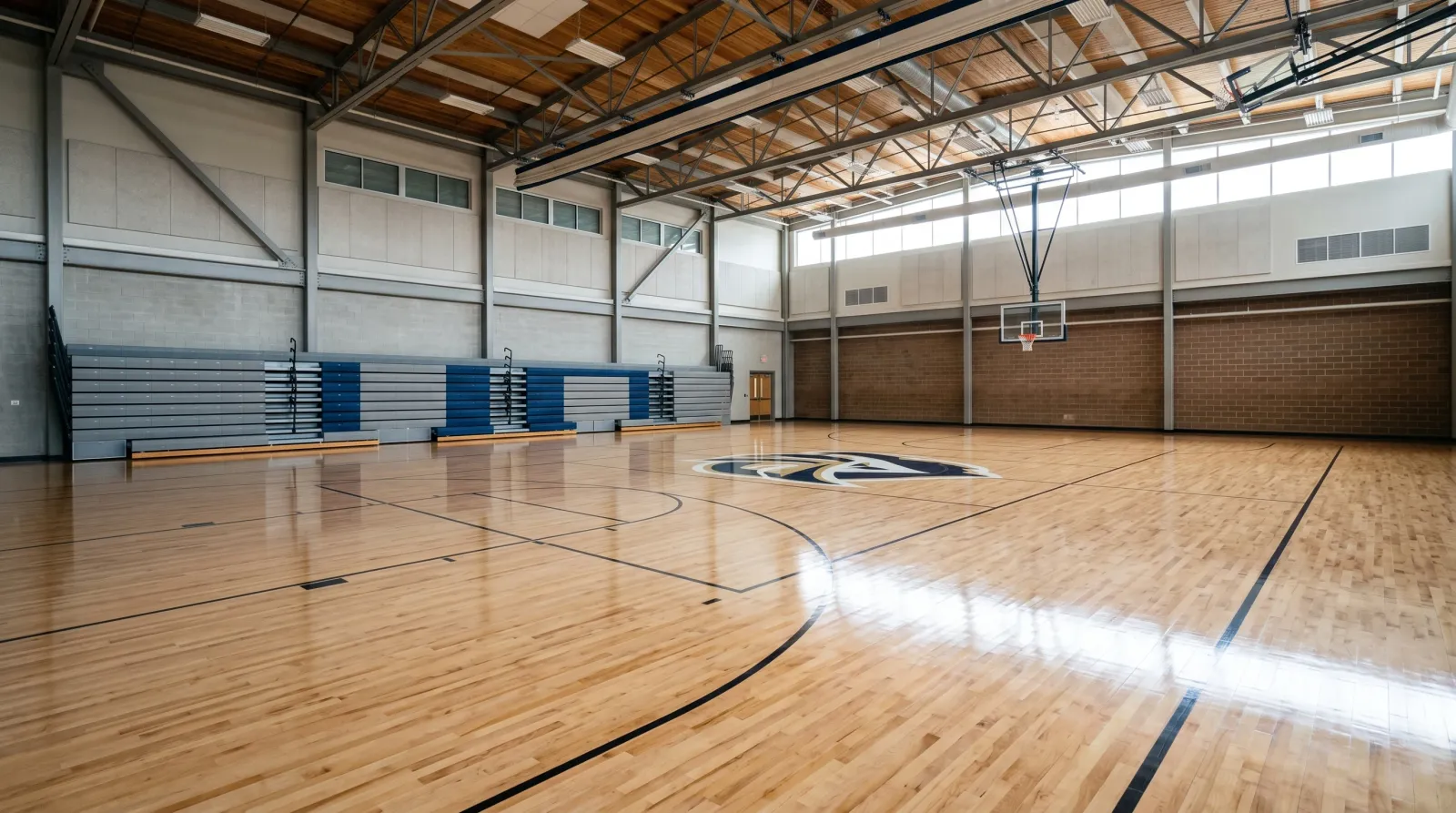
A gymnasium floor coating has to do two jobs that pull against each other: hold a controlled slip range that lets athletes plant and cut without skidding, and survive rolling bleacher loads, dragged equipment, sneaker abrasion, and a mop bucket every night. The asset is usually one of two substrates. The first is a tongue-and-groove maple court (MFMA second-and-better grade) over a sleeper or floating subfloor, finished clear with painted game lines and a center logo. The second is a sealed concrete slab in a multi-use gym, rec center, or school cafetorium, coated with an epoxy or urethane sport system in court colors.
The two substrates take different chemistries, and confusing them is the most expensive spec error on this page. Maple gets an oil-modified or waterborne court finish from a sport-floor maker (Bona, Hillyard, Basic Coatings); concrete gets an industrial epoxy or urethane stack. A concrete-floor epoxy on maple traps moisture in the wood and cups the boards. A wood court finish on concrete has no abrasion package for rolling steel loads and wears through to the slab in a season.
Service life depends on the layer. A clear court finish on maple is a wear coat, not a permanent surface. Expect a screen-and-recoat every 1–2 years and a full sand-and-refinish every 8–12 years, depending on play hours. Game lines re-shoot at refinish. Concrete sport systems run 7–10 years on the color and clear before a recoat, longer on the structural buildup beneath. The number that governs is play volume: a varsity court running practices, games, and PE for 14 hours a day wears the finish three times faster than a church fellowship hall.
Zoned Recommendation Matrix
A gym building is not one surface. The playing floor, the run-out, and the back-of-house each see different loads, and the right system differs by zone.
| Zone | Recommended system | Why |
|---|---|---|
| Maple playing court | System B (waterborne sport finish, clear + game lines) | Athletic COF, MFMA-compatible, recoatable |
| Concrete multi-use court | System A or C (epoxy/urethane, court colors) | Rolling loads, no wood, color in the film |
| Bleacher run-out / sidelines | Same as court + extra clear coat | Telescoping bleacher wheels concentrate load |
| Locker room / wet entry | Epoxy with aggregate broadcast | Wet slip, ASTM D2047 grip raised at the door |
| Weight room | High-build epoxy or rubber-topped system | Dropped plates, point impact |
| Hallway / lobby tie-in | Standard commercial floor coating | Traffic, not athletics |
The bleacher run-out is the zone owners forget. Telescoping bleacher wheels put the full stand load on a narrow track each time the bleachers roll out, and that track wears through a court finish first. Spec an extra clear coat or a urethane wear strip along the roll path.
Spec Requirements
| Spec | Value |
|---|---|
| Dry film thickness (DFT) | Maple clear finish 3–5 mils dry per coat, 2–3 coats; game lines 4–8 mils dry; concrete sport system 12–25 mils total |
| Coverage @ DFT | Waterborne court finish 400–600 sq ft/gal per coat; epoxy color coat 80–160 sq ft/gal |
| VOC | Waterborne sport finish under 275 g/L (industrial maintenance / sport-floor category); solvent oil-modified urethane 450–550 g/L, restricted under SCAQMD Rule 1113 and the OTC states — spec waterborne in CA and the Northeast |
| Standards | ASTM D2047 (static COF), ASTM D4060 (Taber abrasion), ASTM F1869 (MVE), ASTM D7234 (adhesion), ASTM E648 (radiant flux for the room) |
| Substrate prep — maple | Sand to bare wood (full refinish) or abrade with a 120–150 grit screen (recoat); tack and vacuum; never wet-mop before finish |
| Substrate prep — concrete | Shotblast or diamond-grind to ICRI CSP 2–3; SSPC-SP1 solvent clean; vacuum twice with HEPA |
| Moisture (concrete) | ASTM F1869 MVE ≤3 lb/1000 sq ft/24h, or ASTM F2170 ≤75% internal RH |
| Moisture (maple) | Wood moisture content 6–9% and within 4% of subfloor before finishing |
| Service temp | 55–80°F during application; floor in service at 60–80°F typical gym range |
| Cure to service | Maple recoat: light use 24–72h, line play 5–7 days. Concrete system: foot traffic 24h, rolling loads 7 days |
| Slip (ASTM D2047) | Static COF 0.5–0.6 dry on the playing surface; raise to 0.6+ with aggregate at wet entries |
| Dew point / humidity | Substrate ≥5°F above dew point; RH 40–75% during application; ventilate to off-gas |
System Chemistry Compared
Pick the chemistry to the substrate first, then the brand. Wood and concrete do not share a column here.
| Class | Substrate | Recoat window | Service life | UV stable | $/sq ft installed | Best for |
|---|---|---|---|---|---|---|
| Waterborne sport finish | Maple | 2–4h | 1–2 yr per coat, 8–12 yr to refinish | Yes | $1.50–3.50 (recoat) | Athletic maple courts, low VOC |
| Oil-modified urethane | Maple | Overnight | 1–2 yr per coat | Ambers slightly | $1.25–3.00 (recoat) | Traditional maple, high gloss |
| Epoxy + urethane clear | Concrete | 8–24h | 7–10 yr | Clear coat yes, epoxy no | $4–9 | Multi-use concrete courts |
| Polyaspartic | Concrete | 1–4h | 8–15 yr | Yes | $8–15 | Fast-turnaround concrete, rec centers |
| MMA | Concrete | 1h | 10–15 yr | Yes | $14–28 | 24/7 facilities, no downtime tolerance |
Waterborne sport finish is the modern default for a maple court because it meets the low-VOC ceiling, dries fast enough for a same-week recoat, and won’t amber the maple the way oil-modified urethane does over time. Oil-modified still has a following for the deep gloss and the traditional look, but it carries 450–550 g/L VOC and is off the table in California and the OTC states. For concrete, epoxy with a UV-stable urethane clear is the value pick. Polyaspartic earns its premium only where the gym cannot tolerate the longer epoxy downtime, which the broader polyaspartic floor specifier guide breaks down by recoat window.
Recommended Systems
System A — Concrete, Epoxy + UV-Stable Urethane (Multi-Use Court)
Service life 7–10 years on the wear coat. Total DFT 12–16 mils. The right system for a school cafetorium, rec-center, or church gym on a slab.
| Layer | Product | DFT |
|---|---|---|
| Primer | Sherwin-Williams ArmorSeal 1K HS Epoxy Sealer | 2–3 mils |
| Color / game-line coat | Sherwin-Williams ArmorSeal Tread-Plex (court colors, lines) | 4–6 mils |
| Clear topcoat | Sherwin-Williams ArmorSeal Tread-Plex clear (anti-slip aggregate at entries) | 3–5 mils |
Sherwin-Williams ProIndustrial product page →
System B — Maple, Waterborne Sport Finish (Hardwood Court)
The athletic-court standard. MFMA-compatible, low VOC, recoatable on a 1–2 year cycle without a full sand. Service life 8–12 years to refinish.
| Layer | Product | DFT |
|---|---|---|
| Sealer | Bona Sportive Seal (waterborne) | 2–3 mils |
| Game lines | Bona Sportive Paint (court colors, lines) | 3–5 mils |
| Finish coats (2) | Bona Sportive Finish (semi-gloss or satin) | 3–5 mils per coat |
Bona’s waterborne sport line is one of the MFMA-familiar finishes; Hillyard (Trophy / Super Shine-All), Basic Coatings (StreetShoe), and 3M sport finishes are the other names a flooring contractor will quote. Keep the seal, paint, and finish in one manufacturer family. Mixing a Bona seal under a different brand finish is the fastest path to a recoat that peels.
System C — Concrete, Polyaspartic Fast-Turnaround (Rec Center)
For a concrete gym that cannot lose a week. Polyaspartic cures to foot traffic in hours. Service life 8–15 years. Total DFT 16–24 mils.
| Layer | Product | DFT |
|---|---|---|
| Primer | Rust-Oleum Concrete Saver 5400 Epoxy Primer | 3 mils |
| Color / game-line coat | Rust-Oleum Concrete Saver epoxy (court colors) | 6–8 mils |
| Clear topcoat | Rust-Oleum Concrete Saver urethane / polyaspartic clear | 3–5 mils |
Rust-Oleum Industrial product page →
Systems Compared
| System | Substrate | Total DFT | $/sq ft installed | Service life | Best for |
|---|---|---|---|---|---|
| A | Concrete | 12–16 mils | $5–8 | 7–10 yrs | Multi-use school / church gym |
| B | Maple | 8–13 mils (3 coats) | $2–4 (recoat) / $5–9 (full refinish) | 8–12 yrs to refinish | Varsity hardwood court |
| C | Concrete | 16–24 mils | $8–14 | 8–15 yrs | Rec center, no-downtime |
Cost includes prep, primer, color, game lines, and clear with contractor labor. The maple recoat number ($2–4) assumes an existing court in sound condition that takes a screen-and-recoat. A full sand-and-refinish with new game lines runs the higher band. In-house recoat with a buffer and rented equipment drops the maple number but raises the risk of a finish-compatibility failure, covered below.
Application & Contractor Path
This splits by substrate. For a maple court, spec a flooring contractor familiar with MFMA sport-floor systems, not a general painter. Sanding maple flat without dishing the soft early-wood, cutting clean game lines with bleed-free tape, and timing waterborne recoat windows are trade skills. The finish manufacturers (Bona, Hillyard, Basic Coatings) run certified-applicator networks and will name local crews. For a concrete sport system, spec an SSPC-QP1 coatings contractor with shotblast capability, the same path as any industrial floor.
A trained in-house crew can run a clear screen-and-recoat on a maple court between seasons: abrade with a 120–150 grit screen on a buffer, tack and vacuum to a dust-free surface, then roll two finish coats with the manufacturer’s applicator. That work is within reach and saves the mobilization. The moment the job involves bare-wood sanding, a color change, new game lines, or any concrete coating, it leaves the in-house range. Game lines in particular are a contractor skill: a bled line on a center-court logo is visible from the back row and is a full re-sand to fix.
The honest DIY-vs-pro call: recoat clear in-house, refinish and stripe with a pro, never coat concrete without an SSPC-QP1 crew and a documented moisture test. For the residential and light-commercial concrete version of this work, the concrete floor painting guide walks the prep at a smaller scale.
Failure Modes & How to Prevent Them
- Finish incompatibility / peeling recoat. A waterborne finish over an old oil-modified or wax-contaminated court won’t bond and peels in sheets within a season. Prevention: screen-test a 2-by-2 ft patch, check adhesion at 48 hours, and keep seal, line, and finish coats in one manufacturer family. If the old finish is unknown, sand to bare wood.
- Moisture cupping (maple) and blistering (concrete). Maple absorbs subfloor moisture and the boards cup; concrete vapor lifts a non-breathable coating in disc-shaped blisters. Prevention: wood moisture content 6–9% and within 4% of the subfloor before finishing; ASTM F1869 MVE test on concrete with a barrier primer if over 3 lb.
- Slip out of range. A finish too glossy reads slick and athletes skid; too matte or over-aggregated and they catch and roll an ankle. Prevention: specify ASTM D2047 static COF 0.5–0.6 dry on the playing surface and reserve aggregate broadcast for wet entries and locker paths.
- Game-line bleed and ghosting. Lines wick under the tape or a re-shot line ghosts the old one. Prevention: use sport-floor line tape and a tack-and-burnish edge; on a re-stripe, sand the old line out at refinish rather than overcoating it.
- Bleacher-track wear-through. Telescoping bleacher wheels concentrate load and wear the finish through to wood or slab along the roll path. Prevention: extra clear coat or a urethane wear strip on the run-out, and felt or polymer wheel guards on the bleachers.
- Premature wear from skipped maintenance. Sand and grit ground in by sneakers act like sandpaper and cut the finish life in half. Prevention: daily dust-mop, no street shoes, and a recoat on a play-hours schedule rather than a calendar.
Where to Buy / Spec
| Channel | Best for | Link |
|---|---|---|
| Manufacturer-direct (S-W Industrial, Rust-Oleum, Bona Sport) | Spec’d projects, certified-applicator referral, warranty | S-W ProIndustrial · Bona Sport · Rust-Oleum Industrial |
| Sport-floor distributor (Hillyard, Basic Coatings dealers) | Maple court finishes, line paint, screens, applicators | (regional) |
| Pro retail (Sherwin-Williams stores) | Concrete sport coatings, local pickup, contractor pricing | (S-W store locator) |
| Amazon Business | Line tape, applicators, small recoat stock | (search by manufacturer) |
FAQ
See the frontmatter for the buyer questions a facility manager actually asks before signing the bid.