BSL Coating Systems for Biocontainment Labs: Specifier's Guide (2026)
Seamless wall, floor, and ceiling coatings for BSL-2 and BSL-3 labs. Decontaminable to VHP and bleach, DFT and chemical-resistance specs, ICRI CSP prep, contractor path.

Disclosure: Affiliate links to retailers and manufacturer-direct programs. Recommendations are spec-driven, not commission-driven.
Use Case
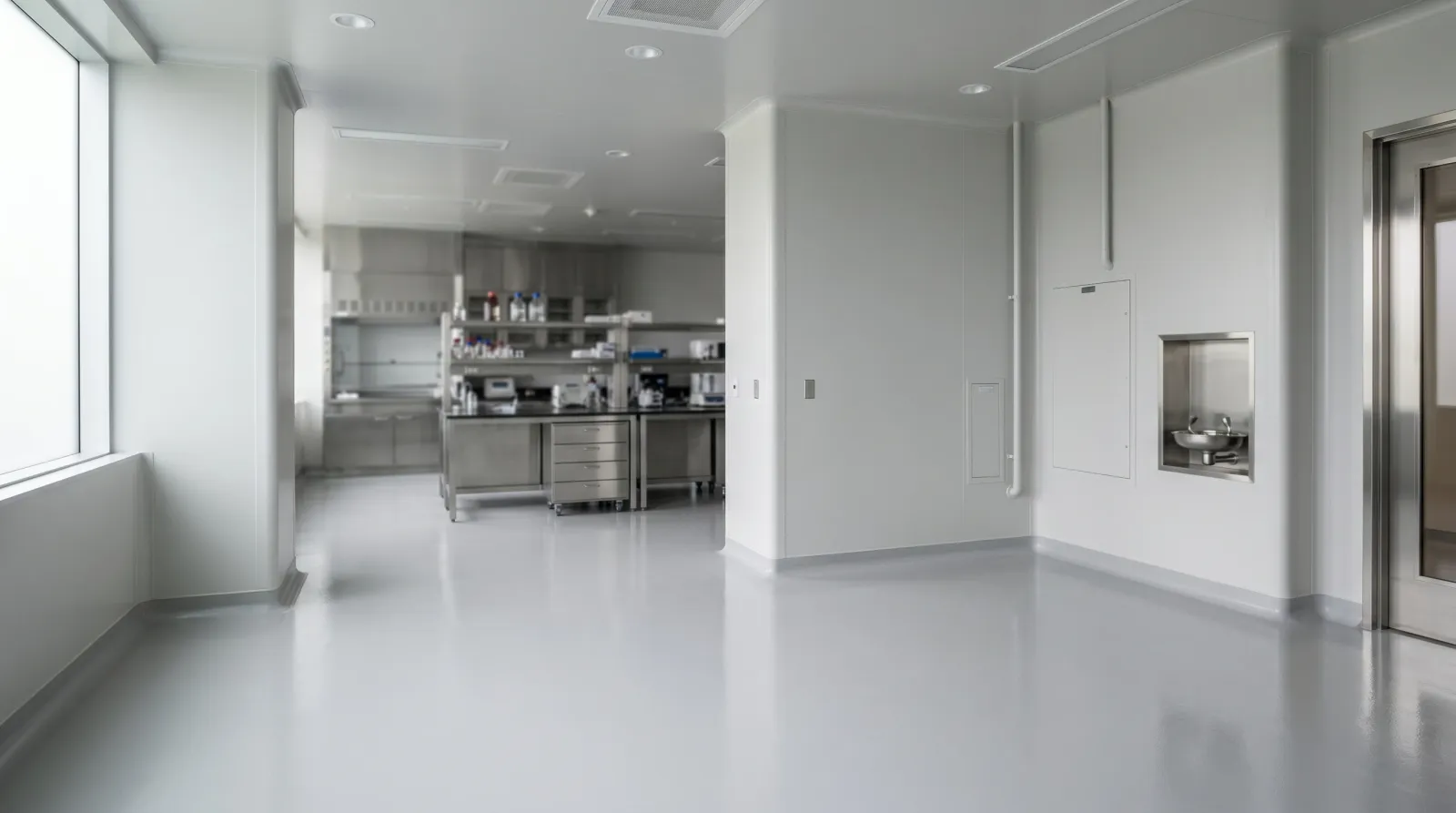
A BSL coating is the seamless, decontaminable surface system that turns a concrete-and-stud shell into a biocontainment laboratory. The asset is the room itself: the floor, the wall, the floor-to-wall cove, the ceiling, and every penetration through them. In a Biosafety Level 2 or Level 3 suite, those surfaces are part of the safety case. The CDC/NIH Biosafety in Microbiological and Biomedical Laboratories manual (the BMBL) treats interior finishes as a secondary barrier: they have to be cleanable, resistant to the disinfectants the lab uses every day, and able to survive room-level gaseous decontamination without breaking down.
The spec gets written into clinical and hospital labs, university research buildings, vivariums and animal-holding rooms, public-health and CDC-affiliated facilities, vaccine and diagnostics labs, and pharmaceutical R&D. What separates a BSL surface from an ordinary commercial finish is the disinfection regimen it has to take. The coating sees 1:10 bleach, quaternary ammonium, accelerated hydrogen peroxide, and isopropyl alcohol on a routine schedule, plus periodic gaseous decontamination by vaporized hydrogen peroxide (VHP) or paraformaldehyde fumigation when the room is taken down for service. A latex wall paint chalks and lifts under that load inside a year.
Three surfaces, three problems. The floor needs abrasion and chemical resistance, an integral cove base so the floor-to-wall joint wipes as one surface, and controlled anti-slip texture that stays cleanable. The walls and ceiling need a smooth, monolithic, non-porous film with no open seams or pinholes for an organism to hide in. Penetrations (conduit, plumbing, gas, data) need sealing into the envelope so the room holds during a fumigation.
Service life runs 10 to 15 years for a properly specified wall and ceiling system in a conditioned lab, and 15 to 20 years for a high-build epoxy or urethane-cement floor that took the right prep. Service life is set by surface preparation and seam integrity, not by topcoat brand. Skip the prep or leave a cold joint at the cove and the system fails the next decon cycle, no matter whose product is on the wall.
Zoned Recommendation Matrix
A containment suite is not one surface. The system changes by what each zone sees and how it gets decontaminated.
| Zone | Recommended system | Why |
|---|---|---|
| BSL-3 procedure room floor | System A (high-build epoxy or urethane cement, integral cove) | Carts, decon equipment, daily wet decon; monolithic floor-to-wall junction |
| BSL-2 lab floor | System A or B, troweled or broadcast epoxy with cove | Chemical resistance and cleanability; lower DFT acceptable |
| Lab walls (BSL-2 and BSL-3) | System B (high-performance epoxy) over block filler | Smooth, non-porous, bleach- and VHP-resistant, Class A fire |
| Ceilings | System C (waterborne high-performance epoxy) | Lighter exposure, must take fumigant, Class A flame spread |
| Vivarium / animal rooms | System A urethane-cement floor, epoxy walls | Repeated pressure-wash, urine and feed acids, thermal cycling |
| Anteroom / gowning vestibule | System B walls and floor | Cleanable but lighter chemical load than the procedure room |
| Mechanical / support rooms (non-containment) | Standard commercial epoxy or pre-catalyzed wall epoxy | Outside the barrier; spec least-cost compliant cleanable finish |
For a single small BSL-2 room, one wall system and one floor system carry the whole suite. The zoning matters most in a multi-room BSL-3 facility where the procedure rooms, the corridors, and the animal-holding rooms each take a different decontamination load.
Spec Requirements
The spec block, before any product name. Numbers vary by manufacturer and by whether the floor is a thin broadcast or a trowel-down; the categories do not.
| Spec | Value |
|---|---|
| Floor DFT | 30–250 mils total (thin broadcast 30–60; high-build trowel or urethane cement 125–250) |
| Wall / ceiling DFT | 8–16 mils total in a primer plus high-performance epoxy stack |
| Coverage @ DFT (walls) | 150–250 sq ft / gal per coat depending on build |
| VOC | <100 g/L waterborne wall systems; <340 g/L solvent-borne high-performance epoxy under SCAQMD Rule 1113; CARB-compliant grades available |
| Chemical resistance | ASTM D543 against 1:10 bleach, quaternary ammonium, accelerated hydrogen peroxide, IPA; compatibility with VHP and paraformaldehyde decon |
| Abrasion / wear | ASTM D4060 Taber abrasion for floors |
| Fire | ASTM E84 Class A (flame spread ≤25, smoke developed ≤450) on wall and ceiling coatings |
| Fungal resistance | ASTM G21 (no growth) for humid and vivarium rooms |
| Substrate prep (concrete floor) | ICRI CSP 3 shotblast for broadcast systems; CSP 4–5 for high-build trowel and urethane cement |
| Substrate prep (walls) | SSPC-SP13 / ICRI surface prep on concrete and CMU; block filler to fill voids; clean and sand on drywall in BSL-2 |
| Moisture | ASTM F1869 ≤3 lb/1000 sq ft/24h or ASTM F2170 ≤75% RH before floor coating; MVE barrier primer if failed |
| Cove base | Integral epoxy or urethane-cement cove, 4–6 inches up the wall, formed monolithic with the floor |
| Service temp | -20°F to +180°F floors (urethane cement to +250°F for steam/wet decon); interior conditioned for walls |
| Cure to service | Foot traffic 24h; full chemical and decon resistance 5–7 days |
| Ambient at application | 55°F to 90°F; substrate ≥5°F above dew point; RH <85% |
| Anti-slip | OSHA 1910.22 static COF ≥0.5 dry; aggregate at controlled density so the floor stays decontaminable |
Three things govern whether this system survives in a lab: the seam integrity at the cove and the penetrations, the chemical resistance of the topcoat against the lab’s real disinfectant list, and the moisture condition of the slab. Miss any one and the failure shows up at a decontamination cycle, which is the worst time to find it.
System Chemistry Compared
The chemistries that compete for a lab envelope. A wall is almost always epoxy; a floor chooses among three.
| Chemistry | Pot life | Recoat | Service temp | UV / decon stability | $/sq ft installed | Best for |
|---|---|---|---|---|---|---|
| High-performance epoxy (walls and floors) | 30–45 min | 8–24h | -20°F to 180°F | Holds bleach and VHP; ambers in daylight (interior, not a concern) | $4–10 walls; $7–14 floors | Standard BSL-2 and BSL-3 walls, floors, ceilings |
| Urethane cement (floors) | 20–30 min | 8–12h | -40°F to 250°F | Excellent under hot wet decon and pressure-wash | $12–25 | Vivarium, animal rooms, steam-cleaned floors |
| Polyaspartic / aliphatic urethane (topcoat) | 15–30 min | 1–2h | -40°F to 200°F | UV-stable, fast return, good chemical hold | $10–18 | Fast-turnaround floors, light-stable topcoat over epoxy |
| Waterborne acrylic-epoxy (walls and ceilings) | 2–3h working | 4–6h | interior | Good bleach hold, Class A, low VOC | $3–7 | Ceilings, BSL-2 walls, low-VOC-mandated jobs |
High-performance epoxy is the default for the containment envelope. Urethane cement is the answer for any floor that gets hot water, steam decon, or pressure-washing, which is most vivarium and animal-holding work. Waterborne acrylic-epoxy wins where the VOC budget is tight or the surface load is lighter, such as ceilings and gowning rooms.
Recommended Systems
Three full stacks at different price-performance points. All three use real, specified product lines; verify the current product data sheet and chemical-resistance chart against your lab’s disinfectant list before bid.
System a — Tnemec High-Build Epoxy Envelope (premium, Containment-Grade)
| Layer | Product | DFT |
|---|---|---|
| Floor primer | Tnemec Series 201 Epoxoprime | 4–6 mils |
| Floor body / broadcast | Tnemec Series 215 Universal Epoxy with 237SC aggregate | 60–125 mils |
| Floor topcoat | Tnemec Series 280 Tneme-Glaze chemical-resistant glaze | 4–8 mils |
| Integral cove | Series 215 / urethane-cement cove, 4–6 in. | monolithic |
| Wall fill / primer | Tnemec Series 130 Envirofill block filler | fill voids |
| Wall finish | Tnemec Series 280 Tneme-Glaze (two coats) | 8–12 mils |
| Floor total | 68–139 mils |
Service life 15–20 years on the floor, 12–15 on the walls. Tnemec’s chemical-resistant glaze is specified into hospital labs, vivariums, and federal containment work for its hold against bleach and gaseous decontamination. The Series 280 glaze gives the smooth, non-porous, wipe-clean surface a BSL-3 wall has to have. Tnemec product and rep network.
System B — Sherwin-Williams ProIndustrial Epoxy Envelope (mid-Tier, Spec-Common)
| Layer | Product | DFT |
|---|---|---|
| Floor primer | Sherwin-Williams ArmorSeal 1K HS | 2–3 mils |
| Floor body / broadcast | ArmorSeal high-build epoxy with aggregate | 60–125 mils |
| Floor topcoat | ArmorSeal 1000 HS chemical-resistant epoxy | 5–8 mils |
| Integral cove | Epoxy cove, 4–6 in. | monolithic |
| Wall finish | Pro Industrial Pre-Catalyzed Epoxy or High-Performance Epoxy (B70/B73) | 6–10 mils, two coats |
| Floor total | 67–136 mils |
Service life 12–15 years floor, 10–12 walls. The most widely specified option on this list because the Sherwin-Williams ProIndustrial wall epoxy is in stock at every commercial S-W store, and the rep network supports the spec. Pre-Catalyzed Epoxy gives a hard, scrubbable, bleach-tolerant wall film for BSL-2; step up to the High-Performance Epoxy for BSL-3 procedure rooms. Sherwin-Williams ProIndustrial product line.
System C — PPG Waterborne Acrylic-Epoxy Walls and Ceilings (low-VOC, Lighter-Load)
| Layer | Product | DFT |
|---|---|---|
| Wall / ceiling primer | PPG Perma-Crete or Aquapon WB primer | 2–4 mils |
| Wall / ceiling finish | PPG Pitt-Glaze WB1 acrylic epoxy (two coats) | 6–10 mils |
| Wall total | 8–14 mils |
Service life 8–12 years. A waterborne acrylic-epoxy at under 100 g/L VOC, Class A flame spread, with a tile-like glaze that wipes clean and tolerates routine bleach. This is the ceiling and BSL-2 wall answer where a low-VOC mandate (California, OTC states) or an occupied-building schedule rules out a solvent-borne system. Pair it with System A or B on the floor. PPG Pitt-Glaze WB1 product page.
Systems Compared
| System | Total DFT | $/sq ft installed | Service life | Best for |
|---|---|---|---|---|
| A — Tnemec high-build envelope | Floor 68–139 mils; walls 8–12 mils | $14–24 floor; $6–10 walls | 15–20 yr floor / 12–15 walls | BSL-3 procedure rooms, vivarium, federal containment |
| B — S-W ProIndustrial envelope | Floor 67–136 mils; walls 6–10 mils | $9–16 floor; $4–8 walls | 12–15 yr floor / 10–12 walls | BSL-2 and most BSL-3 clinical and research labs |
| C — PPG waterborne walls/ceilings | Walls 8–14 mils | $3–7 walls | 8–12 yr | Ceilings, BSL-2 walls, low-VOC jobs (paired floor) |
Pricing assumes a contracted install of 2,000 sq ft or more, prep and integral cove included. Small single-room retrofits run 25–60 percent higher per square foot because mobilization, containment of the work area, and the cove detail don’t scale down. Urethane-cement floors for vivarium rooms add $4–8 per square foot over the epoxy floor numbers above.
Application & Contractor Path
This is not a self-perform scope on a working containment suite. The seamless, decontaminable result depends on shotblast prep, moisture testing, controlled film build, a monolithic integral cove, and sealed penetrations. Specify a contractor with the right credentials:
- SSPC-QP1 certification for industrial coatings work, or a documented cleanroom and healthcare flooring track record.
- Demonstrated experience with integral cove base and seamless wall-to-floor detailing in a lab or pharma environment.
- A field QC log covering DFT, dew point, recoat windows, and seam inspection.
Three contractor-qualifying questions before signing:
- Show me two BSL or pharma labs you coated in the last 24 months, with the system spec and the decon regimen the owner runs. Cleanroom and food-plant experience transfers; warehouse-floor experience does not, because the cove and seam detail is the whole job.
- What is your moisture-test and MVE-mitigation protocol? A contractor who can’t describe ASTM F1869 testing and a barrier primer plan should not be bidding a floor.
- How do you detail and inspect the penetrations and the cove? For BSL-3, the room has to hold during a fumigation, and an unsealed conduit or a pinholed cove is the leak.
Every manufacturer on this list (Tnemec, Sherwin-Williams, PPG) runs a spec-and-rep service: a free pre-bid review of the room drawings, a chemical-resistance check against the lab’s disinfectant list, and a recommended system per zone. Use it. The chemical-resistance match against your real decon agents is the single most important pre-construction decision, and the rep does it at no cost. Catching a wrong topcoat at the drawing stage costs an email; catching it after a failed VHP cycle costs the room.
Failure Modes & How to Prevent Them
Five failures cover the bulk of lab-coating rejections and warranty claims.
- Floor delamination from moisture vapor. Cause: no ASTM F1869 or F2170 test, epoxy installed over a slab emitting above 3 lb/1000 sq ft/24h. The vapor lifts the film in disc-shaped blisters. Prevention: moisture test before the floor, MVE barrier primer if it fails.
- Cove or seam failure at decontamination. Cause: a cold joint or pinhole at the floor-to-wall cove or a penetration left unsealed; the gaseous decon or the wet wipe-down works into it and lifts the edge. Prevention: monolithic integral cove formed with the floor, seam and penetration inspection in the QC log, a holiday-style visual check of the cove before sign-off.
- Topcoat breakdown under the disinfectant. Cause: a wall coating chosen on price or aesthetics that wasn’t checked against the lab’s actual agents, then chalks or softens under repeated bleach or VHP. Prevention: ASTM D543 chemical-resistance data matched to the lab’s disinfectant list, confirmed with the manufacturer rep, before the product goes in the spec.
- Application below dew point or above humidity ceiling. Cause: condensation between coats or on the slab during application, blistering the system. Prevention: sling psychrometer in continuous use, substrate held 5°F above dew point, RH below 85 percent through every coat.
- Anti-slip that won’t decontaminate. Cause: aggregate broadcast too heavy or too coarse, leaving a profile that traps soil and organisms and resists wipe-down. Prevention: controlled aggregate density tuned to hit OSHA COF 0.5 while staying cleanable, with a glaze topcoat that closes the texture enough to wipe.
Moisture-driven floor delamination and cove failures are the two I see reviewed most often. Both are decided in pre-construction, not at the topcoat. Test the slab and detail the cove, and the system holds for the design life.
Where to Buy / Spec
| Channel | Best for | Path |
|---|---|---|
| Tnemec rep network | Spec’d BSL-3, vivarium, and federal containment work | Tnemec rep locator |
| Sherwin-Williams ProIndustrial / Commercial | BSL-2 and BSL-3 clinical and research labs; in-stock wall epoxy | S-W ProIndustrial |
| PPG rep / pro store | Low-VOC wall and ceiling systems; Pitt-Glaze WB1 | PPG Pitt-Glaze WB1 |
| Industrial distributor (Rawlins US, regional coatings houses) | Multi-manufacturer projects, mixed-system bids | Distributor account with project-specific pricing |
| Amazon Business | Support-room and non-containment touch-up only | Search by manufacturer; not for the containment envelope |
Manufacturer-direct is the recommended channel on any project that crosses a containment barrier. The rep service includes the chemical-resistance match, the per-zone system recommendation, and the warranty path through a certified contractor, all of which are worth more than any retail discount on the pail.
FAQ
See the questions a facility buyer actually asks in the spec block above; the full Q&A is rendered from the page metadata.