Pharma Facility Floor Coatings: Specifier's Guide (2026)
Pharma facility floor systems compared by DFT, USP cleanability, and service life. ICRI CSP prep, MVE limits, USDA-acceptable resins, and the contractor path that passes audit.

Disclosure: Affiliate links to retailers and manufacturer-direct programs. Recommendations are spec-driven, not commission-driven.
Use Case
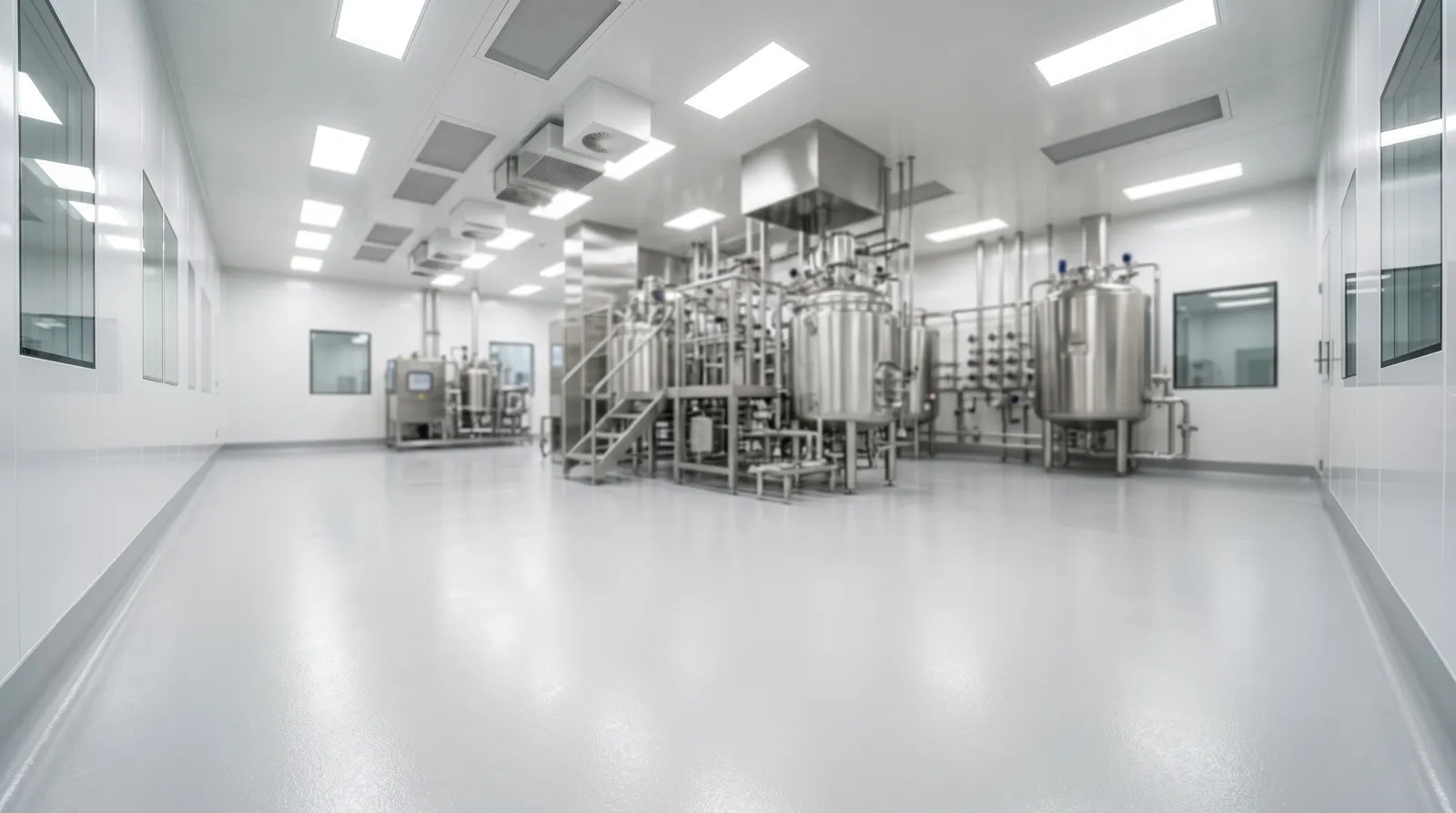
A pharmaceutical facility floor has to pass an audit, not just a foot. The asset is the slab under a cGMP manufacturing suite, a sterile fill line, a tablet press room, an API plant, a QC lab, or a packaging hall. The coating’s job is to be seamless, non-shedding, chemically resistant to the cleaning and process chemistry that runs across it, and cleanable to a documented standard that an FDA or EU GMP inspector will accept. The spec calls for a monolithic surface with no grout lines, no seams, and an integral cove base that radiuses up the wall so there is no crevice to harbor bioburden.
Service life expectations: 8–12 years on light-traffic packaging and corridor floors, 10–15 years on a properly broadcast aseptic epoxy system, and 15–25 years on a troweled urethane cement body coat in a wet-process or washdown suite. Service life on a pharma floor is governed by chemical resistance and thermal cycling more than abrasion. The floor sees clean-in-place caustic, peracetic acid sanitizers, isopropyl alcohol, occasional solvent spills, and in many plants a steam or hot-water washdown that thermal-shocks the slab.
Where the floor fails the spec is rarely wear. It is a seam that opened at the cove, a topcoat that ambered and could no longer be visually inspected for residue, or a slab that drove moisture up through an epoxy build and delaminated it inside the validation period. Each of those is a specification decision, not an application accident. This guide lays out the systems that survive the audit and the prep that earns the service life.
Zoned Recommendation Matrix
A pharma facility is not a single floor. The classification and the chemistry change room to room, and so does the system. The spec for a typical oral-solid-dose plant:
| Zone | Recommended system | Why |
|---|---|---|
| Wet process / CIP washdown | System B (urethane cement, troweled) | Thermal shock, caustic dwell, standing water at joints |
| Aseptic / sterile fill suite | System C (aseptic epoxy, broadcast) | Cleanability, gloss for visual residue inspection, USP-grade seamless finish |
| Tablet press / granulation | System B with aggregate broadcast | Dust load, point loading from equipment, washdown |
| QC / analytical lab | System A (high-build thin-film epoxy) | Reagent spot resistance, light traffic, chemical legibility |
| Corridors / gowning | System A or System C light build | Foot traffic, cart traffic, cleanability without the wet-zone build |
| Warehouse / staging | Standard high-build epoxy (separate spec) | Forklift abrasion, no sterility requirement |
For a single-zone asset such as a small compounding pharmacy or a standalone lab, skip the matrix and pick one system across the slab. For a multi-suite plant, segment the floor at the bid and let each zone carry its own DFT, its own cove detail, and its own warranty line.
Spec Requirements
The spec block, before any product name:
| Spec | Value |
|---|---|
| Dry film thickness (DFT) — thin-film systems | 16–60 mils total (primer + build + topcoat) |
| Dry film thickness — troweled urethane cement | 125–250 mils body coat plus 5–14 mil seal |
| Coverage at spec’d DFT | 80–125 sq ft/gal per thin-film coat; urethane cement is trowel-applied by thickness |
| VOC limit | <100 g/L on compliant coats; 100% solids on aseptic and cleanroom builds (SCAQMD Rule 1113, CARB SCM industrial maintenance) |
| Standards | ASTM D4060 (abrasion), ASTM F1869 (MVE), ASTM C722 (chemical resistance), ASTM D7234 (pull-off adhesion), ASTM E2167 (cleanability) |
| Certifications | USDA-acceptable resin, FDA 21 CFR 175.300 food-contact eligible, NSF/ANSI 51 on select SKUs |
| Substrate prep — concrete | ICRI CSP 3 shotblast for thin-film; CSP 4–5 for urethane cement to key the heavy mortar |
| Surface prep — embedded steel / drains | SSPC-SP10 near-white blast on stainless drain bodies and trench frames |
| Moisture vapor emission ceiling | 3 lb/1,000 sq ft/24h (ASTM F1869) for epoxy; urethane cement tolerates to ~5 lb |
| Ambient at application | 50°F–90°F; relative humidity <85%; substrate ≥5°F above dew point |
| Cure to service | Foot traffic 12–24h · full chemical resistance 5–7 days · CIP washdown at 7 days |
| Service temperature | -40°F to 250°F continuous for urethane cement; up to 140°F for standard epoxy |
| OSHA 1910.22 anti-slip | Static COF ≥0.5 dry; broadcast aggregate required on wet-process and CIP zones |
Three numbers drive the inspection: the MVE rate, the cove-base radius and seal, and the substrate temperature relative to dew point. The urethane cement tolerance for higher moisture is the reason it dominates wet-process pharma suites, where the slab is often new construction that has not finished curing when the schedule demands a floor.
System Chemistry Compared
Choose the chemistry class before naming a product. The chemistries that apply to a pharma floor:
| Chemistry | Pot life | Recoat window | Service temp | UV stability | $/sq ft installed | Best for |
|---|---|---|---|---|---|---|
| Aseptic epoxy (broadcast) | 30–45 min | 8–24h | up to 140°F | ambers under UV (rare in sealed suites) | $6–12 | Sterile fill, packaging, labs, gowning |
| Urethane cement | 30–90 min | 4–12h | -40°F to 250°F | mid; some amber | $10–22 | Wet process, CIP washdown, thermal shock |
| Polyaspartic seal | 20–45 min | 30 min–4h | -40°F to 250°F | UV-stable | $3–6 (as topcoat only) | Fast-cure seal over a build coat |
| MMA (methyl methacrylate) | 5–15 min | 1h | -40°F to 200°F | UV-stable | $14–28 | One-hour cure-to-service, occupied-plant emergency repair |
Aseptic epoxy is the default for dry, classified, light-traffic suites where gloss and cleanability matter most. Urethane cement is the answer wherever there is heat, water, or caustic dwell, which is most wet-process pharma. Polyaspartic earns its place as a fast-cure seal coat over an epoxy or urethane cement build, not as the whole system. MMA buys a one-hour return to service when an occupied plant cannot shut a line down, at a price that only an emergency repair justifies.
Recommended Systems
Three full multi-coat stacks at different zones and price-performance points. All reference the same MVE ceiling and the same coved-base requirement.
System A — Tnemec Aseptic Epoxy (sterile Suite, Lab, Packaging)
| Layer | Product | DFT |
|---|---|---|
| Primer | Tnemec Series 201 Epoxoprime | 4–6 mils |
| Build coat | Tnemec Series 237 Power-Tread broadcast with quartz | 30–60 mils |
| Topcoat | Tnemec Series 290 CRU urethane seal | 3–5 mils |
| Total | 37–71 mils |
Service life 10–15 years on classified-suite traffic. The quartz broadcast gives the OSHA anti-slip profile, and the CRU urethane seal holds gloss for visual residue inspection where a standard epoxy would amber and read dirty under the suite lighting. Tnemec product reference.
System B — Sika Sikafloor PurCem (wet Process, CIP Washdown)
| Layer | Product | DFT |
|---|---|---|
| Primer | Sikafloor-156 epoxy primer (dry-slab zones only) | 4–6 mils |
| Body coat | Sikafloor-21 N PurCem urethane cement, troweled | 120–250 mils |
| Topcoat / seal | Sikafloor-31 N PurCem seal coat | 8–14 mils |
| Total | 132–270 mils |
Service life 15–25 years under washdown and thermal cycling. PurCem tolerates a damp slab and survives steam and caustic CIP that would lift an epoxy. This is the spec for any suite that runs hot-water or peracetic washdown across the floor. Sika heavy-duty flooring reference.
System C — Sherwin-Williams General Polymers Urethane Cement (mid-Range Process Floor)
| Layer | Product | DFT |
|---|---|---|
| Scratch coat | General Polymers urethane mortar scratch coat | to profile |
| Body coat | Resuthane TUF urethane cement | 125–250 mils troweled |
| Topcoat / seal | Resuflor Aspartic 100 polyaspartic seal | 5–10 mils |
| Total | 130–260 mils |
Service life 12–20 years. The polyaspartic seal cures fast and stays UV-stable, which shortens the return-to-service window in a plant that cannot stay down. This is the value answer for a process floor that needs urethane cement durability without the top-tier price of a fully imported system. Sherwin-Williams General Polymers reference.
Systems Compared
| System | Total DFT | $/sq ft installed | Service life | Best for |
|---|---|---|---|---|
| A — Tnemec aseptic epoxy | 37–71 mils | $9–14 | 10–15 years | Sterile suites, labs, packaging, gowning |
| B — Sika PurCem urethane cement | 132–270 mils | $14–22 | 15–25 years | Wet process, CIP washdown, thermal shock |
| C — SW General Polymers urethane cement | 130–260 mils | $11–18 | 12–20 years | Mid-range process floors, granulation |
Installed pricing assumes a 5,000+ sq ft scope through a manufacturer-rep certified contractor with shotblast prep, integral cove base, and MVE testing included. The cove base alone runs $12–25 per linear foot and is not optional in a classified space. Sub-1,000 sq ft jobs run 30–60% higher per square foot on every system.
Application & Contractor Path
This is not a DIY product class, and it is not a general-commercial-painter product class either. Specify a contractor with SSPC-QP1 certification, a NACE Level 2 (or AMPP CIP equivalent) inspector on call, and the manufacturer’s installer certification for the specific resin system. Urethane cement is troweled to thickness by hand, the body coat goes off in minutes once catalyzed, and the integral cove base is detailed by a crew that has done it before. A contractor who has never run PurCem or Resuthane will leave you a floor that fails the cove inspection.
Three contractor-qualifying questions before you sign:
- Has the crew installed this exact resin system, with a coved base, in a cGMP facility in the last 12 months? Reference the project and call the facility.
- What is the MVE protocol? ASTM F1869 in three locations minimum on any slab, including new pours, because pharma slabs are often coated before they finish curing.
- How is the cove base detailed and sealed, and is it named in the installed warranty? The cove-to-wall transition is where most warranty claims originate.
The manufacturer rep path is the strongest lever you have. Sherwin-Williams General Polymers, Sika, and Tnemec all run pre-bid site visits through their protective-coatings reps. The rep catches the moisture problem and the cove detail before the bid lands, and the certified-installer roster narrows the bid list to crews the manufacturer will actually warrant. Use the site visit. It is worth more than any material discount.
The only honest DIY-eligible scope on a pharma campus is a small thin-film epoxy refresh in a non-sterile mechanical room, warehouse, or staging area under about 500 sq ft, where a competent maintenance crew can shotblast and roll a high-build epoxy. Anything classified, wet, or coved goes to a certified contractor.
Failure Modes
Five failures account for nearly every pharma-floor warranty claim and audit finding. Prevent these and the system delivers its rated service life.
- Cove-base seam failure. The radius at the floor-to-wall transition cracks or debonds, opening a seam that traps residue and fails the cleanability audit. Cause: cove installed by a crew without resin-cove experience, or a movement joint not honored. Prevention: specify an integral coved base detailed by a certified installer, named in the warranty, and inspect the radius before sign-off.
- Moisture-driven delamination from below. Cause: MVE rate above the system ceiling, no vapor-mitigation primer, coated before the slab cured. Prevention: ASTM F1869 calcium chloride testing pre-bid; specify urethane cement on high-moisture slabs or a moisture-tolerant epoxy primer above 3 lb/1,000 sq ft/24h.
- Thermal-shock cracking in washdown zones. Cause: standard epoxy specified where hot-water or steam CIP cycles the slab, epoxy and concrete expand at different rates and the coating debonds. Prevention: urethane cement (System B or C) on any floor that sees hot washdown; epoxy is the wrong chemistry there.
- Chemical staining and gloss loss. Cause: peracetic acid, caustic, or solvent dwell on a topcoat not rated for it, leaving the floor discolored and impossible to visually inspect for residue. Prevention: ASTM C722 chemical-resistance verification against the actual plant chemistry; spec a CRU or polyaspartic seal, not a bare epoxy build.
- Application below dew point. Moisture condenses between coats and blisters the system. Prevention: substrate ≥5°F above dew point during every coat, tracked on the contractor’s QC log with a surface thermometer and sling psychrometer. A blistered film in a sterile suite is a full re-do, not a touch-up.
The first two failures, the cove seam and MVE, produce the majority of the field claims and audit findings I see on pharma floors. Both are settled in the specification phase, not on the application day.
Where to Buy / Spec
| Channel | Best for | Path |
|---|---|---|
| Manufacturer-direct rep (SW General Polymers, Sika, Tnemec) | Spec’d cGMP projects, pre-bid site visit, full installed warranty | SW General Polymers · Sika flooring · Tnemec |
| Industrial flooring distributor | Material supply to a certified installer | Regional resinous-flooring distributors |
| Pro retail (S-W stores) | Small thin-film refresh material, account pricing | S-W store locator, account holder pricing |
| Amazon Business | Non-sterile mechanical-room epoxy, repair kits | Search by manufacturer SKU |
Manufacturer-direct is the only channel for the classified and wet-process zones. The rep network controls the installer certification and the warranty, and the pre-bid visit catches the moisture and cove problems before they become audit findings. Amazon Business and pro retail belong only to the non-sterile refresh scope.