Clean Room Floor Coatings: Specifier's Guide (2026)
Seamless clean-room floor coating systems compared by DFT, particle shedding, and ISO class. ICRI CSP prep, MVE limits, ESD options, and the contractor path.

Disclosure: Affiliate links to retailers and manufacturer-direct programs. Recommendations are spec-driven, not commission-driven.
Use Case
A clean-room floor has a job no warehouse floor has: it cannot shed particles, it cannot harbor microbes in a seam, and it has to survive daily contact with aggressive disinfectants without losing gloss or bond. The asset is a controlled-environment room classified under ISO 14644-1 (ISO 5 through ISO 8) or the older Federal Standard 209E grades (Class 100 through Class 100,000). Specified across pharmaceutical compounding, sterile fill-finish, semiconductor fabrication, biotech labs, medical-device assembly, aseptic food production, and hospital compounding pharmacies governed by USP 797 and USP 800.
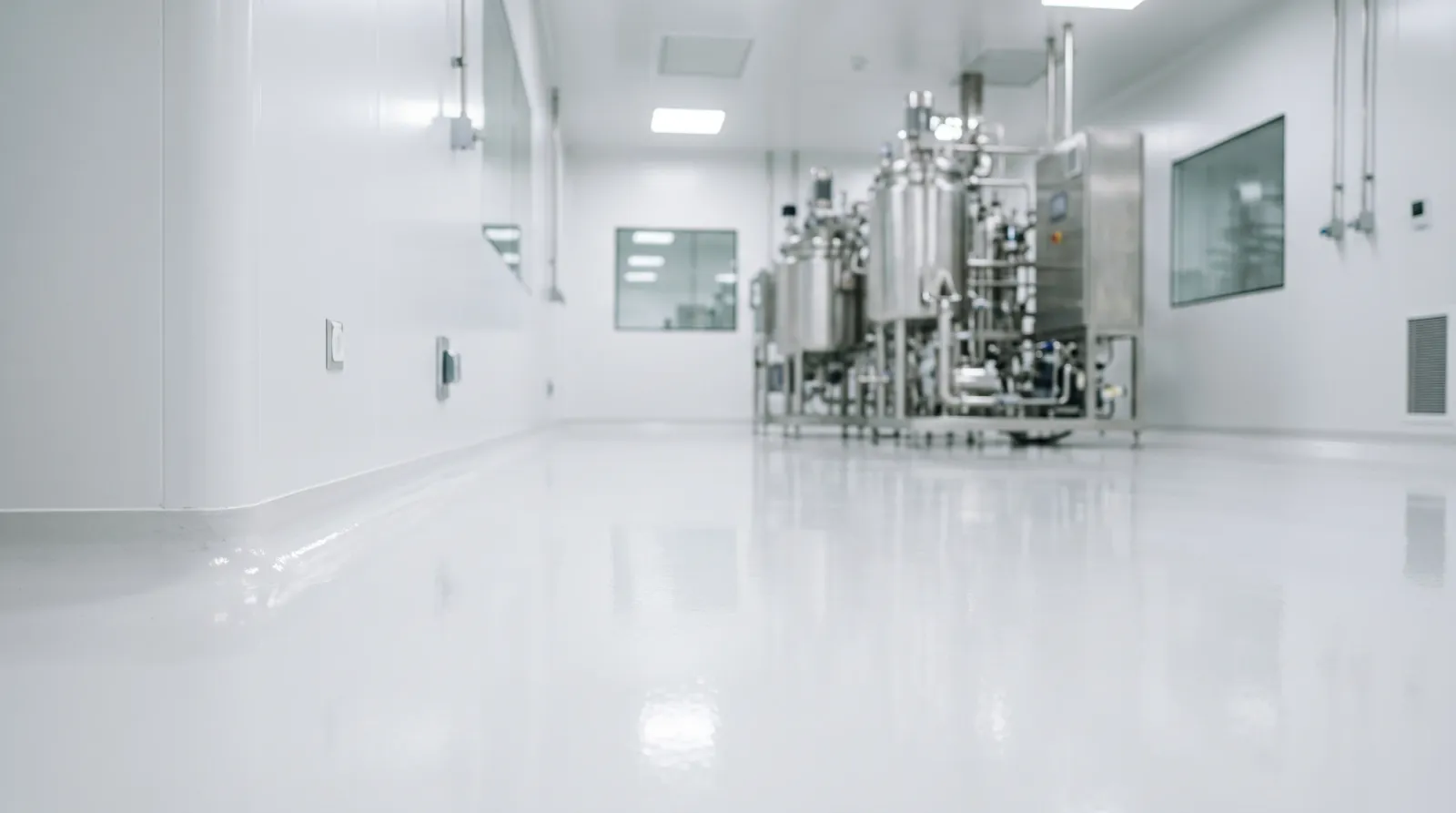
The performance target is a seamless, monolithic, non-porous surface. Tile, sheet vinyl, and any system with joints or grout lines lose on contamination grounds before cost enters the conversation. The floor must turn up the wall as an integral cove base, eliminating the 90-degree wall-floor junction where particles and biofilm collect. A flat floor with a square base is not a clean-room floor; it is a floor in a room that happens to be clean.
Service life expectations: 8–12 years on ISO 7/8 gowning and support spaces, 10–15 years on a full self-leveling epoxy or urethane build in an ISO 5/6 critical zone, shorter where a sporicidal cleaning regimen runs daily. Chemical durability against the cleaning chemistry, not abrasion, usually governs the replacement cycle. Hydrogen peroxide, peracetic acid, quaternary ammonium, and sodium hypochlorite all attack a coating differently, and the disinfectant the facility actually uses has to be on the bid documents before a topcoat gets named.
Zoned Recommendation Matrix
A clean-room suite is not one environment. The classification steps down from the critical core out to the gowning and support corridors, and the floor spec steps down with it:
| Zone | ISO class | Recommended system | Why |
|---|---|---|---|
| Critical / aseptic core | ISO 5 | System A (self-leveling epoxy, full cove, smooth topcoat) | Lowest particle shed, fully seamless, daily sporicidal contact |
| Process / filling | ISO 6–7 | System A or System B (urethane where wet/thermal) | Spill and disinfectant resistance, integral cove |
| Gowning / airlock | ISO 7 | System B (mid-tier, light texture at transition) | Slip control at gowning step, cleanable, coved |
| Support corridor / staging | ISO 8 | System C (thin-mil epoxy build) | Lighter traffic, cleanable, lower DFT acceptable |
| Wash / autoclave room | wet process | Urethane cement (Tnemec 237, Sikafloor PurCem), NOT thin epoxy | Thermal shock, sustained water and caustic dwell |
| ESD-sensitive (fab/electronics) | ISO 5–7 | Static-dissipative system with conductive primer grid | ASTM F150 surface resistance 10^6–10^9 ohms |
For a single-room build with one classification across the slab, skip the matrix and spec one system wall to wall. Most real suites are multi-zone, and pricing the whole suite at the critical-core tier wastes budget on the support corridors.
Spec Requirements
The spec block, before any product gets named:
| Spec | Value |
|---|---|
| Dry film thickness (DFT) — total system | 20–60 mils typical; self-leveling base runs 60–125 mils (1.5–3 mm); thin-mil 12–20 mils for ISO 8 support only |
| Coverage at spec’d DFT | Self-leveling base placed by volume (sq ft per mm of build); topcoat 150–250 sq ft/gal |
| VOC limit | <50 g/L for 100% solids systems; SCAQMD Rule 1113 industrial maintenance <100 g/L; CARB SCM-compliant SKUs available |
| Standards | ASTM D4060 (abrasion), ASTM F1869 (MVE ≤3 lb), ASTM D7234 (adhesion), ASTM F150 (ESD where required), IEST-RP-CC027 (cleanroom flooring), ISO 14644-1 (particle class) |
| Certifications | USP 797/800-compatible formulations; FDA 21 CFR 175.300 incidental food contact; USDA-acceptable on select SKUs |
| Substrate prep — concrete | ICRI CSP 3 shotblast for self-leveling builds; CSP 2 diamond grind for thin-mil only |
| Surface prep | SSPC-SP1 solvent clean + SSPC-SP13 mechanical (shotblast); HEPA-vacuum twice |
| Moisture vapor emission ceiling | 3 lb/1000 sq ft/24h (ASTM F1869) or 75% RH (ASTM F2170); above ceiling requires MVE barrier primer |
| Service temp | -20°F to 180°F (epoxy); urethane cement to 250°F for autoclave/wash zones |
| Cure to service | Foot traffic 24h · full chemical/cleaning resistance 7 days |
| Ambient at application | 60°F to 85°F; humidity <80%; substrate ≥5°F above dew point |
| OSHA 1910.22 anti-slip | Static COF ≥0.5 dry; light texture at gowning and wet transitions |
| Cove base | Integral, minimum 4-inch turn-up, radiused at the wall-floor junction |
Three of those govern pass or fail more than the rest: the MVE rate, the cove-base detail, and the cleaning-chemistry compatibility of the topcoat. The DFT range looks wide because a self-leveling base coat carries most of the build, while the topcoat that actually meets the disinfectant runs only a few mils on top of it.
System Chemistry Compared
Pick the chemistry class for the zone before you pick a product. Cleanrooms run on three families plus an ESD variant:
| Chemistry | Pot life | Recoat window | Service temp | UV stability | $/sq ft installed | Best for |
|---|---|---|---|---|---|---|
| Self-leveling epoxy (100% solids) | 20–40 min | 8–16 hr | -20°F to 180°F | Ambers in daylight (rare in cleanrooms) | $7–14 | ISO 5–7 critical and process floors |
| Polyaspartic / polyurethane topcoat | 20–45 min | 30 min–4 hr | -40°F to 200°F | UV-stable, gloss-retentive | $9–15 | Seal coat over epoxy base; chemical-resistant finish |
| Urethane cement (PurCem-class) | 30–60 min | 4–12 hr | -40°F to 250°F | Mid; some yellowing | $10–18 | Wash bays, autoclave rooms, thermal-shock zones |
| ESD-dissipative epoxy | 20–40 min | 8–16 hr | -20°F to 180°F | Ambers | $12–22 | Semiconductor, electronics, charge-sensitive fill |
Self-leveling epoxy is the default for the cleanroom envelope because it produces a dead-flat monolithic surface that coves cleanly. The polyurethane or polyaspartic seal coat goes on top because epoxy alone, while hard, gives up gloss faster under hydrogen peroxide and peracetic acid than a urethane finish does. Urethane cement enters only where heat and water do, typically the wash and autoclave rooms off the cleanroom core. ESD systems carry a conductive primer grid and a measured-resistance topcoat, and you specify them only when the process spec calls for static control.
Recommended Systems
Three full multi-coat stacks at different zones and price-performance points. All three assume ICRI CSP 3 shotblast prep, the 3 lb MVE ceiling, and an integral cove base at every wall junction.
System a — Sherwin-Williams Resuflor Self-Leveling Epoxy (premium ISO 5–6 Critical)
| Layer | Product | DFT |
|---|---|---|
| Primer | ArmorSeal 1K HS / Resuprime moisture-tolerant primer | 3–5 mils |
| Self-leveling base | Resuflor Deko SL 100% solids epoxy | 60–125 mils (1.5–3 mm) |
| Topcoat | ProIndustrial Pre-Catalyzed or Polyaspartic seal coat | 4–8 mils |
| Total | 67–138 mils |
Service life 10–15 years in a critical core under daily disinfection. The self-leveling base produces the seamless monolithic surface USP 797/800 calls for, and the polyaspartic seal coat holds gloss against peracetic acid where bare epoxy would chalk. Coves up the wall as an integral 4-to-6-inch base. Sherwin-Williams Protective & Marine flooring.
System B — Tnemec Deco-Tread / Series 237 Urethane (mid-Tier Process and Wet Zones)
| Layer | Product | DFT |
|---|---|---|
| Primer | Series 201 Epoxoprime / 218 MortarClad | 4–8 mils |
| Self-leveling / build | Series 237 Power-Tread urethane | 60–125 mils |
| Topcoat | Series 290 Decoflor or 280 Tneme-Glaze | 3–6 mils |
| Total | 67–139 mils |
Service life 10–14 years, and the urethane chemistry tolerates the thermal cycling and sustained moisture that retire an epoxy floor early in wash bays and autoclave rooms. This is the system for the process and wet-adjacent zones where System A’s epoxy base would crack at the joints. Tnemec product catalog.
System C — Sika Sikafloor 264 Self-Leveling Epoxy (budget ISO 7–8 Support)
| Layer | Product | DFT |
|---|---|---|
| Primer | Sikafloor 161 / Sika MVE barrier primer | 4–8 mils |
| Self-leveling base | Sikafloor 264 epoxy self-leveling | 40–80 mils (1–2 mm) |
| Topcoat | Sikafloor 305 W polyurethane seal | 3–5 mils |
| Total | 47–93 mils |
Service life 8–12 years on gowning, airlock, and support corridors that see lighter traffic and a less aggressive cleaning regimen. A thinner self-leveling build holds the cost down where the classification does not justify the critical-core spec. Sika industrial flooring.
Systems Compared
| System | Total DFT | $/sq ft installed | Service life | Best for |
|---|---|---|---|---|
| A — SW Resuflor | 67–138 mils | $11.00–16.00 | 10–15 years | ISO 5–6 critical and aseptic cores |
| B — Tnemec 237 urethane | 67–139 mils | $12.00–18.00 | 10–14 years | Process, wet, autoclave/wash zones |
| C — Sika 264 | 47–93 mils | $8.00–12.00 | 8–12 years | ISO 7–8 gowning and support corridors |
Installed pricing assumes a 2,000+ sq ft scope through a manufacturer-rep contractor with shotblast prep and integral cove base included. The cove base adds $8–$20 per linear foot of wall on every system and is not optional in a regulated room. Sub-1,000 sq ft jobs run 30–60% higher per foot. These numbers run above a standard warehouse epoxy floor for one reason: the prep tolerance, the cove detailing, and the cleaning-chemistry-grade topcoat all cost more than a forklift-aisle build. For the lower-spec industrial comparison, see the warehouse epoxy floor specifier guide.
Application & Contractor Path
This is not a DIY product class, and it is not a job for a general commercial painting crew. Self-leveling placement is a pump-and-trowel operation timed to the pot life; the integral cove base is a hand-detailed termination that decides whether the room passes a contamination audit. Spec a contractor with SSPC-QP1 certification (industrial coatings) or NACE Level 2 inspection credentials, documented cleanroom or regulated-facility experience, and the manufacturer’s installer certification for the specific product line.
Four contractor-qualifying questions before you sign:
- Has the crew installed this exact product line in a regulated cleanroom in the last 12 months? Self-leveling epoxy experience in a warehouse does not transfer to a coved ISO 5 build.
- How is the cove base detailed and radiused? A square or cracked cove is a contamination trap and an audit finding. Ask to see photos of prior cove terminations.
- How is MVE measured, and what is the contingency above 3 lb? ASTM F1869 in three locations minimum on any slab over 5 years old, with a moisture-mitigation primer priced as an alternate.
- Has the cured topcoat been verified against our specific disinfectant? The facility’s sporicidal agent has to be named on the bid and the manufacturer has to confirm the topcoat survives it.
Manufacturer rep networks publish certified-installer rosters by region. Sherwin-Williams Protective & Marine, Tnemec, Sika, and PPG all run pre-bid site visits that catch the MVE and dew-point problems before the bid lands. Use the visit. On a regulated floor it is worth more than any material discount.
Failure Modes & How to Prevent Them
Five failures account for nearly every clean-room floor warranty claim and audit finding. Each is preventable in the specification phase, not the application phase.
- Moisture-driven delamination from below. Cause: MVE above 3 lb/1000 sq ft/24h with no vapor barrier primer; the vapor-impermeable system lifts off in disc-shaped blisters. Prevention: ASTM F1869 calcium chloride testing pre-bid; specify a moisture-mitigation primer (Sika MVE barrier, Sherwin-Williams Resuprime, Tnemec Series 218) above the ceiling.
- Cove-base cracking and seam failure. Cause: a square or under-radiused cove, a cold joint at the wall, or a crew that troweled the base after the self-leveling field had skinned over. A cracked cove is a microbial harborage and an audit failure. Prevention: integral radiused cove placed wet-in-wet with the field coat, minimum 4-inch turn-up, by a crew that has done it before.
- Chemical attack from the cleaning regimen. Cause: a topcoat that meets abrasion but not the facility’s sporicidal disinfectant; peracetic acid and hydrogen peroxide chalk a bare epoxy in months. Prevention: name the disinfectant on the bid, specify a urethane or polyaspartic seal coat, and verify gloss retention against the actual agent before sign-off.
- Particle shedding from an abraded or chalked surface. Cause: a worn topcoat in a critical zone sheds the particles the room exists to exclude, failing ISO 14644-1 particle counts. Prevention: adequate topcoat DFT, a recoat schedule keyed to particle-count trending, and routine surface inspection rather than waiting for a failed certification.
- Application below dew point. Cause: substrate within 5°F of dew point during placement; moisture condenses at the interface and blisters the system. Prevention: dew point ≥5°F below substrate temperature logged at every coat by the contractor’s QC, plus climate control during the install window.
The first two, MVE and the cove base, produce most of the field failures I see on regulated floors. Both are specification decisions, and both are cheaper to solve at bid time than after a contamination event shuts the room down. For the related moisture-driven failure on uncoated slabs, see how to diagnose and fix concrete floor efflorescence.
Where to Buy / Spec
| Channel | Best for | Path |
|---|---|---|
| Manufacturer-direct (S-W P&M, Tnemec, Sika) | Spec’d regulated projects, rep support, system warranty | SW Resuflor · Tnemec · Sika |
| Industrial distributor | Bulk material, contractor accounts | (regional rep network) |
| Pro retail (Sherwin-Williams stores) | Topcoat and primer pickup for certified crews | (S-W store locator) |
| Amazon Business | Ancillary supplies, not the primary system | (search by manufacturer) |
Manufacturer-direct is the only recommended channel for the system itself on a regulated cleanroom floor. The self-leveling base, the cove detail, and the documented USP/ISO compatibility all come through the rep, not a retail shelf. Buy ancillary materials anywhere; spec the floor system through the manufacturer.