Asphalt Bitumen Roof Coating: Specifier's Guide (2026)
Asphalt bitumen roof coating compared by chemistry for BUR and modified-bitumen low-slope roofs. ASTM D-numbers, DFT in mils, fibered vs aluminized, and the contractor path.

Disclosure: Affiliate links to retailers and manufacturer-direct programs. Recommendations are spec-driven, not commission-driven.
Use Case
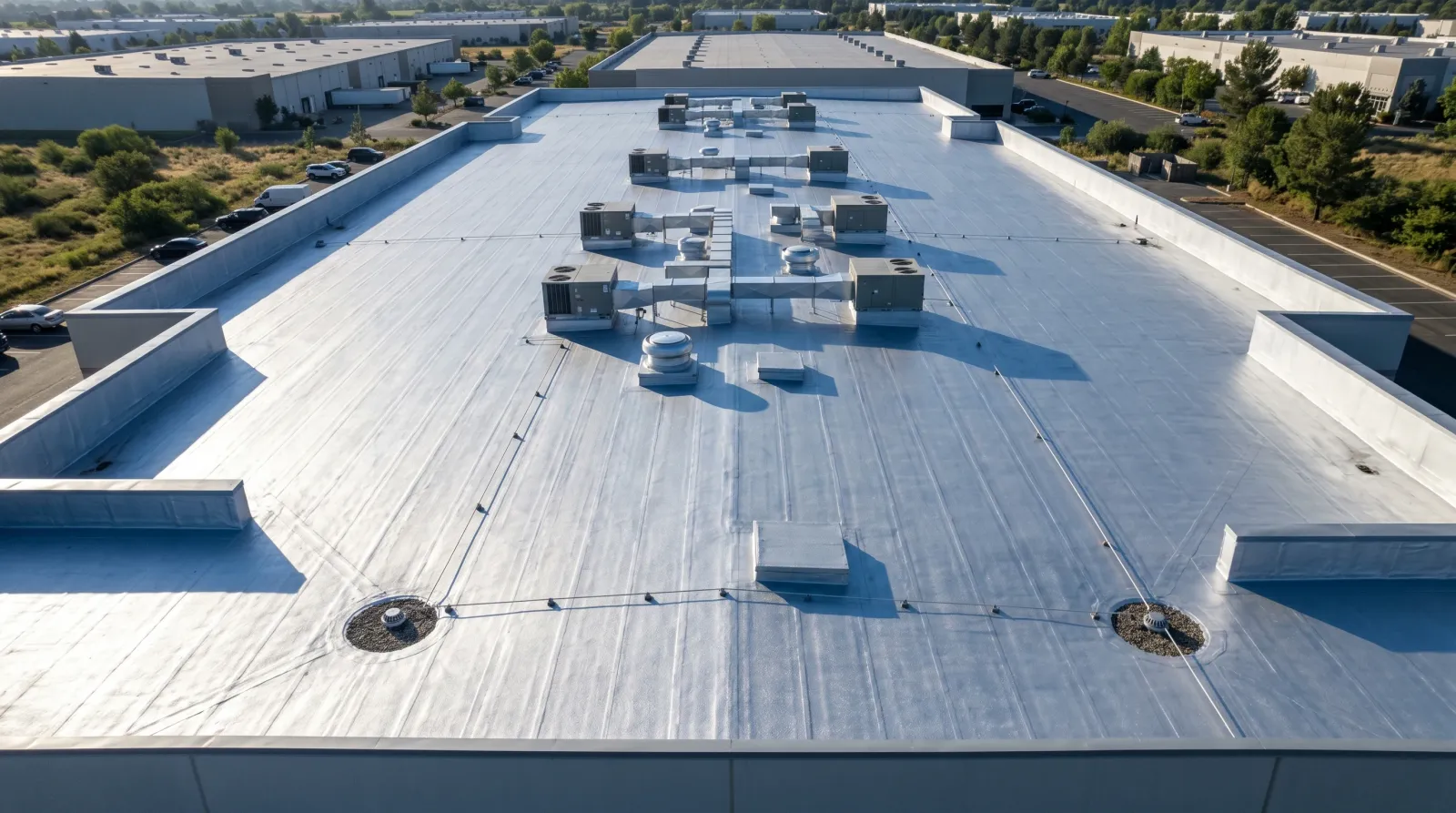
An asphalt bitumen roof coating is a liquid-applied bituminous surfacing and maintenance film for a low-slope commercial roof built on the same asphalt chemistry as the membrane underneath it. It is brushed, squeegeed, or sprayed over an aged built-up roof (BUR), a modified-bitumen cap sheet (APP or SBS), or a metal roof, and it renews the surface bitumen that ten or fifteen years of UV and weather have oxidized away. The asset is the roof of a warehouse, a manufacturing plant, a school, a strip mall, or a municipal building. These are the gravel-surfaced or smooth-surfaced asphalt roofs that have carried American commercial square footage since the 1950s.
The economic case is maintenance versus recover versus replace. A tear-off and re-roof runs $7 to $14 per square foot. An elastomeric recover system runs $2 to $5. A bituminous surfacing coat runs $0.50 to $1.50 per square foot installed and buys 3 to 10 years on a roof that is structurally sound but surface-spent. The grade matters. A plain emulsion is a sacrificial surfacing layer; an emulsion base under a reflective fibered-aluminum topcoat is a cool-roof maintenance system that also cuts the rooftop temperature driving the cooling load.
The phrase that governs the bid is “compatible chemistry.” Bitumen over bitumen is the oldest like-on-like roofing pairing there is, and that compatibility is the reason these coatings still ship by the tanker. An asphalt emulsion bonds to an aged BUR or modified-bitumen cap the way no acrylic or silicone reliably does without a bleed-blocking primer, because the asphalt in the coating and the asphalt in the membrane are the same family. The coating does not fix wet insulation, a structural deck split, or a membrane past its load-bearing life. It restores a weathered, watertight asphalt roof and resets the surface-aging clock. Service life tracks the grade: 3 to 7 years for plain emulsion, 5 to 10 years for an aluminized two-coat system, and shorter on any roof that ponds water past 48 hours.
Spec Requirements
The spec block governs the bid. Numbers move with the grade (emulsion, cutback, or aluminized), but the categories do not. A roof is a single-zone asset, so one system gets written across the deck rather than a zone matrix.
| Spec | Value |
|---|---|
| Wet film / coverage, emulsion base | 20–40 wet mils, 2–3 gal per 100 sq ft per coat; porosity and surface roughness drive the high end |
| Wet film / coverage, fibered aluminum top | 12–18 wet mils, 1.25–1.5 gal per 100 sq ft; aluminum flake content sets reflectance |
| Coverage, asphalt primer (ASTM D41) | 1 gal per 100 sq ft on porous or dusty BUR before the base coat |
| VOC | Emulsion (waterborne) <50 g/L; cutback (solvent-borne) 250–450 g/L, restricted under SCAQMD Rule 1113 and CARB; verify before a California or OTC-state bid |
| Standards | ASTM D1227 (emulsion), ASTM D2823/D2824 (fibered/non-fibered aluminum), ASTM D4479 (asbestos-free asphalt coatings), ASTM D41 (asphalt primer) |
| Cool-roof rating | CRRC-listed and ENERGY STAR values on aluminized reflective grades only; plain black emulsion carries no cool-roof listing |
| Substrate prep, BUR / modified bitumen | Power broom and low-pressure wash to remove loose gravel, chalk, and dirt; full dry; repair splits, blisters, and flashings before surfacing |
| Substrate prep, metal | Treat rust to SSPC-SP3 power-tool clean (SSPC-SP6 commercial blast on heavy corrosion); ASTM D41 asphalt primer; re-fasten and seal panel seams |
| Reinforcement | Polyester or fiberglass membrane embedded in emulsion at seams, splits, drains, curbs, and penetrations; required on any warranted re-surfacing |
| Ambient at application, emulsion | Air and substrate 50°F to 95°F; substrate ≥5°F above dew point; no rain in the cure window (24–72 hr to rain-safe) |
| Ambient at application, cutback | Down to 40°F per product; flammable solvent flash-off, no ignition sources, 1910.106 handling |
| Ponding tolerance | Limited. Emulsion re-emulsifies under standing water; route ponding roofs to silicone |
| Cure to service | Emulsion rain-safe in 24–72 hr, full cure 3–7 days; cutback rain-safe faster but full solvent cure 2–7 days |
Three numbers decide the outcome: the gallons-per-square against the published coverage rate, the dryness of the substrate before the base coat, and the dew-point and substrate-temperature window during application. Spread the emulsion too thin and it oxidizes through in two summers. Coat over a damp deck and it blisters. Apply below the dew point and the emulsion never breaks and sets.
System Chemistry Compared
Three bituminous grades carry almost every asphalt-roof maintenance spec, and one reflective topcoat sits on top of all of them. The choice is driven by VOC regulation, climate at application, and whether the roof needs a cool-roof surface before any brand name comes up. For a longer single-application service life on the same roof, the elastomeric chemistries are the step up. See the elastomeric roof coating specifier guide for the silicone and acrylic comparison.
| Chemistry / grade | Cure mechanism | Cold-weather use | VOC band | $/sq ft installed | Best for |
|---|---|---|---|---|---|
| Asphalt emulsion (waterborne) | Water evaporation | 🔴 50°F substrate floor; will not set in cold/damp | 🟢 <50 g/L | $0.50–1.00 | Low-VOC maintenance, California/OTC bids, base coat under aluminum |
| Cutback asphalt (solvent-borne) | Solvent flash-off | 🟢 Sets down to ~40°F, sheds damp better | 🔴 250–450 g/L; SCAQMD/CARB restricted | $0.65–1.20 | Cold or damp application windows, tougher film, non-restricted states |
| Fibered aluminum (asphalt + aluminum) | Solvent or water carrier | 🟡 Grade-dependent | 🟡 Solvent grades restricted; emulsion-base aluminum lower | $0.60–1.10 | Reflective topcoat, cool-roof rebate, UV protection of the asphalt below |
| SBS-modified bituminous mastic | Cure by evaporation | 🟡 Mid | 🟡 Grade-dependent | $1.00–2.00 | Flashing/detail mastic, ponding-tolerant patch, higher elongation |
Emulsion wins on VOC and cost for any positive-drainage roof coated in warm, dry weather. Cutback wins the cold-and-damp application window where emulsion will not break, at the price of solvent VOC and flammable handling. Fibered aluminum is the topcoat answer on either base, because a black asphalt surface bakes itself old and the aluminum leaf slows that. If the roof ponds water for more than 48 hours, none of these grades is the right call. That job routes to a silicone elastomeric.
Recommended Systems
Three full multi-coat stacks from real manufacturers, each built as a base plus reflective top with a primer where the substrate calls for it. Confirm the substrate-specific primer and the published coverage rate against the manufacturer’s system data before bid.
System a — Henry Emulsion + 558 Fibered Aluminum (low-VOC Cool-Roof Maintenance)
| Layer | Product | Coverage / WFT |
|---|---|---|
| Primer (porous/dusty BUR) | Henry 107 Asphalt Emulsion thinned, or ASTM D41 asphalt primer | 1 gal per 100 sq ft |
| Base / surfacing coat | Henry 107 (non-fibered) or 108 (fibered) asphalt emulsion | 20–40 wet mils, 2–3 gal/100 sq ft |
| Reflective topcoat | Henry 558 Premium Fibered Aluminum Roof Coating | 12–15 wet mils, 1.25–1.5 gal/100 sq ft |
Service life 5 to 10 years. The Henry emulsion base bonds bitumen-to-bitumen on an aged BUR or modified-bitumen cap without solvent VOC, and the 558 fibered aluminum leafs a reflective surface over it that drops rooftop temperature 40°F to 70°F against a black coat. This is the grade the spec calls for in California and OTC states where cutback is restricted. ENERGY STAR-listed aluminum for cool-roof rebate eligibility. Henry roof coatings.
System B — Karnak 220 Fibered Emulsion + 97 Fibered Aluminum (heavy-Surfacing, Asbestos-Free)
| Layer | Product | Coverage / WFT |
|---|---|---|
| Primer (metal/aged BUR) | Karnak 108 Asphalt Primer (ASTM D41) | 1 gal per 100 sq ft |
| Base / surfacing coat | Karnak 220 AF Fibered Asphalt Emulsion | 20–40 wet mils, 2–3 gal/100 sq ft |
| Reflective topcoat | Karnak 97 AF Fibered Aluminum Roof Coating | 12–18 wet mils, 1.25–1.5 gal/100 sq ft |
Service life 5 to 10 years. Karnak 220 AF is a heavily fibered, asbestos-free emulsion that builds a thicker surfacing film on a rough or gravel-surfaced BUR, and the fiber bridges hairline checking that a non-fibered emulsion would mirror through. The 97 AF aluminum top carries the reflectance and UV protection. Karnak’s asphalt line is a mainstay on industrial and municipal re-surfacing where the spec wants a documented ASTM D2824 aluminum and ASTM D1227 emulsion. Karnak product line.
System C — Black Jack / Gardner-Gibson Fibered + 5527 Premium Aluminum (budget Patch and Re-Surface)
| Layer | Product | Coverage / WFT |
|---|---|---|
| Primer (bare/porous) | Black Jack 6150 Asphalt Primer (ASTM D41) | 1 gal per 100 sq ft |
| Base / surfacing coat | Black Jack 6230 Speed-Fill / Fibered Asphalt Emulsion | 20–40 wet mils, 2–3 gal/100 sq ft |
| Reflective topcoat | Black Jack 5527 Premium Fibered Aluminum Roof Coating | 12–15 wet mils, 1.25–1.5 gal/100 sq ft |
Service life 3 to 7 years. The Black Jack line (Gardner-Gibson, distributed through Rust-Oleum’s retail and home-center channels) lands at the lowest installed cost of the three and is the practical choice for small-scope patch-and-re-surface work that a facility crew or a local contractor runs out of 5-gallon pails. It is sold widely at home centers, so material is easy to stock for between-cycle maintenance. For the brand’s broader industrial line, see the Rust-Oleum brand review. Black Jack roof products.
Systems Compared
| System | Build | $/sq ft installed | Service life | Best for |
|---|---|---|---|---|
| A: Henry emulsion + 558 aluminum | Primer + emulsion + fibered aluminum | $0.70–1.40 | 5–10 years | Low-VOC cool-roof maintenance, CA/OTC bids |
| B: Karnak 220 AF + 97 aluminum | Primer + fibered emulsion + aluminum | $0.80–1.50 | 5–10 years | Rough/gravel BUR, heavy fibered surfacing, municipal spec |
| C: Black Jack 6230 + 5527 aluminum | Primer + emulsion + fibered aluminum | $0.50–1.10 | 3–7 years | Budget patch-and-re-surface, in-house crews, home-center stocking |
Pricing assumes a 20,000+ sq ft scope on a substrate in restorable condition, two-coat build with detail reinforcement. Heavy prep (gravel removal, split and flashing repair, wet-insulation replacement) adds $0.30 to $1.50 per square foot and is the line item most often underbid on a tired BUR. Run the numbers over the service-life horizon before choosing the grade. A bituminous re-surface at $1.00 per square foot delivering 7 years costs about $0.14 per square foot per year, against a silicone elastomeric restoration near $4.00 delivering 18 years at about $0.22 per square foot per year. The bitumen system wins on near-term cash and on like-on-like compatibility; the elastomeric wins on cost-per-year over a long horizon and on ponding tolerance. The right call depends on how many capital cycles the building owner needs to bridge.
Application and Contractor Path
A bituminous re-surfacing is the most facility-crew-accessible of the commercial roof coatings, and that accessibility is exactly where it gets specified wrong. Small patch, flashing, and re-surface scopes on a sound, accessible low-slope roof are within reach of a trained maintenance crew, provided OSHA 1910.28 fall protection is in place at the edge and around openings, the substrate is dry and broomed clean, and any cutback solvent grade is handled with no ignition sources under 1910.106. That covers the keep-it-watertight-between-capital-cycles work most facilities actually need from this category.
A full re-surfacing carrying a manufacturer system warranty is a different scope. The warranty attaches to a gallons-per-square coverage log, embedded reinforcement at every detail, repaired flashings, and a documented dry substrate. Spec a contractor with one of the following:
- Manufacturer-recognized applicator status on the specific product line (Henry, Karnak, or Gardner-Gibson contractor program). Recognition is what unlocks the system warranty tier.
- A current state roofing or general contractor license carrying the workers-comp and liability coverage for rooftop work.
- A documented OSHA 1910.28 / 1926.501 fall-protection program for crews working at the roof edge, around skylights, and at openings.
Three contractor-qualifying questions before signing:
- What is the gallons-per-square target per coat, and how is coverage logged during application? Spreading emulsion thin to stretch material across more square footage is the single most common cause of premature oxidation and warranty denial. A wet-mil gauge and a per-section coverage log are the answer.
- How is the substrate being dried and verified before the base coat? Bituminous emulsion over a damp deck blisters in the first hot season. A moisture survey and a confirmed dry substrate belong in the bid, not the field.
- Is this an emulsion or cutback grade, and does it clear the VOC rule for this jurisdiction? On a California or OTC-state job the answer has to be a sub-50 g/L emulsion. A contractor who reaches for cutback on a restricted job exposes the owner to a code violation.
Every major manufacturer on this list runs a free pre-bid roof survey through the rep or distributor network: substrate condition, drainage, detail repair scope, and the recommended grade. Use it. Catching wet insulation or an open flashing at the survey stage costs a core sample; catching it after the coating blisters costs the re-surface twice.
Failure Modes
Five failures cover the bulk of premature bituminous-roof rejections and re-coat calls.
- Coating over trapped moisture. Cause: emulsion applied over wet insulation or a damp deck. Solar heat drives the vapor up through the curing film and lifts it into blisters within the first hot season. Prevention: an infrared or capacitance moisture survey before bid; core and replace any wet insulation; verify a dry substrate before the base coat. The mechanics are the same on a roof as on a wall. See why coatings blister over moisture and how to prevent it.
- Under-application below the coverage rate. Cause: the crew spread the emulsion thin to cover more square footage. The film oxidizes, chalks, and cracks through years early. Prevention: gallons-per-square target written into the contract; wet-mil gauge logged per section; manufacturer field verification on warranted work.
- No reflective topcoat on a black emulsion. Cause: the base emulsion was left as the finish surface to save a coat. The black asphalt bakes at 150°F to 190°F, oxidizes fast, and chalks within two to three summers. Prevention: a fibered-aluminum topcoat on any roof meant to last past five years, which also unlocks the cool-roof reflectance and rebate.
- Emulsion over ponding water. Cause: a waterborne emulsion spec’d on a roof that ponds. The film re-emulsifies, softens, and washes thin at the low spots. Prevention: route any roof with standing-water history to a silicone elastomeric; correct drainage where the budget allows; never write emulsion on a roof that holds water past 48 hours.
- Application below the dew point or on a dirty substrate. Cause: spraying onto a substrate within 5°F of the dew point, or over loose gravel, chalk, and dirt that was never broomed and washed. The emulsion never breaks and sets, or it bonds to dust instead of the membrane and delaminates. Prevention: power broom, low-pressure wash, and full dry; sling psychrometer in use during application; substrate temperature held 5°F above the dew point through the cure window.
Trapped moisture and under-application account for most of the field failures I review on bituminous roofs. Both are caught in the pre-construction survey and the coverage log. Neither is a field improvisation.
Where to Buy / Spec
| Channel | Best for | Path |
|---|---|---|
| Henry / distributor | Low-VOC emulsion cool-roof maintenance; CA/OTC compliant spec | Henry roof coatings |
| Karnak rep / distributor | Heavy fibered emulsion and aluminum on rough BUR; municipal and industrial spec | Karnak product line |
| Gardner-Gibson / Black Jack (home center, Rust-Oleum channel) | Budget patch and re-surface; 5-gal pails for in-house maintenance | Black Jack roof products |
| Amazon Business / distributor | Repair-scope material, fibered cement and flashing mastic, fleet stocking | Business account with project pricing |
Manufacturer-direct or distributor through a recognized applicator is the recommended channel on any warranted re-surfacing above 5,000 sq ft. The rep network bundles the moisture survey, the substrate assessment, and the grade recommendation against the jurisdiction’s VOC rule. Those services carry the warranty; a retail discount on the pail does not. For small in-house patch work, the home-center channel and a business account on 5-gallon pails are the practical path.
FAQ
See the frontmatter for the full Q&A: emulsion versus cutback, coating over an active leak, the black-roof heat problem and the aluminized fix, the contractor requirement, and how long the grade lasts.