Aluminum Roof Coating: Reflective Specifier's Guide (2026)
Fibered and non-fibered aluminum roof coating compared by DFT, reflectivity, and substrate. ASTM D2824, dry mils, metal roof and BUR prep, and the contractor path.

Disclosure: Affiliate links to retailers and manufacturer-direct programs. Recommendations are spec-driven, not commission-driven.
Use Case
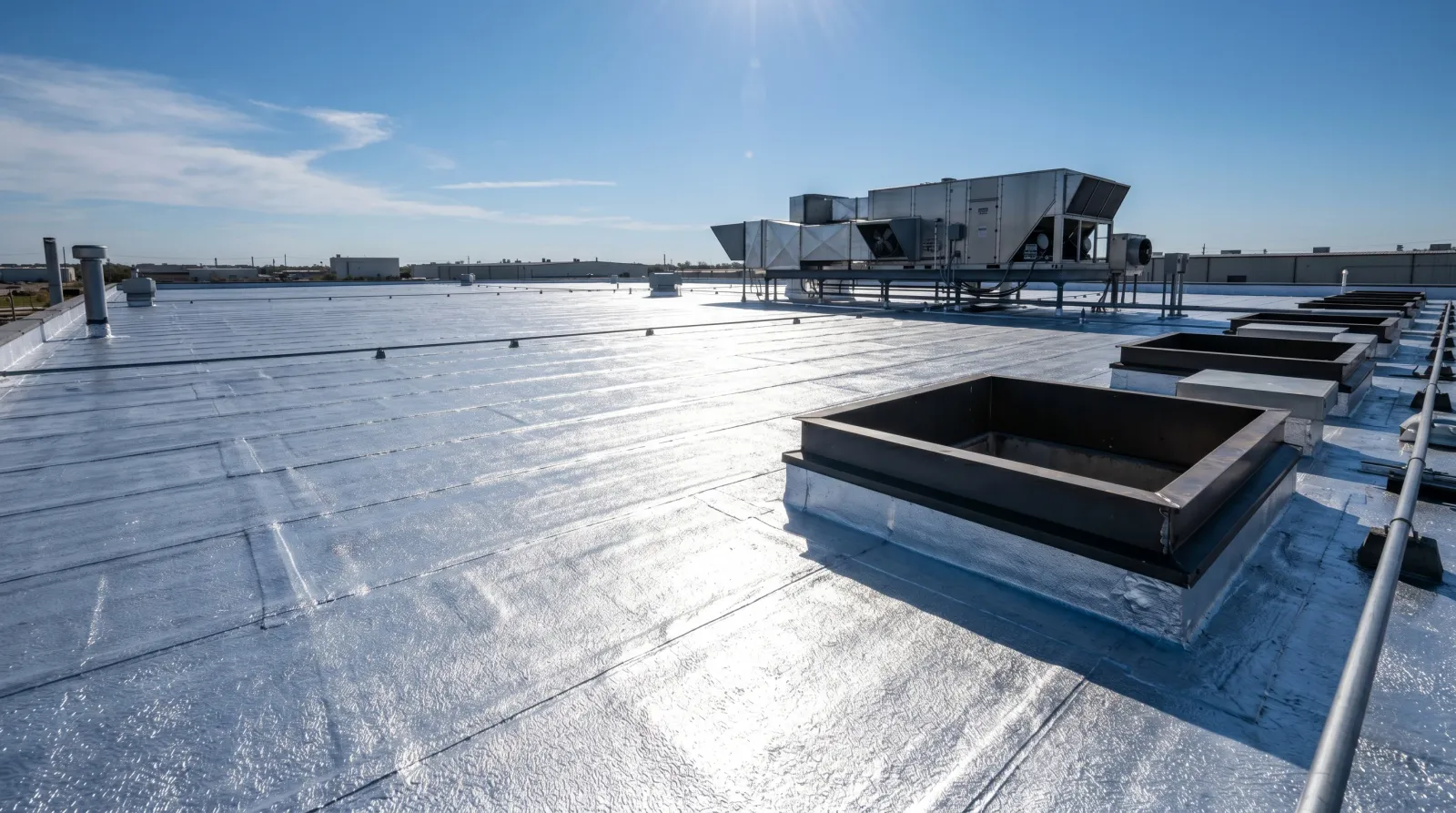
Aluminum roof coating is the reflective maintenance coat specified to extend the service life of an aging low-slope roof and knock down its surface temperature. The asset is almost always a built-up roof (BUR), a modified-bitumen membrane, or a metal roof on a commercial, light-industrial, or institutional building. The chemistry is leafing aluminum flake suspended in an asphalt cutback (fibered or non-fibered) or, in the waterborne grades, in an acrylic emulsion. The aluminum flake orients flat near the surface as the solvent or water flashes off, forming a reflective metallic skin that bounces solar radiation and shields the asphalt beneath from the UV that drives it brittle.
The spec gets written for a roof that still has years of membrane left but is starting to dry out, chalk, and run hot. A 15-year-old BUR on a distribution center bakes at 160 to 180°F on a July afternoon; the asphalt oxidizes, alligators, and the building’s cooling load climbs. A reflective aluminum coat drops that surface temperature, slows the oxidation, and buys the owner three to five more years before a re-coat or a tear-off. On a galvanized or Galvalume standing-seam metal roof, the same coating seals lap joints and fastener heads against the rust that starts at every penetration.
Service life runs 3 to 5 years for fibered asphalt-aluminum in a high-UV climate, 5 to 7 years in a mild climate or on a shaded slope, and 7 to 10 years for a waterborne aluminized acrylic restoration system applied at full mil build. None of these is a roof in its own right. The coating is a sacrificial, periodically renewed maintenance layer over a sound membrane. Coat a roof that is already leaking and the coating fails with the roof. The first decision in the spec is not the product; it is whether the roof underneath earns a coating at all.
Spec Requirements
The spec block, before product names. Aluminum roof coatings split into two families that share a look but not a data sheet: solvent-borne fibered asphalt-aluminum (ASTM D2824) and waterborne aluminized acrylic (ASTM D6083). The numbers below cover both; read the per-coat rate against the family you are specifying.
| Spec | Value |
|---|---|
| Dry film thickness (DFT) — fibered asphalt-aluminum | 1.0–1.5 mils dry per coat; 2.0–3.0 mils dry total at two coats |
| Dry film thickness — waterborne aluminized acrylic | 10–12 mils dry per coat; 20–24 mils dry total at the restoration build |
| Coverage @ spec’d rate | 1.0–1.5 gal per 100 sq ft per coat (fibered); 1.0–1.5 gal per 100 sq ft (acrylic base/top) |
| VOC | <400 g/L asphalt-cutback fibered; restricted to <250 g/L under SCAQMD Rule 1113 and OTC states; <100 g/L waterborne acrylic |
| Standards | ASTM D2824 (asphalt-aluminum), ASTM D6083 (acrylic), ASTM C1549 (solar reflectance), ASTM E1980 (SRI), ASTM D2370 (elongation) |
| Solar reflectance (fresh) | 0.40–0.55 fibered asphalt-aluminum; 0.60–0.75 waterborne aluminized acrylic |
| Substrate prep — aged BUR / mod-bit | Power-wash; cure and prime asphalt bleed with emulsion or asphalt primer; repair seams and blisters before coating |
| Substrate prep — metal | SSPC-SP2 hand-tool or SSPC-SP3 power-tool clean of rust; rust-inhibitive primer; seal laps and fasteners |
| Service temp (cured film) | -20°F to 180°F roof surface; the film must stay flexible through freeze-thaw and the daily thermal cycle |
| Ambient at application | 50°F to 95°F, rising; substrate dry; no rain for 24–48 hours (fibered) or per acrylic data sheet |
| Humidity / dew point ceiling | RH below 85%; substrate temperature at least 5°F above dew point through cure |
| Cure to rain-fast | 8–24 hours fibered asphalt-aluminum; 2–8 hours waterborne acrylic at 75°F, 50% RH |
| Re-coat cycle | 3–5 years fibered; 7–10 years waterborne acrylic restoration build |
Three numbers decide whether the coating holds. The first is substrate moisture: a wet or ponding roof blisters any coating, and no aluminum film fixes wet insulation. The second is the VOC ceiling for the jurisdiction, because the solvent-cutback fibered grades that contractors reach for by habit are restricted in California and the Northeast. The third is the asphalt-bleed window: coat a BUR that is still bleeding and the bitumen migrates through the aluminum and stains it brown within weeks.
The reflectance numbers carry a caveat. Fibered asphalt-aluminum at 0.40 to 0.55 fresh reads cool on day one and weathers down as the leafing flake oxidizes and asphalt bleeds through. For a documented cool-roof claim (a CRRC rating, ENERGY STAR, or California Title 24), the three-year aged reflectance is what counts, and only the waterborne aluminized acrylics and white acrylics carry those listings. A metallic look is not a cool-roof rating.
System Chemistry Compared
Two chemistries cover the aluminum-roof spec, and a third (white acrylic) competes for the same job when reflectance is the priority over asphalt compatibility.
| Chemistry | Cure to rain-fast | Re-coat cycle | Service temp | UV / weathering | $/sq ft installed | Best for |
|---|---|---|---|---|---|---|
| Fibered asphalt-aluminum (solvent) | 8–24 hr | 3–5 yr | -20°F to 180°F | Moderate; chalks and bleeds over time | $0.15–0.45 | Aged BUR and mod-bit, metal roofs, asphalt-compatible maintenance |
| Waterborne aluminized acrylic | 2–8 hr | 7–10 yr | -20°F to 200°F | Good; holds reflectance longer | $0.60–1.40 | Cool-roof restoration, CRRC/Title 24, low-VOC jurisdictions |
| White acrylic elastomeric (reference) | 2–8 hr | 7–12 yr | -40°F to 200°F | Best reflectance retention | $0.70–1.60 | Maximum SRI, full restoration over single-ply or mod-bit |
Fibered asphalt-aluminum is the right answer when the roof is an asphalt-based BUR or mod-bit and the goal is asphalt-compatible UV protection at the lowest installed cost. The asphalt carrier bonds to the asphalt roof the way like bonds to like. Waterborne aluminized acrylic is the answer when the jurisdiction caps VOC, when the owner wants a documented cool-roof rebate, or when the longer re-coat cycle pencils out over a service-life horizon. White acrylic elastomeric beats both on reflectance retention and is the move when SRI is the whole point, but it is a different look and a different bond chemistry over asphalt. Match the carrier to the roof, then the reflectance target to the budget.
Recommended Systems
Three full systems at different price-performance points. Two are fibered asphalt-aluminum maintenance coatings (Henry, Karnak) for asphalt-based roofs at the lowest installed cost. The third is a waterborne aluminized acrylic restoration system (Gaco) for cool-roof and low-VOC work. Verify the current data sheet and the jurisdiction’s VOC ceiling before bid; the solvent grades are restricted in California and the OTC states.
System a: Henry 587 Premium Fibered Aluminum (asphalt-Based Maintenance)
| Layer | Product | DFT |
|---|---|---|
| Surface prep / primer | Henry 107 Asphalt Emulsion or 208R fibered base over weathered BUR; Henry 553 metal primer on rust | — |
| Aluminum coat 1 | Henry 587 Premium Fibered Aluminum | 1.0–1.5 mils dry (1.0–1.25 gal/100 sq ft) |
| Aluminum coat 2 (cross-direction) | Henry 587 Premium Fibered Aluminum | 1.0–1.5 mils dry |
| Total | 2.0–3.0 mils dry |
Service life 3–5 years over sound BUR or mod-bit in a high-UV climate. Henry 587 is the contractor-default fibered aluminum, carried at every commercial roofing supply house, and the asbestos-free fiber reinforcement bridges hairline cracks the way a non-fibered coating won’t. Two coats applied in cross directions (first north-south, second east-west) is the spec; a single heavy coat leafs unevenly and reads streaky. Henry 587 product page · Search on Amazon.
System B: Karnak 298 Fibered Aluminum (asphalt-Based, Heavy Build)
| Layer | Product | DFT |
|---|---|---|
| Surface prep / primer | Karnak 100 Asphalt Primer on bare BUR/mod-bit; Karnak 502 rust-inhibitive primer on metal | — |
| Aluminum coat 1 | Karnak 298 Fibered Aluminum | 1.0–1.5 mils dry (1.25–1.5 gal/100 sq ft) |
| Aluminum coat 2 (cross-direction) | Karnak 298 Fibered Aluminum | 1.0–1.5 mils dry |
| Total | 2.0–3.0 mils dry |
Service life 3–5 years. Karnak 298 carries a heavier fiber load and a higher application rate than the Henry, which is the trade-off: more body and crack-bridging on an alligatored BUR, more gallons per square. Karnak’s rust-inhibitive 502 primer pairs cleanly on a metal roof where the 298 doubles as a fastener and lap-seam sealer. Specify Karnak when the roof is rough and needs the extra build to fill the texture. Karnak 298 product page · Search on Amazon.
System C: Gaco Aluminized Acrylic Reflective (cool-Roof Restoration)
| Layer | Product | DFT |
|---|---|---|
| Surface prep / primer | Power-wash, rinse, dry; Gaco acrylic primer; rust-inhibitive primer on bare metal | — |
| Reflective base coat | GacoFlex waterborne acrylic aluminized base | 10–12 mils dry (1.0–1.5 gal/100 sq ft) |
| Reflective topcoat | GacoFlex waterborne acrylic aluminized topcoat | 10–12 mils dry |
| Total | 20–24 mils dry |
Service life 7–10 years. This is the cool-roof answer: a waterborne acrylic ships under 100 g/L VOC, qualifies in SCAQMD and Title 24 jurisdictions, and holds reflectance far longer than a solvent fibered grade because the acrylic binder doesn’t bleed asphalt through the film. The mil build is an order of magnitude higher than the fibered grades because this is a restoration membrane, not a thin maintenance coat. Specify it when the roof needs a true re-cover and the owner wants the longer cycle and the documented rebate. Gaco product line · Search on Amazon.
Systems Compared
| System | Total DFT | $/sq ft installed | Service life | Best for |
|---|---|---|---|---|
| A — Henry 587 Fibered Aluminum | 2.0–3.0 mils | $0.20–0.45 | 3–5 years | Sound BUR / mod-bit, default asphalt maintenance |
| B — Karnak 298 Fibered Aluminum | 2.0–3.0 mils | $0.25–0.50 | 3–5 years | Rough alligatored BUR, metal roof seal, heavy build |
| C — Gaco Aluminized Acrylic | 20–24 mils | $0.90–1.60 | 7–10 years | Cool-roof restoration, CRRC/Title 24, low-VOC |
Pricing assumes a 10,000+ sq ft accessible low-slope roof through a commercial roofing contractor with prep included. Small or cut-up roofs with heavy penetration density run higher per square foot. The total cost over a service-life horizon is the number that matters: two fibered re-coats across ten years can land near a single acrylic restoration on material, but the acrylic carries the reflectance, the warranty, and the rebate. Run the math on the building’s full hold period, not on the first application.
Application and Contractor Path
Fibered aluminum on a small, accessible, sound low-slope roof is within reach of a trained in-house facilities crew. It rolls and brushes like a heavy paint, the tools are cheap, and the failure modes are forgiving on a maintenance coat. Two conditions gate that: the crew must work under OSHA 1926.501 fall protection for any roof work, and the substrate must already be sound. A crew can roll aluminum; a crew cannot diagnose a wet roof, and that is where in-house jobs go wrong.
For a full re-coat over an aged BUR or mod-bit roof, spec a contractor. The reason is prep, not application. A commercial roofing contractor brings the moisture survey (infrared scan or capacitance meter) that finds wet insulation no coating will fix, the seam and blister repair that has to happen before the aluminum coat, and the manufacturer relationship that backs the installed warranty. On a metal roof, the prep is the job: rust treatment to SSPC-SP2 or SP3, fastener replacement, lap-seam sealing, and rust-inhibitive priming come before a drop of aluminum touches the panel.
Specify a contractor with one or more of the following:
- Manufacturer approval on the specific product line (Henry, Karnak, or Gaco/Holcim approved applicator) where an installed warranty is required.
- An NRCA-member commercial roofing firm with documented low-slope restoration experience, not a general painting crew.
- A current OSHA fall-protection program and proof of $2M aggregate general liability.
Three contractor-qualifying questions before signing. First, what is the moisture-survey result, and what is the repair scope before coating? A bid that skips the moisture survey is bidding a coating over an unknown roof. Second, two cross-direction coats or one? A single-coat aluminum bid is underspec’d and will read streaky and weather fast. Third, who carries the installed warranty, the manufacturer or the contractor? On a maintenance fibered coat the answer is often “neither beyond the can,” and that is acceptable if the owner understands the coating is a 3-to-5-year sacrificial layer. The manufacturer rep network on all three lines includes a free roof assessment and a written re-coat schedule. Use it; catching a wet-insulation problem before the coating goes down saves the whole job.
Failure Modes & How to Prevent Them
Five failures cover most premature aluminum-roof-coating rejections.
- Blistering over trapped moisture. Cause: the coating was applied over a wet membrane, ponding water, or wet insulation, and solar heat drove the moisture up under the film. Prevention: an infrared or capacitance moisture survey before coating; full cure and dry-down of the roof; positive drainage corrected before the coat goes down. No aluminum film bridges a wet roof.
- Asphalt bleed-through staining. Cause: a fresh or still-bleeding BUR or mod-bit was coated before the bitumen stabilized, and the asphalt migrated up through the aluminum and stained it brown. Prevention: an emulsion or asphalt primer (Henry 107, Karnak 100) over bleed-prone surfaces; a cure window on new asphalt; a non-bleeding waterborne acrylic where bleed risk is high.
- Streaky, uneven leafing. Cause: a single heavy coat applied in one direction, or application in wind that disturbed the flake before the solvent flashed. Prevention: two coats in cross directions at the spec’d rate; application below 15 mph wind; even roller or spray passes with consistent overlap.
- Rust bleed and lap-seam failure on metal. Cause: rust was coated over instead of treated, or lap joints and fastener heads were left unsealed, and the corrosion continued under the film. Prevention: SSPC-SP2/SP3 rust removal; rust-inhibitive primer (Henry 553, Karnak 502); fastener replacement and lap-seam sealing before the aluminum coat.
- Early chalking and reflectance loss. Cause: a fibered solvent coating in a high-UV climate weathered and oxidized faster than the re-coat budget assumed, and the owner expected a cool roof that didn’t last. Prevention: set the re-coat cycle at 3–5 years in the maintenance budget; spec a waterborne aluminized acrylic where reflectance retention and a CRRC rating are the requirement. See the chalking diagnosis and fix for the field test that distinguishes normal weathering chalk from a coating failure.
Wet-roof blistering is the failure I see most on aluminum re-coats, and it is the most preventable. The moisture survey is cheap; the re-coat over a wet roof is a total loss. Asphalt bleed is the second, and it is a sequencing error: the primer and the cure window solve it every time.
Where to Buy / Spec
| Channel | Best for | Path |
|---|---|---|
| Manufacturer-direct (Henry, Karnak, Gaco/Holcim rep) | Spec’d restoration projects, installed warranty, roof assessment | Henry roof coatings · Karnak · Gaco |
| Commercial roofing distributor (ABC Supply, Beacon, SRS) | Bulk 5-gal pails, fiber, primer, contractor accounts | Distributor account with project pricing |
| Amazon Business | Small-area maintenance, fleet stocking, in-house crews | Search aluminum roof coating |
| Pro retail (home center pro desk, paint store) | Local 5-gal pickup, single-roof touch-up | Local pickup at contractor pricing |
Manufacturer-direct is the recommended channel on any full re-coat above 5,000 sq ft. The rep brings the roof assessment, the moisture-survey referral, and the written re-coat schedule, and those services are worth more than any per-pail discount. Amazon Business and the pro desk are the right channels for in-house maintenance crews coating a small, sound roof on a documented cycle.
FAQ
See the frontmatter for the full Q&A; the same questions a facility buyer asks before signing are answered there: contractor-required, warranty, substrate moisture, cool-roof rebate, and re-coat cycle.