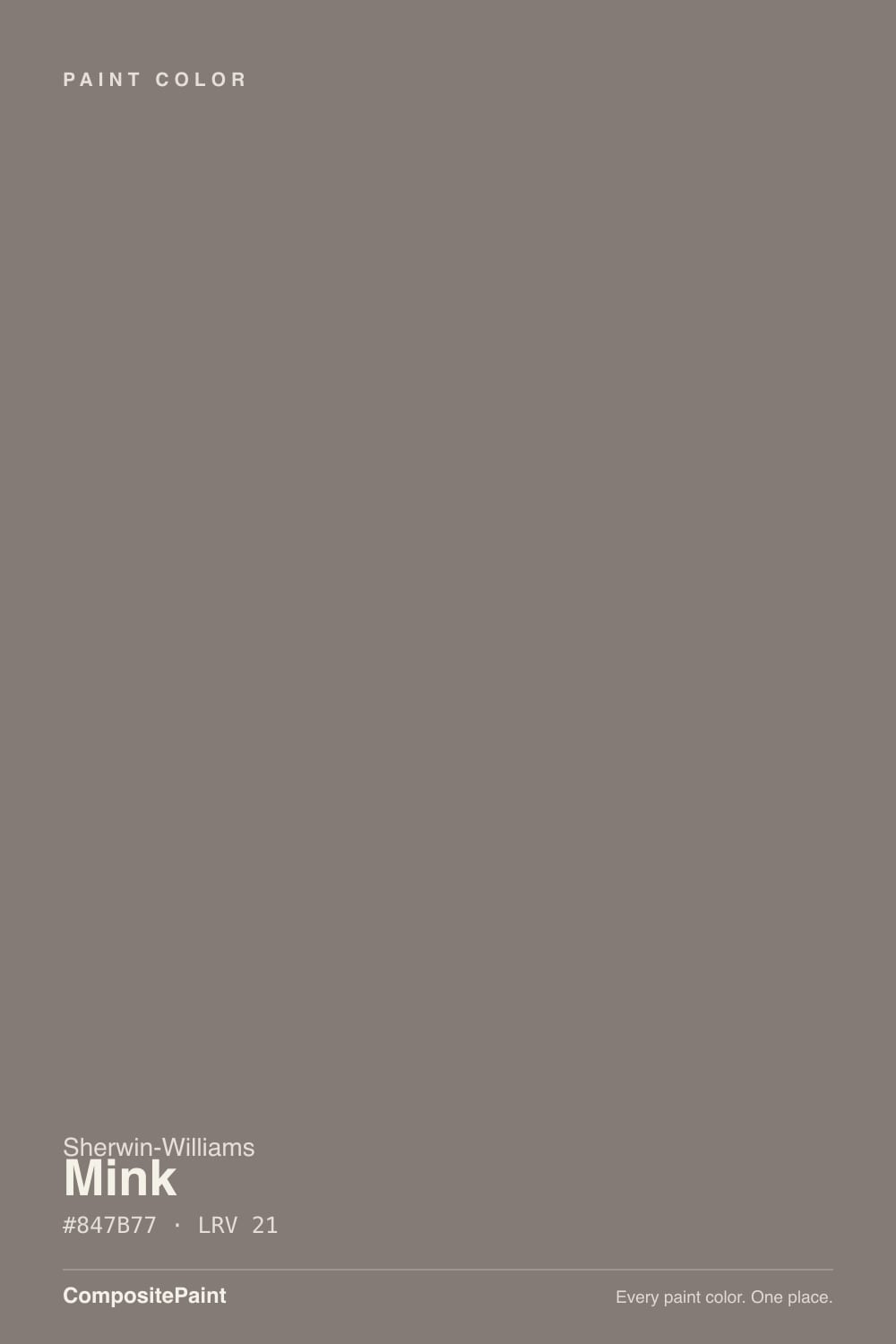
Mink
SW 6004 · #847B77 · LRV 21 — warm red tone, dark — high drama, needs strong daylight or warm bulbs.
- 1Black Fox7
- 2Pewter Green12
- 3Mink21
- 4Stardew43
- 5Quietude48
What Color Is Mink, Really?
Mink SW 6004 is a dark warm gray. Its hex value is #847B77 and its LRV is 21, which sits near the bottom of the mid-tone range. At that lightness the color carries real weight on a wall: it reads as a soft charcoal rather than a pale gray, and it will visibly drop the light level in a room. The hue measures 18 degrees with only 5 percent saturation, so a warm red-brown thread runs through it without ever becoming an obvious brown.
People pick Mink when they want a deep gray that does not feel cold. Most grays this dark pull blue or green and can make a room feel like a basement. The warm red base keeps Mink closer to taupe, so it stays comfortable next to wood, leather, and warm whites. That is why it turns up on dining rooms, offices, islands, cabinetry, and exterior bodies where a flat charcoal would look severe.
The thing to check before committing is light. An LRV of 21 reflects only about a fifth of what hits it, so in a north-facing or window-poor room Mink can go flat and muddy. The second catch is the red undertone. Next to a true neutral gray it can suddenly read mauve or purple-brown. Sample it on two walls and look at it after dark under your own bulbs.
Mink is built on a warm red base. The hue reads at 18 degrees, which sits between red and orange, but the saturation is only 5 percent, so the paint behaves like a gray with a warm thread rather than a brown. On a small chip it usually just looks dark gray. Spread across a wall, the warmth becomes clear.
What it sits next to decides which side shows. Against a cool blue-gray, Mink looks distinctly mauve or taupe. Against a beige or a tan, the same paint flips and reads as a plain gray. Against warm oak and brass it settles into a quiet brown-gray that feels deliberate.
Before you commit, hold a sample against your floors, your counters, and your trim white at the same time. The red lean is subtle enough that the surrounding materials, not the paint itself, usually decide whether people call Mink a gray, a taupe, or a purple.
Best Rooms and Uses for Mink
Mink suits rooms where depth is the point. Dining rooms, home offices, bedrooms, and libraries take it well, since those spaces get used in the evening and benefit from the enclosure a dark wall gives. In a full room an LRV of 21 will noticeably lower the light level, so it works best where the windows are decent or lamplight is part of the plan.
On millwork it is easier to live with. Kitchen islands, lower cabinets, built-ins, and interior doors gain real weight from Mink while the walls around them stay light. The warm base keeps painted cabinetry from looking industrial.
Outdoors it works as a body color on a house with warm stone or wood, and it is a solid shutter, garage door, or front door color against a lighter body. Skip it on ceilings in low rooms and in small windowless baths, where the low reflectance has nothing to bounce off.
How Lighting Changes Mink
At LRV 21, Mink reflects only a small share of the light that reaches it, so the room does most of the work. In north-facing rooms the cool, flat daylight cancels some of the red warmth and Mink reads as a heavier, more neutral charcoal. It can feel closed in there unless the windows are generous.
South-facing rooms are the easy case. Strong warm light lifts the color and lets the red-brown base show, which keeps it from going grim. East rooms look warmest in the morning and settle grayer by afternoon. West rooms do the opposite and glow late in the day.
Bulbs matter more than usual at this depth. Warm 2700K lamps push Mink toward taupe and make it cozy. Cooler 4000K bulbs strip the warmth out and can leave it looking cold and faintly purple. Look at your sample at night as well as at noon, because a dark color spends most of its life under artificial light.
Most complaints about Mink are a light mismatch. Upload a photo of your actual room and see it on your walls — then ask for the same wall in north light or evening lamps before you buy a single sample.
Need It From Another Brand?
Any paint counter can custom-tint Sherwin-Williams SW 6004 directly. If you would rather stay in one brand's own deck, these are the closest stock matches, measured as ΔE2000. Under 2 is a difference you will not see on the wall.
| Brand | Closest color | ΔE | LRV | |
|---|---|---|---|---|
| Behr | Complex GrayN140-5 · Behr | 1.2 | 20 | Color page → |
| Benjamin Moore | GraniteAF-660 · Benjamin Moore | 2.1 | 21 | Color page → |
| Valspar | Mountain Smoke6004-2B · Valspar | 3.7 | 20.2 | Color page → |
| PPG / Glidden | Cool CharcoalPPG1007-6 · PPG / Glidden | 1.6 | 20 | Color page → |
| Glidden | Cool CharcoalPPG1007-6 · Glidden | 2.4 | 20 | Color page → |
| Dutch Boy | Weathered Plum403-5DB · Dutch Boy | 2.7 | 20 | Color page → |
Similar Sherwin-Williams Colors
The nearest shades to Mink within Sherwin-Williams's own range, ranked by perceptual color distance — useful when you want the same look a touch lighter, darker, or warmer.
WCAG 2.1: AA is 4.5 : 1 for normal text, 3 : 1 for large text, AAA is 7 : 1.
Mink vs Similar Colors
Chinchilla SW 6011 is the closest Sherwin-Williams neighbor at LRV 20 and hex #867875, a shade darker and a touch more purple. Renwick Heather SW 2818 shares the LRV of 21 but at #8B7D7B reads more openly mauve. Attitude Gray SW 7060 at LRV 20 and #7C7D75 goes the other way, trading the red for a green-gray cast that looks clearly cooler on a wall.
Across brands, Benjamin Moore Granite AF-660 at LRV 21 and hex #827D7B is a delta E of 2.1 from Mink. That is very close, but sample first, since Granite runs a hair cooler. Behr Greyhound PPU24-21 at LRV 20 sits at 2.93, in the same bracket.
Farrow and Ball Mole's Breath No. 276 at LRV 23 and #87847F is 4.53 away, close but visibly different side by side. It reads lighter and less red than Mink.
Colors That Go With Mink
Mink needs a clean white above and around it. Trim, ceiling, and casing in a bright white give the eye somewhere to rest and make the depth look deliberate. A creamy white softens the contrast if you want the room quieter. Either approach works, but keep the trim clearly lighter, because a mid-tone trim next to LRV 21 muddies both surfaces.
For tonal layering across a hall or an adjoining room, the Sherwin-Williams neighbors sit at almost the same depth. Backdrop SW 7025 at LRV 20 is the browner version of the same idea. Sensuous Gray SW 7081 at LRV 21 runs cooler and more violet. Going Grey SW 9554 at LRV 22 leans slightly green. One room apart they read as related rather than repeated.
Materials finish the scheme. Warm oak, walnut, unlacquered brass, aged bronze, and leather all flatter the red base. Polished chrome and stark blue-white marble fight it.
Coordinated palette
Generated by hue-rotating #847B77 in HSL space. Pair Mink with one accent and one neutral — the swatches below are starting points, not final picks.
Mink FAQ
Is Mink warm or gray?
It is both. Mink SW 6004 is a gray at heart, but it is built on a warm red base at hue 18 with only 5 percent saturation. That gives it a taupe lean rather than the blue or green cast most deep grays carry. Next to a cooler gray the warmth shows plainly; next to a beige it can look like a straight neutral.
What LRV is Mink?
Mink has an LRV of 21. Light reflectance value runs from 0 for black to 100 for pure white, so at 21 the color reflects only about a fifth of the light that lands on it. That makes it a genuinely dark wall color, with presence and enclosure, and it means the room will feel noticeably dimmer than it does in a mid-tone.
Does Mink look purple?
It can, in the right company. The undertone is a warm red at hue 18, and when Mink sits beside a true neutral or a blue-leaning gray, that red can tip toward mauve or purple-brown. Beside beige, wood, or brass it settles back into taupe. Cool 4000K bulbs make the purple more likely, so test under your own lighting.
Does Mink work in a dark room?
Only if you accept the room getting darker. At LRV 21 Mink gives very little light back, so in a north-facing or window-poor space it can go flat and muddy during the day. It can still work if you lean into it and treat the room as a cozy evening space with good lamps, but it will not brighten anything.
What white trim goes with Mink?
A clearly lighter white in either direction works. A bright, clean white gives crisp contrast against the LRV 21 body and makes the depth look intentional. A warm creamy white softens the edge and plays to Mink's red base. What to avoid is an off-white close to mid-tone, since low contrast against a dark wall makes both look dull.
Is Mink good for exteriors and cabinets?
Yes to both, with the same caveat. On cabinets, islands, and built-ins the warm red base keeps painted millwork from looking industrial the way a cold charcoal can. Outdoors it holds up as a body color alongside warm stone or wood, and it makes a strong shutter, garage door, or front door against a lighter body. Just remember that LRV 21 absorbs heat and light.
Have you painted with Mink?
Rate it — one tap helps the next reader decide.
Ask a Question