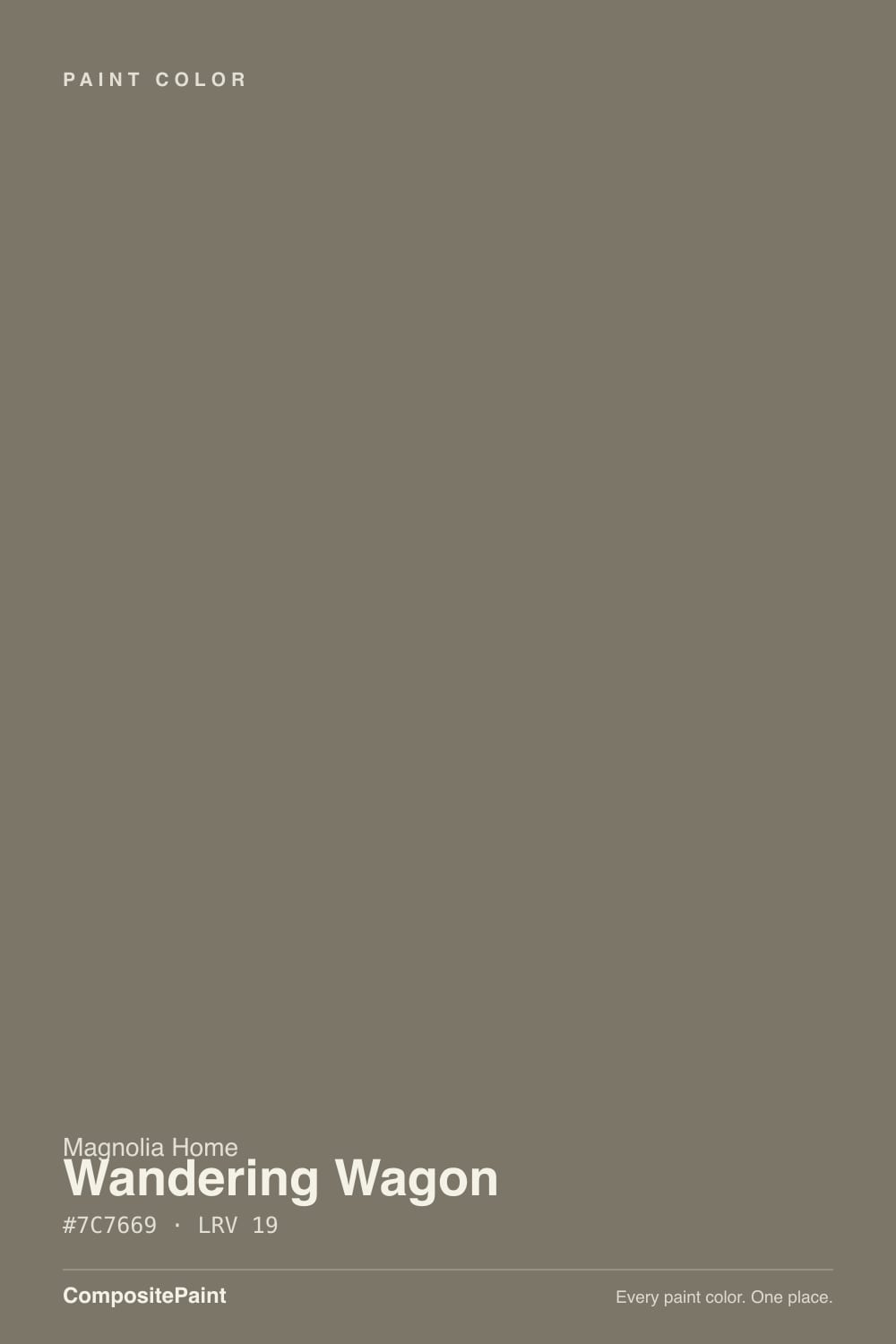
Color spec
| Brand | Magnolia Home |
| Name | Wandering Wagon |
| SKU | JG-071 |
| Hex | #7C7669 |
| RGB | 124, 118, 105 |
| HSL | 41°, 8%, 45% |
| LRV | 19 |
| Undertone | warm red-orange tone |
| Family | Neutral |
What Color Is Wandering Wagon, Really?
Wandering Wagon (JG-071) is Magnolia Home's deep warm greige, the color where brown and gray meet and neither one fully wins. The hex sits in the tan-brown range with only about 8 percent saturation, so it reads as a soft, muddy neutral rather than anything obviously colorful. Its warmth comes from a low yellow-orange lean, which keeps it looking earthy instead of cold or slate-like.
With an LRV of 19, this is a genuinely dark color. It soaks up light rather than bouncing it back, so a room painted in it feels grounded and enclosed. That depth is the whole appeal.
It is popular as an earthy mid-greige featured in Magnolia farmhouse-style reveals, where it anchors a room against crisp white trim and natural wood. It suits people who want walls with real weight, and homes with decent daylight or warm lamplight to carry it.
At roughly 8 percent saturation, Wandering Wagon is close to a true neutral with a slight warm lean rather than a strongly colored paint. The measured hue sits in the yellow-orange range, which is why it feels earthy and brown-leaning rather than the cooler, bluer look of a true gray. In practice you will read it as a warm greige most of the time.
The undertone shows most where the color meets contrast. Next to a cool gray it will look distinctly brown and tan. Next to a warm beige it can shift the other way and look grayer. Against bright white trim the depth reads clearly, while against wood the shared warmth blends.
Test it directly against a cool gray and a plain tan on the same wall. That side by side tells you whether the warmth or the gray is winning in your specific light before you commit.
Best Rooms and Uses for Wandering Wagon
Because its LRV is only 19, treat Wandering Wagon as a statement and contrast color rather than a light whole-home neutral. On full walls it works best in rooms you want to feel cozy and grounded, such as a dining room, study, bedroom, or a den with good daylight or plenty of lamps. In a bright, larger space it can carry all four walls; in a small dim room it may feel closed in, so an accent wall is the safer play.
It is a strong cabinet color, especially on a kitchen island or lower cabinets paired with lighter uppers, where the depth reads as intentional. On a front door or shutters it gives an earthy, farmhouse-appropriate exterior accent against a paler body. As trim it is too dark for most homes, but it can frame a light wall as deliberate contrast trim.
How Lighting Changes Wandering Wagon
With an LRV of 19, Wandering Wagon is on the dark end of the scale and depends heavily on the light it gets. In north-facing rooms, which stay cool and indirect all day, it will look its deepest and most gray, and can turn moody or heavy if the room is small. South-facing rooms get warm direct sun that brings out the tan warmth and keeps the color feeling rich rather than flat.
East light is warm in the morning then cools by afternoon, so the wall shifts noticeably across the day. West rooms do the reverse, cool early and glowing warm at sunset.
Bulb choice matters just as much. Warm bulbs around 2700K push the earthy, brown side forward and flatter this color. Cooler daylight bulbs mute the warmth and can make it read closer to a plain dark gray. Given the low LRV, keep the room well lit.
Most complaints about Wandering Wagon are a light mismatch. Upload a photo of your actual room and see it on your walls — then ask for the same wall in north light or evening lamps before you buy a single sample.
TEST IT IN YOUR LIGHT →Wandering Wagon vs Similar Colors
Estate (JG-159, LRV 17) is a close neighbor but reads a touch grayer and slightly deeper, with less of the tan warmth. If you want the depth of Wandering Wagon but a cooler, more slate-leaning result, Estate is the pick; if you want the earthy brown warmth, stay with Wandering Wagon.
Elemental (JG-129, LRV 18) sits at almost the same darkness but leans a little more clearly brown. In a warm-lit room the two can look very similar, so the choice comes down to how much brown you want against your wood tones.
Wooden Palette (JG-130, LRV 22) is lighter and more of a plain taupe-gray with less color of its own. It is the safer, more neutral option for a whole room, while Wandering Wagon gives more drama and warmth. Always sample all three together, since these greiges separate only in your actual light.
Colors That Go With Wandering Wagon
For trim and ceilings, pair it with a clean high-LRV white like True White (JG-079, LRV 87) or the slightly softer One Horn White (JG-090, LRV 82). Either gives the crisp edge that makes the dark wall look deliberate.
For a lighter second wall color in an open plan, Stone's Throw (JG-069, LRV 50) keeps the warm greige family going while opening the space up. Cobbler's Tan (JG-050, LRV 31) is a warmer mid-tone step if you want more color.
For an accent, Sage (JG-022, LRV 35) brings a soft muted green that flatters the earthy base, and Old World (JG-102, LRV 14) is a rich brown for wood-toned built-ins or a front door. To go darker and more dramatic, Coal (JG-040, LRV 3) makes a strong near-black accent. Natural oak, walnut, and both brass and matte black hardware all sit comfortably alongside it.
Need It From Another Brand?
Any paint counter can custom-tint Magnolia Home JG-071 directly — but if you would rather stay in one brand's own deck, these are the closest stock matches:
Similar Magnolia Home colors
closest in the Magnolia Home deckThe nearest shades to Wandering Wagon within Magnolia Home's own range, ranked by perceptual color distance — useful when you want the same look a touch lighter, darker, or warmer.
Coordinated palette
Generated by hue-rotating #7C7669 in HSL space. Pair Wandering Wagon with one accent and one neutral — the swatches below are starting points, not final picks.
Accessibility (WCAG contrast)
WCAG 2.1: AA = 4.5:1 normal text · AA Large = 3:1 large text · AAA = 7:1 normal text.
The Questions Everyone Asks
Is Wandering Wagon warm or cool?
Wandering Wagon is a warm color. Its hue sits in the yellow-orange range, giving it an earthy, brown-leaning warmth rather than the blue or slate feel of a cool gray. The saturation is low, around 8 percent, so it stays a soft muddy neutral, but in most rooms it reads clearly as a warm greige, especially under warm bulbs or direct sun.
Is Wandering Wagon more gray or more brown?
It lands between the two, which is what makes it a greige. The measured undertone is warm, so it leans brown more than gray, but the low saturation keeps it from looking like a rich chocolate. Next to a cool gray it will look distinctly brown and tan; next to a warm beige it can look grayer. Context decides which side shows.
What trim white goes with Wandering Wagon?
A clean, high-LRV white gives the best contrast. True White (JG-079, LRV 87) is a bright, crisp choice that makes the dark wall look deliberate. If you want something a little softer and warmer, One Horn White (JG-090, LRV 82) still reads as white but is easier on the eye next to this earthy greige.
Does Wandering Wagon work on cabinets or exteriors?
Yes. Its depth makes it a strong cabinet color, especially on an island or lower cabinets paired with lighter uppers, where it reads as intentional. On exteriors it works well as an earthy accent on a front door or shutters against a paler body color, and it fits farmhouse-style homes. As a full exterior body color it will feel dark, so test large samples first.
What does an LRV of 19 mean for Wandering Wagon?
LRV measures how much light a color reflects, from 0 for black to 100 for white. At 19, Wandering Wagon reflects little light and reads as a genuinely dark color. Rooms painted in it feel cozy and grounded but can look heavy if they lack daylight, so it performs best with strong natural light or warm lamps and is often used as an accent in dim spaces.
How is Wandering Wagon different from Estate?
The two are close, both dark warm greiges, but Estate (JG-159, LRV 17) is slightly deeper and reads a touch grayer and cooler, with less tan warmth. Wandering Wagon keeps more of its earthy brown lean. Choose Estate for a cooler, more slate-like result and Wandering Wagon when you want the warmer, farmhouse-friendly version. Sample both, since they separate mainly in your own light.
Will It Work in YOUR Room?
No page can promise how Wandering Wagon behaves in your light. Upload a photo and see it on your own walls in seconds — before you spend a cent on samples.
TRY WANDERING WAGON ON YOUR ROOM →Ask a Question

Not sure about Wandering Wagon in your room?
Ask Jessica below — every question gets a real reply, usually within a day.