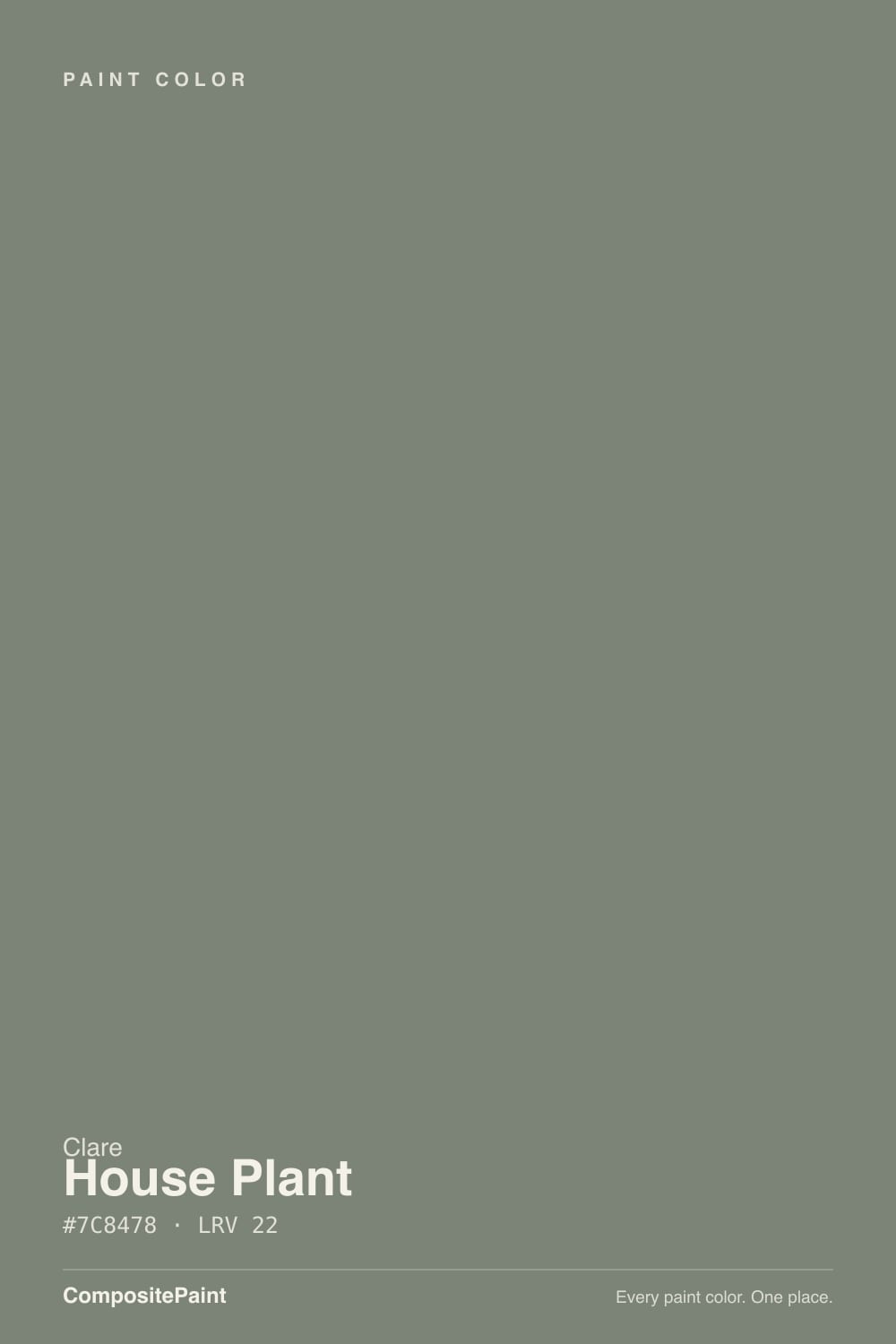
Color spec
| Brand | Clare |
| Name | House Plant |
| SKU | Clare 16 |
| Hex | #7C8478 |
| RGB | 124, 132, 120 |
| HSL | 100°, 5%, 49% |
| LRV | 22 |
| Undertone | neutral with no strong undertone |
| Family | Green |
What Color Is House Plant, Really?
House Plant is a muted sage that sits right between green and gray. Its measured saturation is very low, only about 5 percent, so it never reads as a bold or leafy green. Instead you get a soft, dusty green-gray with a quiet yellow-green lean, the color of a well-loved snake plant in low light. The hex is #7C8478 and the light reflectance value is 22, which puts it in the deeper mid-tone range.
Clare positioned this as its plant-room color, and it earned a following with millennial buyers who wanted something calm and organic without going bright. It behaves more like a soft neutral than a statement green.
It suits homes going for a grounded, natural, slightly moody feel. If you like earthy tones, wood, and greenery but want a wall color that recedes rather than shouts, House Plant fits. It works in modern, transitional, and cottage spaces alike.
House Plant leans green, but only just. Its saturation measures around 5 percent, which is well under the 10 percent mark where a color starts to read as a clear hue. That makes it a near-neutral: a soft green-gray with a faint yellow-green cast rather than a true sage. In most rooms your eye will register it as a quiet, natural gray-green rather than a color you could name from across the room.
The green shows most in strong daylight and against clean whites. Put a bright white trim or a crisp sheet of paper next to it and the green pulls forward. Set it beside a warmer beige or brown and it can look almost gray. To judge it honestly, tape a sample next to a true gray and a true sage side by side. That tells you which way it drifts in your specific light before you commit.
Best Rooms and Uses for House Plant
At LRV 22, House Plant is a mid-to-deep tone, so it works best where you want some weight and atmosphere rather than airy brightness. On full walls it shines in rooms with good daylight: living rooms, bedrooms, studies, and dining rooms all take it well and feel enveloping. In darker or smaller rooms it can close in, so test carefully before painting every wall.
It is a natural cabinet color. On kitchen or bathroom cabinetry and built-ins it gives a soft, organic green that pairs easily with wood and brass. It also makes a strong accent wall or the moody half of a two-tone scheme.
Outside, its depth and green-gray character suit siding, shutters, and especially a front door, where it reads as an understated, garden-friendly green. Keep trim in a lighter shade so the color has a clean edge.
How Lighting Changes House Plant
With an LRV of 22, House Plant absorbs far more light than it reflects, so it always reads as a deeper, moodier tone. Lighting decides whether that feels rich or muddy.
In north-facing rooms, which get cool, indirect light all day, it can go flat and grayer, losing its green. South-facing rooms get the most from it: strong daylight wakes up the yellow-green and keeps the walls from feeling heavy. East light makes it fresh and green in the morning, then quieter by afternoon, while west light warms it up as the day ends.
Bulb choice matters at this depth. Warm bulbs around 2700K bring out the sage and make the room cozy. Cool daylight bulbs push it toward gray and can feel clinical. Because a low LRV needs support, keep the room reasonably lit, and always look at a sample by both day and lamplight.
Most complaints about House Plant are a light mismatch. Upload a photo of your actual room and see it on your walls — then ask for the same wall in north light or evening lamps before you buy a single sample.
TEST IT IN YOUR LIGHT →House Plant vs Similar Colors
House Plant sits in a crowded band of soft green-grays, so small differences matter. Against Shade (PNT100-MD-14), at LRV 28, House Plant is clearly deeper and greener. Shade is lighter and reads as a warm gray with almost no green, so choose it when you want the barely-there version and House Plant when you want the tone to feel more like a color.
Compared with Irony (PNT100-MD-16), at LRV 21, the two are close in depth but different in character. Irony is a true cool gray with no green lean, while House Plant carries that yellow-green cast. If a room's other elements are already warm, Irony stays neutral where House Plant nudges sage.
Daily Greens (PNT100-DP-61), at LRV 18, is darker and more openly green. Pick it for a bolder, obviously sage statement, and House Plant when you want the quieter, grayer middle ground.
Colors That Go With House Plant
For trim and ceilings, a clean white gives House Plant a crisp edge and makes its green step forward. Snow Day (Clare 04), at LRV 92, is the brightest option. If you want a softer, warmer frame, Beach House (Clare 01), at LRV 84, keeps things gentle.
For a second wall color or an adjoining room, Greige (Clare 07), at LRV 50, bridges the green to warmer neutrals without competing. Mainstay (Clare 05), at LRV 65, is a lighter neutral that lifts the scheme.
To add life, Avocado Toast (Clare 08), a lighter green at LRV 35, layers naturally in the same family. For a real accent, such as a front door, island, or piece of furniture, Cracker Jack (Clare 17), a burnt terracotta at LRV 16, gives warm contrast, while Goodnight Moon (Clare 10), a deep blue at LRV 6, brings a moodier note. Warm wood and unlacquered brass both flatter it.
Need It From Another Brand?
Any paint counter can custom-tint Clare Clare 16 directly — but if you would rather stay in one brand's own deck, these are the closest stock matches:
Similar Clare colors
closest in the Clare deckThe nearest shades to House Plant within Clare's own range, ranked by perceptual color distance — useful when you want the same look a touch lighter, darker, or warmer.
Coordinated palette
Generated by hue-rotating #7C8478 in HSL space. Pair House Plant with one accent and one neutral — the swatches below are starting points, not final picks.
Accessibility (WCAG contrast)
WCAG 2.1: AA = 4.5:1 normal text · AA Large = 3:1 large text · AAA = 7:1 normal text.
The Questions Everyone Asks
Is House Plant warm or cool?
House Plant is close to neutral with a slight warm lean. Its hue sits in the yellow-green range, so it feels earthy and organic rather than icy. In warm light it reads as a soft, cozy sage, while cool daylight can push it toward a flatter gray. Overall it behaves like a gently warm green-gray rather than a strictly warm or cool color.
Is House Plant more green or more gray?
It is more gray than green in most rooms. Its saturation is only about 5 percent, well below the level where a color reads as a clear hue, so it acts like a soft neutral with a green lean. The green shows most in bright daylight and next to clean white trim, and fades toward gray beside warmer beige or brown tones.
What trim white goes with House Plant?
Snow Day (Clare 04), at LRV 92, is the crispest choice and makes House Plant's green step forward against the trim. If you prefer a softer, warmer frame, Beach House (Clare 01), at LRV 84, keeps the contrast gentle. Either gives the deeper wall color a clean edge and helps a low-LRV green feel intentional rather than heavy.
Does House Plant work on cabinets and exteriors?
Yes. Its soft green-gray character suits kitchen and bathroom cabinets, where it pairs easily with wood and brass for an organic look. Outdoors, the same depth works well on siding, shutters, and especially a front door, reading as an understated garden green. Keep trim lighter so the color has a clean edge in both uses.
What does an LRV of 22 mean for House Plant?
LRV measures how much light a color reflects, from 0 for black to 100 for white. At 22, House Plant reflects relatively little light, so it reads as a deeper, moodier mid-tone. It brings atmosphere and works best in rooms with good daylight or warm bulbs. In dark or small spaces it can feel heavy, so test a sample first.
How is House Plant different from Daily Greens?
Both are muted sage-greens from Clare, but Daily Greens (PNT100-DP-61) is darker, at LRV 18, and reads as a more openly green color. House Plant, at LRV 22, is a touch lighter and grayer, sitting closer to neutral. Choose Daily Greens for a bolder, obviously sage statement and House Plant for the quieter, more versatile middle ground.
Will It Work in YOUR Room?
No page can promise how House Plant behaves in your light. Upload a photo and see it on your own walls in seconds — before you spend a cent on samples.
TRY HOUSE PLANT ON YOUR ROOM →Ask a Question

Not sure about House Plant in your room?
Ask Jessica below — every question gets a real reply, usually within a day.