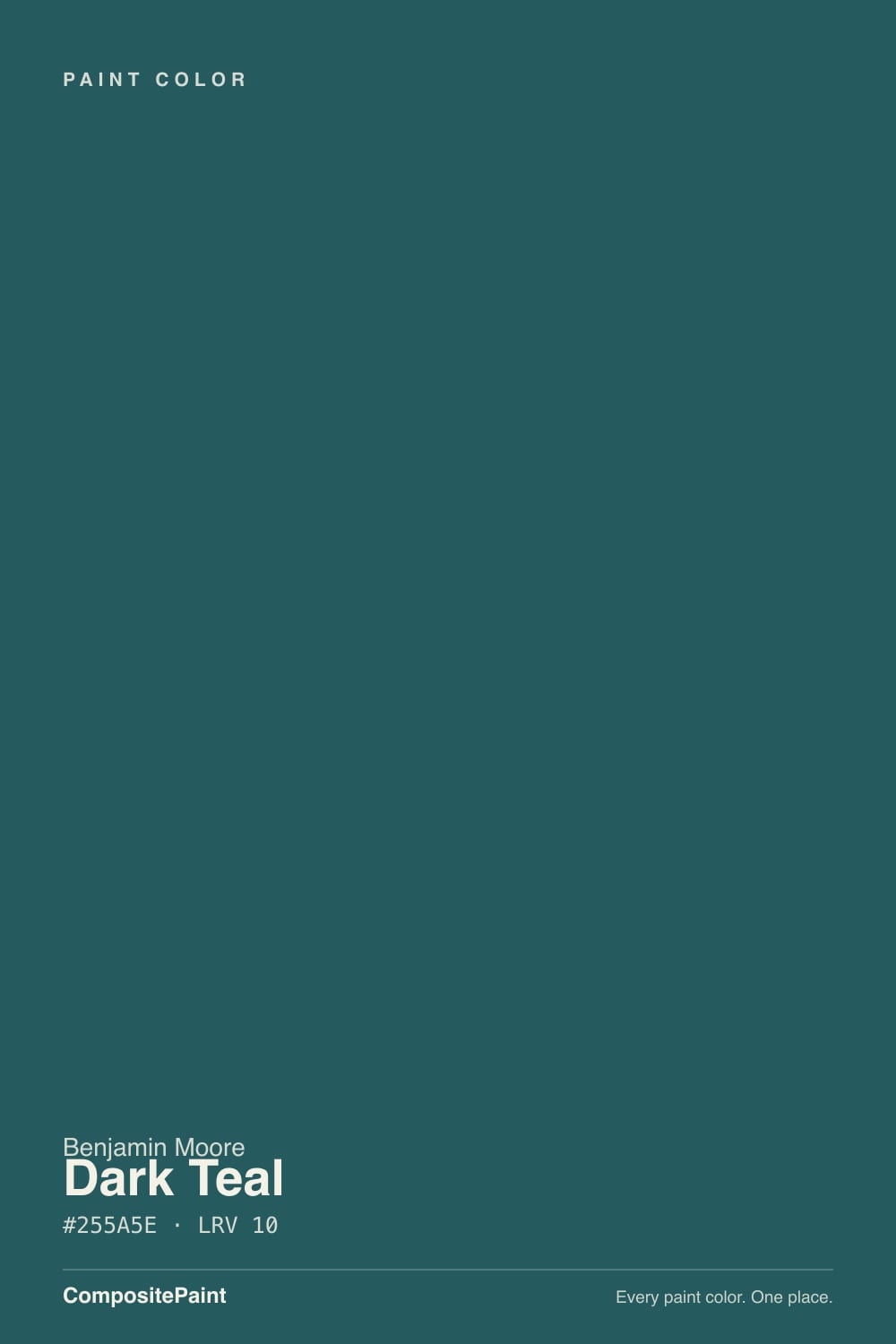
Dark Teal
2053-20 · #255A5E · LRV 10 — cool blue-green tone, dark — high drama, needs strong daylight or warm bulbs.
- 1Dark Night4
- 2Dark Teal10
- 3Adirondack Blue22
- 4Van Courtland Blue31
What Color Is Dark Teal, Really?
Dark Teal 2053-20 is exactly what the name says. Its hex is #255A5E and its hue sits at 184 degrees, the point where blue and green meet, with about 44 percent saturation. The LRV is 10, near the bottom of the scale, so this is a deep color that gives back very little light. It is dark enough to work as a near-black, but saturated enough that the teal always stays visible.
That balance is why people choose it. A lot of dark colors turn into gray sludge once they are on a wall; at 44 percent saturation this one keeps its blue-green identity even in a dim corner. It gives a room the weight of black with an obvious color underneath, which suits studies, dining rooms, cabinets, and front doors.
What to check before committing is how much light the room actually gets. At LRV 10 the color absorbs almost everything, so a small north-facing space will feel genuinely dark and slightly cold, since the hue already leans cool. Dark low-sheen finishes also show drywall flaws and roller lines under angled light. Paint a large sample board, stand it against the wall, and judge it after sundown as well as at noon.
At 184 degrees the hue sits almost exactly between blue and green, which is the definition of teal. Neither side dominates, so what you notice depends on what is nearby. Against a navy, Dark Teal looks green. Against a forest green, it looks blue. That flip catches people out when they sample it against only one thing.
Saturation of about 44 percent is moderate, enough to keep the color reading as color rather than as gray, but not so much that it looks bright. On a wall it comes across as a deep, slightly dusty teal rather than a jewel tone.
The cool character is consistent. There is no warm cast hiding in it, so warm bulbs and wood tones are doing the balancing work in any room where you use it. Sample it next to your existing tile, stone, and metals, since a nearby blue or green will push it the other way.
Best Rooms and Uses for Dark Teal
This is a color for rooms you want to feel enclosed. At LRV 10 it will shrink a space visually, so use it where that reads as cozy rather than cramped: a study, a dining room, a powder room, a den, or a bedroom meant to be dark. Rooms with good windows carry it much better than interior ones.
Cabinets and millwork are the easiest entry point. A kitchen island, a lower cabinet run, a bathroom vanity, built-in shelving, or paneled wainscoting all take it well, and the teal gives more interest than a plain charcoal would.
Outdoors it is strong on a front door or shutters against white, cream, or gray siding, and it works as a full body color on a house with pale trim. Deep exterior colors absorb heat and fade differently than pale ones, so ask about the right exterior product for a color at this depth.
How Lighting Changes Dark Teal
An LRV of 10 means very little light comes back off this color, so the room's own light sets the tone. In north-facing rooms the cool daylight reinforces the blue-green and the walls read deeper and colder, close to a dark slate teal. South-facing rooms suit it best, because strong warm light keeps the teal visible and stops it from flattening.
East rooms show the color clearly in the morning and let it sink after midday. West rooms stay heavy until late sun arrives and briefly warms them.
Bulb choice does the most work after dark, which is when a room this deep is usually used. Warm 2700K lamps soften the cool lean and make Dark Teal feel enveloping rather than chilly. Cooler 3500K to 4000K bulbs keep the color crisp but can make the space feel like a waiting room. Look at the sample under your actual fixtures before you order paint.
Most complaints about Dark Teal are a light mismatch. Upload a photo of your actual room and see it on your walls — then ask for the same wall in north light or evening lamps before you buy a single sample.
Need It From Another Brand?
Any paint counter can custom-tint Benjamin Moore 2053-20 directly. If you would rather stay in one brand's own deck, these are the closest stock matches, measured as ΔE2000. Under 2 is a difference you will not see on the wall.
| Brand | Closest color | ΔE | LRV | |
|---|---|---|---|---|
| Behr | Terrace TealPPF-56 · Behr | 0.7 | 9 | Color page → |
| Valspar | ZephyrT604 · Valspar | 4.2 | 8.8 | Color page → |
| PPG / Glidden | Emerald PoolPPG1146-7 · PPG / Glidden | 2.8 | 9 | Color page → |
| Glidden | Emerald PoolPPG1146-7 · Glidden | 3.0 | 9 | Color page → |
| Dutch Boy | Petrol Blue234-7DB · Dutch Boy | 5.0 | 9 | Color page → |
| Dunn-Edwards | Dance Teal DawnDEFD38 · Dunn-Edwards | 1.6 | 9 | Color page → |
Similar Benjamin Moore Colors
The nearest shades to Dark Teal within Benjamin Moore's own range, ranked by perceptual color distance — useful when you want the same look a touch lighter, darker, or warmer.
WCAG 2.1: AA is 4.5 : 1 for normal text, 3 : 1 for large text, AAA is 7 : 1.
Dark Teal vs Similar Colors
Inside the line, Oasis Blue 2049-20 (#225A5D, LRV 8) is nearly the same color a step darker. Pine Green 2051-20 (#2D5D5A, LRV 9) shifts toward green, and Dollar Bill Green 2050-20 (#325654, LRV 8) goes further that way again. Galapagos Turquoise 2057-20 (#1F5763, LRV 8) is the bluer, deeper option, while Bermuda Turquoise 728 (#285E6B, LRV 10) holds the same lightness with more blue and more brightness.
Across brands, Behr Terrace Teal PPF-56 (#275B60, LRV 9) at a deltaE of 0.71 is a genuine match. Dunn-Edwards Dance Teal Dawn DEFD38 at 1.58 and Diamond Vogel Blue Period 0690 at 1.79 are visually identical in normal room light. PPG Emerald Pool PPG1146-7 (#145E61, LRV 9) at 2.77 is very close, so sample first. Valspar Zephyr T604 at 4.21 and Dutch Boy Petrol Blue 234-7DB at 5.0 are close but visibly different side by side.
Colors That Go With Dark Teal
White trim is the natural counterweight. A warm white takes the chill off and makes the pairing feel traditional, while a crisp white sharpens the teal and reads more modern. At LRV 10 the contrast is dramatic either way, so choose based on the temperature you want.
Inside Benjamin Moore, the close neighbors work as companions at slightly different angles. Pine Green 2051-20 at LRV 9 is the greener partner for cabinetry under Dark Teal walls. Galapagos Turquoise 2057-20 at LRV 8 pushes bluer and deeper. Deep Sea Green 735 at LRV 9 is a quieter version of the same idea, and Bermuda Turquoise 728 at LRV 10 is brighter and more clearly blue if you want the door to stand apart from the walls.
Materials matter here. Warm oak, walnut, rattan, brass, and aged bronze counter the cool hue. Chrome and cool nickel double down on it, which can look sharp but will read cold.
Coordinated palette
Generated by hue-rotating #255A5E in HSL space. Pair Dark Teal with one accent and one neutral — the swatches below are starting points, not final picks.
Dark Teal FAQ
Is Dark Teal warm or cool?
Dark Teal is cool. Its hue sits at 184 degrees, right between blue and green, with no warm cast underneath. Saturation is around 44 percent, so the cool color stays clearly visible rather than fading to gray. Warm bulbs and wood tones are what balance it in a room.
What LRV is Dark Teal?
Dark Teal has an LRV of 10. On the 0 to 100 scale that is very dark, so it reflects almost no light and will make a room feel smaller and more enclosed. Unlike many colors this deep, its moderate saturation keeps the teal readable instead of letting it collapse into black.
Is Dark Teal more blue or more green?
It is balanced between the two, which is what makes it a teal. At 184 degrees neither side leads, so context decides what you see. Next to a navy it looks green, and next to a forest green it looks blue. Sample it against both before you settle on it.
Does Dark Teal work in a dark room?
It will hold its color better than a low-saturation dark shade, but it will not brighten anything. At LRV 10 a small north-facing room painted in it feels genuinely dark and slightly cold, since the hue already leans cool. Warm 2700K bulbs help a lot. If you need light back, this is the wrong color.
What white trim goes with Dark Teal?
A warm white takes the chill off and gives a traditional look, while a crisp white sharpens the teal and reads more modern. Either creates strong contrast against an LRV 10 wall. Use one white consistently on trim, doors, and ceiling, since two similar whites beside a very dark color look unintentional.
Is Dark Teal good for cabinets and front doors?
Yes on both counts. On kitchen islands, vanities, and lower cabinets its LRV of 10 gives depth while the teal adds more character than a plain charcoal. On a front door it reads dark and solid from the street but still shows its color up close. Ask your dealer which exterior line suits the door material.
Have you painted with Dark Teal?
Rate it — one tap helps the next reader decide.
Ask a Question