Dark Purple
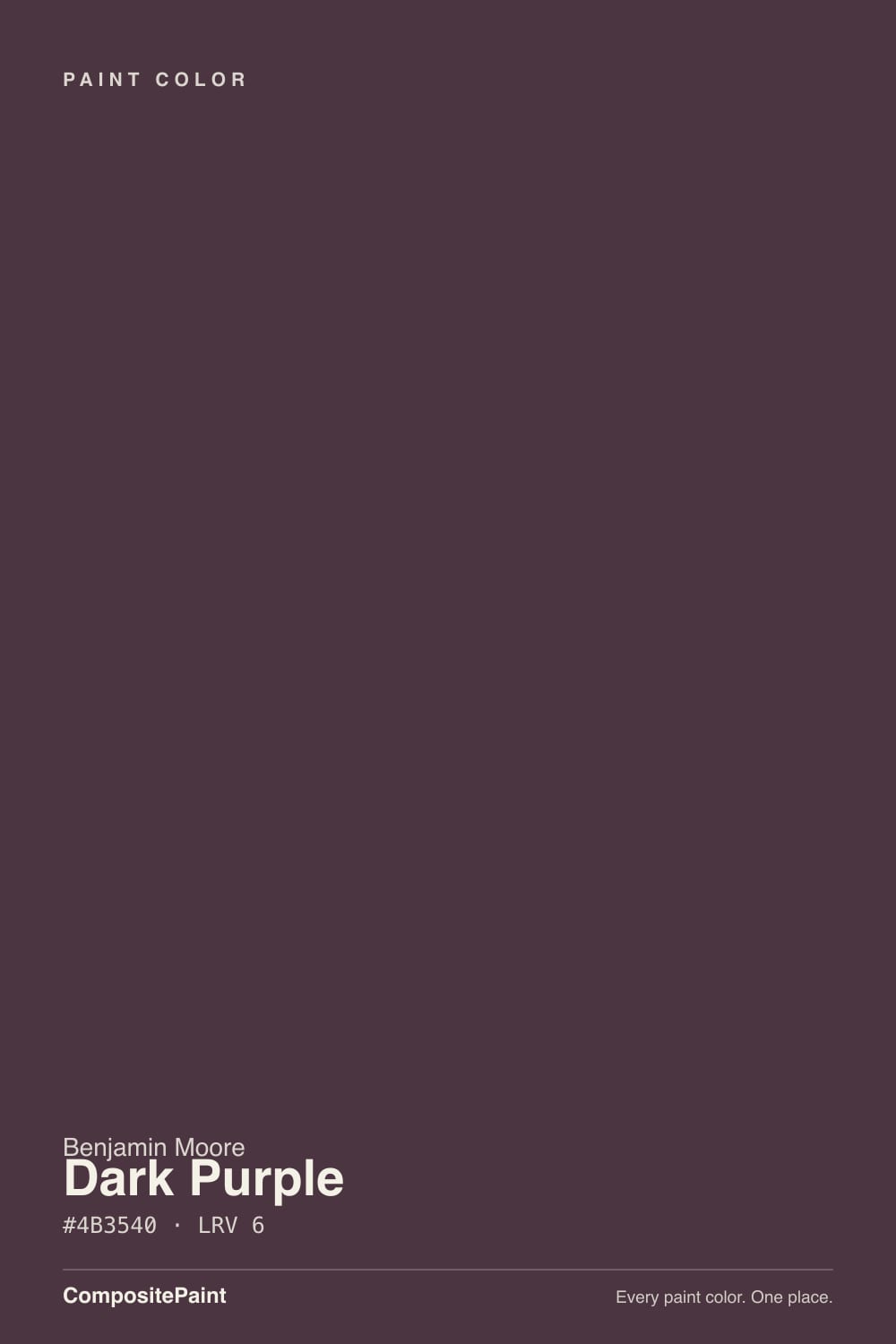
2073-10 · #4B3540 · LRV 6 — warm magenta tone, very dark — reads black in most rooms.
- 1Liberty Blue1
- 2Dark Purple6
- 3Blue Nova17
- 4Gothic Purple24
What Color Is Dark Purple, Really?
Dark Purple 2073-10 is a near-black purple. The hex is #4B3540 and the LRV is 6, which is deep enough that in most rooms your eye registers it as black first and finds the purple only in good light. The hue sits at 330 degrees, in the magenta range, with saturation around 17 percent, so what color there is leans warm and plummy rather than cold and violet.
People choose it when they want a dark room that is not a plain black room. Compared with a true black, Dark Purple has a soft, slightly berry warmth that reads richer under lamplight and looks less flat on large surfaces. It is a color for creating an enclosed, low-light mood on purpose: dining rooms, studies, powder rooms, a wall of cabinetry.
The practical catch is that at LRV 6 the color absorbs nearly all the light that reaches it. In a room with limited daylight it will simply be black, and the purple you paid for disappears. It also shows every roller mark, patch, and drywall flaw, so surface prep and a flat or matte sheen matter more here than with a mid-tone. Sample it on the wall you actually plan to paint, not on a board propped in the brightest corner.
The undertone is a warm magenta. At 330 degrees the hue sits between red and violet, closer to plum than to lavender, and saturation of about 17 percent means the color is heavily grayed down. That is what stops it from looking like a costume purple and lets it behave as a near-black.
Where the purple shows is entirely about light and neighbours. Under a lamp, on a glossy trim, or on a surface catching direct sun, the plum comes through clearly. On a flat wall across the room from the window it reads charcoal.
Comparison decides the rest. Next to a true black or a black-brown, Dark Purple looks obviously purple. Next to a saturated aubergine it looks gray. Against warm woods and brass it reads warmer and browner; against cool gray stone the magenta stands out. If you want the purple to be visible rather than implied, plan for lamplight and a sheen above dead flat on at least some surfaces.
Best Rooms and Uses for Dark Purple
This is a mood color, not a general wall color. At LRV 6 it works best where you want the room to feel enclosed and quiet: a dining room used mostly at night, a study or library, a media room, a powder room where drama is welcome and you are not there long enough to miss the daylight.
On cabinetry and millwork it is easier to live with than on four walls. A kitchen island, a run of lower cabinets, a built-in bookcase, or a set of panelled doors all take it well, and the purple shows better on a semi-gloss or satin surface than on flat drywall.
Outdoors it makes a strong front door or shutter color against a light body, where sunlight gives the plum a chance to appear. Trim should stay clearly lighter, since there is no contrast to be had at this depth. Because dark colors need consistent tinting across gallons, buy the full job at once. Benjamin Moore sells through independent dealers, so ask them to box the batches.
How Lighting Changes Dark Purple
An LRV of 6 means the color reflects almost nothing. Whatever light the room has is absorbed, so Dark Purple never brightens and never bounces light back to the ceiling. Plan the lighting first and the color second.
In north-facing rooms, where daylight is cool and weak, the magenta at 330 degrees gets pushed toward gray and the wall reads as a soft charcoal-black. In south-facing rooms with direct sun the difference is dramatic: sunlit patches show the plum clearly while the shaded parts of the same wall stay black. That split is normal for very dark colors and is worth expecting rather than fixing. East and west rooms show the purple for a couple of hours a day and read black the rest of the time.
Artificial light does most of the work at night. Warm 2700K bulbs flatter it, bringing out the berry warmth and giving the wall depth. Cooler 4000K bulbs flatten it into a hard, cold near-black.
Most complaints about Dark Purple are a light mismatch. Upload a photo of your actual room and see it on your walls — then ask for the same wall in north light or evening lamps before you buy a single sample.
Need It From Another Brand?
Any paint counter can custom-tint Benjamin Moore 2073-10 directly. If you would rather stay in one brand's own deck, these are the closest stock matches, measured as ΔE2000. Under 2 is a difference you will not see on the wall.
| Brand | Closest color | ΔE | LRV | |
|---|---|---|---|---|
| Sherwin-Williams | MerlotSW 2704 · Sherwin-Williams | 3.6 | 4 | Color page → |
| Behr | Mahogany SpiceBNC-31 · Behr | 2.3 | 4 | Color page → |
| Valspar | VirtuosoM215 · Valspar | 4.1 | 4.4 | Color page → |
| Glidden | Ranch House Brown85RR 05/082 · Glidden | 4.9 | 5 | Color page → |
| Magnolia Home | Plum SuedeJG-102 · Magnolia Home | 3.6 | 5 | Color page → |
| Diamond Vogel | Purple ProvinceH065 · Diamond Vogel | 2.9 | 6 | Color page → |
Similar Benjamin Moore Colors
The nearest shades to Dark Purple within Benjamin Moore's own range, ranked by perceptual color distance — useful when you want the same look a touch lighter, darker, or warmer.
WCAG 2.1: AA is 4.5 : 1 for normal text, 3 : 1 for large text, AAA is 7 : 1.
Dark Purple vs Similar Colors
Its Benjamin Moore neighbors split into warmer and cooler camps. Caponata AF-650 (#453133, LRV 6) is the same depth but redder and browner, so it reads like a very dark wine rather than a plum. Black Raspberry 2072-20 (#4D3D4B, LRV 7) is slightly lighter and clearly more purple, the choice when you want the color to be recognizable. Dark Basalt 2072-10 (#40363C, LRV 5), Plum Martini CSP-540 (#403C3F, LRV 5), and Galaxy 2117-20 (#413D44, LRV 6) sit closer to charcoal, with Deep Mulberry 2069-10 (#3C3845, LRV 5) leaning bluer.
Across brands, C2 Black Locust BD42 at deltaE 1.29 is visually identical in normal room light, though its LRV of 4 makes it deeper. Purple Shadow 1215, listed by Kompozit and Hirshfield's at deltaE 2.15, plus Behr Mahogany Spice BNC-31 (2.29) and Diamond Vogel Purple Province H065 (2.93), are very close, so sample first. Sherwin-Williams Merlot SW 2704 (3.6) and Glidden Ranch House Brown 85RR 05/082 (4.94) are close but visibly different side by side, both reading distinctly redder.
Colors That Go With Dark Purple
Light trim is the main partner. Any clean or soft white will do the job, and the contrast against LRV 6 will be extreme no matter which you pick, so choose the white on its own merits rather than for contrast.
Inside the Benjamin Moore deck, its neighbours make good companions on adjacent surfaces. Black Raspberry 2072-20 at LRV 7 is fractionally lighter and slightly more purple, useful on trim or a ceiling if you want a dark room that still has layers. Caponata AF-650 at LRV 6 is the same depth with a browner, redder cast, good for an adjoining room. Dark Basalt 2072-10 at LRV 5 and Plum Martini CSP-540 at LRV 5 are cooler and grayer, and Deep Mulberry 2069-10 at LRV 5 pulls toward blue-violet. Galaxy 2117-20 at LRV 6 is the most neutral of the group.
For materials, warm brass, aged bronze, and mid-brown to walnut wood all bring out the magenta. Deep greens and warm terracotta read well as accents. Cool chrome and blue-gray stone tend to fight it.
Coordinated palette
Generated by hue-rotating #4B3540 in HSL space. Pair Dark Purple with one accent and one neutral — the swatches below are starting points, not final picks.
Dark Purple FAQ
Is Dark Purple warm or cool?
It is warm for a purple. The hue sits at 330 degrees, in the magenta range between red and violet, so the color leans plum rather than blue-violet. Saturation is low at roughly 17 percent, which grays it down heavily, but the warmth is what separates it from a plain charcoal or black.
What LRV is Dark Purple?
Dark Purple 2073-10 has an LRV of 6. On the 0 to 100 scale where 0 is black and 100 is pure white, 6 is about as deep as paint colors go. It absorbs nearly all the light that hits it, so it reads as a near-black in most rooms and only shows its purple in direct or warm light.
Does Dark Purple look black?
Often, yes. At LRV 6 with only about 17 percent saturation, most rooms will read it as black first. The magenta undertone appears in direct sunlight, under warm lamps, and on sheened surfaces like doors and cabinets. If you want the purple to be obvious, plan for good lighting or use a satin finish instead of a flat one.
Does Dark Purple work in a dark room?
It works in the sense that it creates a deliberately enclosed, moody space, but it will not read as purple there. With an LRV of 6 the color gives back almost no light, so a room with little daylight will simply look black. Add warm 2700K lamps if you want the plum tone to show at night.
What white trim goes with Dark Purple?
Almost any white works, because the contrast against LRV 6 is extreme in every case. A soft warm white flatters the magenta undertone and keeps the pairing from feeling harsh, while a crisp cool white gives a sharper, more graphic edge. Pick based on the rest of the room, not on the purple.
Is Dark Purple good for exteriors or cabinets?
Yes to both. On an exterior it makes a strong front door or shutter color against a light body, and outdoor sun is where the plum actually shows. On cabinets it reads richer than on flat drywall because the sheen catches light. Buy all your paint at once so the deep tint load stays consistent between gallons.
Have you painted with Dark Purple?
Rate it — one tap helps the next reader decide.
Ask a Question