Charcoal
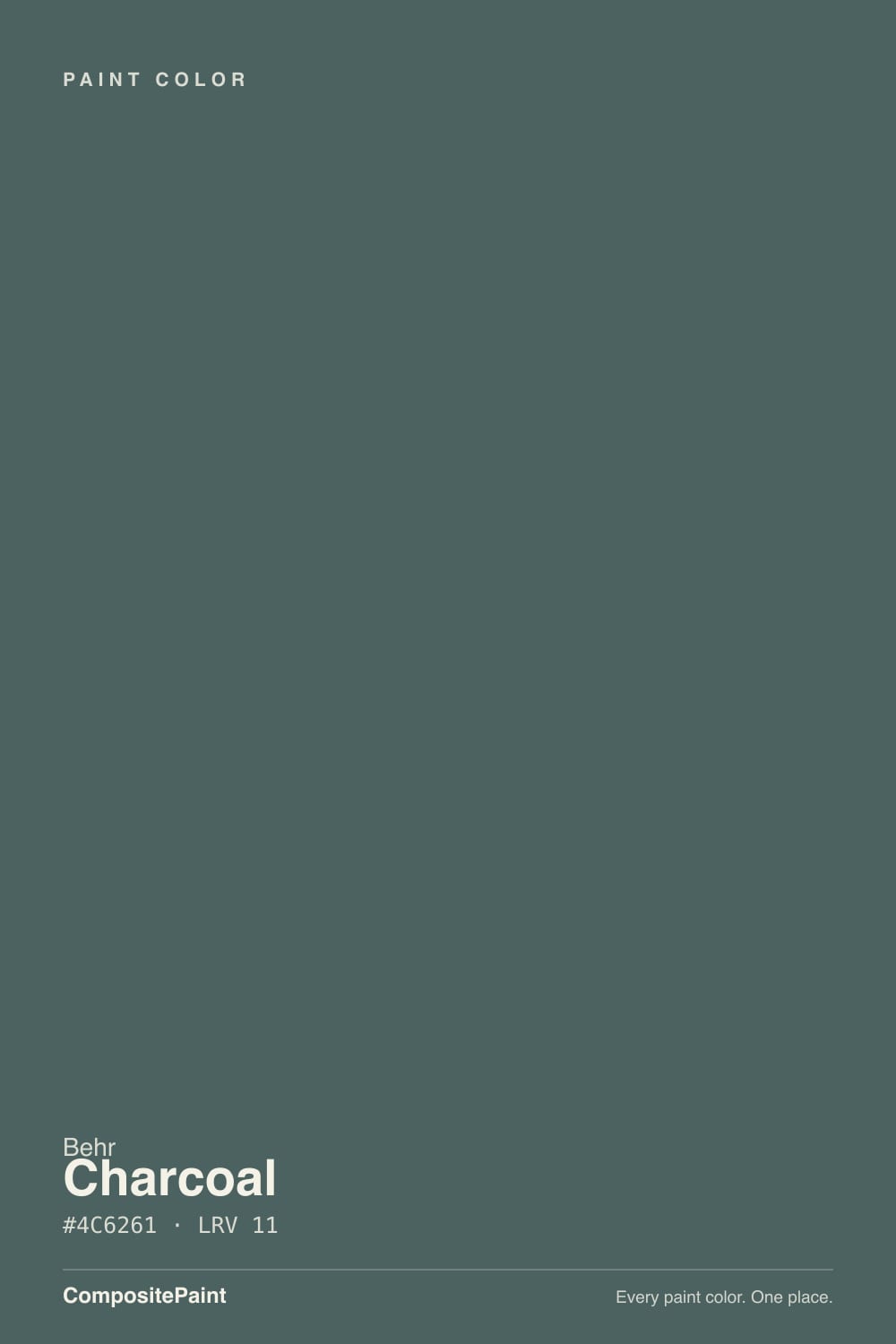
BXC-41 · #4C6261 · LRV 11 — cool blue-green tone, dark — high drama, needs strong daylight or warm bulbs.
- 1Salamander6
- 2Charcoal11
- 3Adirondack Blue22
- 4Van Courtland Blue31
What Color Is Charcoal, Really?
Charcoal BXC-41 is not a gray. Behr files it in the teal family, and the numbers agree: hex #4C6261, a hue of 177 degrees that sits at the blue-green midpoint, and 13 percent saturation. Its LRV is 11, near the bottom of the scale, so it absorbs most of the light that reaches it and reads as a deep, smoky color on the wall. The muted blue-green tone is what separates it from an actual charcoal gray.
People pick it when they want depth without going black. At 11 LRV it carries the same visual weight as a near-black, but the cool blue-green keeps it from looking flat, and it shifts a little through the day in a way true black never does. That makes it a common choice for dining rooms, libraries, kitchen islands, and dark exterior bodies.
The catch is the name. Buy it expecting neutral charcoal and you will get a dark teal, and it announces itself once it covers four walls next to warm white trim. The second issue is light. At LRV 11 a room with one small window loses most of the color and simply looks dark. Paint a large board, move it around the room, and check it at night under your own bulbs.
The hue reading of 177 degrees puts Charcoal exactly between blue and green, so neither side wins outright. At 13 percent saturation the color is muted rather than vivid, which is why it can pass for a dark gray in a photo or on a one-inch chip. On a wall, in daylight, the teal is clear.
Which half you see depends on the company it keeps. Next to a warm white or a cream trim the blue-green pops and the color looks distinctly teal. Next to a real navy it turns greener. Next to a warm olive or a wood tone it cools down and starts reading closer to slate.
Before committing, put a sample next to your trim white, your countertop, and any metal finish in the room. Brass and warm brown wood pull the green forward. Chrome and cool gray stone push it toward blue.
Best Rooms and Uses for Charcoal
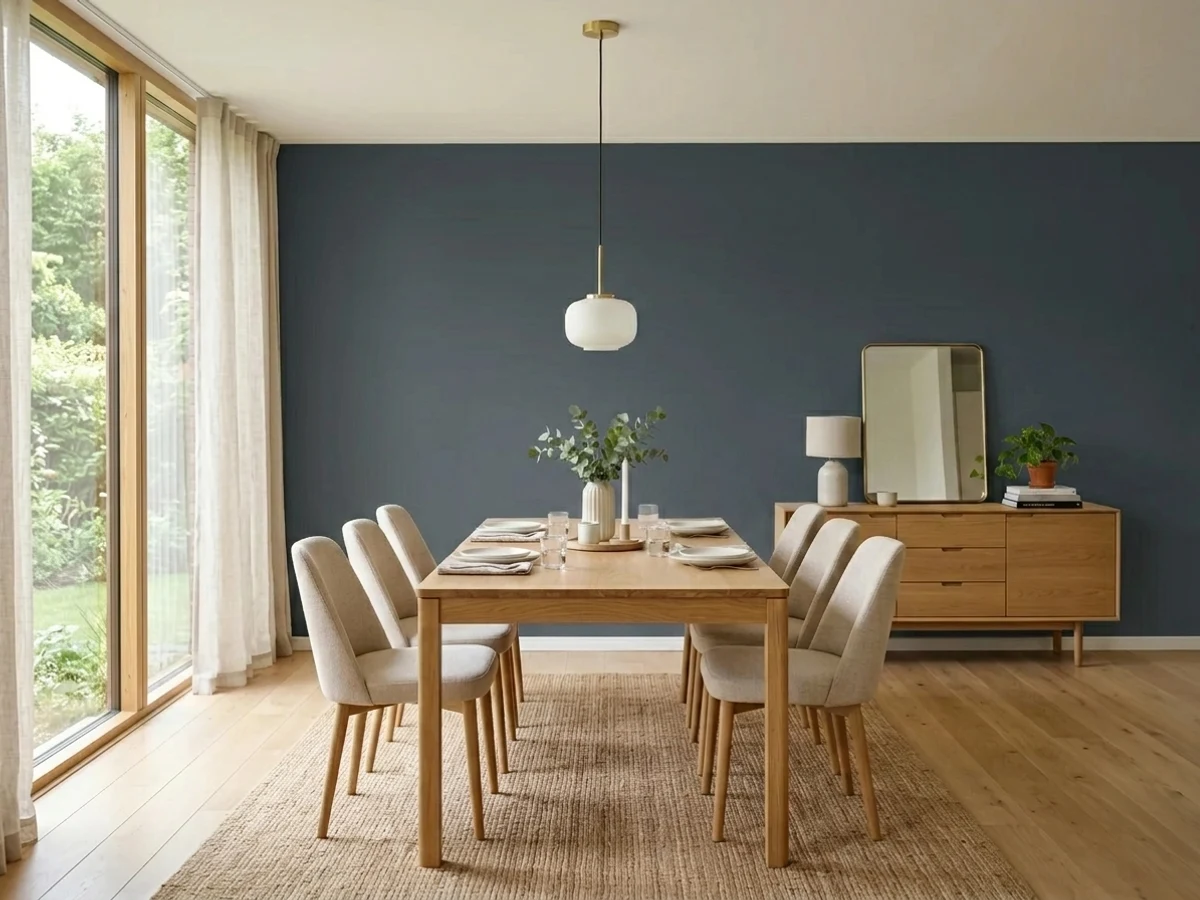
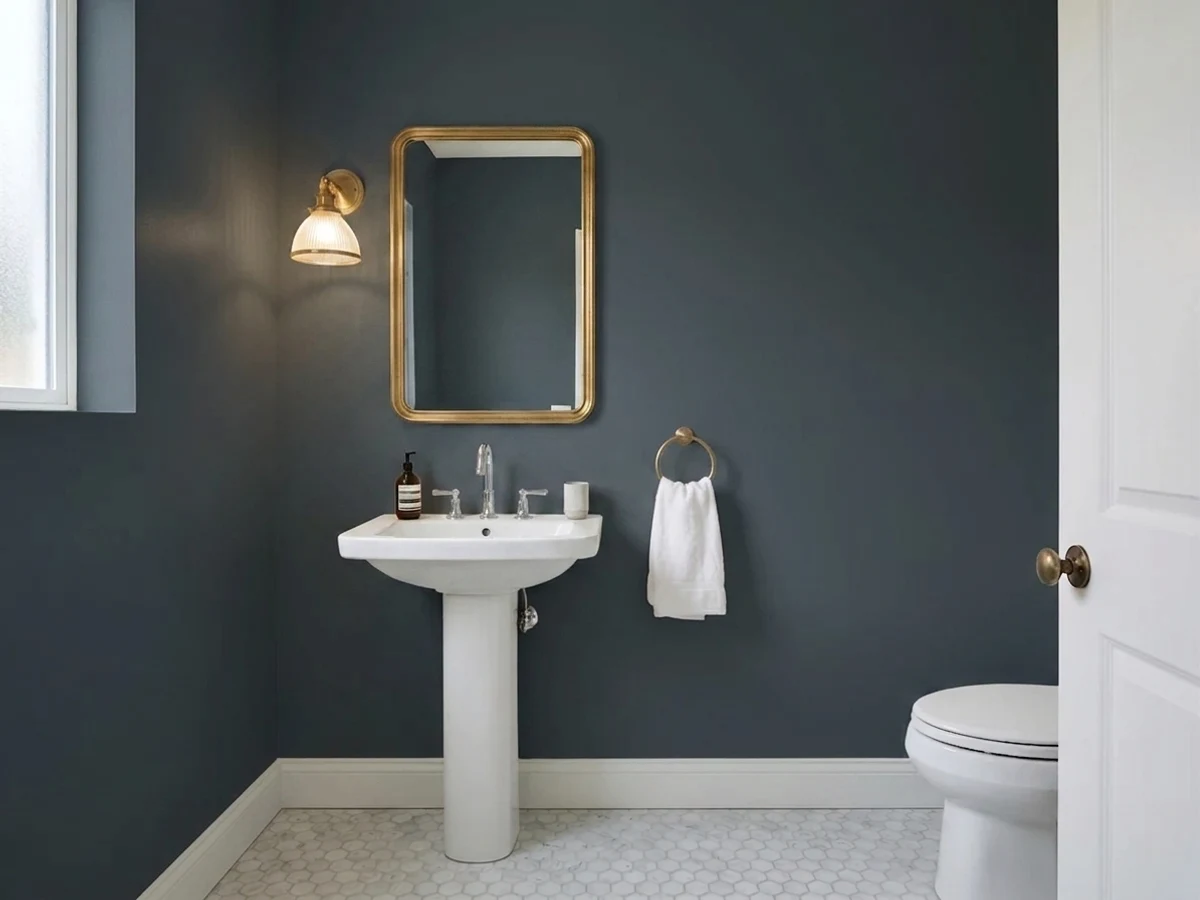
At LRV 11 this is a commitment color. It works best where you want the room to feel enclosed and quiet: a dining room, a study, a bedroom accent wall, a powder room, or a stair hall with good light from above. Rooms used mostly at night suit it better than rooms you sit in all morning.
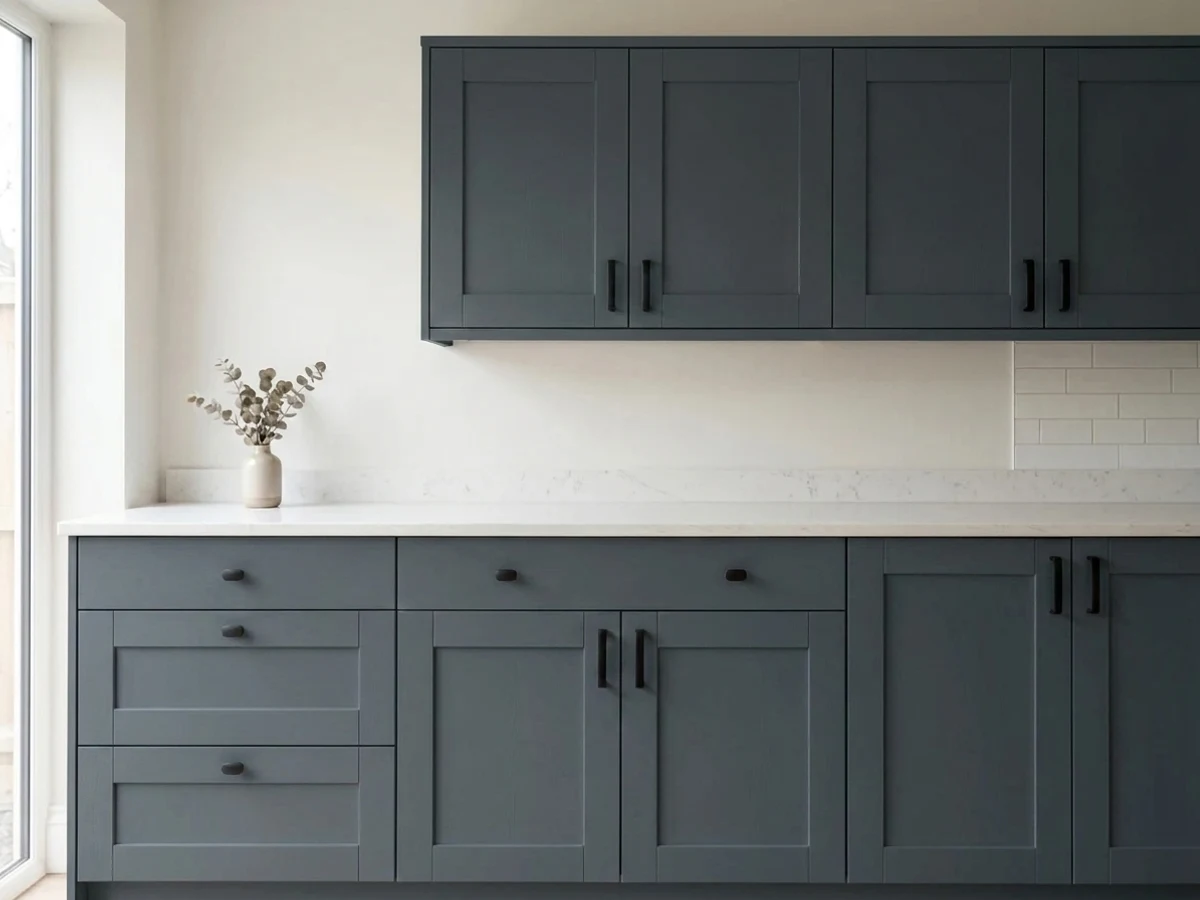
Cabinetry is the safer route if full walls feel like too much. A kitchen island, a run of lower cabinets, a laundry base, or a set of built-in bookshelves in Charcoal gives you the depth without darkening the whole space. The blue-green reads richer on cabinet doors than a plain black would.
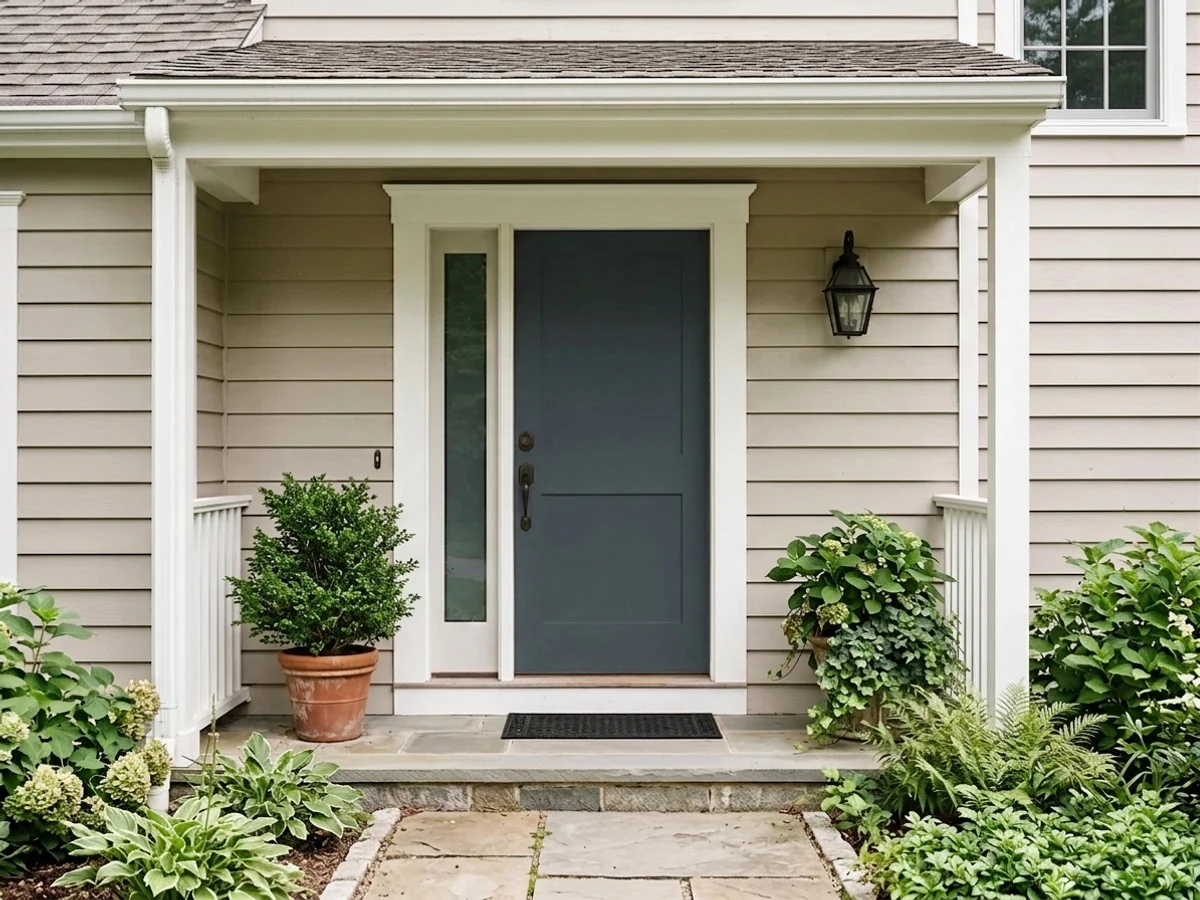
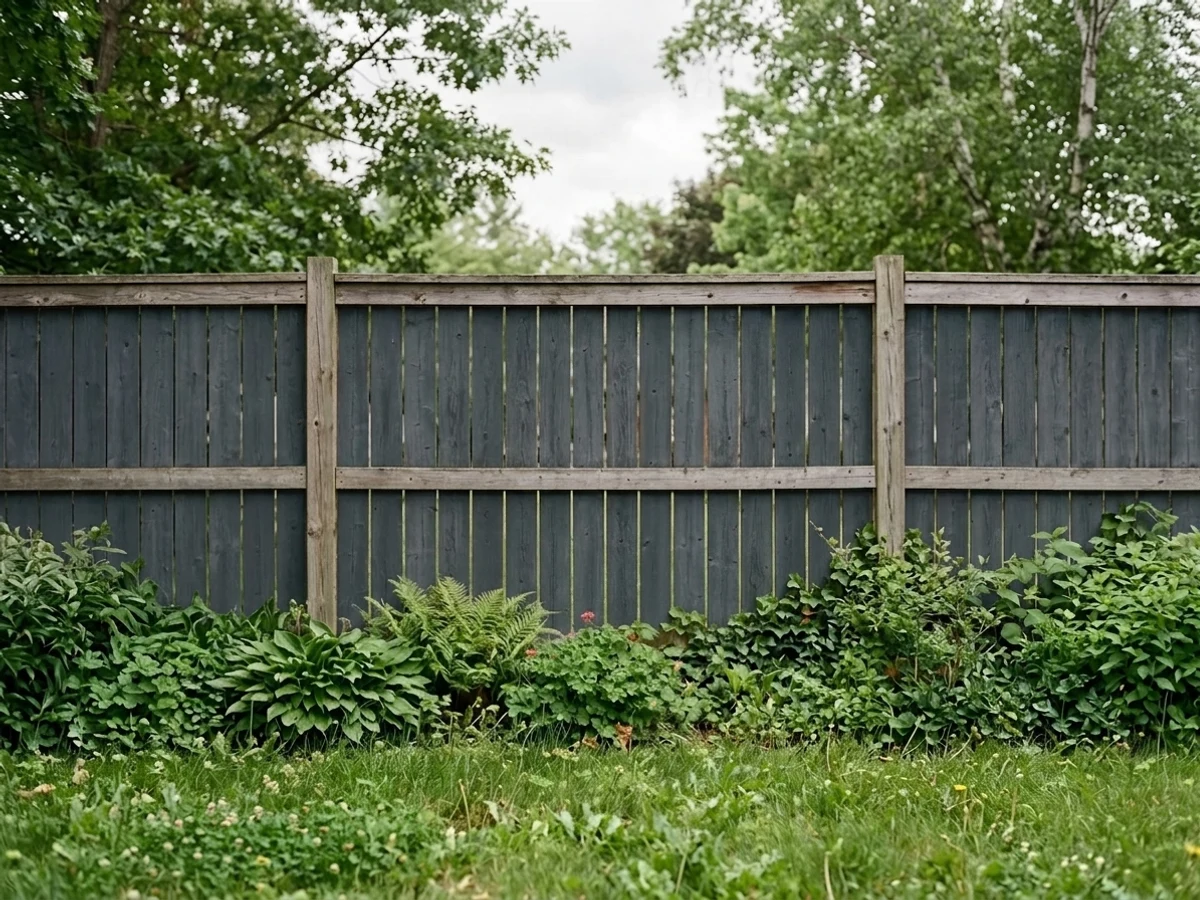
Outdoors it is a strong body color for a modern or farmhouse exterior, and it makes a good front door against a light body. Keep trim in a clean white so the teal registers as a color and not just as shadow.
How Lighting Changes Charcoal
With an LRV of 11, Charcoal keeps very little of the light that lands on it, so the room's light supply matters more than with any mid-tone. In north-facing rooms the cool daylight stacks onto an already cool blue-green and the color goes deeper, quieter, and closer to black in the corners. It can feel heavy if the room is small.
South-facing rooms give it the best chance. Strong warm light lifts the teal out of the darkness and the walls show their color instead of just their weight. East rooms read cooler and sharper in the morning; west rooms flatten early and glow late.
Bulbs decide the evening. Warm 2700K lamps soften the blue and make the room feel enclosed in a good way. Neutral 3500K to 4000K bulbs sharpen the blue-green and can make it look cold. Layered lamps beat one ceiling fixture here.
Most complaints about Charcoal are a light mismatch. Upload a photo of your actual room and see it on your walls — then ask for the same wall in north light or evening lamps before you buy a single sample.
Need It From Another Brand?
Any paint counter can custom-tint Behr BXC-41 directly. If you would rather stay in one brand's own deck, these are the closest stock matches, measured as ΔE2000. Under 2 is a difference you will not see on the wall.
| Brand | Closest color | ΔE | LRV | |
|---|---|---|---|---|
| Sherwin-Williams | Tempe StarSW 6229 · Sherwin-Williams | 4.7 | 11 | Color page → |
| Valspar | Grand Prix8003-38F · Valspar | 2.4 | 11 | Color page → |
| PPG / Glidden | ObligationPPG1135-7 · PPG / Glidden | 4.1 | 12 | Color page → |
| Glidden | Deep Shaded Grove30GG 11/099 · Glidden | 2.7 | 11 | Color page → |
| Dutch Boy | Stormed Blue334-6DB · Dutch Boy | 4.7 | 11 | Color page → |
| HGTV Home by Sherwin-Williams | OceanusHGSW 3301 · HGTV Home by Sherwin-Williams | 2.7 | 10 | Color page → |
Similar Behr Colors
The nearest shades to Charcoal within Behr's own range, ranked by perceptual color distance — useful when you want the same look a touch lighter, darker, or warmer.
WCAG 2.1: AA is 4.5 : 1 for normal text, 3 : 1 for large text, AAA is 7 : 1.
Charcoal vs Similar Colors
Underwater PPU12-20 at hex #4E6163 and LRV 11 is almost the same color, a fraction bluer. Binary Star N450-6 at LRV 12 is a shade lighter and softer. Equilibrium T18-20 at #486159 leans clearly greener, New Hunter ICC-86 at LRV 10 goes greener and darker still, and Wanderlust T17-12 at #426267 is the bluest of the group. Walk Me Home MQ6-02 at LRV 12 sits between blue and gray.
Across brands, Valspar Grand Prix 8003-38F at LRV 11 is the closest at a deltaE of 2.38, followed by HGTV Home by Sherwin-Williams Oceanus HGSW 3301 at 2.7 and Glidden Deep Shaded Grove at 2.71. All three are very close, but sample first because a dark color exaggerates small shifts.
Rodda Trillion R060 at 3.63 and Farrow & Ball Coppice Blue No. G9 at 3.71 are close but visibly different side by side, and Sherwin-Williams Tempe Star SW 6229 at 4.65 reads noticeably bluer.
Colors That Go With Charcoal
The safest partner is a white with a lot of daylight in it. A crisp white on trim and ceiling keeps the teal reading as color instead of dirt, while a warm cream white softens the contrast and makes the room feel older and calmer. Pick one and use it everywhere rather than mixing two whites in the same room.
Within Behr, the near neighbors work as related surfaces rather than contrast. Binary Star N450-6 at LRV 12 or Underwater PPU12-20 at LRV 11 can take a ceiling or an adjoining built-in without breaking the scheme, and New Hunter ICC-86 at LRV 10 pushes greener if you want a slightly earthier partner.
For materials, warm wood is the best counterweight: white oak, walnut, and rattan all keep a room this dark from going cold. Brass and aged bronze hardware suit it. Polished chrome tends to look clinical against the blue-green.
Coordinated palette
Generated by hue-rotating #4C6261 in HSL space. Pair Charcoal with one accent and one neutral — the swatches below are starting points, not final picks.
Charcoal FAQ
Is Behr Charcoal actually gray?
No. Despite the name, Charcoal BXC-41 sits in the teal family. Its hue is 177 degrees, the midpoint between blue and green, with 13 percent saturation. On a small chip it can pass for a dark gray, but on a full wall in daylight the blue-green is obvious, especially next to a warm white trim.
What LRV is Charcoal?
Charcoal BXC-41 has an LRV of 11. On the 0 to 100 light reflectance scale that is deep, close to the near-black end, so the color absorbs most of the light in a room rather than bouncing it back. Expect walls to feel enclosed and expect to add lamps in any space with limited daylight.
Is Charcoal warm or cool?
It is cool. The blue-green undertone at hue 177 degrees runs cool by nature, and the low LRV of 11 gives it no brightness to warm it up. Warm 2700K bulbs and warm wood floors offset that; cool 4000K bulbs and gray stone push it further toward cold slate.
Does Charcoal work in a dark room?
It can, but only on purpose. At LRV 11 it will not brighten anything, so a dim room painted in it becomes a genuinely dark room. That works for a study, dining room, or powder room used at night. In a small daytime room with one window, most of the teal disappears and you are left with plain darkness.
What white trim goes with Charcoal?
A clean bright white gives the sharpest edge and keeps the blue-green reading as a real color. A soft warm white lowers the contrast and makes the room feel gentler and more traditional. Either works, but use a single white throughout the room, since two different whites against an LRV 11 wall become obvious.
Is Charcoal good for exteriors and cabinets?
Yes to both. On an exterior body it reads as a deep smoky teal against white trim, and it also works as a front door color on a light house. On cabinets, especially an island or lower run, the LRV of 11 gives real depth while leaving the rest of the room light. Behr is sold at The Home Depot, so matching exterior and cabinet products is straightforward.
Have you painted with Charcoal?
Rate it — one tap helps the next reader decide.
Ask a Question