Product review · Rust-Oleum · Updated August 7, 2026
RockSolid Semi-Transparent Concrete StainRust-Oleum paint review
7.6/10A good-looking stain that is only half a system — buy the sealer at the same time or buy the one-step version.
Good-looking mottled color on a bare slab for $35 to $50 a gallon. Read the label twice, though: this is the color step only, and it needs a separate sealer over it.

Mark Thompson · Pro Contractor & Field Editor · Updated August 7, 2026
22 years running residential and light commercial repaints across the Midwest. Mark has stained patios, walkways, and basement slabs, and has ground off the ones somebody stained over old sealer. About the testing process →
Rust-Oleum RockSolid Semi-Transparent Concrete Stain1 sheen
Coverage250–400 sq ft/gal on smooth concrete
VOCWater-based
Slab cure before stainingNew concrete must cure 28 days
Sheens Flat
Read this first
The Fast Verdict
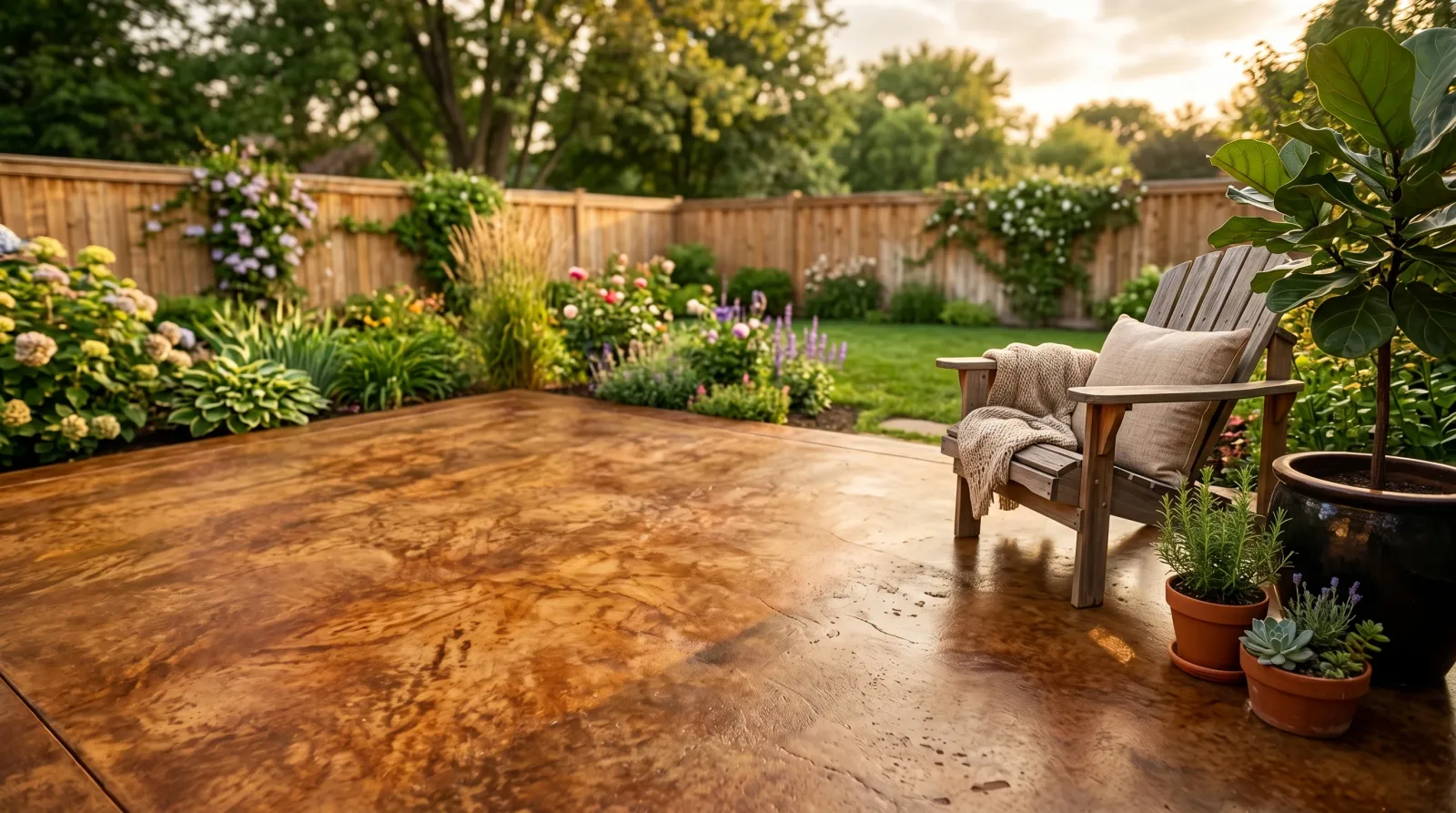
On a bare, unsealed, porous slab it is worth it. For $35 to $50 a gallon you get a natural mottled stained-concrete look that beats a solid floor paint, and it goes down water-based and low-odor. The catch is that it is color only. You have to buy and apply a separate RockSolid sealer over it or it scuffs and water-spots within a season. If your concrete is already sealed or slick, or you want one product instead of two, buy the Concrete Stain plus Sealer instead.
Best for
Bare unsealed porous concrete · Patios and walkways · Basement and garage floors · Pool decks · Layered accent colors · Anyone who wants stained concrete, not painted concrete
Skip if
The slab is sealed or power-troweled slick · You want one product, not two · Vertical surfaces like foundation walls · Hard-use garage floors with hot tires · New concrete under 28 days old
What it's good at
- The look — real depth and variation, reads like stained concrete instead of the flat plastic look of a solid floor paint
- Water-based and low-odor, no acid and no respirator drama on a basement slab
- Layerable color; float an accent tone over a base coat before sealing for the marbled effect
- Coverage on a smooth troweled slab, where 250 to 400 sq ft a gallon holds up
- Tool cleanup — brushes, sponges, and a pump sprayer all rinse in the sink
- Cost of the color step; a one-car garage floor or a mid-size patio often lands in one gallon
What it's not good at
- Abrasion resistance on its own; unsealed it scuffs and water-spots within a season
- Anything already sealed, slick, or power-troweled, where it beads and blotches
- Coverage on rough or weathered concrete, which drops to about 175 sq ft a gallon
- Being a one-product job — you are buying and applying a sealer too
- Vertical surfaces like foundation walls; this is a horizontal stain that has to soak in
- Hard-use garage floors with hot tires and dropped tools, where a stain is the wrong tool
Same shelf, different cans
Which RockSolid Concrete Product Are You Buying?
Rust-Oleum sells three things with concrete stain on the label and they are not interchangeable. This review covers the two-step Semi-Transparent Concrete Stain. If you wanted one-and-done, you grabbed the wrong can.
RockSolid Semi-Transparent Concrete Stain (this review)
BaseWater-based penetrating stain, color only
SheensFlat; any gloss comes from the topcoat sealer
Buy it if
You want to layer accent colors first and seal once at the end, and you accept the second product and often the second day.
Avoid if
You want protection in the same can. Unsealed, this scuffs and water-spots in a season.
RockSolid Concrete Stain + Sealer
BaseOne-step color plus sealer in the same can
SheensLow-gloss or high-gloss
Buy it if
You want a durable stained patio without buying and applying two products. This is the smarter buy for most homeowners.
Avoid if
You are building a layered multi-color effect that needs to stay open until the end.
RockSolid Semi-Transparent Concrete Stain Spray
BaseSame stain in an aerosol
SheensFlat
Buy it if
Small areas, accent work, tight spots, and touch-ups.
Avoid if
You are covering a patio. This is not a full-slab product.
Numbers, not adjectives
Spec Sheet
- Type
- Water-based semi-transparent penetrating concrete stain
- Coverage
- 250–400 sq ft/gal on smooth concrete; 175–250 sq ft/gal on rough or porous
- Sheen
- Flat. Any gloss comes from the topcoat sealer, not the stain
- Recoat
- About 1 hour between coats and before accent colors
- Foot traffic
- 4 to 6 hours
- Heavy items and vehicles
- 24 to 48 hours after the final sealer coat
- Slab cure before staining
- New concrete must cure 28 days
- Apply at
- 50–90F air temp, relative humidity below 85 percent
- VOC
- Water-based, low-odor; exact g/L not published on the consumer page
- Primer
- No primer. Needs a separate RockSolid film-forming sealer over the top for any real wear protection
- Surfaces
- Bare interior and exterior horizontal concrete and masonry
- Sizes
- Gallon and quart tint base; pre-mixed color gallons
- Price
- $35–50 / gal for the stain, plus $35–55 for the required sealer
Application Settings That Work
- Brush
- Brush, sponge, or pump sprayer all work, and all rinse out in the sink. Lay the base coat, wait the hour, then float a second accent tone over it if you want the marbled look. Do not flood it — this stain has to soak in, and a puddle dries as a dark blotch.
- Primer
- No primer, but the prep is the job. Clean, degrease, etch or grind, rinse, and let the slab dry fully. New concrete needs its full 28 days first. Water-test a hidden corner: if it beads instead of darkening, the slab is sealed and the stain will not grab. And plan on a film-forming RockSolid sealer over the top, because the stain gives you color and nothing else.
Dry Times and When You Can Park On It
Recoat is about an hour, which is also your window for floating an accent tone over the base. Light foot traffic is fine at 4 to 6 hours. Heavy items and vehicles wait 24 to 48 hours after the final sealer coat, not after the stain — that distinction matters, because the sealer is what you are actually driving on. Cool or humid weather stretches all of it. Apply between 50 and 90F with humidity under 85 percent. And new concrete needs a full 28 days to cure before any stain touches it. Rush the car back on and you get tire pickup, where hot tires lift the finish on a hot day.
Mid-project panic
When It Goes Wrong, and How to Fix It
The stain beads or blotches instead of soaking in
Why it happens. The slab is not bare. Old sealer, a leftover curing compound, or a slick power-troweled finish all block penetration, and a stain that cannot soak in has nowhere to go.
The fix. Test first. Pour a cup of water on the concrete. If it darkens, you are good. If it beads, the slab is sealed and you have grinding or stripping ahead of you before the stain will grab. There is no product fix for this step.
Scuffs and water spots within the first season
Why it happens. This is the color step, not a finished floor. Unsealed, the stain has almost no abrasion resistance. Drag a planter, park a bike on its kickstand, hose it hard, and it shows.
The fix. Topcoat it with a film-forming RockSolid concrete sealer, which is what Rust-Oleum's own steps call for. Budget the sealer and a second day into the job from the start, or buy the one-step Concrete Stain plus Sealer instead.
Ran short three feet from the steps
Why it happens. Coverage on a broom-finished or weathered porous slab drops to about 175 sq ft a gallon, well under the 250 to 400 you get on smooth troweled concrete.
The fix. Buy by the rough number, not the smooth one. Measure the slab, look at how coarse the surface really is, and round up. A partial second gallon is cheaper than a visible stop line across a patio.
A fresh patch reads lighter than the rest
Why it happens. Semi-transparent color forgives a recoat better than a solid does, but a new patch over an area that has weathered still sits lighter until it ages in.
The fix. Work to a natural break — a full section, a full bay, edge to control joint — instead of patching a spot. If you are layering accent tones, keep a record of the order and the dilution so a later repair has a chance of matching.
Side by side
Stain Only vs Stain Plus Sealer vs a Film Coating
Three ways to change the look of a slab, and they answer different questions. The first two are about color on concrete; the third is about hiding it under a protective film.
| Semi-Transparent Stain | Concrete Stain + Sealer | RockSolid Polycuramine kit | |
|---|---|---|---|
| What you get in the can | Color only | Color plus sealer in one step | A thick opaque protective film |
| Number of products | Two — stain, then a separate film-forming sealer | One | One kit |
| Look | Natural mottled stained concrete, flat until sealed | Same color family, low-gloss or high-gloss finish | Solid color with decorative chips; the concrete disappears |
| Durability | Poor unsealed; good once the right sealer is on | Built in | Highest of the three; takes hot tires and dropped tools |
| Layered accent colors | Yes — this is its real job | Harder, since each coat carries sealer | No |
| Schedule | Often two days | One day for most patios | A weekend, with a 24 to 36 hour wait before vehicles |
| Price | $35–50 / gal plus $35–55 for the sealer | More per gallon than the stain alone, but one product | $120–230 per kit |
What you get in the can
Semi-Transparent StainColor only
Concrete Stain + SealerColor plus sealer in one step
RockSolid Polycuramine kitA thick opaque protective film
Number of products
Semi-Transparent StainTwo — stain, then a separate film-forming sealer
Concrete Stain + SealerOne
RockSolid Polycuramine kitOne kit
Look
Semi-Transparent StainNatural mottled stained concrete, flat until sealed
Concrete Stain + SealerSame color family, low-gloss or high-gloss finish
RockSolid Polycuramine kitSolid color with decorative chips; the concrete disappears
Durability
Semi-Transparent StainPoor unsealed; good once the right sealer is on
Concrete Stain + SealerBuilt in
RockSolid Polycuramine kitHighest of the three; takes hot tires and dropped tools
Layered accent colors
Semi-Transparent StainYes — this is its real job
Concrete Stain + SealerHarder, since each coat carries sealer
RockSolid Polycuramine kitNo
Schedule
Semi-Transparent StainOften two days
Concrete Stain + SealerOne day for most patios
RockSolid Polycuramine kitA weekend, with a 24 to 36 hour wait before vehicles
Price
Semi-Transparent Stain$35–50 / gal plus $35–55 for the sealer
Concrete Stain + SealerMore per gallon than the stain alone, but one product
RockSolid Polycuramine kit$120–230 per kit
If you want a durable stained patio and do not want to think about it, buy the Concrete Stain plus Sealer. That is what most homeowners actually want, and it saves the second product and often the second day. The stain-only product reviewed here exists for the person who wants to layer accent tones first and seal once at the end, and it is genuinely better at that. If the slab is a hard-use garage floor with hot tires and dropped tools, neither stain is the answer — build a film with a polycuramine or epoxy kit and give up seeing the concrete.
If not this one
Honest Alternatives
BP
Behr Premium Semi-Transparent Concrete Stain$35–50 / gal
Runs about the same per gallon and is the easy grab at Home Depot. The color deck is smaller and the depth is not quite as rich, but for a plain back patio where you want a warm tone down fast, it does the job and the prep is identical.
RO
Rust-Oleum RockSolid Concrete Stain + SealerMore per gallon than the stain alone
Same RockSolid color with the sealer built into the can, so you skip the separate topcoat step. You are not buying two products or working two days. For most homeowners who just want a durable stained patio, this is the version to buy.
RP
RockSolid Polycuramine Garage Floor Kit$120–230 / kit
When the slab is a hard-use garage floor that sees hot tires and dropped tools, a stain is the wrong tool. A polycuramine or epoxy kit builds a thick protective film instead of soaking in. It hides the concrete rather than showing it, but it takes abuse a stain never will.
Questions people actually ask
RockSolid Semi-Transparent Concrete Stain Questions, Answered
Is Rust-Oleum concrete stain worth it?
On a bare, unsealed, porous slab it is. For $35 to $50 a gallon you get a natural mottled stained-concrete look that beats a solid floor paint, and it goes down water-based and low-odor. The catch is that it is color only — you have to buy and apply a separate RockSolid sealer over it or it scuffs and water-spots within a season.
Do I really need a separate sealer over Rust-Oleum concrete stain?
Yes. The Semi-Transparent stain is the color step only. On its own it scuffs, water-spots, and wears at door thresholds within a season. Rust-Oleum's own instructions tell you to topcoat it with a film-forming RockSolid concrete sealer. Budget for that sealer and a second day of work, or buy the one-step Concrete Stain plus Sealer instead.
Can I use this stain on an old sealed driveway?
No, and this is the most common failure. The stain has to soak into bare, porous concrete to take color. Old sealer, a cured curing compound, or a slick power-troweled finish all block penetration and the stain beads or blotches. Test a hidden corner with water first: if it beads instead of darkening, the slab is sealed and the stain will not grab.
Is Rust-Oleum concrete stain an acid stain?
No. It is a water-based, semi-transparent stain that mimics the marbled look of an acid stain without the hazardous acid step. That makes it far safer for a homeowner. The trade-off is less of the deep, unpredictable chemical-reaction mottling that true acid stains produce on the right slab.
How long before I can park a car on it?
Wait 24 to 48 hours after the final sealer coat before driving or parking on it, longer in cool or humid weather. Light foot traffic is fine at 4 to 6 hours. Rushing the car back on is how you get tire pickup, where hot tires lift the finish on a hot day.
How much stain do I need?
250 to 400 sq ft a gallon on a smooth troweled slab, 175 to 250 on rough or weathered concrete. Buy by the rough number if your patio is broom-finished, or you will run short three feet from the steps. A standard one-car garage floor or a mid-size patio often lands in one gallon.
Can I layer two colors?
Yes, and that is the real reason to buy the stain-only version. Because it is semi-transparent, you can lay a base coat and float a second accent tone over it before sealing. Wait the hour between coats and do not flood it. That layering is how you get the mottled marble effect instead of a flat sheet of color.
Can I use it on a foundation wall or other vertical surface?
No. This is a horizontal stain that needs to soak in. It is specified for interior and exterior horizontal concrete and masonry — patios, walkways, basement and garage floors, pool decks. On a wall it runs and will not penetrate evenly.
How new can the concrete be?
New concrete needs a full 28 days to cure before you stain it. Staining green concrete gives you blotchy color and a bond that will not hold. Apply between 50 and 90F with relative humidity under 85 percent, and let the slab dry completely after any washing or etching.
What prep does it need?
Clean, degrease, etch or grind, rinse, then let it dry fully. That is the whole job, and skipping it is why good stain peels and blotches. Water-test the slab when you are done: if it darkens, it will take the stain. If it beads, keep grinding.
Keep exploring
Rust-Oleum brand reviews and lineupBest concrete floor coatings, testedTransparent vs semi-transparent stain, explainedStain opacity guide
We may earn a commission when you buy through the retailer link above. It never changes the score or the verdict.
Ask a Question