Product review · Portola Paints · Updated August 7, 2026
Roman ClayPortola Paints paint review
8.8/10The most convincing hand-troweled wall you can buy in a can, on one wall, indoors, with the patience it asks for.
A lime-and-clay plaster you trowel on in thin overlapping passes, so the wall reads like soft stone instead of flat color. Here is what it costs by weight, how hard the technique really is, and which walls it belongs on.

Jessica Williams · Color Stylist & Interior Editor · Updated August 7, 2026
Jessica spent eight years styling residential interiors in Chicago and Charleston before moving into editorial work. She has stood in front of enough troweled plaster at breakfast and again at six o'clock to know a finish sold on depth has to be judged in the room, never from a chip. About the testing process →
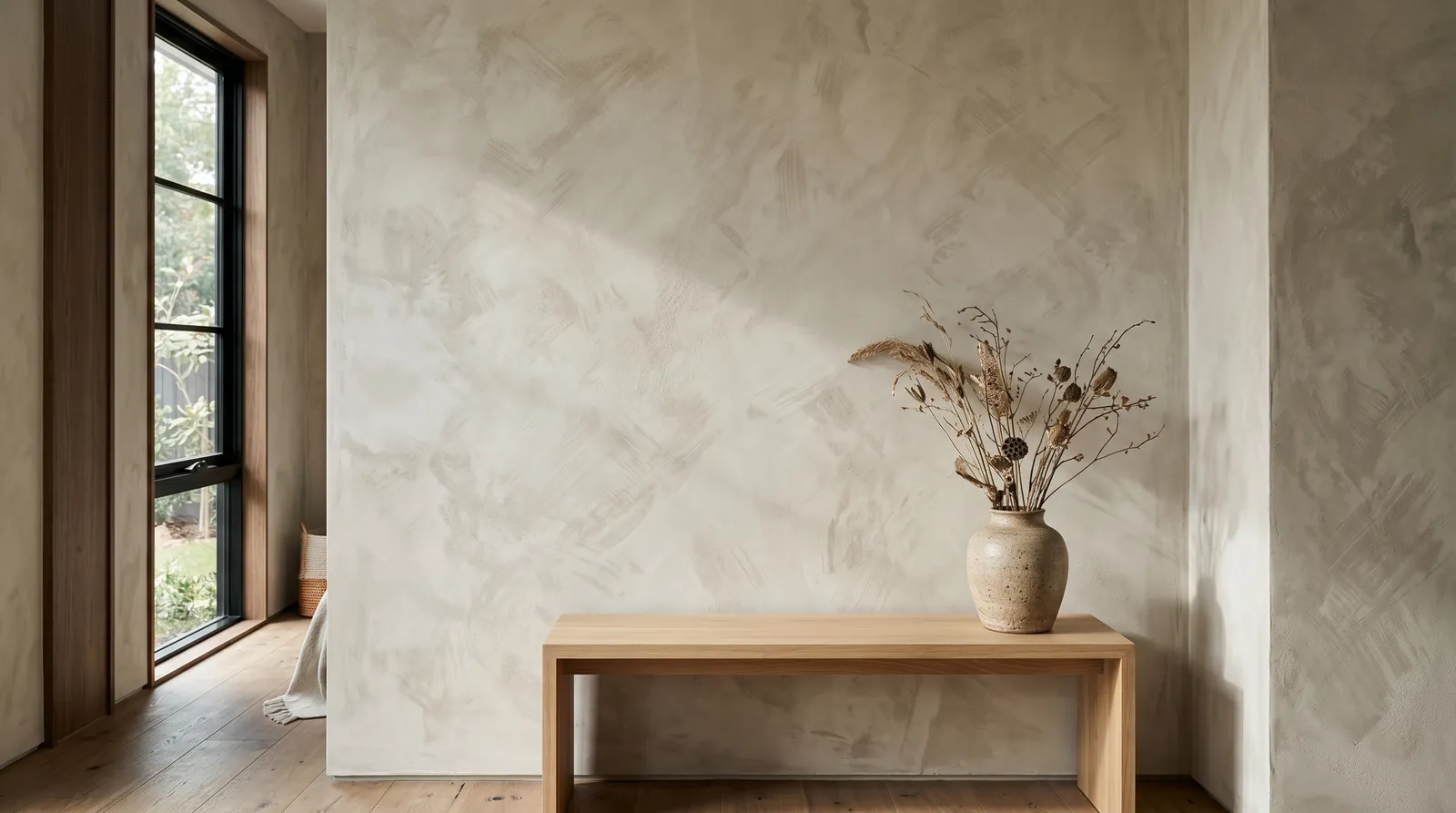
Portola Paints Roman Clay1 sheen
CoverageAbout 20–25 sq ft per 1 Kilo at two coats
VOCVirtually zero
CureCures matte unless sealed
Sheens Matte
Read this first
The Fast Verdict
Buy it for the one wall that is meant to be the room: a fireplace, a powder room, a dining wall, an entry. It gives a surface depth and movement flat paint cannot reproduce, the materials are natural lime and clay with almost no odor, and Portola's earthy palette was built for a plaster surface. The costs are real. It is sold by weight, about $30 for a 1 Kilo unit covering 20 to 25 square feet at two coats, it asks for technique, and it is interior-only.
Best for
Feature walls · Fireplace surrounds · Powder rooms · Dining rooms and entries · Smooth Level 5 drywall · Rooms where you want movement instead of even color
Skip if
Bathrooms, showers, any wet area · Whole-house even color · Large walls on a tight budget · Textured or patched drywall · An ambitious first project with no practice board
What it's good at
- Depth flat paint cannot fake — the color pools and thins across the surface the way it would across stone
- Shifting with the hour: soft and a little cool in north-facing morning light, warm with faint trowel shadow at five o'clock
- Close-up walls where the eye lingers — powder rooms, fireplaces, entries, dining rooms
- Clean materials, natural lime and clay, low odor to live with while it cures
- A palette built for plaster, so the color and the finish rarely fight each other
- Reading as a custom, considered surface that has no mass-market shortcut
- Forgiving small inconsistency on a small wall, where variation reads as character
What it's not good at
- Even, predictable color across four walls — the movement is the whole point
- Bathrooms, showers or any wet area; it is listed interior-only
- Textured or poorly finished drywall, since it wants smooth, Level 5 preferred
- Value on a large wall, at about $30 per Kilo for 20 to 25 square feet at two coats
- Roller speed — this is labor, either your weekend or a finish painter's day rate
- Light colors under a metal knife, which burnishes to shine
- Taking a wipe unsealed, and the sealer that fixes it deepens the color
Numbers, not adjectives
Spec Sheet
- Type
- Lime-and-clay plaster, tinted to the full Portola palette
- Coverage
- About 20–25 sq ft per 1 Kilo at two coats; 400–500 sq ft per 20 Kilo
- Sheen
- Matte — ultra-low, suede-like
- Coats
- Two: base coat, light sand, final coat left unsanded
- Application
- Troweled on with a putty knife or flexible trowel, not rolled
- Cure
- Cures matte unless sealed
- VOC
- Virtually zero; natural-ingredient lime and clay
- Surfaces
- Smooth interior walls only, Level 5 drywall preferred
- Not for
- Bathrooms, showers, wet areas, exteriors
- Sealer
- Roman Clay Topcoat, water-based, sold separately
- Sizes
- Sold by weight — 1, 5, 10 and 20 Kilo; samples as jars, drawdowns and 16-by-16-inch boards
- Price
- $30 for 1 Kilo up to $345 for 20 Kilo, topcoat extra
How It Sets, and What the Topcoat Changes
Roman Clay does not dry the way paint dries. You build it. The standard job is two coats — a base coat, a light sand once it has set, then a final coat left unsanded so it cures to that suede matte. Bare, the surface stays chalky-soft, and that softness is exactly what makes light graze across it instead of bouncing off. It also means a hand or a chair back can leave a mark. Portola's Roman Clay Topcoat, a water-based sealer, makes the wall wipeable, and it deepens the color by ten to twenty percent. That is not a small shift on a deep clay tone. Seal a sample board, live with it in the room for a day, and only then decide whether the wall gets sealed.
Mid-project panic
When It Goes Wrong, and How to Fix It
Shiny Streaks in a Pale Wall
Why it happens. Metal blades burnish clay. On light colors a steel putty knife polishes the plaster where it drags, and those polished passes come back at you as shine the moment low light rakes the wall. You usually cannot see it while you work, only later in the afternoon.
The fix. Use plastic putty knives on light colors, which is what Portola steers you to. Save the flexible stainless knife for deeper colors, where it gives you more control over the movement and the burnish does not read the same way.
The Movement Goes Patchy Across a Big Wall
Why it happens. This is a technique finish. Each coat is a set of overlapping knife passes, and keeping those passes even over a large surface takes practice. A tired stretch at the end of a long wall shows, because the technique is part of the finish and there is nowhere to hide it.
The fix. Practice on a piece of offcut drywall until the pressure and the overlap feel automatic. Keep your first real wall small and forgiving — a powder room, a fireplace surround — where a little variation reads as character. For a whole dining room in unforgiving light, hire a finish painter.
Running Short of Material Mid-Wall
Why it happens. It is sold by weight, not by volume, and the coverage is low: roughly 20 to 25 square feet per 1 Kilo at two coats. People size the order with paint math, come up short, and a seam where you stopped and waited on a delivery does not blend back in.
The fix. Measure the wall, divide by about 22, then add margin for practice and waste and round up. A 20 Kilo covers 400 to 500 square feet. Order everything before you start, not while you are standing on the drop cloth.
The Wall Marks Where Hands Touch It
Why it happens. Unsealed Roman Clay is matte and chalky-soft by design. In a hallway, at shoulder height, or anywhere a kid runs a palm along the wall, that softness turns into visible marks.
The fix. Seal the walls that get touched with the Roman Clay Topcoat and leave the quiet dining wall bare. Sample the sealed color first, since the topcoat deepens it by ten to twenty percent and the sealed sample is the color you will actually live with.
Side by side
Roman Clay vs Lime Wash
Portola's two hand-applied finishes both give a wall movement, and people mix them up constantly. They are not the same surface, and the choice comes down to whether you want weathered and breezy or smooth and quietly grand.
| Roman Clay | Lime Wash | |
|---|---|---|
| The look | Smooth, suede-matte, tight. Cloudy tonal movement like honed stone. | Cloudy, chalky, mottled. Softer and more rustic, closer to weather settling on the wall. |
| How it goes on | Troweled in thin overlapping layers with a putty knife or flexible trowel. | Brushed on in loose cross-hatch strokes with a wide stain brush. |
| How forgiving | Least forgiving of the two. Uneven passes and burnish marks show. | More forgiving. Small errors disappear inside the mottling. |
| Surfaces | Smooth interior walls, Level 5 drywall preferred. | Drywall, plaster, stucco, brick and masonry. |
| Indoors or out | Interior only, and not for wet rooms. | Interior and exterior. Outdoors it patinas rather than peeling. |
| Coverage and price | 20–25 sq ft per 1 Kilo at two coats; $30 per Kilo up to $345 for 20 Kilo. | 150–200 sq ft per gallon over two coats; quart $30, gallon $84, 5-gallon $345. |
| Where it belongs | A dining wall, a fireplace, a powder room — anywhere you want polished and carved. | A brick chimney breast, old lime plaster, a facade — anywhere you want timeworn. |
The look
Roman ClaySmooth, suede-matte, tight. Cloudy tonal movement like honed stone.
Lime WashCloudy, chalky, mottled. Softer and more rustic, closer to weather settling on the wall.
How it goes on
Roman ClayTroweled in thin overlapping layers with a putty knife or flexible trowel.
Lime WashBrushed on in loose cross-hatch strokes with a wide stain brush.
How forgiving
Roman ClayLeast forgiving of the two. Uneven passes and burnish marks show.
Lime WashMore forgiving. Small errors disappear inside the mottling.
Surfaces
Roman ClaySmooth interior walls, Level 5 drywall preferred.
Lime WashDrywall, plaster, stucco, brick and masonry.
Indoors or out
Roman ClayInterior only, and not for wet rooms.
Lime WashInterior and exterior. Outdoors it patinas rather than peeling.
Coverage and price
Roman Clay20–25 sq ft per 1 Kilo at two coats; $30 per Kilo up to $345 for 20 Kilo.
Lime Wash150–200 sq ft per gallon over two coats; quart $30, gallon $84, 5-gallon $345.
Where it belongs
Roman ClayA dining wall, a fireplace, a powder room — anywhere you want polished and carved.
Lime WashA brick chimney breast, old lime plaster, a facade — anywhere you want timeworn.
Want the wall to look smooth, refined and a little grand, and you are willing to practice or pay a finish painter? Roman Clay. Want a softer, weathered patina, you are painting brick or masonry, or the wall goes outside? Lime Wash, which also forgives a first-timer far more easily. Both cost real money and both need a sample board before you commit a room.
If not this one
Honest Alternatives
PL
Portola Lime Wash$84 / gal
The chalkier, brushed sibling. More forgiving for a first attempt, works on brick and masonry, and goes outside. You trade the smooth troweled surface for a cloudier, more rustic one.
Full review →PN
Portola New Standard Acrylic$74–92 / gal
The same Portola colors as ordinary rolled wall paint. No trowel, no technique, no risk of a botched plaster wall — and none of the movement either. The right call if you love the color but want an even surface.
Questions people actually ask
Roman Clay Questions, Answered
Is Portola Roman Clay worth it?
For one wall that is meant to be the room, yes. It gives a surface depth and movement flat paint cannot reproduce, the materials are clean and virtually zero-VOC, and the earthy palette was built for a plaster finish. The costs are real: about $30 for a 1 Kilo unit covering 20 to 25 square feet at two coats, plus the labor of a technique finish, and it is interior-only and not for wet rooms. Skip it if you want an even color across a whole house, or the budget is tight and the wall is large.
What is Roman Clay, exactly?
It is a lime-and-clay plaster you trowel onto a wall in thin overlapping layers, not a paint you roll. It cures to a smooth, matte, almost suede-like surface with soft stone-like movement, and it is a virtually zero-VOC, natural-ingredient material. Portola tints it across its full color palette, so you choose a color the way you would with any paint and get a plastered surface instead of a flat one.
Can a beginner apply Roman Clay themselves?
A small wall, yes, with patience and a steady hand. It goes on in two coats with a putty knife or trowel, and the technique is forgiving in a powder room or on a fireplace surround where a little variation reads as character. A whole room is harder, because keeping the movement even across a big surface takes practice. Order a sample board, try it on offcut drywall first, and hire a finish painter for anything ambitious.
Where does Roman Clay work best?
Smooth interior walls, with Level 5 drywall preferred. It shines on feature walls, fireplaces, dining rooms and powder rooms — the spots where you want a surface with depth rather than flat color. It pays you back most in the places you stand nearest, because the movement does its work at close range.
Can I use Roman Clay in a bathroom?
No. Portola lists it as interior-only and explicitly not for bathrooms, showers or wet areas. The lime-and-clay surface, left bare, is not built to take standing humidity. A powder room with no shower is a different story and one of the finish's best rooms.
Does Roman Clay need sealing, and how durable is it?
Left unsealed it stays matte and chalky-soft, which is the look most people want. In high-traffic spots or anywhere you will wipe the wall, add Portola's Roman Clay Topcoat, a water-based sealer that makes the surface wipeable and deepens the color by ten to twenty percent. Seal a hallway or a kid-height wall; leave a quiet dining wall bare.
How much Roman Clay do I need?
Roughly 20 to 25 square feet per 1 Kilo at two coats, and 400 to 500 square feet from a 20 Kilo. Measure the wall, divide by about 22, add margin for practice and waste, then round up. Running short mid-wall on a troweled finish is a worse problem than running short on paint, because the pause shows.
What knife should I use?
It depends on the color. On light shades use plastic putty knives, because a metal blade can burnish the surface and leave shiny streaks in a pale wall. On darker colors a flexible stainless knife gives you more control over the movement, and the burnish does not read the same way.
Roman Clay or Lime Wash?
Roman Clay is the smooth, troweled, more contemporary one — tighter, more velvet than chalk, interior-only. Lime Wash is brushed on in thin watery coats and dries chalky, cloudy and more rustic, forgives a beginner more easily, and works on exterior masonry too. Choose the surface first, then the color.
Keep exploring
Portola Lime Wash reviewPortola Paints brand hubBest paint for plaster wallsBrowse all Portola colors
We may earn a commission when you buy through the retailer link above. It never changes the score or the verdict.
Ask a Question