Product review · Behr · Updated August 7, 2026
Wet-Look Sealer No. 985Behr paint review
7.2/10The cheapest honest gloss on the shelf, with a narrow window for doing it right.
Eighty to ninety gloss units for about $39 a gallon, which is real. The catch is a two-minute working window, a coverage chart everyone reads wrong, and a surface Behr itself warns is slippery when wet.

Mark Thompson · Pro Contractor & Field Editor · Updated August 7, 2026
22 years running residential and light commercial repaints across the Midwest. Mark has sealed enough patios and paver walks to lead with the haze causes, and he has watched a homeowner go down on their own sealed front steps after a light rain. About the testing process →
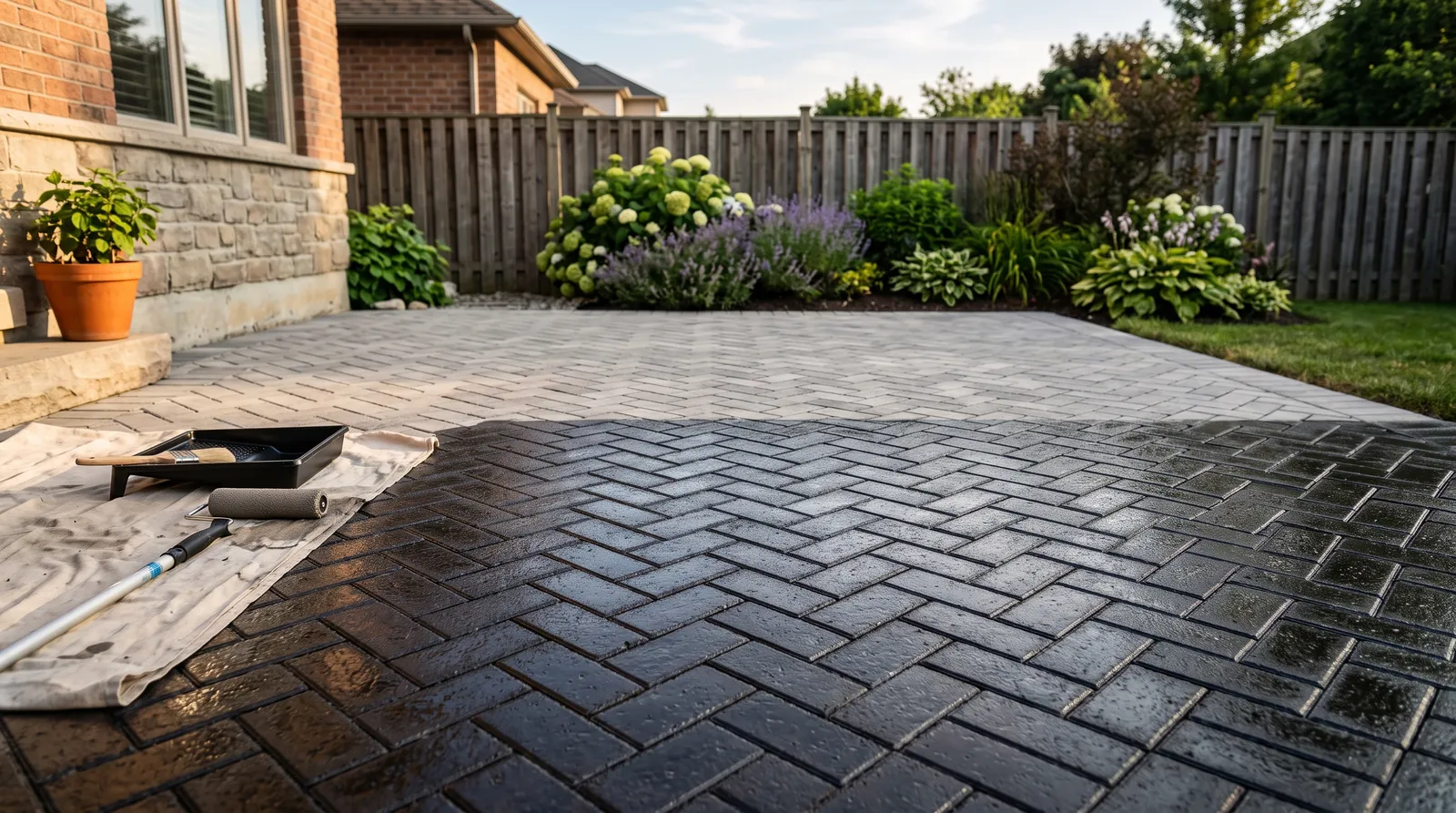
Behr Wet-Look Sealer No. 9851 sheen
Coverage200-450 sq ft / gal
Dry / RecoatTouch 1h
VOCUnder 100 g/L
Sheens Two separate products
Read this first
The Fast Verdict
Yes if you want cheap, real gloss on a dry, cured, properly prepped patio or paver walkway, and you accept that acrylic is a 2-to-3-year film rather than a decade. The 80 to 90 gloss number is honest — two coats on smooth concrete looks permanently rained on, and pavers and brick read a shade deeper. No if the surface stays damp, sees hot tires daily, sits below grade, or is anywhere people walk barefoot and wet.
Best for
Stamped and exposed-aggregate concrete · Paver patios and brick · Covered patios · Interior masonry and basement floors · A clear topcoat over porch paint or solid stain
Skip if
Pool decks and shaded steps · Daily-driver garage floors · Below-grade slabs · Wood, metal, granite, marble, or terrazzo · Anything already coated in oil-based product
What it's good at
- Honest gloss for the money — 80 to 90 at 60 degrees for about $39 a gallon
- Real color lift on masonry; brick, stone, and pavers read saturated instead of chalky
- Making exposed aggregate pop, which is one of its best uses
- Easy resealing: clean, dry, one thin coat, no stripping and no etching
- Low VOC for a sealer at under 100 g/L with water cleanup, where solvent wet-look sealers smell like a body shop for two days
- Working as a clear topcoat over porch paint or a solid color concrete stain, adding gloss and a wear layer
What it's not good at
- Giving you time — it skins in two or three minutes in warm sun and cannot be thinned
- Surviving weather; rain or heavy dew inside 24 hours hazes it milky white
- Even gloss across substrates, since thirsty pavers sink the first coat and one-coat jobs look unsealed
- Film thickness for a horizontal surface, at about 3.2 mils dry over two coats
- Wet feet — Behr's own cautions warn the surface may become slippery when moisture is present
- Driveway wheel tracks, which want annual touch-up
- Wood, metal, granite, marble, terrazzo, below-grade slabs, or anything already coated in oil-based product
Same shelf, different cans
Wet-Look No. 985 or Low-Lustre No. 986 — Pick the Gloss First
Two separate products with two separate numbers on the shelf, not two sheens of one can. Same acrylic resin, same coverage, same dry times, same price bracket. The only meaningful difference is shine, and it decides where each one belongs.
BEHR PREMIUM Wet-Look Sealer No. 985
BaseClear water-based acrylic, 25 percent (±2) solids by volume
Sheens80-90 gloss at 60 degrees — high-gloss-enamel territory
Recoat4 hr
Buy it if
The surface is a feature: stamped concrete, an exposed-aggregate pad, a brick patio you want to look wet after rain, or an interior floor. Roll it with a 3/8-inch to 1/2-inch nap.
Avoid if
The surface is a path people walk on when it is damp, or your rolling is not tidy. At 80 to 90 gloss it shows every roller stop, lap mark, and dust nib.
BEHR PREMIUM Low-Lustre Sealer No. 986
BaseClear water-based acrylic, 25.9 percent solids by volume
Sheens15-25 gloss at 60 degrees
Recoat4 hr
Buy it if
Walkways, steps, and anything underfoot and damp. It still deepens the color, it hides sloppy work, and it is the safer film where people walk. It also lists Bonding Primer No. 880 for new masonry, which Wet-Look does not.
Avoid if
You actually want the mirror. Low-Lustre deepens color but it will not build the wet look on stamped or feature concrete.
Numbers, not adjectives
Spec Sheet
- Type
- Clear, non-yellowing, water-based acrylic masonry sealer
- Gloss
- 80-90 at 60 degrees
- Solids
- 25 percent (±2) by volume · 27 percent (±2) by weight
- Coverage
- 200-450 sq ft / gal — first coat near 200, second near 450
- Film build
- Coat 1: 8.0 mils wet / 2.2 mils dry. Coat 2: 3.5 mils wet / 1.0 mil dry
- Dry / Recoat
- Touch 1h · recoat 4h at 77°F and 50 percent RH
- Traffic
- Heavy foot 24-48h · vehicles 72h · cardboard under tires 14 days · clean after 30 days
- VOC
- Under 100 g/L; complies with SCAQMD, LADCO, CARB SCM 2007, AIM, OTC and OTC Phase II
- Application temp
- 50-80°F, out of direct sun; too hot to touch means too hot to coat
- Surfaces
- Concrete, exposed aggregate, brick, stone, masonry and stucco, Mexican and unglazed tile. Not wood, metal, granite, marble, terrazzo, below-grade slabs, or the deck immediately around a pool
- Thinning
- Do not thin. Cleanup is warm soapy water
- Price
- About $39 / gal, about $183 per 5-gallon at Home Depot; 2-year shelf life unopened
Application Settings That Work
- Airless
- 0.015-inch to 0.019-inch tip with a 60 mesh filter, at package consistency. Back-roll it. The coverage numbers on the chart do not include spray loss, so buy extra.
- Thinning
- Do not thin it. It is built for package consistency, and thinning is how you get thin spots and blotchy gloss on a film that already reads every flaw at 80 to 90 gloss units.
- Primer
- No primer listed for Wet-Look on cured concrete — the slab does the work. Cure new concrete 30 days. Clean off dust, chalk, oil, grease, wax, polish, mold and mildew stains, loose paint, and rust; degrease oil spots properly or they telegraph through the clear. Etch or mechanically profile bare concrete to a 150-grit feel and rinse the residue off. Then two pass/fail checks: sprinkled water has to soak in fast rather than bead, and a taped plastic square left overnight has to come up dry underneath. Low-Lustre No. 986 does list Bonding Primer No. 880 for new or uncoated masonry.
Dry Times and When You Can Park
Touch dry in an hour, recoat at 4, heavy foot traffic off for 24 to 48 hours. Cars wait 72 hours, and even then you park on squares of corrugated cardboard for the first 14 days so hot tires do not lift the film. No cleaning at all for 30 days. Every one of those numbers assumes 77°F and 50 percent humidity, and cool or damp weather stretches all of them. The window that really catches people is not the cure, it is the working time: in 80-degree sun this skins in two or three minutes. Roll one thin pass in bays you can reach without stepping in wet material, keep a wet edge, and never re-roll an area that has started to set. Going back into a skinned pass is the most common way people manufacture their own haze.
Mid-project panic
When It Goes Wrong, and How to Fix It
It dried milky white and hazy
Why it happens. Trapped moisture, almost always. The slab was still damp, dew or rain landed inside 24 hours, the film went on too thick, or it got rolled again after it started to skin — which takes only a couple of minutes in sun. Bare concrete needs 30 days of cure and a genuinely dry surface before it sees sealer.
The fix. Light haze sometimes releases if you dab denatured alcohol on the spot and let the trapped air escape. Deep haze means stripping and starting over, and stripping acrylic off pavers is a miserable weekend. Prevent it instead: moisture-test with a taped plastic square overnight, check the forecast for rain and dew inside 24 hours, roll thin, and never go back over a set pass.
Ran out of material three-quarters of the way across
Why it happens. The label says 200 to 450 sq ft per gallon and people average it to 325. Those are two different coats, not a range. Behr's own film-thickness table puts the first coat at 8.0 mils wet, which is 200 sq ft per gallon, and the second at 3.5 mils wet, which is 450. Bare concrete soaks up the first pass; the second has almost nothing to soak into.
The fix. Do the two-number math. A 400 sq ft patio needs 2 gallons for coat one and about 0.9 for coat two — buy 3 gallons, or the 5-gallon pail if the surface is rough. Porous pavers, exposed aggregate, split-face block, and old dried-out concrete all pull more, so add 20 percent. A batch break shows in the gloss, which is why running short is worse than a leftover gallon.
It does not look wet at all
Why it happens. One coat on a porous surface. On dense troweled concrete it is a mirror straight away, but on thirsty pavers, brick, or exposed aggregate the first coat sinks in and does almost nothing visually. The second coat is what builds the shine.
The fix. Two coats on anything porous, perpendicular to each other, recoated at 4 hours. Also test a hidden square first and look at it dry, not wet — Wet-Look darkens paver color noticeably, and you want to know that before the whole patio is done.
The sealed walkway got slick after rain
Why it happens. A high-gloss acrylic film on horizontal concrete is slick when wet, and Behr says so in the cautions: sealed surfaces may become slippery when moisture is present. Shaded walks, north-facing steps, anything under a downspout, and anything people cross barefoot are where it bites. Behr already rules out the deck immediately around a pool.
The fix. Three options, best first. Use Low-Lustre No. 986 on the walking surfaces — costs you nothing but shine. Or stir in a micronized polymer additive made for clear sealers, such as H and C SharkGrip; Behr's own No. 970 additive is explicitly not for clear coatings. It knocks the gloss back a little, and that is a good trade. Or seal the seating area for looks and leave the traffic lane bare. On steps, add the grit.
The gloss wore off in the wheel tracks
Why it happens. This is a thin film for a horizontal surface — about 3.2 mils dry across two coats. Behr's own sheet warns that horizontal surfaces may see excessive wear and periodic touch-ups may be necessary. On a driveway, wheel tracks will tell you within two years.
The fix. Reseal the tracks annually and only the tracks. Resealing acrylic is genuinely easy and it is this product's best feature: clean, let it dry a full day, roll one thin maintenance coat, no stripping and no etching. The one rule is never let it wear through to bare concrete, because a patched worn-through spot next to a sealed one shows and now you are recoating everything. For a garage floor with hot tires, this was the wrong product to begin with.
Side by side
Acrylic Film vs Penetrating Sealer vs a 2-Part Floor System
These are three different jobs that all get called sealer. Pick by what you want the surface to look like afterward, and by what happens when the coating eventually wears.
| Behr Wet-Look No. 985 | Penetrating Siloxane Sealer | 2-Part Epoxy or Polyaspartic | |
|---|---|---|---|
| What it does to the look | Sits on top as a film. Real gloss, deeper color, a surface you can mop. | Soaks in and reacts. No gloss, no color change, nothing to look at. | A thick, hard cured film built for a floor rather than for looks. |
| Can it peel or haze | Yes. Hazing from trapped moisture is the number-one complaint. | No film, so nothing to peel or haze. | Far more film to lose, but it does not lift under a hot tire. |
| Hot tires | Wrong tier. Driveway wheel tracks want annual touch-up and Behr says so. | Nothing on top to lift, but it gives you no wear layer either. | The right answer for hot tires, dropped tools, and solvent spills. |
| Reseal and maintenance | The best part of the product. Clean, dry, one thin coat — no stripping, no etching. | Reapplies without a film to strip; you just cannot see when it is working. | Real prep every time, and a much bigger job to redo. |
| Cost | About $39 / gal, about $183 per 5-gallon. | More per gallon, and it gives you nothing to look at. | Three to five times more, plus real prep. |
| Where it wins | Stamped pads, paver patios, brick, interior masonry — surfaces you look at. | Driveways and exposed slabs in freeze-thaw country where durability is the point. | Working garages where a clear acrylic is the wrong tier no matter how many coats. |
What it does to the look
Behr Wet-Look No. 985Sits on top as a film. Real gloss, deeper color, a surface you can mop.
Penetrating Siloxane SealerSoaks in and reacts. No gloss, no color change, nothing to look at.
2-Part Epoxy or PolyasparticA thick, hard cured film built for a floor rather than for looks.
Can it peel or haze
Behr Wet-Look No. 985Yes. Hazing from trapped moisture is the number-one complaint.
Penetrating Siloxane SealerNo film, so nothing to peel or haze.
2-Part Epoxy or PolyasparticFar more film to lose, but it does not lift under a hot tire.
Hot tires
Behr Wet-Look No. 985Wrong tier. Driveway wheel tracks want annual touch-up and Behr says so.
Penetrating Siloxane SealerNothing on top to lift, but it gives you no wear layer either.
2-Part Epoxy or PolyasparticThe right answer for hot tires, dropped tools, and solvent spills.
Reseal and maintenance
Behr Wet-Look No. 985The best part of the product. Clean, dry, one thin coat — no stripping, no etching.
Penetrating Siloxane SealerReapplies without a film to strip; you just cannot see when it is working.
2-Part Epoxy or PolyasparticReal prep every time, and a much bigger job to redo.
Cost
Behr Wet-Look No. 985About $39 / gal, about $183 per 5-gallon.
Penetrating Siloxane SealerMore per gallon, and it gives you nothing to look at.
2-Part Epoxy or PolyasparticThree to five times more, plus real prep.
Where it wins
Behr Wet-Look No. 985Stamped pads, paver patios, brick, interior masonry — surfaces you look at.
Penetrating Siloxane SealerDriveways and exposed slabs in freeze-thaw country where durability is the point.
2-Part Epoxy or PolyasparticWorking garages where a clear acrylic is the wrong tier no matter how many coats.
If the surface is something you look at — a stamped pad, a brick patio, an exposed-aggregate pour — Wet-Look is the cheapest honest gloss on a big-box shelf, and the easy resealing is the reason to live with the touchy application. If the surface is something you drive on, or you want a look that never changes and never peels, buy a penetrating siloxane instead and stop worrying about haze. And if it is a garage with hot tires and solvent on the floor, no number of acrylic coats gets you there; that is 2-part territory.
If not this one
Honest Alternatives
BP
BEHR PREMIUM Low-Lustre Sealer No. 986About $38-40 / gal
Same acrylic, same coverage, same dry times, 15 to 25 gloss instead of 80 to 90. Deepens color without the mirror, hides application mistakes, and is the safer film on anything people walk on. It also lists Bonding Primer No. 880 for new masonry, which Wet-Look does not. If you are on the fence, this is the can more people should be buying.
AP
A penetrating siloxane sealerMore per gallon than the acrylic
Soaks in and reacts instead of sitting on top. No gloss, no color change, and no film to peel or haze. For driveways, exposed slabs in freeze-thaw country, or anywhere you just want water and salt kept out, it is the more durable answer by a wide margin — and it gives you nothing to look at.
AT
A two-part epoxy or polyaspartic floor systemThree to five times the cost
If the concern is hot tires, dropped tools, and solvent spills in a garage, a clear acrylic is the wrong tier no matter how many coats you roll. Two-part systems take real prep and real money, but they do not lift under a hot tire.
Questions people actually ask
Wet-Look Sealer No. 985 Questions, Answered
How glossy is Behr Wet-Look Sealer, really?
Genuinely glossy. The data sheet puts it at 80 to 90 gloss units read at 60 degrees, the same bracket as an interior high-gloss enamel. On smooth troweled concrete it looks like wet glass. On porous pavers, brick, or exposed aggregate the first coat sinks in and the shine looks patchy, so the second coat is what actually builds the wet look. If you want the color deepened without the shine, buy Low-Lustre No. 986 instead.
Is Behr Wet-Look Sealer slippery?
Yes, when it is wet. Behr's own cautions say sealed surfaces may become slippery when moisture is present. On a shaded walkway, a pool surround, or a north-facing step that stays damp, a high-gloss acrylic film is a real fall risk. Behr's Anti-Slip Floor Finish Additive No. 970 is not rated for clear coatings, so the workaround is a micronized polymer additive made for clear sealers, such as H and C SharkGrip. It knocks the gloss back a little. Take the trade.
How much do I need?
Read the coverage range as two different numbers, not an average. The data sheet puts the first coat near 200 sq ft per gallon and the second near 450. So a 400 sq ft patio needs about 2 gallons for coat one and about 1 more for coat two — roughly 3 gallons, not the 1.3 you get by dividing 400 by 300. Porous pavers and exposed aggregate drink more than that, so add 20 percent.
How long before I can walk or park on it?
Touch dry in 1 hour, recoat at 4 hours, and Behr says to keep heavy foot traffic off for 24 to 48 hours. Cars wait 72 hours, and even then you park on squares of corrugated cardboard for the first 14 days so hot tires do not lift the film. Every one of those numbers assumes 77°F and 50 percent humidity. Cool or damp weather stretches all of them.
Why did my sealer dry white and hazy?
Trapped moisture, almost always. The slab was still damp, dew or rain landed inside 24 hours, the film went on too thick, or it got rolled again after it started to skin, which takes only a couple of minutes in sun. Bare concrete needs 30 days of cure and a dry surface before it sees sealer. Light haze sometimes clears with denatured alcohol dabbed on the spot. Deep haze means stripping and starting over.
Can I use it on pavers?
Yes, and pavers are one of the better uses for it — Behr lists brick, natural and artificial stone, and masonry among the recommended surfaces. Sweep fresh polymeric sand into the joints and let it set before you seal, because this is a film sealer, not a joint stabilizer. Wet-Look will darken paver color noticeably. Test a hidden square first and look at it dry, not wet.
What surfaces should I not use it on?
Behr rules out wood, metal, granite, marble, terrazzo, and the deck immediately adjacent to a pool. It is also not for below-grade slabs or anywhere under hydrostatic pressure, which means a basement floor with a damp underside will push the film right off. And it will not go over an oil-based product. Wood decks want a deck stain, not this.
Do I really need two coats?
Yes on anything porous. The first coat sinks into the concrete and does almost nothing visually — it goes down at 8.0 mils wet for 2.2 mils dry. The second one goes on at 3.5 mils wet and builds the shine. One-coat jobs are exactly where the reviews saying this does not look wet at all come from. Roll the second coat perpendicular to the first.
How often do I have to reseal?
Plan on a light maintenance coat every 2 to 3 years on an open patio or paver path, 3 to 5 on a covered patio or interior floor, and annually in driveway wheel tracks — Behr's own sheet says horizontal surfaces may see excessive wear and periodic touch-ups. The good news is acrylic reseals easy: clean it, let it dry, roll one thin coat. No stripping, no etching, as long as you never let it wear through to bare concrete.
Is it the same as the Behr Wet-Look Waterproofing sealer?
No. Behr also sells a Protector and Waterproofer (No. 980) family, which is a different job — water repellency without the gloss film. If the goal is waterproofing rather than looks, that is the aisle to read. This can is a clear acrylic film sealer bought for gloss and color depth.
Keep exploring
Best concrete sealers, testedBest paver sealers comparedBehr paint brand guide — lines and where they fitWhat a sealer actually doesHow to seal a driveway, step by step
We may earn a commission when you buy through the retailer link above. It never changes the score or the verdict.
Ask a Question