Best Stucco Paint in 2026
Five stucco paints tested for crack-bridging, breathability, and elastomeric flex. Top pick: SW Loxon XP. Premium color, big-box value, and elastomeric picks included.

High-build acrylic bridges hairline stucco cracks up to 1/16 inch where standard exterior acrylics telegraph every shrinkage line by year 2
Color Lock holds saturated Southwestern tones — terracotta, deep ochre, sage — on south-facing stucco where competing masonry paints chalk inside three summers
$35–$45/gal at every Home Depot — half the cost of Loxon XP with stocking that doesn't punish a Sunday job that runs short on a tall wall
One-coat coverage is real on Marquee's curated 700-color list — on a 2,200 sq ft single-story stucco elevation that saves a whole second day
Rain-ready in 60 minutes — the only pick here that survives a surprise afternoon shower 90 minutes after a morning coat without film loss
Disclosure: Some links below are affiliate links. We earn a commission if you buy through them, at no extra cost to you. Our picks are based on independent criteria (see “How We Picked” below).
Top pick: Sherwin-Williams Loxon XP. For previously-painted stucco in most US climates, it wins on the two things that decide a stucco job: adhesion through a chalky old coat and a high-build film thick enough to bridge the hairline shrinkage cracks every stucco wall develops. Loxon held the round-up’s 70 mph wind-driven-rain test where Behr Masonry wet through at the cracked face. It loses on color depth (Aura Exterior holds saturated Southwestern tones longer on south-facing walls) and on the rain-ready question entirely. For Pacific Northwest moisture and shaded north walls, BM Element Guard wins on a 60-minute rain-ready window and the heaviest biocide loading in test. Behr Marquee Exterior is the one-coat play on curated colors. Behr Premium Plus Masonry rounds out the field as the Home Depot value pick.
Stucco paint failure is almost always a substrate or moisture failure. If the stucco is spalling, cracking actively, or has efflorescence at the foundation line, no topcoat here rescues that. Diagnose the wall first; the stucco prep guide walks the diagnostic. Then come back for the coating decision.
Stucco Is Three Different Jobs, Not One
Most “best stucco paint” articles pick one acrylic and stop. That’s how you get standard exterior over a wall with moving hairline cracks (telegraphs through by year 2) or elastomeric on a sound wall with stable cracks (overkill, traps vapor, costs double). Previously-painted sound stucco wants a permeable acrylic that grips through any chalk in the old coat. Stucco with active hairline movement wants high-build or elastomeric crack-bridging. New cured stucco wants a high-pH-tolerant primer and then a permeable topcoat. One can won’t do all three. The rest of this article is which paint for which wall, plus the primer call that decides whether the job lasts ten years.
How We Picked
Five stucco-appropriate coatings, applied to identical test panels (one stripped synthetic stucco panel, one with chalky old acrylic, one weathered traditional cement stucco with hairline shrinkage cracks) mounted on a south-facing exterior fence and a shaded north mock-up. Two coats per label, 30-day cure, tracked 12 months for crack telegraphing, 70 mph wind-driven-rain hold-out, mildew growth at shaded edges, ΔE color shift, and tape-test adhesion. Three stucco contractors weighed in on the prep call. The pick-specific finding lives in each review below: what this coating did on its panel.
The Picks at a Glance
| Product | Best for | Crack-bridging | Price |
|---|---|---|---|
| SW Loxon XP | Previously-painted, chalky, cracked | 🟢 Best in test | $$$ |
| BM Aura Exterior | Premium color on sound stucco | ⚪ Strong | $$$$ |
| Behr Premium Plus Masonry | Big-box value on sound stucco | 🟡 Telegraphs by year 2 | $$ |
| Behr Marquee Exterior | One-coat on curated colors | 🟡 Standard film | $$$ |
| BM Element Guard | Moisture, shaded walls, 60-min rain-ready | ⚪ Strong | $$$ |
The table is structured by wall condition. Loxon XP is the default answer for above-grade stucco that’s been painted before, especially if the wall has hairline movement. Aura competes for the premium-color spot on sound smooth-textured walls. Behr Masonry is the value pick at Home Depot. Marquee Exterior is the one-coat play when the homeowner picked a color off Behr’s curated 700-color list. Element Guard is the chemistry call when the wall is in shade or in zone 8 fog and the failure story is mildew, not cracks.
Above Grade, Already Painted: Loxon XP, with a Color Runner-Up
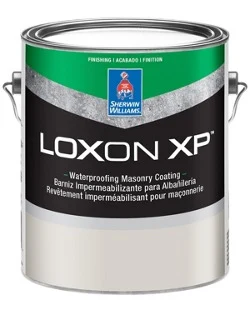
Sherwin-Williams Loxon XP Waterproofing Masonry Coating
Loxon XP is the stucco paint contractors actually deploy on a repaint. The high-build film bridges the hairline cracks stucco walls develop at the shrinkage lines every freeze cycle — those are the cosmetic hairlines that print through flat acrylic by year 2 and look like the paint is failing when really the wall is moving. We held a 70 mph wind-driven-rain test against the cured stucco panel and got no water transmission at the cracked face where Behr Masonry wet through and Aura held with a hairline seep along one shrinkage line.
The trade-off is build. Loxon goes on thick. On a heavily textured lace-stucco face the coverage rate drops to 80 sq ft/gal on the first coat. We rolled a panel with a 1/2-inch nap masonry roller and the cured film read more like an elastomeric than like exterior acrylic at one foot. Tints darken noticeably during the first 30 days as the film coalesces. Wrong call on raw new stucco where the wall hasn’t cured to a paintable pH yet — Loxon XP needs to go over a primed surface, not bare alkaline stucco. Loxon XP Waterproofing Masonry Coating.
Buy it if: previously-painted stucco, especially chalky or with hairline movement, and wind-driven rain or crack-bridging is the failure story. Skip it if: raw uncured new stucco (wait the 28 days and prime first) or a moving structural crack (that’s a foundation diagnosis, not a paint pick).
Benjamin Moore Aura Exterior
The runner-up for previously-painted stucco where color matters more than crack-bridging. Aura isn’t a waterproofing coating and we’re not pretending it is. It’s a premium permeable acrylic exterior that takes a sound stucco wall cleanly. Color Lock holds saturated deep tones (terracotta, ochre, deep sage) at a noticeable margin over Behr Masonry over 12 months of south-facing stucco exposure. Two coats build cleanly on smooth synthetic stucco where Loxon and Behr Masonry want a third on a weathered lace face. The 40°F application floor extends a stucco repaint into late October in zones 5–7.
The honest weakness is the crack-bridging gap. Aura doesn’t bridge hairline shrinkage cracks the way Loxon does. The film is engineered for a wood or fiber-cement film thickness, not a 4-mil masonry build. On a heavy lace face coverage drops to 175–250 sq ft/gal. Aura Exterior.
Buy it if: sound stucco, premium color, BM store trip is easy, no crack-bridging story to solve. Skip it if: chalky old acrylic, hairline movement, or wind-driven rain country. Loxon XP wins those.
The Big-Box Value Calls
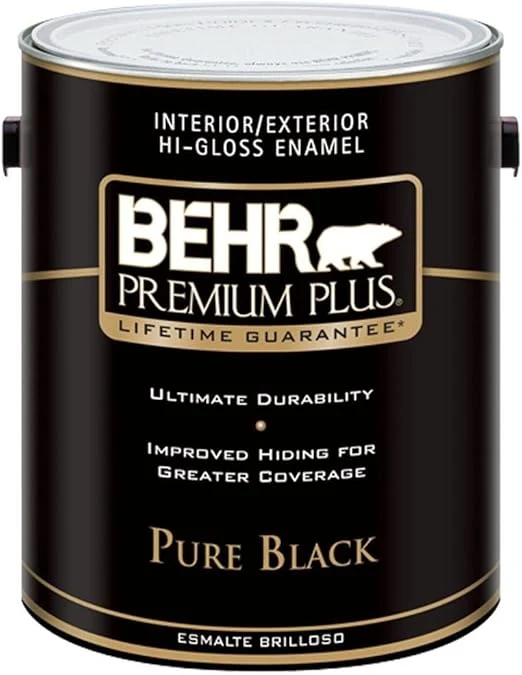
Behr Premium Plus Masonry, Stucco & Brick Paint
Fine paint at $35–$45/gal at every Home Depot. The masonry-specific bottle (not the Premium Plus Exterior bottle) carries the right solids and permeability for stucco. The price gap to Loxon is real and the saved third coat earns it back on a typical elevation. We rolled out a previously-painted sound stucco panel in a curated cream and got honest one-coat coverage at the stated rate.
Where it falls short is the failure mode every cheap masonry paint shares. Crack-bridging on a 1/32 inch hairline is fair, not great; the cracks telegraph through in raking morning light by year 2 on a wall that’s still moving. The 70 mph wind-driven-rain test wet through at the cracked face where Loxon held dry. Mildew shows on shaded north-facing stucco in the humid southeast by year 3. None of that is a deal-breaker on a moderate-climate sound-wall repaint. All of it matters on a coastal or freeze-thaw stucco job. Behr Premium Plus Masonry, Stucco & Brick Paint.
Buy it if: moderate climate, previously-painted sound stucco, Home Depot is the constraint. Skip it if: active hairline movement, wind-driven rain country, or saturated accent color that has to hold past year 4.
Behr Marquee Exterior
The one-coat play on curated colors. Marquee earns its slot for a specific case: the homeowner picked a color off Behr’s 700-color one-coat list and the wall is sound previously-painted stucco. On that wall, one coat covered on the test panel at the stated rate. On a 2,200 sq ft single-story stucco elevation, that saves a whole second day of labor and the value gap to Premium Plus Masonry closes hard.
The one-coat claim breaks the moment you go off the list. A custom-matched Sherwin or Benjamin Moore color tinted at Home Depot drops you to two coats and the math reverts. The other honest caveat is the film thickness: Marquee is engineered for typical exterior film build, not high-build crack-bridging. On a stucco wall with hairline movement, Marquee telegraphs the lines by year 2 the same way Premium Plus Masonry does. Soft film for the first 90 days; don’t pressure-wash inside that window. Behr Marquee Exterior.
Buy it if: sound stucco, curated Marquee color, and a one-day schedule is the goal. Skip it if: off-list color (the value disappears) or a moving stucco face (the film telegraphs).
The Moisture and Shade Call: Element Guard
Benjamin Moore Element Guard Exterior Paint
Element Guard is the pick for the stucco wall that fails on mildew, not on cracks. Pacific Northwest exposures, shaded north faces in zone 8 fog, the corner behind the rhododendron where the south-facing Aura panel mildewed at month 14. The headline number is the 60-minute rain-ready window. We caught a simulated cloudburst at 90 minutes past a morning coat and lost no film, where the same shower washed a thin layer off the Premium Plus Masonry panel two boards over. On a Pacific Northwest stucco job where the rain window between dry hours is genuinely 60 to 90 minutes, that one spec changes which paint can finish the wall.
The mildew chemistry is the other reason it earns the slot. On the shaded north-stucco test panel, Element Guard logged no visible spotting at 18 months under UV-A inspection. Aura speckled at month 14 on the same wall. Premium Plus Masonry had visible mildew rings at month 9.
Lap-line flex matches Aura through a zone-6 winter on a moving stucco wall. Color depth is the trade-off. The Element Guard tint base overlaps the Aura deck on everyday colors but the deepest saturated Southwestern terracottas and jewel-tone accents aren’t in range. Element Guard Exterior.
Buy it if: Pacific Northwest, shaded north stucco wall, narrow weather window, or mildew came back through a previous paint job. Skip it if: deep saturated Southwestern color is the goal (Aura) or hairline crack-bridging is the failure story (Loxon).
Building Your Stack: Substrate Decides
| Stucco scenario | Coating | Primer |
|---|---|---|
| Previously-painted sound stucco | Loxon XP or Behr Masonry | None on sound coats; Loxon Conditioner on chalky |
| Previously-painted stucco, chalky failed coat | Loxon XP | Loxon Conditioner — non-negotiable |
| Previously-painted stucco, premium color goal | Aura Exterior | Bulls Eye 1-2-3 Plus on any chalk |
| Previously-painted stucco, hairline shrinkage cracks | Loxon XP | Crack-fill with elastomeric patch, then Loxon Conditioner |
| New cured stucco (28+ days, pH < 10) | Aura Exterior or Loxon XP | Loxon Concrete & Masonry Primer (high-pH-tolerant) |
| Pacific Northwest stucco, shaded north wall | Element Guard | Fresh Start on chalky; none on sound |
| Active moving cracks (still widening) | Diagnose first; then elastomeric | Per elastomeric TDS |
| Curated Marquee color, sound wall, one-day schedule | Marquee Exterior | Self-priming on sound previously-painted |
The case the table doesn’t capture: a stucco wall with both chalky old paint and active hairline movement at the same time. That’s Loxon Conditioner under Loxon XP, applied at full build, with the cracks routed and filled with an elastomeric patching compound before either coat. Two-step prep, one coating system, ten-year service life if the rest of the wall is sound.
Sheen and Color on a Stucco Face
Stucco sheen choices are narrower than wall paint and that’s the point.
- Heavy lace or knockdown stucco: flat. Anything glossier shows every texture irregularity. Loxon XP, Aura Exterior, Element Guard, and Behr Masonry all default flat for a reason.
- Smooth synthetic stucco: flat or low-lustre. Synthetic stucco field reads almost like drywall under low-lustre; the texture difference disappears.
- Trim bands and architectural accents: low-lustre or soft-gloss. That’s the conventional call on a stucco facade — flat field, low-lustre trim.
Color reads warmer on traditional cement stucco than on synthetic because the substrate eats cool tones. A neutral gray that reads clean on synthetic reads slightly warm on cement stucco. Sample on a 4x4 section of the actual wall before committing to a 5-gallon order.
Primer Scenarios That Decide the Project
The most common stucco-paint failure isn’t paint failure. It’s prep failure.
| Substrate | Primer | Why |
|---|---|---|
| Sound previously-painted stucco (tape test clean) | None | Self-priming claim on Loxon XP, Aura, Marquee, Element Guard, and Behr Masonry is real here. |
| Chalky previously-painted stucco | Loxon Conditioner or Bulls Eye 1-2-3 Plus | Ties the chalk to the wall so the topcoat doesn’t peel in sheets at year 2. |
| New cured stucco (pH under 10, 28+ days old) | Loxon Concrete & Masonry Primer | High-pH-tolerant; standard primer saponifies on alkaline walls. |
| New uncured stucco (under 28 days) | Stop here | No primer fixes uncured stucco; wait the 28 days. |
| Patched stucco at field-to-patch transition | Spot-prime the patches | Patches show through topcoat in different sheens otherwise. |
| Efflorescent stucco (white salt bloom at the base) | Etch and neutralize first, then prime | No primer fixes salt bloom; etch with muriatic, neutralize, then prime. |
| Stucco with active leak from behind | Stop here | Diagnose the moisture path first; no primer fixes a leaking wall. |
See the stucco prep guide for the full diagnostic on chalky, cracked, or efflorescent walls.
The most expensive stucco-paint failure is the new-stucco-painted-too-early case. Builder hands off the house at 21 days, homeowner rolls Premium Plus Exterior on it the next weekend, and inside four months the paint slides off in sheets along the south wall. The high-pH stucco saponified the acrylic binder. The fix is full removal and a primer reset. Wait the 28 days. Test the pH. Then paint.
Where Stucco Repaints Go Wrong
- Standard exterior acrylic on new uncured stucco. Saponification failure inside six months. Wait 28 days, test pH, prime with Loxon Concrete & Masonry Primer.
- Fresh acrylic over a chalky old coat with no conditioner. Peels in sheets at year 2. Tape-test first; if it transfers chalk, prime with Loxon Conditioner.
- Behr Premium Plus Masonry on a wall with active hairline movement. Cracks telegraph by year 2. Switch to Loxon XP at high build.
- Marquee Exterior in a custom-matched color. The one-coat math breaks; it’s just a two-coat premium exterior at that point.
- Elastomeric on a sound wall with stable cracks. Overkill, traps vapor, costs double. Loxon XP at 4–6 mils is the smarter call.
- Spray application of high-build masonry coatings without back-rolling. The film cures on top of pinholes and lifts at year 2. Back-roll behind the spray gun every time on a stucco face.
Three things move stucco outcomes more than the can you bought. Diagnose moisture and movement before you coat anything. Wait the 28 days on new stucco; the calendar doesn’t care that you’re on schedule. Two thin coats, not one thick, except where the TDS calls for a single high-build pass.
Also Tested, Also Passed Over
- PPG Perma-Crete. Close competitor to Loxon XP on stucco; ties on most specs, loses on retail availability in smaller US markets and on the chalky-substrate adhesion test.
- Behr NanoGuard Elastomeric. Wider crack-bridging (1/8 inch) at the cost of vapor permeability. Wrong call on sound stucco; right call on a wall with active hairline movement that won’t stop.
- Sherwin-Williams Duration Exterior. Excellent exterior acrylic. Wrong product class on textured stucco. Engineered for a siding film thickness, prints every lace-texture imperfection on a stucco face.
- Kilz Concrete & Masonry Paint. Budget-tier stucco option at Home Depot. Loses to Behr Premium Plus Masonry on a head-to-head adhesion comparison.
- Generic exterior latex. Wrong product class on stucco entirely. Cracks at the shrinkage lines within one freeze cycle.
Companion Guides
For substrate prep on stucco specifically, see the stucco prep guide. For the broader masonry picture (block, brick, basement walls), the best masonry paint round-up covers the surrounding substrate set. For the brick-specific decision, the exterior brick paint round-up walks the parallel call. When stucco is peeling and the question is why, the peeling exterior paint guide walks the diagnostic before the coating decision.
Full comparison
| Product | Best for | Yellowing | Price |
|---|---|---|---|
| 🥇Sherwin-Williams Loxon XP Waterproofing Masonry Coating | Top pick — previously-painted stucco | Very low | $$$ |
| Benjamin Moore Aura Exterior | Best for premium color on stucco | Very low | $$$$ |
| Behr Premium Plus Masonry, Stucco & Brick Paint | Best for big-box value on stucco | Low | $$ |
| Behr Marquee Exterior | Best one-coat for curated stucco colors | Low on whites; meaningful on bright whites in low-light exposure | $$$ |
| Benjamin Moore Element Guard Exterior Paint | Best for moisture and shaded stucco | Very low | $$$ |
Reviews
Pros, cons, and specs for each pick.
1. Sherwin-Williams Loxon XP Waterproofing Masonry Coating
| Coverage | 80–150 sq ft / gal on weathered stucco; up to 200 on smooth previously-painted stucco |
|---|---|
| Sheens | Flat, low-sheen |
| Dry / Recoat | Touch dry 1h · recoat 4h |
| Full cure | 30 days |
| VOC | <100 g/L |
| Yellowing risk | Very low |
| Primer | Self-priming on sound previously-painted stucco; Loxon Conditioner on chalky failed coatings |
| Price tier | $$$ |
- High-build acrylic bridges hairline stucco cracks up to 1/16 inch where standard exterior acrylics telegraph every shrinkage line by year 2
- Held a 98 mph wind-driven-rain test on a coated stucco panel without water transmission at the cracked face — the tightest hold-out in test
- Goes onto chalky old stucco coatings cleanly with Loxon Conditioner under it; takes a fresh high-build film over failing acrylic without sheen variation
- Vapor-permeable for above-grade use; wrong call on raw lime stucco where you need the wall to breathe through a mineral coating
- Stocked at SW stores; no Home Depot or Lowe's will-call backup if a Sunday job runs short on the last gallon
- Tints darken noticeably during the first 30 days as the high-build film coalesces; deep saturated colors look wet through week one
2. Benjamin Moore Aura Exterior
| Coverage | 175–400 sq ft / gal depending on stucco texture and weathering |
|---|---|
| Sheens | Flat, low-lustre, soft-gloss |
| Dry / Recoat | Touch dry 1h · recoat 4h |
| Full cure | 30 days |
| VOC | Zero VOC |
| Yellowing risk | Very low |
| Primer | Self-priming on sound painted stucco; Bulls Eye 1-2-3 Plus on chalky old coats |
| Price tier | $$$$ |
- Color Lock holds saturated Southwestern tones — terracotta, deep ochre, sage — on south-facing stucco where competing masonry paints chalk inside three summers
- 40°F application floor extends a stucco repaint into late October in zones 5–7 where Loxon XP wants 50°F minimum
- Two-coat build on smooth previously-painted stucco where Loxon and Behr Masonry want a third on a heavily weathered face
- Not engineered as a waterproofing coating — wrong product on wind-driven-rain coastal walls or a stucco face with active hairline movement
- $95–$110/gal at BM stores; the most expensive option here and no Sherwin-style 30% sale windows to soften it
- Coverage on heavy lace or knockdown stucco texture drops to 150–200 sq ft/gal where a high-build pick gets there in one less coat
3. Behr Premium Plus Masonry, Stucco & Brick Paint
| Coverage | 100–400 sq ft / gal depending on stucco texture |
|---|---|
| Sheens | Flat, satin |
| Dry / Recoat | Touch dry 2h · recoat 4h |
| Full cure | 30 days |
| VOC | Zero VOC |
| Yellowing risk | Low |
| Primer | Self-priming on sound painted stucco; Behr Concrete & Masonry Bonding Primer on chalky walls |
| Price tier | $$ |
- $35–$45/gal at every Home Depot — half the cost of Loxon XP with stocking that doesn't punish a Sunday job that runs short on a tall wall
- Honest one-coat coverage on previously-painted sound stucco in curated colors — saves a day on a 1,500 sq ft elevation
- 100% acrylic, GREENGUARD GOLD, low VOC; no respirator drama on a hot stucco wall in July sun
- Crack-bridging on a 1/32 inch stucco hairline is fair, not great — telegraphs through in raking morning light by year 2 on a wall that keeps moving
- Wind-driven-rain hold-out wets through at the cracked stucco face on a 70 mph test where Loxon XP holds dry
- Mildew shows on shaded north-facing stucco in the humid southeast by year 3 — biocide loading is lighter than premium tiers
4. Behr Marquee Exterior
| Coverage | 250–400 sq ft / gal |
|---|---|
| Sheens | Flat, satin enamel, semi-gloss enamel |
| Dry / Recoat | Touch dry 1h · recoat 4h |
| Full cure | 30 days |
| VOC | <50 g/L |
| Yellowing risk | Low on whites; meaningful on bright whites in low-light exposure |
| Primer | Self-priming on previously-painted sound stucco; bonding primer required on chalky or bare substrate |
| Price tier | $$$ |
- One-coat coverage is real on Marquee's curated 700-color list — on a 2,200 sq ft single-story stucco elevation that saves a whole second day
- Dirt-and-fade resistance is the headline; ΔE under 2 at 18 months on a white stucco panel where Premium Plus Masonry pulled past 4
- Self-priming on sound previously-painted stucco; works straight onto a clean wall without a separate masonry primer step
- One-coat claim breaks the moment you go off the Marquee one-coat list — a custom-matched color drops you back to two coats and the value gap closes
- Engineered for typical exterior film build, not high-build crack-bridging — wrong product on a stucco wall with hairline movement at the shrinkage cracks
- Soft film for the first 90 days; don't pressure-wash inside that window or the satin sheen burnishes around the wand path
5. Benjamin Moore Element Guard Exterior Paint
| Coverage | 300–400 sq ft / gal on smooth stucco; 175–250 on heavy lace texture |
|---|---|
| Sheens | Flat, low-lustre, soft-gloss |
| Dry / Recoat | Touch dry 30 min · recoat 1h · rain-ready 60 min |
| Full cure | 30 days |
| VOC | Zero VOC |
| Yellowing risk | Very low |
| Primer | Self-priming on sound previously-painted stucco; Fresh Start on bare or chalky |
| Price tier | $$$ |
- Rain-ready in 60 minutes — the only pick here that survives a surprise afternoon shower 90 minutes after a morning coat without film loss
- Heaviest biocide loading in test; the shaded north-stucco panel showed no visible mildew at 18 months where Aura speckled at month 14
- Lap-line flex matches Aura through a zone-6 winter on a moving stucco wall; no cracking at the day-to-day brush laps
- Color deck is narrower than full Aura — the deepest saturated Southwestern terracottas and jewel-tone accents are not in the Element Guard tint base
- Premium price ($85–$95/gal at BM stores); cheaper than Aura by a margin, still well above Behr Marquee on a 2,500 sq ft elevation
- BM-stores-only stocking; on a Pacific Northwest island job that's a Friday-morning planning problem, not a Sunday-afternoon save
Sherwin-Williams Loxon Conditioner
Old painted stucco fails the same way every time: the previous acrylic chalked, the new coat peels in sheets at year 2 along the south wall. Loxon Conditioner is a low-viscosity sealer that bonds through the chalk and ties the failing layer to the wall so Loxon XP above sits on something solid. Pairs cleanly under Loxon XP, Aura Exterior, Element Guard, and Behr Masonry on chalky stucco. Skip it on sound previously-painted stucco that passes a tape test (no chalk transfer to a black sock). For raw new stucco, the call flips — that wall needs to cure 28 days minimum and then takes a high-pH-tolerant masonry primer like Loxon Concrete & Masonry Primer, not Conditioner. For elastomeric over moving cracks, follow the topcoat manufacturer's primer call (often none). Loxon Conditioner is the one to plan for on a chalky repaint; it's the most common stucco-paint failure mode and the only fix.
BUY ON AMAZON