Best Spray Paint for 2026
Six aerosol spray paints tested on steel, ABS plastic, raw pine, and powder-coated aluminum for adhesion, sag, and fade. Top pick: Rust-Oleum Painter's Touch 2X.

Widest usable range in the test: it laid down cleanly on raw pine, primed steel, and MDF without a separate primer, and only slipped on slick ABS plastic
Oil-based alkyd with rust-inhibitive pigment. On our rusted-steel offcut it was the only can with zero bleed-through at week 12
Only can in the test that passed a full cross-hatch tape pull on untreated ABS plastic with zero square loss
The wide fan trigger is the best spray head sold at retail. It cut visible overlap banding on our gloss navy aluminum panel to nothing
$4 to $5 a can and touch dry in about 10 minutes, the fastest in the test
Dead-flat velvet finish out of a can, with none of the brush texture that gives a chalk-paint job away
Disclosure: Some links below are affiliate links. We earn a commission if you buy through them, at no extra cost to you. Our picks come from the test protocol in “How We Picked”. No brand pays for placement.
Top pick: Rust-Oleum Painter’s Touch 2X Ultra Cover. At about $6 a can it’s the cheapest thing in this test that behaves like a real coating, and it covered a black-to-white flip on raw pine in two passes where the budget cans needed four. Painter’s Touch wins on hide, price, and being stocked in every hardware store in the country. It falls short on tip design and on bare rusted steel, where the acrylic chemistry is simply wrong. If you need to spray untreated plastic, buy Krylon Fusion All-In-One instead. If the project is a rusty gate or a wrought-iron rail, buy Rust-Oleum Stops Rust and accept the two-day cure.
The can matters less than most people believe. Distance, pass speed, and temperature decide more of the outcome than which label you grabbed, and I’ve watched a $4 can outperform an $11 one because the person holding it kept a steady 10 inches and didn’t chase full coverage on pass one.
Where the can does decide things: plastic adhesion, rust bleed-through, and whether a matte finish stays matte. Those three are where the picks separate.
How We Picked
Six aerosols sprayed onto four matched substrates (16-gauge cold-rolled steel, untreated black ABS, raw kiln-dried pine, powder-coated aluminum) plus a pre-rusted steel offcut with no primer, all at 72°F and 45% humidity. After a 7-day cure I ran ASTM D3359 cross-hatch tape pulls on every panel, stepped each nozzle 2 inches closer per pass on a vertical board until the film ran, counted passes to full hide on both a black and a white ground, and left duplicate panels on a south-facing rack from April through June. Pick-specific results sit inside each review below.
The Field at a Glance
| Product | Best for | Touch dry | Plastic adhesion | Price |
|---|---|---|---|---|
| Rust-Oleum Painter’s Touch 2X | Top pick: wood, MDF, primed metal | 20 min | 🟡 2B | $ |
| Rust-Oleum Stops Rust Spray | Bare and rusted metal | 2–4 h | 🟡 2B | $ |
| Krylon Fusion All-In-One | Plastic, resin, vinyl | 20 min | 🟢 5B | $ |
| Rust-Oleum Universal Premium | Best finish, decorative textures | 30 min | 🟢 4B | $$ |
| Krylon COLORmaxx | Budget, craft, seasonal | 10 min | 🔴 0B | $ |
| Rust-Oleum Chalked Spray | Matte furniture look | 20 min | 🟢 4B | $ |
Two numbers in that table do most of the work. The plastic column is why Fusion exists, and the touch-dry column is why Stops Rust costs you a weekend. Everything else is preference.
Grouped by Chemistry
| Chemistry | Picks | What it’s good at | Where it fails |
|---|---|---|---|
| Waterborne acrylic | Painter’s Touch 2X, COLORmaxx | Fast dry, low odor, no yellowing on whites | Bleeds through on rusted steel; softer film |
| Oil-based alkyd | Stops Rust | Rust inhibition, film build, gloss retention | Slow cure, strong odor, ambers on pale colors |
| Acrylic-alkyd hybrid | Universal Premium | Sag resistance, decorative textures, flow-out | Costs 60% more; not a rust primer |
| Adhesion-modified acrylic | Krylon Fusion | Bonds to untreated plastic with no prep | Thin build on porous wood |
| Chalk-mineral | Chalked Ultra Matte | Flat velvet finish, sands like brush chalk paint | Needs a separate topcoat to be washable |
The split that matters here is oil versus everything else. Alkyd is the only chemistry in the aisle with a rust-inhibitive pigment that keeps corrosion from pushing back through the film, and no amount of acrylic marketing changes that. Everything else on the shelf is a variation on waterborne acrylic with different resin modifiers and different tips.
Quick Decision Tree
- A wooden chair, a shelf, a lamp base, a picture frame: Painter’s Touch 2X. Two coats, done Saturday.
- A rusty gate, a wrought-iron rail, a mailbox post: Stops Rust. Wire-brush the loose scale, spray straight over the tight rust, block out two days.
- Patio resin, an IKEA plastic bin, a planter, a bike helmet: Krylon Fusion. No primer, no sanding on clean plastic.
- A finish someone will look at closely, or a hammered/forged texture: Universal Premium. Pay the extra $4.
- Seasonal decor, a craft project, something you’ll repaint next spring: COLORmaxx.
- A dresser you want reading as chalk-painted: Chalked Spray plus the matte topcoat. Budget for both.
The Picks in Detail
Rust-Oleum Painter’s Touch 2X Ultra Cover, Top Pick
This is the can I’d hand someone who owns one can. Acrylic, quick, cheap, and the pigment load lives up to the “2X” claim in a way most marketing numbers don’t. On the hide test I sprayed gloss white over a black-primed pine board and hit full opacity in two passes. COLORmaxx needed four and still ghosted at the edges under raking light. On raw pine and MDF the tape pull came back 5B with no square loss, and on the powder-coated aluminum panel it was 4B.
Two things it doesn’t do. The stock nozzle is a narrow fan, maybe 2 inches wide at 10 inches out, which means anything wider than a chair back turns into a strip-and-overlap exercise. In gloss black the overlap bands showed at an angle under shop light on my first panel. I fixed it by spraying wetter and overlapping by half, but the Universal trigger solves it without technique. And the sag threshold is 7 inches at a slow pass. Get closer than that on a vertical surface and it runs.
On the rusted offcut, Painter’s Touch failed exactly the way acrylic over rust fails: it looked fine at week one and by week eight there were orange halos pushing through at the pit edges. Not a defect. A wrong-tool result. For that job the acrylic is never the answer, no matter which brand’s label is on it.
At $6 a can it’s about $0.45 per square foot at full hide, cheapest per covered foot in the whole test once you account for the pass count. Home Depot, Lowe’s, Ace, Walmart, and Amazon all carry it, and the 12-oz can ships well.
Buy it if the project is wood, MDF, primed metal, or anything you’d otherwise brush. Skip it if you’re spraying untreated plastic or bare rust.
Rust-Oleum Stops Rust Protective Enamel Spray, Best for Metal
The specialist. Oil-based alkyd with a rust-inhibitive pigment package, and the only can here that put zero orange through the pre-rusted steel offcut at week 12. Every acrylic in the group bled somewhere. Stops Rust didn’t.
The reason is film build and chemistry together. Stops Rust lays down a noticeably heavier wet coat than the acrylics, so it flows out over pitted metal instead of shrinking into every crater as it dries. On a wrought-iron rail that reads as a smooth finish rather than a texture map of the corrosion underneath. The gloss also holds: at three months on the south rack my gloss black panel still had wet-look depth where the acrylic gloss black had gone slightly satin.
You pay for it in time. Touch dry is 2 to 4 hours, not 20 minutes. Handle is 5 to 9 hours. The recoat window is within 1 hour or after 48, and the dead zone in between is real; I’ve seen the wrinkle failure that comes from ignoring it, and there’s no fix except sanding back. Plan a gate or a rail as a two-day job with the second coat going on Sunday morning.
The other honest cost is the smell. This is a solvent alkyd, it off-gasses hard for 24 hours, and the overspray dries sticky instead of dusty so it tracks onto floors. Respirator, outdoors, and put down real canvas. Cheap plastic sheeting slides underfoot and the overspray beads on it instead of soaking in. Our drop cloth picks cover what’s worth buying there.
Whites amber in a garage. Don’t fight it; pick a mid or deep tone. For the prep sequence on corroded metal, work through the rusted metal prep guide before you buy.
Buy it if there’s rust, tight scale, or bare steel involved. Skip it if you need the piece back in service today.
Krylon Fusion All-In-One, Best for Plastic
Fusion is the only can in this round-up that passed a full 5B cross-hatch on untreated black ABS. Zero squares lifted. Painter’s Touch came back 2B on the same panel, COLORmaxx came back 0B and peeled in a single sheet when I pulled the tape, which was the most dramatic failure in the whole test.
The tip deserves its own paragraph. Fusion’s 360-degree dial sprays upside down and at any angle, which sounds like a gimmick until you’re doing the underside of a patio chair. I sprayed a full stackable resin chair without turning it over once. Touch dry landed at just under 20 minutes on a 72°F afternoon and the piece was handleable inside the hour.
Where it gives ground is build. On raw pine it soaked in and needed a third pass to even out, where Painter’s Touch was done in two. The color range is narrower and leans bright: good coverage across pastels and mid-tones, nothing in true navy or oxblood. And the no-prep marketing has a boundary. Clean plastic, yes. A patio chair that’s been chalking in Arizona sun for six years still wants a scrub and a 220-grit scuff, or you’re bonding to a powdery layer that’s already letting go.
Buy it if the substrate is plastic, resin, vinyl, or anything slick. Skip it if the job is mostly raw wood; you’ll spend the savings on a third can.
Rust-Oleum Universal Premium, Best Finish
The upgrade you can see. Universal’s wide fan trigger is the best spray head sold at retail and it isn’t close. On the gloss navy aluminum panel I couldn’t find an overlap band anywhere, which is the failure mode that gives away a rattle-can job at 3 feet. Sag resistance was also the best in the group: it held a clean vertical film at 5 inches on a slow pass, two inches tighter than Painter’s Touch.
The decorative range is the second reason. Hammered, forged, distressed, aged metallic, oil-rubbed bronze. These finishes exist because they hide substrate flaws, and on a garage-sale metal side table with dents in it, the hammered charcoal made the damage read as intentional texture. That’s a genuinely useful trick and none of the other picks in this test offer it.
The catch is money and touch-up. At $9 to $11 a can against $6 for Painter’s Touch, a four-can project is $20 more for a finish most people can’t distinguish at conversational distance. And the textured finishes are close to impossible to spot-repair invisibly a year later; a chip means respraying the whole face.
Buy it if the piece is visible and the finish is the point. Skip it if you’re painting a shelf that lives in a garage.
Krylon COLORmaxx, Budget Pick
$4 a can and touch dry in about ten minutes. That’s the pitch and it’s true.
Everything else is a trade. The film is the thinnest in the test, which is why it took four passes to a full color flip and why the price advantage evaporates on anything with real square footage. The sage panel on the outdoor rack chalked visibly at week 10 while every other pick held. And it clogged twice on me, both times after I stopped mid-can and didn’t invert-purge the tip before walking away.
None of that disqualifies it for what it’s actually for. Pumpkins, wreath frames, terracotta pots, a photo-shoot backdrop, a kid’s project, anything you’ll redo next season. For that work it’s the right amount of paint at the right price.
Skip this if the piece lives outdoors past one summer.
Rust-Oleum Chalked Ultra Matte Spray, Best Matte Furniture Finish
The reason this one is in the round-up is texture. Brush-applied chalk paint always carries some brush drag, and on a flat dresser front that drag is what tells people it’s a DIY job. Sprayed, the same look arrives dead flat and completely even. On my raw pine and laminate panels it grabbed with no sanding and came back 4B on the tape pull, which no other flat aerosol I’ve tested manages on laminate.
It also distresses correctly. A 220-grit rub on a drawer edge cut through to the wood with the same soft feathered break you get from brush-on chalk paint, not the hard chipped edge acrylic gives.
Two real limits. Unsealed, the finish marks with a fingernail and a wet glass leaves a ring, so the matching matte topcoat isn’t optional and that’s a second can. And hide is poor on dark-to-light: three coats minimum over a walnut stain. Twelve muted colors, no brights.
If the project is a dresser or a nightstand, the furniture repaint walkthrough covers the sanding and sealing sequence. For the wax-versus-poly question on the topcoat, that decision is its own comparison.
What Actually Ruins a Spray Job
- Spraying at 4 inches to “get it covered.” That’s how runs happen. Ten inches, steady speed, and accept that pass one looks thin.
- Chasing coverage on the first coat. Two light passes beat one heavy one every time, and the heavy one sags.
- Ignoring the recoat dead zone. Within 1 hour or after 48 (24 on most acrylics). In between, the new solvent wrinkles the skinned film underneath.
- Spraying below 50°F or above 90°F. Cold paint atomizes coarse and lands gritty. Hot paint dries in the air and lands as dust.
- Not shaking for the full minute. The label says one minute after the ball rattles. Under-shaken cans spit and spray off-color.
- Skipping the invert-purge. Three seconds upside down after every session is the whole clog-prevention protocol.
- Masking too close. Overspray drifts further than you think. Mask 3 feet past where you believe the edge is, and check what’s parked nearby.
Weather Decides More Than the Can
Aerosol is the most weather-sensitive way to apply paint, and it’s the variable nobody accounts for when a job comes out wrong.
Below about 50°F the propellant loses pressure and the paint atomizes coarse. The droplets land as distinct specks instead of merging into a film, and the panel comes out feeling like fine sandpaper. There’s no fixing that except sanding flat and respraying warm. I ran a duplicate Painter’s Touch panel at 48°F on a March morning and it graded visibly rougher than the 72°F control at the same distance and pass speed.
Above about 90°F the opposite happens. Solvent flashes off mid-flight and the paint arrives half-dry, so it never levels. That’s the dusty, textured finish people get spraying a mailbox in an August driveway at noon. Same can, same technique, wrong hour.
Humidity has its own failure. Above roughly 85% relative humidity, water condenses into the drying film and you get blushing, a milky haze in gloss and clear coats especially. It shows up most on a humid evening after a hot day, when the surface temperature drops below the dew point while the film is still open.
The workable band is 55°F to 85°F, under 70% humidity, out of direct sun, with air moving. Store cans indoors overnight rather than in an unheated garage, because a 45°F can sprays poorly even on a 70°F afternoon. If a can feels cold in your hand, set it in a bucket of warm tap water for ten minutes before you shake it. Never heat an aerosol with anything hotter than that.
Cost Math on Common Projects
| Project | Cans needed | Painter’s Touch 2X | Universal Premium | COLORmaxx |
|---|---|---|---|---|
| Wooden dining chair | 2 | ~$12 | ~$20 | ~$9 |
| Patio chair, metal frame | 2 | ~$12 | ~$20 | ~$9 |
| 3-drawer dresser | 4 | ~$24 | ~$40 | ~$18 |
| Interior door, one face | 3 | ~$18 | ~$30 | ~$14 |
| Set of 6 shutters | 8 | ~$48 | ~$80 | ~$36 |
The shutter row is where aerosol stops making sense. Eight cans of anything is roughly a quart of sprayable paint at four times the price, and at that point equipment wins. Our HVLP sprayer picks cover the entry tier.
On price: all six of these are cheaper per can at a physical Home Depot or Lowe’s than on Amazon, usually by $1 to $2, because aerosols carry a hazmat shipping surcharge. The Amazon links here are worth using for the multi-can packs and for the colors your local store doesn’t stock, which in practice is most of the interesting ones. If you need three cans of gloss white, drive. If you need three cans of Universal’s forged hammered slate, order.
Also Considered, Also Rejected
- Montana Gold and MTN 94. Excellent artist-grade aerosols with the best tip systems in the industry. Wrong audience for this page: $9 a can, sold in art stores, engineered for murals rather than furniture and metal.
- Rust-Oleum Universal Advanced Formula. Same line as our pick with a reformulated resin. Retail stocking is inconsistent across regions right now and I couldn’t get matched panels at the same time, so it sits out this round.
- Krylon Rust Tough. Krylon’s answer to Stops Rust and a decent one. Stops Rust still out-performed it on the pre-rusted offcut, and the color and sheen range is wider.
- Store-brand and hardware-house aerosols. Inconsistent can-to-can pigment within the same lot, which is fatal on any project that needs more than one can.
- Rust-Oleum Painter’s Touch 2X clear topcoat. Not a color coat, so it isn’t a pick, but it’s the right last step over any of these on outdoor furniture. Two coats of clear roughly doubles the outdoor life of the acrylics.
- Automotive lacquer aerosols. Beautiful gloss, and they’ll lift every acrylic underneath. Only use them over automotive primer on a complete system.
Buy the $6 can of Painter’s Touch, hold it 10 inches out, and give it two coats instead of one. That’s most of the difference between a job that looks sprayed and a job that looks painted.
Full Comparison
| Product | Best for | Yellowing | Price |
|---|---|---|---|
| Rust-Oleum Painter's Touch 2X Ultra Cover Spray Paint | Top pick — best all-around rattle can | Low on whites held indoors; slight amber drift outdoors past year two | $ |
| Rust-Oleum Stops Rust Protective Enamel Spray | Best for bare and rusted metal | Medium on whites, high in low-light interiors | $ |
| Krylon Fusion All-In-One Spray Paint | Best for plastic, resin, and slick surfaces | Low | $ |
| Rust-Oleum Universal Premium All-Surface Spray Paint | Best premium finish and best trigger | Low | $$ |
| Krylon COLORmaxx Paint + Primer Spray | Budget pick | Low indoors; chalks before it yellows outdoors | $ |
| Rust-Oleum Chalked Ultra Matte Spray Paint | Best matte furniture finish | Low; the matte topcoat is the yellowing variable, not the color coat | $ |
Every Pick, Pros and Cons
Pros, cons, and specs for each pick. The cons are not optional here.
1. Rust-Oleum Painter's Touch 2X Ultra Cover Spray Paint

- Coverage
- 12–15 sq ft per 12-oz can at full hide
- Sheens
- Gloss, satin, semi-gloss, flat, metallic
- Dry / recoat
- Touch dry 20 min · handle 1h · recoat within 1h or after 48h
- Full cure
- 24 hours to hard film; 7 days to full hardness
- VOC
- Varies by state; compliant low-VOC SKUs sold in CA and the OTC states
- Yellowing risk
- Low on whites held indoors; slight amber drift outdoors past year two
- Primer
- None on wood, MDF, or primed metal; bonding primer on plastic
- Price tier
- $
- Widest usable range in the test: it laid down cleanly on raw pine, primed steel, and MDF without a separate primer, and only slipped on slick ABS plastic
- The 2X pigment load is real. Two passes hid a black-to-white flip on pine where the budget cans needed four and still ghosted
- Roughly $6 a can at 12 oz, stocked at Home Depot, Lowe's, Ace, Walmart, and most hardware counters in America. About 50 stocked colors in gloss, satin, and flat
- Sags easier than the pricier Universal at close range. Our sag threshold was 7 inches at a slow pass; Universal held to 5
- The stock tip is a narrow fan. On anything wider than a chair back you will strip-and-overlap, and overlap bands show in gloss black
- Acrylic chemistry, not oil. On bare rusted steel it is the wrong can and the rust bleeds back through inside a season
2. Rust-Oleum Stops Rust Protective Enamel Spray

- Coverage
- 12–14 sq ft per 12-oz can
- Sheens
- Gloss, satin, semi-gloss, flat, hammered, metallic
- Dry / recoat
- Touch dry 2–4h · handle 5–9h · recoat within 1h or after 48h
- Full cure
- 24 hours to handle hard; 7 days to full chemical hardness
- VOC
- High-solvent alkyd; restricted SKUs in CA and OTC states, check the shelf label
- Yellowing risk
- Medium on whites, high in low-light interiors
- Primer
- None on rusted or bare steel; Clean Metal Primer on galvanized
- Price tier
- $
- Oil-based alkyd with rust-inhibitive pigment. On our rusted-steel offcut it was the only can with zero bleed-through at week 12
- Builds a thicker wet film than any acrylic here, which is why it flows out over pitted metal instead of following every crater
- Deep gloss holds its shine outdoors longer than the acrylics; the gloss black panel was still reading wet-look at three months
- Slow. Touch dry runs 2 to 4 hours, and the recoat window is within 1 hour or after 48 hours. A gate takes a weekend, not an afternoon
- Strong solvent smell that lingers a day indoors. Wear a cartridge respirator and spray it outside
- Whites and pale creams amber noticeably in a garage or shed. Specify a mid or deep tone and the problem disappears
- Overspray dries sticky rather than dusty, so it tracks onto shoes and floors if you skip the drop cloth
3. Krylon Fusion All-In-One Spray Paint
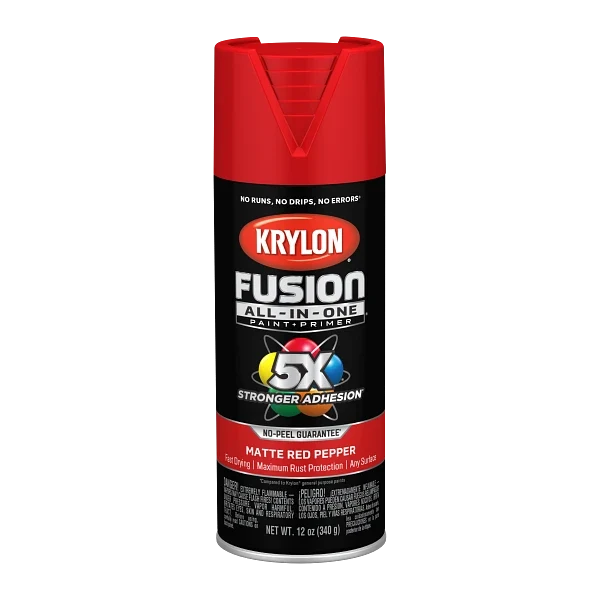
- Coverage
- 20–25 sq ft per 12-oz can
- Sheens
- Gloss, satin, matte, metallic, hammered
- Dry / recoat
- Touch dry 20 min · handle 1h · recoat any time
- Full cure
- 24 hours
- VOC
- Varies by state; compliant SKUs in CA and OTC states
- Yellowing risk
- Low
- Primer
- None on clean plastic, resin, or vinyl
- Price tier
- $
- Only can in the test that passed a full cross-hatch tape pull on untreated ABS plastic with zero square loss
- The 360-degree dial tip sprays upside down, which is the difference between finishing a patio chair and rolling it over four times
- Fast on the clock: touch dry inside 20 minutes and handleable in an hour, so a small piece is a single-evening job
- Thinner build than Painter's Touch. On raw pine it soaked in and needed a third pass for even hide
- Color deck is narrower than Rust-Oleum's and skews bright. Deep oxblood, hunter, and true navy are not in the range
- The no-prep claim is only true on clean plastic. On chalked, sun-baked patio resin it still needs a scuff and a wipe
4. Rust-Oleum Universal Premium All-Surface Spray Paint

- Coverage
- 15 sq ft per 12-oz can
- Sheens
- Gloss, satin, matte, hammered, metallic, textured
- Dry / recoat
- Touch dry 30 min · handle 1–2h · recoat within 1h or after 24h
- Full cure
- 24 hours to hard; 7 days to full hardness
- VOC
- Varies by state; compliant SKUs in CA and OTC states
- Yellowing risk
- Low
- Primer
- None on most surfaces; bonding primer on chalked plastic
- Price tier
- $$
- The wide fan trigger is the best spray head sold at retail. It cut visible overlap banding on our gloss navy aluminum panel to nothing
- Highest sag resistance in the group: held a clean film at 5 inches and a slow pass where Painter's Touch ran at 7
- The decorative range is the reason to buy it. Hammered, distressed, forged, aged metallic, and oil-rubbed bronze all live in this line
- $9 to $11 a can versus $6 for Painter's Touch. On a four-can project that is a real gap for a finish most people cannot pick out at 3 feet
- The hammered and textured finishes hide flaws beautifully and are almost impossible to touch up invisibly later
- Still an acrylic-alkyd hybrid, so it is not the rust answer. Bare corroded steel wants Stops Rust
5. Krylon COLORmaxx Paint + Primer Spray
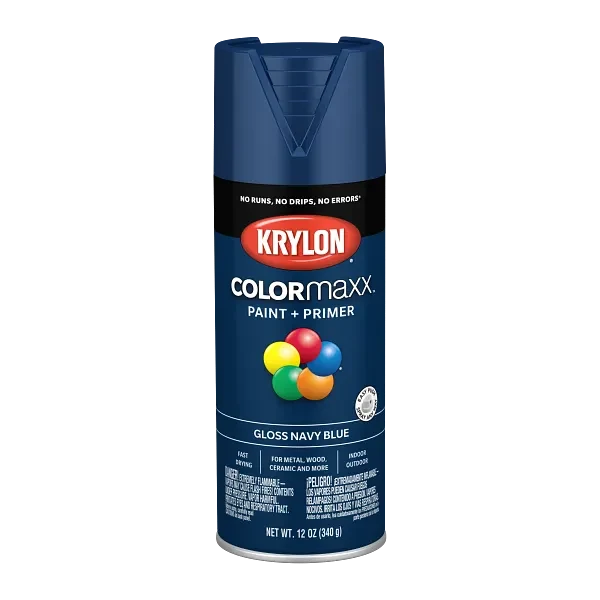
- Coverage
- 20–25 sq ft per 12-oz can at thin build
- Sheens
- Gloss, satin, flat, metallic
- Dry / recoat
- Touch dry 10 min · handle 1h · recoat within 1h or after 24h
- Full cure
- 24 hours
- VOC
- Varies by state; compliant SKUs in CA and OTC states
- Yellowing risk
- Low indoors; chalks before it yellows outdoors
- Primer
- Built-in on wood and metal; separate bonding primer on plastic
- Price tier
- $
- $4 to $5 a can and touch dry in about 10 minutes, the fastest in the test
- Big color deck across gloss, satin, and flat, and it stays consistent can to can within a dye lot
- The right can for craft work, seasonal decor, planters, and anything you expect to repaint next year
- Thinnest film here. Full hide on a color flip took four passes where Painter's Touch took two, which erases the price advantage
- Weakest UV hold. Our sage panel visibly chalked at week 10 outdoors while every other pick held
- Tip clogged twice during testing, both times after an interrupted can that sat overnight without inverting
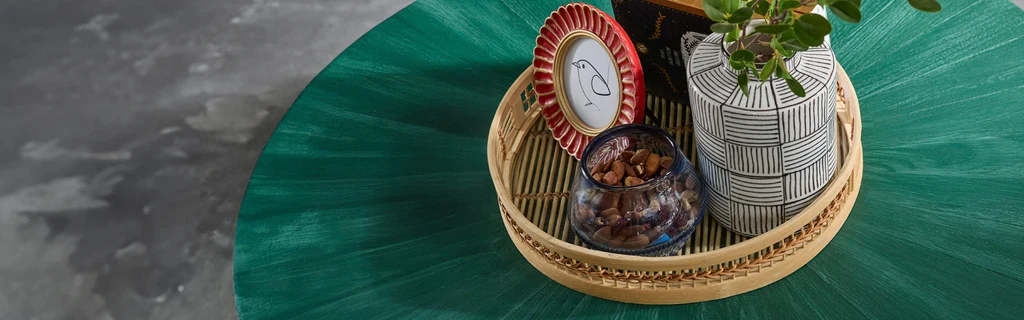
6. Rust-Oleum Chalked Ultra Matte Spray Paint
- Coverage
- 12 sq ft per 12-oz can
- Sheens
- Ultra matte only
- Dry / recoat
- Touch dry 20 min · handle 1h · recoat within 1h or after 24h
- Full cure
- 24 hours before topcoat; 7 days before heavy use
- VOC
- Varies by state; compliant SKUs in CA and OTC states
- Yellowing risk
- Low; the matte topcoat is the yellowing variable, not the color coat
- Primer
- None on raw wood, laminate, or metal
- Price tier
- $
- Dead-flat velvet finish out of a can, with none of the brush texture that gives a chalk-paint job away
- Sands and distresses like brush-on chalk paint, so the edge-rub look on a dresser is available without a brush
- Sticks to raw wood, laminate, and metal with no sanding on our test panels, which is not true of most flat aerosols
- Unsealed chalk finish marks with a fingernail and stains from a wet glass. It needs the matte topcoat, and that is a second purchase
- Twelve stocked colors, all muted heritage tones. No brights, no true black with depth
- Poor hide on a dark-to-light flip; three coats minimum over walnut stain
Rust-Oleum Automotive Self Etching Primer Spray
Galvanized steel, aluminum, and chrome are the three substrates where every can in this round-up fails on its own. The zinc coating on galvanized sheet is chemically slippery, and aluminum grows an oxide skin within minutes of any sanding. A self-etching primer contains phosphoric acid that bites a microscopic profile into that surface while it dries, giving the topcoat something mechanical to hold. One 12-oz can primes a wheelbarrow, a set of patio chair frames, or a galvanized trash can, and it dries hard enough to topcoat in 15 minutes. Skip it on those metals and the paint sheets off the first time a knuckle scrapes the surface. Bare wood, MDF, raw steel, and clean plastic do not need it.
BUY ON AMAZON
Ask a Question