Best Glow-in-the-Dark Paint
Five glow-in-the-dark paints charged and timed on white-primed panels for real afterglow, not label claims. Top pick: Rust-Oleum Specialty Glow in the Dark Brush-On.

Water-based and low-odor, so it goes on a bedroom ceiling without evacuating the house for a night the way an aerosol does
Rated 4 to 8 hours of glow against 2 to 4 for the standard Rust-Oleum spray; ours was still findable in a dark hallway at hour 5
Techno Glow publishes 12-plus hours of glow and a 30-year pigment life; our panel was the only one still visible to a dark-adapted eye the next morning
Blends 1:1 into light-colored acrylics, which is the only clean way to get a daytime color that also glows at night
Dry to touch in 10 minutes and handleable in an hour, so a costume prop finished at 6 p.m. goes out the door at 7
Disclosure: Some links below are affiliate links. We earn a commission if you buy through them, at no extra cost to you. Our picks come out of the test protocol described in “How We Picked”. No brand pays for placement.
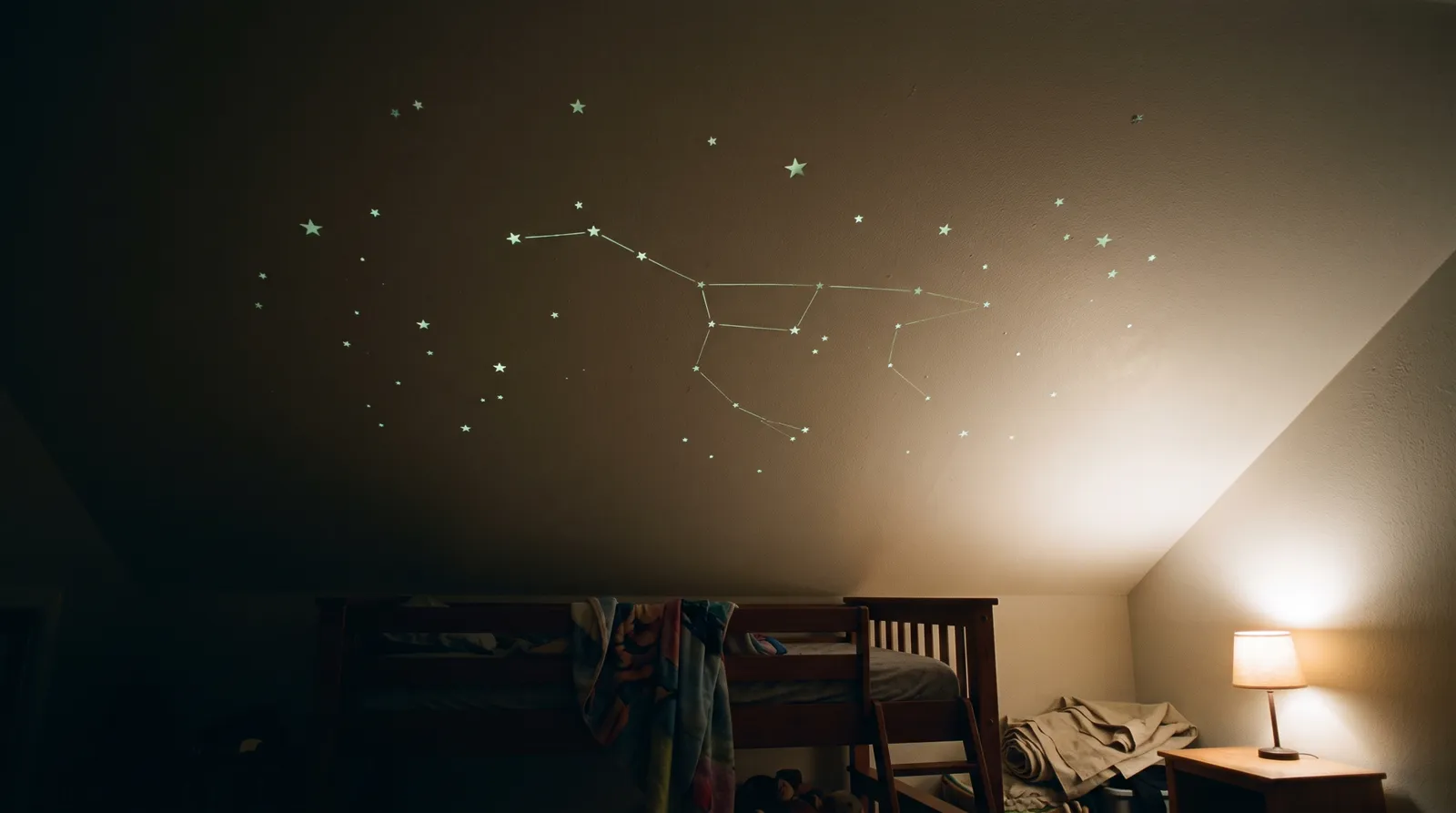
Top pick: Rust-Oleum Specialty Glow in the Dark Brush-On Paint. Roughly $14 for a half-pint at any Home Depot, and it does the thing most people are actually buying glow paint for, which is a ceiling of stars a kid can still see while falling asleep. It wins on price, on availability, and on being water-based enough to roll onto a bedroom ceiling without clearing the house for the night. It falls short on afterglow. Rust-Oleum publishes two hours, our panels matched that, and the last ninety minutes of those two hours are dim. If you need a glow that’s still working at 2 a.m., Techno Glow’s Green Brightest Glow is the strontium-aluminate upgrade at about ten times the cost per square foot.
Glow paint is a battery, not a bulb. It absorbs photons, holds them, and leaks them back out over the next few hours. Everything that makes one can better than another comes down to how much energy the pigment can store and how slowly it releases it. Nothing else in the can matters much.
Which is why the whole category splits into two chemistries and the labels almost never tell you which one you’re holding.
How We Picked
Five glow paints went onto identical 6 by 6 inch hardboard panels primed with two coats of flat white, dried 72 hours, then charged 30 minutes under a 5000K LED shop light metered at about 1,000 lux at the panel face. Decay got logged two ways: a tripod-mounted phone locked at ISO 3200 and a 4-second exposure, shot at 5, 15, 30, 60, 120, 240, and 480 minutes; and a dark-adapted human standing 3 feet away in a windowless room calling each panel dead when they could no longer find its edge. A second run used a 5-minute charge, because in a real bedroom somebody flips a switch, they don’t run a tanning session. We also repeated the top pick over flat white, mid-gray, and navy boards to see how much the substrate steals.
The Five Picks Side by Side
| Product | Best for | Useful glow, our panels | Format | Price |
|---|---|---|---|---|
| Rust-Oleum Glow Brush-On | Top pick: star ceilings, indoor decor | 🟡 ~2 h (bright to ~35 min) | 8 fl oz brush-on | $ |
| Rust-Oleum Glow MAX Spray | Props, gear, outdoor objects | 🟢 ~5 h | 10 oz aerosol | $ |
| Techno Glow Green Brightest | Longest afterglow, murals, safety marking | 🟢 12 h+ | 1 fl oz to 1 gal | $$$$ |
| DecoArt Americana Glow | Fine detail, mixing into other colors | 🟡 ~90 min | 2 / 4 / 8 oz bottles | $ |
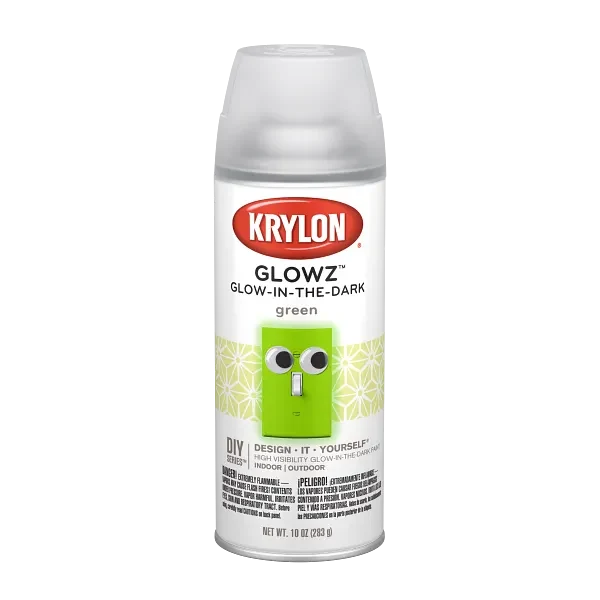
| Krylon Glowz | One-night props and costumes | 🔴 ~45 min | 6 / 10 oz aerosol | $ |
The gap between the top and bottom of that column is not a small quality difference. It’s two different pigments. Copper-doped zinc sulfide gives you a bright first ten minutes and then falls off a cliff. Strontium aluminate doped with europium and dysprosium is roughly ten times brighter at the same charge and holds a visible glow overnight. Manufacturers rarely print which one is in the can, so the published glow-duration number is your tell: under 3 hours means zinc sulfide, 8 hours or more means strontium aluminate.
Which One Fits Your Job
- Kid’s ceiling, painted stars, budget under $30: Rust-Oleum Brush-On over flat white primer. Two coats.
- You want the stars visible at 3 a.m.: Techno Glow Green Brightest Glow. Budget for four to five layers and accept the price.
- Halloween prop, party set, bike frame, camping gear: Rust-Oleum Glow MAX Spray.
- Costume finished tonight, worn tomorrow: Krylon Glowz. Ten minutes to touch dry buys you the evening.
- Painting fine lines, faces, miniatures, or mixing glow into a daytime color: DecoArt Americana Glow.
- Marking stair edges, dock cleats, or a trail: Rust-Oleum Glow MAX Spray outdoors, Techno Glow where reapplication would be a nuisance.
The Picks in Detail
Rust-Oleum Specialty Glow in the Dark Brush-On Paint, Top Pick
This is the can that made glow paint a normal home-center product. Half-pint, water-based, flat, meant for indoor wood, metal, plaster, masonry, and unglazed ceramic. Rust-Oleum publishes up to 2 hours of glow, and on our panels that claim held. What the claim doesn’t say is the shape of the decay: bright and obvious for the first 20 minutes, comfortably findable at 35, then a slow slide into a faint smudge that technically qualifies as glowing until roughly the two-hour mark.
For a bedroom ceiling that’s the correct amount. A kid falls asleep in 20 to 40 minutes and the stars are doing their job that entire window. Nobody is checking at 1 a.m.
Application is where this pick separates from the sprays. We put it on with a 1-inch synthetic chip brush for constellation lines and a pencil eraser dipped straight in the can for the star dots, which gives a consistently round mark that a brush tip won’t. Two coats, an hour apart. A half-pint covered about 200 dots and four constellation lines across a 12 by 12 ft ceiling with paint left over, which is why the material cost on a project like this lands under $20 including primer.
The substrate test was the finding that changed how we’d write the instructions. The same paint over flat white read roughly twice as bright at 30 minutes as it did over a mid-gray board. Over navy it was barely worth doing. If your ceiling is anything other than white, spot-prime each dot in flat white first and let it dry before the glow coat goes on.
The honest weaknesses: indoor-only per the label, and the dried film is faintly visible in daylight as a pale matte dot. On a flat white ceiling in raking morning light you’ll see the constellation if you look for it.
Buy it for star ceilings, light-switch surrounds, closet-door markers, and anything indoors where two hours of glow is enough. Skip this if the object lives outside or you need a glow that survives past midnight.
Rust-Oleum Specialty Glow in the Dark MAX Spray Paint, Best Spray
The MAX version is the quiet bargain of this whole category. Rust-Oleum sells three glow formats, and the spec gap between them is real: brush-on at up to 2 hours, standard spray at 2 to 4 hours, MAX spray at 4 to 8. Same shelf, roughly the same money. Our MAX panel was still findable by a dark-adapted eye in a windowless hallway at hour 5, and still faintly readable on a 4-second phone exposure at hour 8.
Aerosol also solves a problem brushing can’t. Glow output tracks how evenly the pigment sits, and a brush leaves streaks of thick and thin that show up in the dark as a blotchy shape. Three light passes at 10 inches with a minute between them gave the most uniform panel in the test by a wide margin.
Coverage is the catch, and it’s a serious one. Figure 8 to 12 sq ft per 10 oz can at a film build that actually glows, which is a chair, a helmet, a set of stair-edge stripes, not a wall. People who buy one can for a bedroom wall come away furious, and the math was against them before they started.
It’s rated for outdoor objects, with Rust-Oleum noting that periodic reapplication may be needed. That’s an honest line. UV chews the binder faster than it chews the pigment, so a clear exterior topcoat over the cured glow layer stretches an outdoor marking from one season to several. Recoat windows behave like any other Rust-Oleum aerosol: inside an hour, or after 48. The middle is where wrinkling happens. Our spray paint dry time guide has the full window chart.
Buy it for props, gear, outdoor markers, and anything where an even film matters. Skip this if you’re spraying above your head onto textured drywall; that’s a brush job.
Techno Glow Green Glow in the Dark Paint, Best Afterglow
The specialty pick, and the only one here running proper long-life pigment at proper loading. Techno Glow publishes 12-plus hours of glow and a 30-year pigment life. Our panel was the only one in the group a dark-adapted observer could still find the next morning, roughly 11 hours after the charge, which is the closest anything in this test came to matching its own label.
Short-charge behavior is where it really pulls ahead. On the 5-minute charge run, the Techno Glow panel at 30 minutes was brighter than the Rust-Oleum brush-on had been at 30 minutes on a full 30-minute charge. It stores faster and it stores more.
Then you look at the price sheet. Published coverage is 1 fl oz per 2.5 sq ft per layer, and the instructions recommend up to five layers. A 20 sq ft glow feature at five layers is 40 fl oz of paint. At $9 for a 1 oz bottle and $320 for a gallon, that’s real money, and the one-year shelf life means leftovers are not an investment. This is a paint you buy for a specific job, sized to that job.
It’s water-based acrylic, cleans up with hot soapy water, works indoors and out, and fires under a blacklight as well as glowing on its own. Techno Glow is clear that a white primer underneath is required for full brightness and that dark primer wrecks it. They also say it isn’t for foot-traffic floors or automotive use unless the pigment goes into a coating built for that, which is a more honest limitation than most specialty suppliers publish.
Buy it for a mural, a stair-nosing safety line, a ceiling you want glowing at 3 a.m., or anything where going back to recoat would be a genuine hassle. Skip this if the job is 200 small dots on a kid’s ceiling. The Rust-Oleum does that for a tenth of the price and the kid is asleep before the difference matters.
DecoArt Americana Glow-in-the-Dark Paint, Best for Detail
The craft-counter pick. About $5 for a 2 oz bottle, also sold in 4 oz and 8 oz, and thin enough to run through a liner brush without dragging. It was the only paint in the test that handled a 1 mm line cleanly.
The feature that earns it a slot: DecoArt tells you to mix it 1:1 into light-colored acrylics. That’s the trick for anything that needs to look like a normal painted object by day and glow by night. A pale blue wave on a bathroom wall, a mushroom on a nursery mural, lettering on a prop sign. Straight glow paint can’t do that; a 50/50 mix can.
Afterglow ran about 90 minutes on our panels, shortest of the brush-on picks, and it wants a full 45 minutes under fluorescent or LED to charge properly. Fabric work needs DecoArt Fabric Medium and heat setting or the film stiffens and cracks at the first fold.
Verdict: the right bottle for detail and for mixing, the wrong bottle for a ceiling. Use a proper artist and detail brush with it, not the chip brush you’d use for the Rust-Oleum.
Krylon Glowz, Budget Pick
Cheapest can here and the fastest to finish. Krylon publishes 10 minutes to touch dry and an hour to handle, and it stuck to every substrate we threw at it without a bonding primer, including glass and fabric.
The published coverage is 5 to 7 sq ft per can, the lowest number in the round-up, and our panels were effectively dark inside 45 minutes. The White Glowz version glows noticeably weaker than the green, so choosing the color you want costs you brightness.
That’s the whole review. It’s a one-night product for a costume or a party prop, priced like one. Don’t put it above a bed.
The White Base Coat Is Half the Glow
Every failure story in this category starts the same way: somebody painted glow stars directly onto a colored ceiling and reported that the paint doesn’t work.
The paint works. Roughly half the light a glow pigment releases travels backward, into whatever is behind it. A flat white base bounces that half forward to your eye. A gray base absorbs a chunk of it. A navy base eats nearly all of it. Our top pick over flat white read about twice as bright at the 30-minute mark as the identical paint over mid-gray.
Zinsser Bulls Eye 1-2-3 Water-Base Primer is the one we reach for: sticks to glossy trim and previously painted drywall without sanding, dries dead flat white, recoats in an hour, cleans up in water. Any dead-flat white primer does the same job. On a dark ceiling you don’t prime the whole thing, you spot-prime each star and line in the exact shape you’re about to paint, let it dry, then glow-coat on top. It doubles the output for about four dollars of primer. For the wider primer conversation, see the primer round-up, and if you’re starting from bare board, the new drywall prep guide covers the sealing coat that has to happen first.
Where Glow Paint Disappoints People
- “It only glows for 20 minutes.” One thin coat. Glow output tracks pigment quantity on the surface, and a single pass holds roughly a quarter of what three coats hold. Two coats minimum, three is better.
- “It’s invisible from across the room.” Charged under a warm 2700K bulb. Glow pigment wants blue and UV. A 5000K LED, a window, or a $10 blacklight flashlight charges it several times faster than a bedside lamp.
- “You can see it in the daytime.” True of every pick here. The dried film is a pale matte off-white. If you need genuinely invisible-by-day, you want a UV-reactive fluorescent, not a phosphorescent glow paint.
- “It flaked off the outdoor sign in one winter.” The binder failed, not the pigment. Clear exterior topcoat over the glow layer, or plan on annual reapplication as Rust-Oleum’s own copy suggests.
- “It looked blotchy in the dark.” Uneven film. Brush streaks that are invisible in daylight are obvious in the dark because thick spots glow longer. Aerosol or a foam applicator fixes it; so does a third coat.
- “It cracked on the T-shirt.” Craft glow paint without fabric medium. Mix DecoArt Fabric Medium in per label and heat set, or use a spray rated for fabric.
- “It glowed great the first night, then never again.” Nothing wrong. It needs recharging every time. Glow paint has no memory of yesterday’s sunlight.
Application Notes That Change the Result
- Prime flat white, in the exact shape you’ll glow-paint. One coat of white primer under the glow coat buys more brightness than an extra glow coat does.
- Two coats minimum on brush-on, three light passes on aerosol. Let each dry fully. Rushing lifts the previous layer and you end up with less pigment on the wall, not more.
- A pencil eraser makes better stars than a brush. Dip, dab, done. Round, consistent, and you can do 200 of them in twenty minutes.
- Test in the dark before you commit to the whole ceiling. Paint six dots, charge them, kill the lights. Two hours of testing saves a weekend of regret.
- Charge with what you’ll actually use. If the room only ever sees a warm bulb, test under that bulb, not under the sun on the porch.
- Respirator on for the aerosols. These are solvent-based and you’ll be spraying upward. A cracked window is not ventilation; see the respirator round-up.
- Keep a wet edge off the equation. Glow paint is dabbed and stippled, not cut and rolled, so the usual brush-mark fixes apply differently here. Blotchy film, not lap lines, is the failure mode.
What a Star Ceiling Actually Costs
| Approach | Glow paint | White primer | Tools | Total |
|---|---|---|---|---|
| Rust-Oleum Brush-On, 200 dots, 12 by 12 ft room | $14 | $8 (quart) | $6 | ~$28 |
| Rust-Oleum MAX Spray, stenciled, same room | $32 (2 cans) | $8 | $18 (stencils, tape, respirator cartridge) | ~$58 |
| Techno Glow, 200 dots at 4 layers | $85 (8 fl oz) | $8 | $6 | ~$99 |
| DecoArt Americana, 200 dots, 2 coats | $15 (3 bottles) | $8 | $9 (liner brushes) | ~$32 |
A store-bought peel-and-stick star kit runs $12 to $25 and glows about as long as the Rust-Oleum. The reason to paint is control over the pattern, and the fact that painted dots don’t fall off the ceiling in July.
Also Considered, Also Rejected
- Rust-Oleum standard Glow in the Dark Spray (2 to 4 hours). Fine can, wrong slot. The MAX version sits next to it on the same shelf for close to the same price and doubles the glow. There’s no reason to buy the standard one.
- DecoArt Americana Ultimate Glow. The premium DecoArt at about $18, formulated for maximum output and rated for walls as well as craft. Genuinely brighter than the standard Americana Glow. It didn’t make the cut because Techno Glow occupies the same “spend more, glow longer” slot with published duration numbers behind it.
- Glow-in-the-dark powder sold loose, to mix into your own clear. The cheapest path to a strong glow if you’re willing to mix, and the route most professional mural painters take. It’s a different product category with a different failure mode (settling, uneven suspension, wrong binder), and it belongs in its own article.
- Glow-in-the-dark tape and vinyl. Better than paint for stair nosings and exit routing, worse for anything decorative. If the goal is a safety marking on a straight edge, buy tape.
- Generic Amazon glow paint multi-packs. The 12-bottle party sets are almost universally zinc-sulfide pigment at low loading, sold on photos shot under blacklight rather than in the dark. The blacklight photo is the tell; a fluorescent response is not a glow duration.
- Anything marketed as glow paint for a driveway or a road. Foot and tire traffic destroys an unmodified acrylic glow film in weeks. Techno Glow says so plainly about their own product, which is more than most sellers in that niche will tell you.
If the ceiling is white and the room goes properly dark, the $14 Rust-Oleum can is the right answer and the expensive one is overkill. If the ceiling is navy, prime it white first, and buy whichever can you were going to buy anyway.
Full Comparison
| Product | Best for | Yellowing | Price |
|---|---|---|---|
| Rust-Oleum Specialty Glow in the Dark Brush-On Paint | Top pick — best brush-on for ceilings and walls | Pigment is off-white in daylight; no yellowing over time reported | $ |
| Rust-Oleum Specialty Glow in the Dark MAX Spray Paint | Best spray — longest glow you can buy at a home center | None reported; outdoor film needs periodic reapplication | $ |
| Techno Glow Green Glow in the Dark Paint - Brightest Glow | Best afterglow — the strontium-aluminate upgrade | Pigment rated 30-year glow life; slight off-white daytime cast | $$$$ |
| DecoArt Americana Glow-in-the-Dark Paint | Best for craft detail and mixing into other colors | Off-white in daylight, unchanged over time | $ |
| Krylon Glowz Glow-in-the-Dark Spray Paint | Budget pick — cheapest way to glow for one night | None reported over a season | $ |
Every Pick, Pros and Cons
Pros, cons, and specs for each pick. The cons are not optional here.
1. Rust-Oleum Specialty Glow in the Dark Brush-On Paint
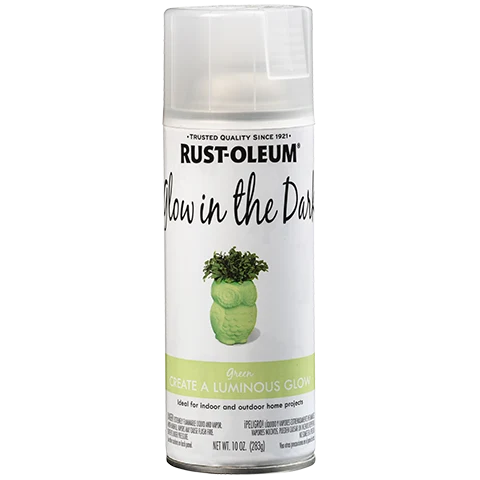
- Coverage
- Roughly 8 to 12 sq ft per half-pint at 2 coats, dabbing-style
- Sheens
- Flat
- Dry / recoat
- Touch dry 1h · recoat 2h
- Full cure
- 24h
- VOC
- Water-based, low odor
- Yellowing risk
- Pigment is off-white in daylight; no yellowing over time reported
- Primer
- Flat white primer strongly recommended under it
- Price tier
- $
- Water-based and low-odor, so it goes on a bedroom ceiling without evacuating the house for a night the way an aerosol does
- Half-pint can runs roughly 12 to 16 dollars and is stocked at Home Depot, Lowe's, Ace, and Amazon; nothing else in this category is that easy to buy on a Saturday
- Brush control is what a star ceiling actually needs, and a 1-inch chip brush plus a pencil eraser dabber does the whole job
- Rust-Oleum publishes up to 2 hours of glow and our panels matched it, but the useful, find-it-across-the-room brightness was gone by minute 35
- Indoor only per the label; the brush-on is not rated for exterior objects the way the spray version is
- Goes on milky-green and stays faintly visible in daylight, which matters on a white ceiling with raking morning light
2. Rust-Oleum Specialty Glow in the Dark MAX Spray Paint
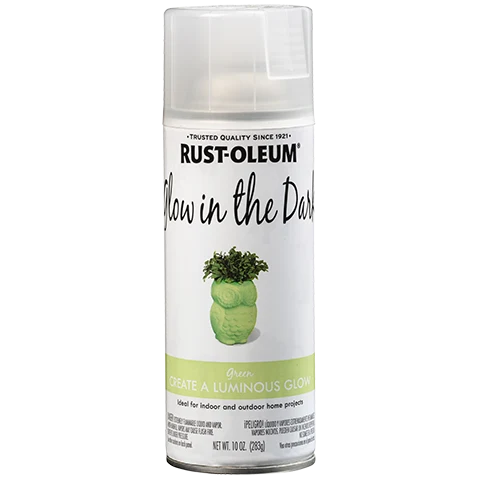
- Coverage
- About 8 to 12 sq ft per 10 oz can at glow-effective film build
- Sheens
- Flat
- Dry / recoat
- Touch dry 20 min · handle 1h · recoat within 1h or after 48h
- Full cure
- 24 to 48h
- VOC
- Solvent aerosol; check state VOC restrictions
- Yellowing risk
- None reported; outdoor film needs periodic reapplication
- Primer
- White or light spray primer under it, per Rust-Oleum's own instructions
- Price tier
- $
- Rated 4 to 8 hours of glow against 2 to 4 for the standard Rust-Oleum spray; ours was still findable in a dark hallway at hour 5
- Rated for indoor and outdoor objects, which covers trail markers, step edges, dock cleats, and mailbox numbers
- Aerosol lays a far more even pigment film than a brush, and even pigment is exactly what glow paint rewards
- Coverage per can is tiny; plan 3 to 4 light passes and expect one can to do about a chair-sized object, not a wall
- Overspray on a textured ceiling is unforgiving and there is no such thing as a subtle aerosol star
- Solvent aerosol means a respirator and real ventilation, not a cracked window
3. Techno Glow Green Glow in the Dark Paint - Brightest Glow

- Coverage
- 1 fl oz per 2.5 sq ft per layer; up to 5 layers recommended
- Sheens
- Flat
- Dry / recoat
- Dries in under 2h between layers
- Full cure
- 24h
- VOC
- Water-based acrylic
- Yellowing risk
- Pigment rated 30-year glow life; slight off-white daytime cast
- Primer
- White primer required for full brightness; dark primer kills it
- Price tier
- $$$$
- Techno Glow publishes 12-plus hours of glow and a 30-year pigment life; our panel was the only one still visible to a dark-adapted eye the next morning
- Sold from 1 fl oz up to a full gallon (about 9 to 320 dollars), so a mural, a driveway edge, and a light-switch plate all buy the same paint
- Water-based acrylic that cleans up in hot soapy water and reads UV-reactive under a blacklight, which sells the effect twice
- Published coverage is 1 fl oz per 2.5 sq ft per layer, and the label asks for up to 5 layers; a 20 sq ft star ceiling done properly is real money
- One-year shelf life once you own it, so buying a gallon for a small job is a way to throw money in the trash
- Not for foot-traffic floors or automotive use unless you mix the pigment into a coating built for that
- Online-only from a specialty supplier; nothing about this is a same-day purchase
4. DecoArt Americana Glow-in-the-Dark Paint
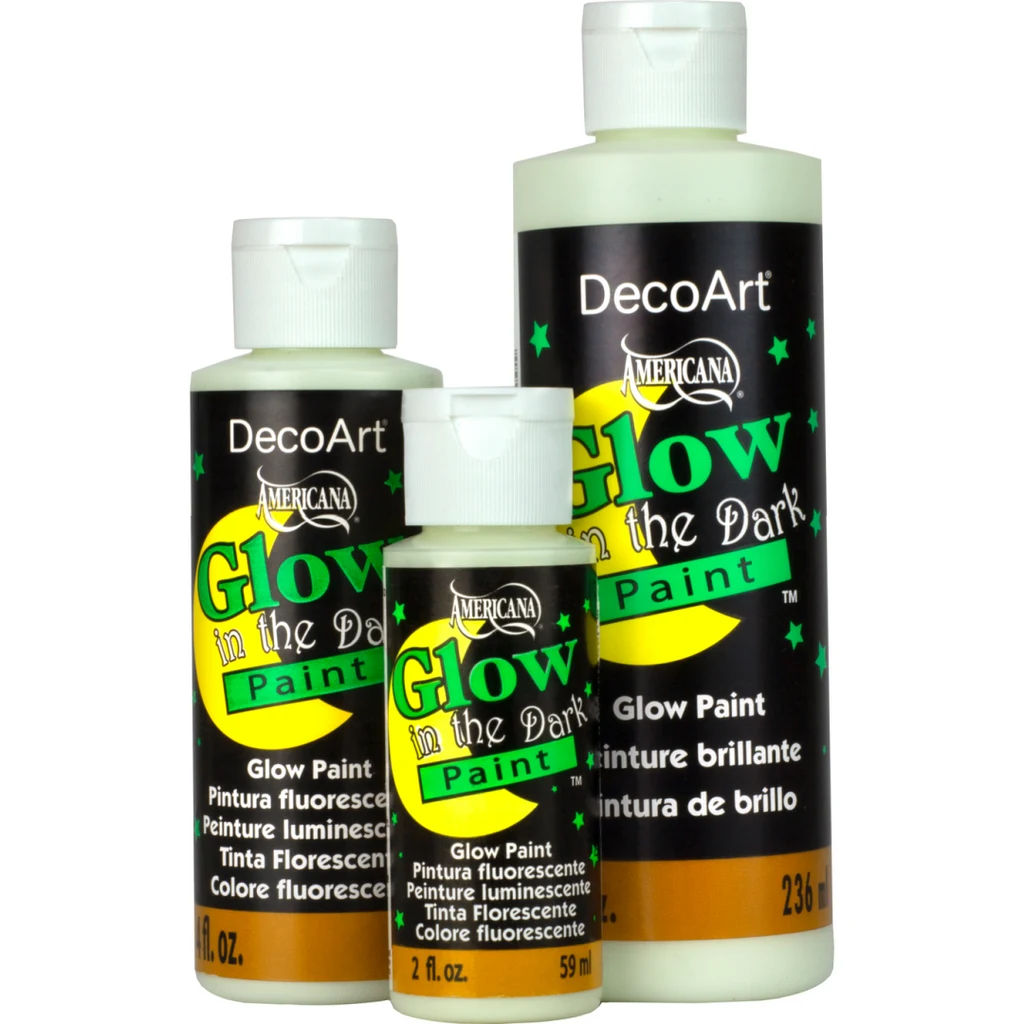
- Coverage
- About 4 to 6 sq ft per 2 oz bottle at 2 coats
- Sheens
- Flat
- Dry / recoat
- Touch dry 20 to 30 min · recoat 1h
- Full cure
- 24h
- VOC
- Water-based acrylic craft paint
- Yellowing risk
- Off-white in daylight, unchanged over time
- Primer
- White gesso or flat white latex under it
- Price tier
- $
- Blends 1:1 into light-colored acrylics, which is the only clean way to get a daytime color that also glows at night
- 2 oz bottle costs about 5 dollars, so testing the idea before committing to a ceiling costs pocket change
- Thin enough for liner-brush work; the only pick here that handles fine detail without dragging
- Wants 45 minutes under fluorescent or LED light to charge fully, which is a long wait next to Techno Glow's fast top-up
- Afterglow ran about 90 minutes on our panels, shortest of the brush-on picks
- Fabric use needs DecoArt Fabric Medium and heat setting; straight from the bottle it stiffens and cracks on cloth
5. Krylon Glowz Glow-in-the-Dark Spray Paint
- Coverage
- 5 to 7 sq ft per can (manufacturer published)
- Sheens
- Flat
- Dry / recoat
- Touch dry 10 min · handle 1h
- Full cure
- 24h
- VOC
- Solvent aerosol; check state VOC restrictions
- Yellowing risk
- None reported over a season
- Primer
- White primer under it, or the glow drops noticeably
- Price tier
- $
- Dry to touch in 10 minutes and handleable in an hour, so a costume prop finished at 6 p.m. goes out the door at 7
- Sticks to wood, metal, plastic, glass, plaster, ceramic, and fabric without a separate adhesion primer
- Cheapest can in the round-up and available in White Glowz as well as Green Glowz, which matters when the object is not going to look right in green
- Krylon publishes 5 to 7 sq ft per can, the lowest coverage here, and our panels went effectively dark inside 45 minutes
- White Glowz glows noticeably weaker than the green; the color choice costs you brightness
- One-night product; it is not what you want above a bed
Zinsser Bulls Eye 1-2-3 Water-Base Primer
Glow pigment does not make light, it releases light it already stored, and roughly half of what it releases goes backward into whatever is behind it. A flat white base bounces that half forward. On our test panels the same Rust-Oleum brush-on over flat white read about twice as bright at the 30-minute mark as the identical paint over a mid-gray board, and over a navy board it was close to pointless. Bulls Eye 1-2-3 is water-base, sticks to glossy trim and previously painted drywall without sanding, dries flat white, and recoats in an hour. Any dead-flat white primer does this job. What kills a glow project is skipping it and blaming the glow paint.
BUY ON AMAZON
Ask a Question