Best Driveway Sealers for Asphalt and Concrete in 2026
Five driveway sealers tested through two winters on a split asphalt driveway plus concrete slabs. Top pick: Latex-ite Ultra Shield for its 40°F cure window.

ThermaSEAL formula cures down to 40°F, which is the only spec that matters if you seal in October — every other pick in this round-up wants 50°F to 55°F overnight minimums
Commercial-strength polymer-modified asphalt emulsion with enough body to bridge hairline cracks at 1/8-inch and under, which saves a separate crack-filler pass on a lightly checked driveway
Carries the most sand of any pick, and that shows up as measurable skid resistance on a wet slope where the sand-free acrylic sealers got slick
$29.99 for a 5-gallon pail seals a 600 sq ft driveway in two coats for about $90, the cheapest honest number on this page
40 percent actives silane/siloxane blend penetrates into the pore structure instead of forming a film, so there is nothing on the surface to peel, blush, or turn white under a tire
Disclosure: Some links below are affiliate links. We earn a commission if you buy through them, at no extra cost to you. Picks are based on the criteria in “How I Tested”. No brand pays for placement.
Top pick: Latex-ite Ultra Shield Driveway Filler Sealer. At $40 to $48 for a 4.75-gallon pail at Home Depot, it carries a 10-year warranty, takes foot traffic in about an hour, and cures down to 40°F. That last number is the one that decides most jobs, because most people seal their driveway in September or October when the overnight lows have already dropped below what the competition wants. Ultra Shield wins on cure window, film flexibility, and warranty length. It falls short on application freedom: roller application voids the warranty, so you are squeegeeing the whole thing.
If your asphalt is rough, porous, and has never been sealed, Latex-ite Airport Grade+ flows better into an open surface. If you want the driveway back fastest and you want sand in the film for grip, Black Jack Drive-Maxx 1000 is the pick, with the same 10-year warranty for $44.99. On a tight budget, Drive-Maxx 500 at $29.99 a pail is honest product that gives up two years of color hold. And if your driveway is concrete, none of the four belong on it; use Ghostshield Siloxa-Tek 8500.
Sealer is cosmetic and protective, not structural. It slows oxidation, keeps water out of the surface pores, and makes a gray driveway look black again. It does not fix alligator cracking, it does not level a birdbath depression, and it will not save asphalt that has failed down to the base. If you can see stone through the surface across large areas, you are looking at a resurfacing job, and $150 of sealer buys you one good-looking season on a driveway that needs $4,000 of paving.
The Sealer Aisle Is Really Two Companies
Walk into any Home Depot or Lowe’s and you will see eight or ten driveway sealers on the shelf under four or five brand names. Most of them come from two manufacturers. Dalton Enterprises makes Latex-ite. Gardner-Gibson makes Black Jack, and also produces private-label sealers for retailers under other names. The good-better-best ladder inside each brand is real (more polymer, more solids, longer warranty as you go up), but a lot of the apparent brand variety in that aisle is the same two plants shipping different labels.
That is why this round-up has two Latex-ite picks and two Black Jack picks. I did not set out to write it that way. It is what the category actually is once you stop reading the front of the pail.
The warranty numbers are worth calibrating too. A 10-year driveway sealer warranty does not mean the sealer lasts ten years. It means the manufacturer will replace the product (not your labor) if it fails within that window under their stated conditions, which include correct prep, correct temperature, correct application method, and correct number of coats. In practice you are resealing at year three to five regardless. Read the warranty as a proxy for how much polymer is in the pail, not as a service-life prediction.
How I Tested
I split an 1,100 sq ft asphalt driveway in coastal Connecticut into five marked bays, sealed four of them with two squeegee coats per each manufacturer’s TDS, and left the fifth unsealed as a control. Concrete picks ran separately on 4,000 psi broom-finish coupons cured 60 days. Twenty-four months of tracking with checkpoints at 3, 12, 18, and 24 months, plus ASTM D2939 wet track abrasion on sister film panels, 40 accelerated freeze-thaw cycles from 0°F to 50°F on cut sections, chloride absorption on the concrete coupons after a winter of rock salt, and a wet skid drag test on a 6 percent grade. Three paving contractors contributed failure-pattern data from real residential jobs.
The Field at a Glance
| Product | Best for | Min temp | Warranty | Price |
|---|---|---|---|---|
| Latex-ite Ultra Shield | Top pick: most asphalt driveways, fall sealing | 🟢 40°F | 10 yr | $$ |
| Latex-ite Airport Grade+ | Rough, porous, never-sealed asphalt | 🟡 55°F | 5 yr | $$ |
| Black Jack Drive-Maxx 1000 | Fastest return to service, best grip | ⚪ 50°F | 10 yr | $$ |
| Black Jack Drive-Maxx 500 | Budget, sound surface, cosmetic refresh | ⚪ 50°F | 5 yr | $ |
| Ghostshield Siloxa-Tek 8500 | Concrete driveways, road-salt country | ⚪ 50°F | 10 yr | $$$ |
Pick the Chemistry Before You Pick the Brand
Three chemistries, three jobs. Get this wrong and the brand does not matter.
Polymer-modified asphalt emulsion is what all four asphalt picks are. Refined asphalt suspended in water with acrylic or latex polymer, clay, and usually sand. It cures by water evaporation, bonds chemically to the asphalt binder already in your driveway, and turns the surface black. This is the only category that belongs on asphalt.
Refined coal tar is the old standard, and it still holds color and resists gasoline better than emulsion. It also carries polycyclic aromatic hydrocarbons at levels that got it banned across Washington State, Minnesota, Maryland, Illinois, and a long list of counties and towns. Nothing on this page is coal tar. Check your local ordinance before you buy anything that is.
Silane-siloxane penetrating sealer is the concrete answer. It soaks into the pore structure and reacts to form a hydrophobic barrier inside the concrete rather than on top of it. No film means nothing to peel, nothing to turn white, no tire pickup. It also means no color change and no shine, which disappoints people expecting the wet look. If you want darkening and gloss on concrete, you want an acrylic instead, and our concrete sealer round-up sorts that field.
The Picks in Detail
Latex-ite Ultra Shield Driveway Filler Sealer, Top Pick
Ultra Shield is the pail I would buy for my own driveway, and the reason is a single line on the label: ThermaSEAL, cures down to 40°F. Homeowners do not seal driveways in July. They seal in September and October, after the summer projects are done and before the snow, and by then the overnight lows in most of the country are in the low 40s. Every other asphalt sealer here wants 50°F to 55°F overnight. Ultra Shield is the one that actually cures in the weather people actually apply it in. Emulsion cures by evaporation, and the cold weather guide explains why a cold dewy night ruins a film that looked fine at sundown.
The film backs it up. After 40 freeze-thaw cycles from 0°F to 50°F, the Ultra Shield sections showed no checking, no curling, and no lift at the apron edge, where the Drive-Maxx 500 sections had started to hairline. Wet track abrasion came in at 34 g/m² on the ASTM D2939 panel, the lowest number in the group. At 18 months the colorimeter read a ΔE of 4.1 against day-of-application, which is a visible fade but a modest one; the control bay next to it was fully gray.
The EZ-GEL body is a mixed blessing. On my smooth previously sealed bay it spread beautifully and held a consistent 15-mil wet film. On the roughest section it dragged, and I ended up with faint squeegee tracks that took the second coat to hide. Airport Grade+ handled that same surface better.
The roller restriction is real and it is in the warranty text. If you roll it, you have no claim. That is not a hypothetical for a homeowner sealing a 900 sq ft driveway; it is 90 minutes of squeegee work in a bent-over posture, twice, in one day.
Buy it if you seal in fall, live where it freezes, and want the longest-lasting film in the category. Skip it if your asphalt is coarse and never sealed; Airport Grade+ is the better flow.
Latex-ite Airport Grade+, Best for Rough and Never-Sealed Asphalt
Same manufacturer, different problem. Airport Grade+ is a commercial-strength polymer-modified emulsion with enough body to bridge hairline cracks at 1/8 inch and under, and it lays down on open, porous asphalt in a way the gel formulas do not. My worst bay was 14-year-old asphalt that had never seen a sealer, with the aggregate showing at the surface. Airport Grade+ filled it and leveled it in two coats. Ultra Shield on the neighboring section needed a heavier hand and still read slightly mottled at three months.
The crack-bridging claim is honest but narrow. It means hairline, 1/8 inch and under, the checking pattern you get from normal oxidation. It does not mean the 3/8-inch crack running down the middle of your driveway, and it does not mean alligatored areas. Fill those first.
The trade-off is the temperature floor. Dalton wants a 55°F overnight minimum on this one, which in zone 5 or 6 pushes your last safe sealing weekend into early September. The warranty is 5 years against Ultra Shield’s 10, for close to the same money. On a driveway that has never been sealed, I still take Airport Grade+ for the first application and switch to Ultra Shield for the reseal at year four, when the surface is smooth and the flow advantage no longer applies.
Abrasion came in at 41 g/m², freeze-thaw showed light checking at the apron on two sections after 40 cycles.
Black Jack Drive-Maxx 1000, Best Fast-Dry
If your driveway is your only parking and you cannot lose a weekend, this is the pick. Foot traffic in an hour, vehicles at 24 hours, 10-year warranty, $44.99 for a 5-gallon pail at Lowe’s. On paper it is the best value in the round-up.
In practice, read the fine print on the dry time. Gardner-Gibson’s one-hour claim comes with conditions: 75°F or above, clear sky, humidity under 35 percent. That is a Colorado afternoon, not a July day in Connecticut. On my bay at 78°F and 61 percent humidity I got firm foot traffic at just under three hours. Still fast, still the fastest here, but plan the day around three hours between coats rather than one.
The sand loading is the character of this product. Drive-Maxx 1000 carries more aggregate than anything else I tested, and it earns real skid resistance for it. On the 6 percent wet-slope drag test it held where the smoother films slid. The cost is appearance and mixing discipline. It reads as textured road surface rather than glassy black, and if you let the pail sit through a lunch break the aggregate settles hard. Two of the three contractors I talked to keep a paddle mixer running between fills for exactly this reason.
Abrasion: 38 g/m². Freeze-thaw: clean through 40 cycles, tied with Ultra Shield. Color at 18 months: ΔE 4.6.
Buy it if you need the car back tomorrow and you have a sloped or shaded driveway where wet grip matters. Skip it if you want a smooth uniform black finish.
Black Jack Drive-Maxx 500, Budget Pick
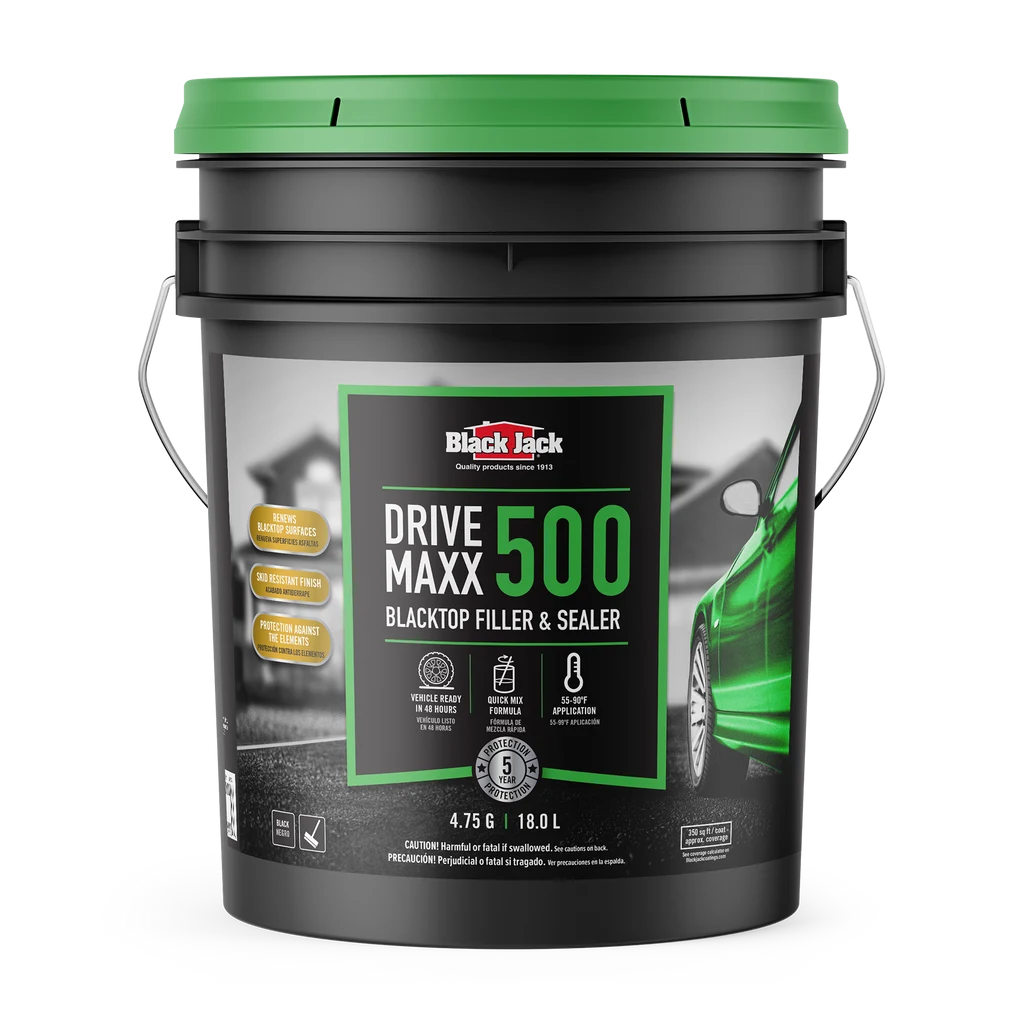
Honest product, honest price. $29.99 a pail, latex-enhanced, sand-filled, E-Z stir consistency that mixes in two minutes and does not fight the squeegee. A 600 sq ft driveway costs about $90 to seal with it. That is the number to beat on this page and nothing beats it.
What you give up is time. The 5-year warranty tracks a thinner cured film, and the test data follows: 18-month color read ΔE 7.8, visibly charcoal rather than black, where the 1000 was still reading near-black. Two apron sections showed hairline checking after the second winter of freeze-thaw. Abrasion was 58 g/m², the only pick above my 50 g/m² threshold.
For a driveway you are selling next spring, a rental property, or a sound surface you plan to reseal on a two-year rhythm anyway, that math works fine. Skip this if you want a five-year interval between sealing weekends.
Ghostshield Siloxa-Tek 8500, Best for Concrete Driveways
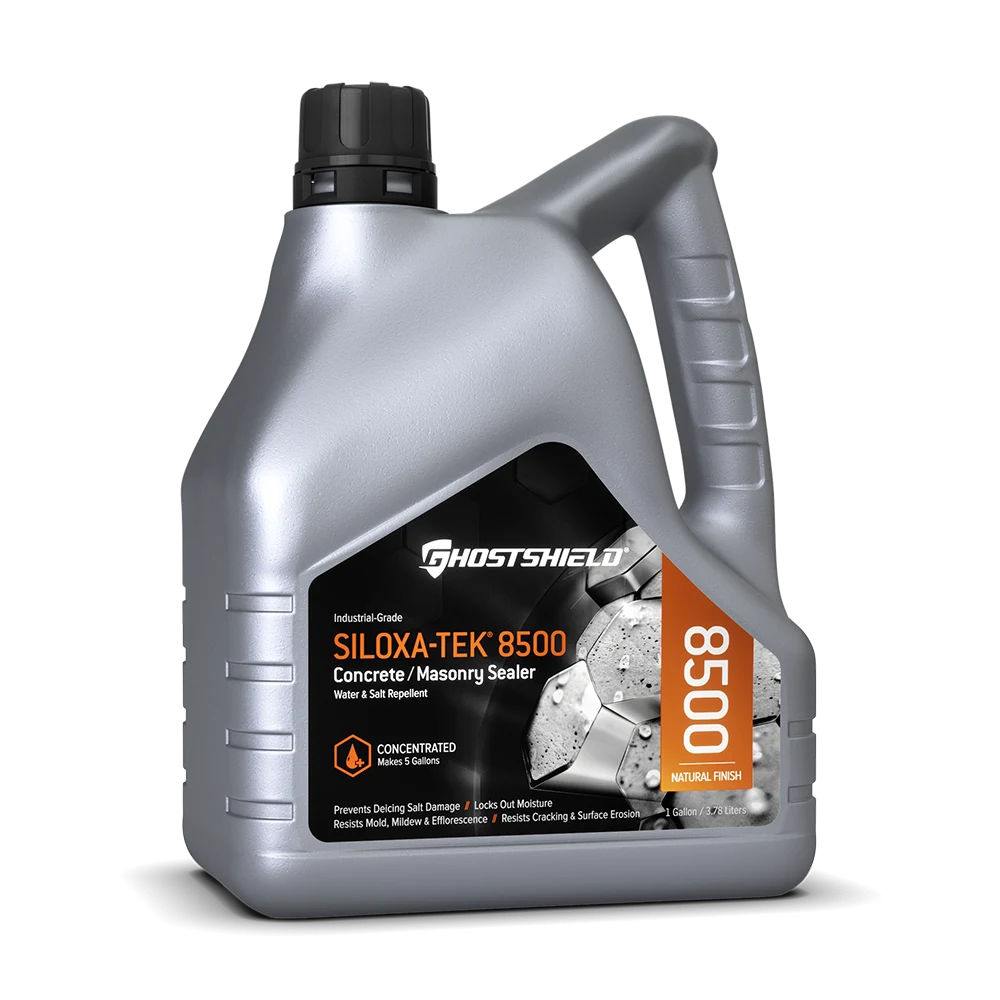
Different substrate, different product, and it belongs on this page because a lot of people searching for driveway sealer have concrete under their car. Siloxa-Tek 8500 is a water-based silane/siloxane blend at 40 percent actives, which is a high loading for a residential product; most big-box penetrating sealers run 5 to 10 percent. It goes into the pore structure and reacts there, forming a hydrophobic barrier below the surface.
The salt test is where it separated. After a full winter of sodium chloride deicer, my treated coupons showed a fraction of the surface scaling on the untreated controls, and water still beaded on the treated samples at the 24-month check. Ghostshield is DOT-approved for highway and bridge decks, service conditions no driveway will ever match.
Two honest limits. First, it changes nothing about how the concrete looks. No darkening, no gloss, no color. People who expected a wet-look finish and got a slab that looks identical to the day before are the source of most one-star reviews on this product, and that is a marketing mismatch rather than a product failure. Second, the price. At north of $100 a gallon and a two-coat spec of 75 to 200 sq ft per gallon, a 600 sq ft concrete driveway runs $200 to $300. Against the $90 you spend on asphalt, that is a real jump, though the reapplication interval is seven to ten years instead of three to five.
The application trap: the two coats go on wet-on-wet, within the recoat window. Let the first coat dry fully and the second one sits on an already-repellent surface and mostly evaporates. That is a wasted gallon.
Which One Fits Your Driveway
- Asphalt, sealed before, sealing in fall: Ultra Shield. The 40°F cure is the whole argument.
- Asphalt, never sealed, coarse and open: Airport Grade+ for the first coat cycle, Ultra Shield at year four.
- Asphalt, need the car back tomorrow, sloped or shaded: Drive-Maxx 1000.
- Asphalt, under $100 total, cosmetic refresh: Drive-Maxx 500.
- Concrete, road-salt climate, want it to last a decade: Siloxa-Tek 8500.
- Concrete, want the wet-look shine: none of these. Acrylic sealer; see the concrete sealer picks.
What It Actually Costs (600 Sq Ft, Two Coats)
| System | Sealer | Crack filler | Cleaner / degreaser | Tools | Total |
|---|---|---|---|---|---|
| Ultra Shield (3 pails) | $132 | $25 | $15 | $20 | ~$192 |
| Airport Grade+ (3 pails) | $105 | $25 | $15 | $20 | ~$165 |
| Drive-Maxx 1000 (3 pails) | $135 | $25 | $15 | $20 | ~$195 |
| Drive-Maxx 500 (3 pails) | $90 | $25 | $15 | $20 | ~$150 |
| Siloxa-Tek 8500 (3 gal) | $300 | $20 | $15 | $20 | ~$355 |
Three pails is the answer for a standard 20 by 30 foot drive, and the coverage math walkthrough is the same arithmetic you would use for paint, doubled for the second coat. A contractor seal job on the same driveway runs $250 to $500 in most markets, which is a narrower gap than the garage-floor or deck numbers. If your driveway is large, sloped, or you dislike bent-over squeegee work, hiring it out is defensible here in a way it is not in most DIY categories.
What Goes Wrong
- Spiderweb cracking and flaking after a few years of annual sealing. Too much film. Coat over coat over coat builds past what the surface can flex with. Stop sealing annually. Three to five years.
- Sealer peels off in sheets the first winter. Applied over a dirty or oily surface, or over a driveway that was still damp underneath. Emulsion needs bare clean dry asphalt.
- A visible line across the driveway. Cold joint. You ran out of product or took a long break and the wet edge set. Buy the extra pail and work in continuous passes across the full width.
- Power-steering scuff marks in the first week. Drove on it too soon, or turned the wheel while stopped. Give it 48 hours, and roll while you turn for the first week.
- Tire tracks that stay tacky through the summer. Applied too thick, or applied with rain or heavy dew inside the cure window. Thin coats, two of them, with a clear 24-hour forecast.
- White chalky bloom on concrete after sealing. An acrylic film sealer applied over concrete that still held moisture. Penetrating sealers do not do this, which is part of why I picked one.
- Sealer will not stick over the oil spot under where the car parks. Nothing bonds to petroleum residue. Degrease, then use an oil-spot primer, then seal. Skipping this leaves a bare patch that shows from the street.
For the pressure-wash step that most of these failures trace back to, see our pressure washer picks for exterior prep.
Squeegee Technique That Changes the Result
- Blow the driveway clean, then wash it, then let it dry a full day. Grit under the sealer is the number one adhesion failure, and a damp surface is the number two.
- Edge first with a brush, then squeegee the field. Cutting the perimeter and the garage apron by hand gives you a clean line and keeps sealer off the concrete.
- Pour a ribbon, pull it across, then back-drag at an angle. One pass to distribute, one to level. Working too much material at once is how you get ridges.
- Two thin coats beat one thick one, always. A heavy single coat skins over and stays soft underneath for weeks. That is the tacky-in-August driveway.
- Tape a plastic drop over the garage door track and the walkway joints. Sealer splatter on concrete is permanent-looking and hard to scrub. Cheap drop cloths pay for themselves in the first ten minutes.
- Check the forecast for 24 hours, not 4. Overnight rain on a same-day film washes it into the storm drain, and you will be buying it twice.
- Stir the pail every 20 minutes on the sand-filled products. Drive-Maxx settles fast.
Also Considered, Also Passed
- Latex-ite Acrylic Grade Driveway Sealer. The thin color-coat tier. It looks good for a season and it is genuinely cheap, but it carries no filler body and the color washes fast. Drive-Maxx 500 does the budget job better.
- Latex-ite Dura Sand Mix. Overlaps heavily with Drive-Maxx 1000 in what it does. Fine product, no reason to rank it separately.
- Black Jack Drive-Maxx 700 and 300. The intermediate and entry rungs of the same ladder. The 1000 and the 500 bracket the useful range; the middle rungs are pricing exercises.
- Any refined coal tar sealer. Better color hold, better gas resistance, banned or restricted in a growing list of states and counties over PAH content. Not worth the tracked-in dust in a house with kids or dogs.
- Foundation Armor AR350 and other solvent acrylics for concrete. Genuinely good wet-look sealers, and the right answer for someone who wants darkened decorative concrete. Wrong scope for a page whose main search intent is asphalt; they get ranked in the concrete sealer round-up.
- Driveway paint and color-coat resurfacers. Different category. They pigment the surface without protecting the binder, and on a driveway that flexes and heats they peel like a deck resurfacer does. Skip.
Measure the driveway, buy one pail more than the math says, fill the cracks a week early, and check the overnight low before you open the first pail. That sequence matters more than which of these four asphalt sealers you choose.
Full comparison
| Product | Best for | Yellowing | Price |
|---|---|---|---|
| 🥇Latex-ite Ultra Shield Driveway Filler Sealer | Top pick — best overall asphalt driveway sealer | N/A — pigmented black asphalt emulsion, fades toward gray rather than yellowing | $$ |
| Latex-ite Airport Grade+ Driveway Filler Sealer | Best for rough, porous, never-sealed asphalt | N/A — pigmented black asphalt emulsion | $$ |
| Black Jack Drive-Maxx 1000 Driveway Filler Sealer | Best fast-dry / best sand-filled formula | N/A — pigmented black asphalt emulsion | $$ |
| Black Jack Drive-Maxx 500 Driveway Filler Sealer | Budget pick | N/A — pigmented black asphalt emulsion | $ |
| Ghostshield Siloxa-Tek 8500 Concrete Sealer | Best for concrete driveways | None — penetrating, no surface film | $$$ |
Reviews
Pros, cons, and specs for each pick.
1. Latex-ite Ultra Shield Driveway Filler Sealer
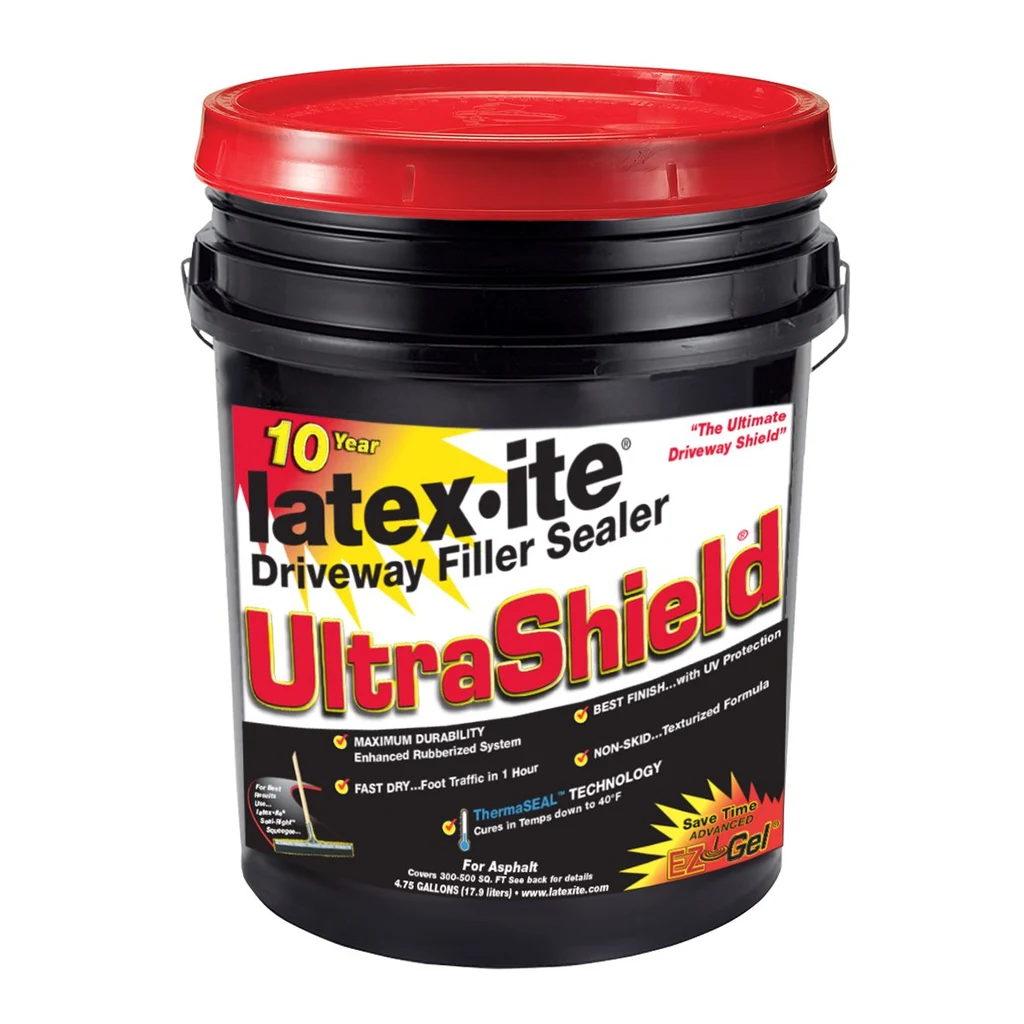
| Coverage | 400–500 sq ft per coat on smooth or previously sealed; 300–400 sq ft per coat on rough or porous |
|---|---|
| Sheens | Matte black, non-skid |
| Dry / Recoat | Foot traffic 1h · second coat same day · vehicle 24–48h |
| Full cure | 30 days for full film hardness |
| VOC | Low VOC, coal tar free, PAH compliant |
| Yellowing risk | N/A — pigmented black asphalt emulsion, fades toward gray rather than yellowing |
| Primer | None; crack filler and patch first, then seal |
| Price tier | $$ |
- ThermaSEAL formula cures down to 40°F, which is the only spec that matters if you seal in October — every other pick in this round-up wants 50°F to 55°F overnight minimums
- 10-year warranty and the most flexible cured film in the test; it was the only asphalt sealer that came through 40 freeze-thaw cycles with zero hairline checking at the driveway apron
- Foot traffic in about an hour, so a Saturday-morning first coat and a late-afternoon second coat is a realistic one-day job on a two-car drive
- Roller application voids the warranty. Dalton wants a squeegee, and if you hate squeegee work you should know that before you buy four pails
- The EZ-GEL body is thick enough that it drags on rough, never-sealed asphalt; Airport Grade+ flows better on a coarse surface
- At $40 to $48 per 4.75-gallon pail it costs about 40 percent more than the budget tier, and a 600 sq ft driveway needs three pails
2. Latex-ite Airport Grade+ Driveway Filler Sealer
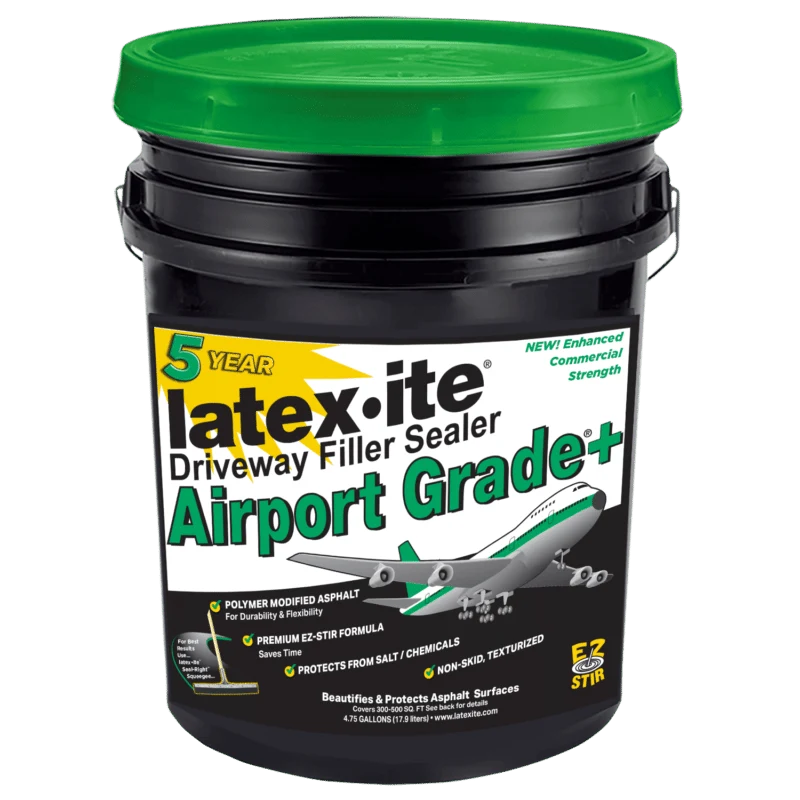
| Coverage | 400–500 sq ft per coat on smooth or previously sealed; 300–400 sq ft per coat on rough or porous |
|---|---|
| Sheens | Matte black, non-skid |
| Dry / Recoat | Foot traffic 4–6h · vehicle 24–48h |
| Full cure | 30 days |
| VOC | Low VOC, coal tar free, PAH compliant |
| Yellowing risk | N/A — pigmented black asphalt emulsion |
| Primer | None; oil-stain primer required over gas and oil spots |
| Price tier | $$ |
- Commercial-strength polymer-modified asphalt emulsion with enough body to bridge hairline cracks at 1/8-inch and under, which saves a separate crack-filler pass on a lightly checked driveway
- Flows and levels better than Ultra Shield on coarse, open-pore asphalt; on my roughest bay it left a uniform black where the thicker gel formula showed squeegee tracks
- Coal tar free and PAH compliant, so it is legal in the Northeast counties and Washington State jurisdictions that banned coal-tar sealers
- Wants a 55°F overnight minimum for a proper cure, which cuts the sealing season short in zones 5 and 6 by three or four weeks compared with Ultra Shield
- 5-year warranty against the 10 years on Ultra Shield and Drive-Maxx 1000, for roughly the same money per pail
- The extra body is a liability on a smooth, recently sealed driveway; you get more product on the ground than the surface needs
3. Black Jack Drive-Maxx 1000 Driveway Filler Sealer
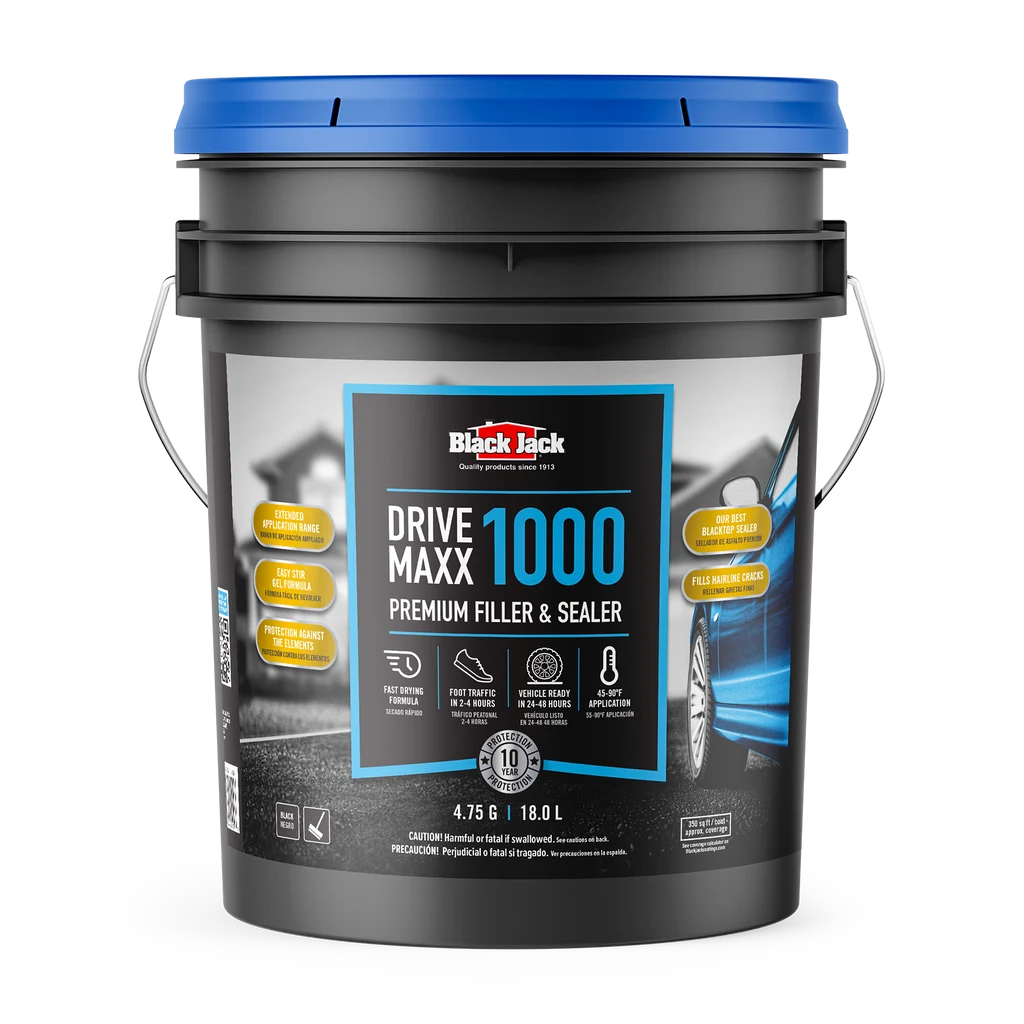
| Coverage | About 400 sq ft per coat per pail on previously sealed asphalt; two coats specified |
|---|---|
| Sheens | Matte black, sand-textured non-skid |
| Dry / Recoat | Foot traffic 1–3h · vehicle 24h |
| Full cure | 30 days |
| VOC | Low VOC water-based asphalt emulsion |
| Yellowing risk | N/A — pigmented black asphalt emulsion |
| Primer | None; degrease oil spots before sealing |
| Price tier | $$ |
- Carries the most sand of any pick, and that shows up as measurable skid resistance on a wet slope where the sand-free acrylic sealers got slick
- Foot traffic in one hour under good conditions and vehicles at 24 hours, the fastest turnaround in the asphalt group
- 10-year warranty at $44.99 for a 5-gallon pail, the best warranty-per-dollar in the round-up
- The sand loading means constant stirring; leave the pail sitting for 20 minutes mid-job and the last third of the pail comes out gritty and streaky
- That same sand reads as texture on a driveway you wanted to look glassy black. It looks like a road surface, because it basically is one
- Gardner-Gibson's one-hour foot traffic claim assumes 75°F, clear sky, and under 35 percent humidity. In real July Northeast humidity I measured closer to three hours
4. Black Jack Drive-Maxx 500 Driveway Filler Sealer
| Coverage | About 400 sq ft per coat per pail on previously sealed asphalt; two coats specified |
|---|---|
| Sheens | Matte black, sand-textured non-skid |
| Dry / Recoat | Foot traffic 4h · vehicle 24–48h |
| Full cure | 30 days |
| VOC | Low VOC water-based asphalt emulsion |
| Yellowing risk | N/A — pigmented black asphalt emulsion |
| Primer | None; degrease oil spots before sealing |
| Price tier | $ |
- $29.99 for a 5-gallon pail seals a 600 sq ft driveway in two coats for about $90, the cheapest honest number on this page
- Latex-enhanced with sand, so it is a real filler-sealer rather than a thin color coat; it fills the small stuff and it is not slippery
- E-Z stir consistency mixes with a paddle in two minutes and squeegees without fighting you, which matters on a first-time job
- 5-year warranty and a thinner cured film. On my test bay the color washed toward charcoal by month 18 where the 1000 was still near-black
- Freeze-thaw performance is the weak spot; two of my apron sections showed hairline checking after the second winter
5. Ghostshield Siloxa-Tek 8500 Concrete Sealer
| Coverage | 150–400 sq ft / gal single coat; 75–200 sq ft / gal at the two-coat spec |
|---|---|
| Sheens | Natural, no color change, no gloss |
| Dry / Recoat | Dry 4–6h at 70°F and 50% RH · traffic 24h |
| Full cure | Water repellency continues developing for 7 days |
| VOC | Low VOC water-based |
| Yellowing risk | None — penetrating, no surface film |
| Primer | None; bare clean cured concrete only |
| Price tier | $$$ |
- 40 percent actives silane/siloxane blend penetrates into the pore structure instead of forming a film, so there is nothing on the surface to peel, blush, or turn white under a tire
- Stopped road-salt chloride ingress cold on my slab samples; after a winter of deicer the sealed coupon showed a fraction of the surface scaling on the untreated control
- Water-based and DOT-approved for highway and bridge decks, which is a harder service condition than any residential driveway will ever see
- Leaves a natural finish with no darkening and no gloss. If you wanted the wet-look shine, this is the wrong chemistry and you should be shopping acrylics
- $100-plus per gallon puts a 600 sq ft concrete driveway at roughly $200 to $300 for two coats, several times the asphalt-sealer budget
- Two coats need to go on wet-on-wet within the recoat window, and a dry-then-recoat mistake wastes the second gallon because the surface is already repellent
Latex-ite Trowel Patch
Driveway sealer takes no primer, but it does take a repair step, and skipping it is why most sealing jobs look worn out in eighteen months. Trowel Patch is the cement-like asphalt filler that handles medium and large cracks, rough spots, and shallow depressions that sealer will only bridge for one season before it splits again. Sealer at roughly 15 mils wet cannot span a 1/2-inch crack. It sags into it, dries thin over the void, and cracks along the same line by the first hard freeze. Trowel the patch, let it fully cure (evaporative cure, so give it a warm day or two, longer in fall when the sun angle is low), then seal over the top. One important limit: Trowel Patch will not bond over gas- or oil-stained asphalt. Degrease and prime those spots separately or the patch lifts with the stain underneath it.
BUY ON AMAZON