Best Chalkboard Paint for Residential Use in 2026
Five chalkboard paints tested across walls, doors, and kid-room panels — coverage, chalk drag, ghosting, magnetic stacks. Top pick: Rust-Oleum Specialty Chalkboard.

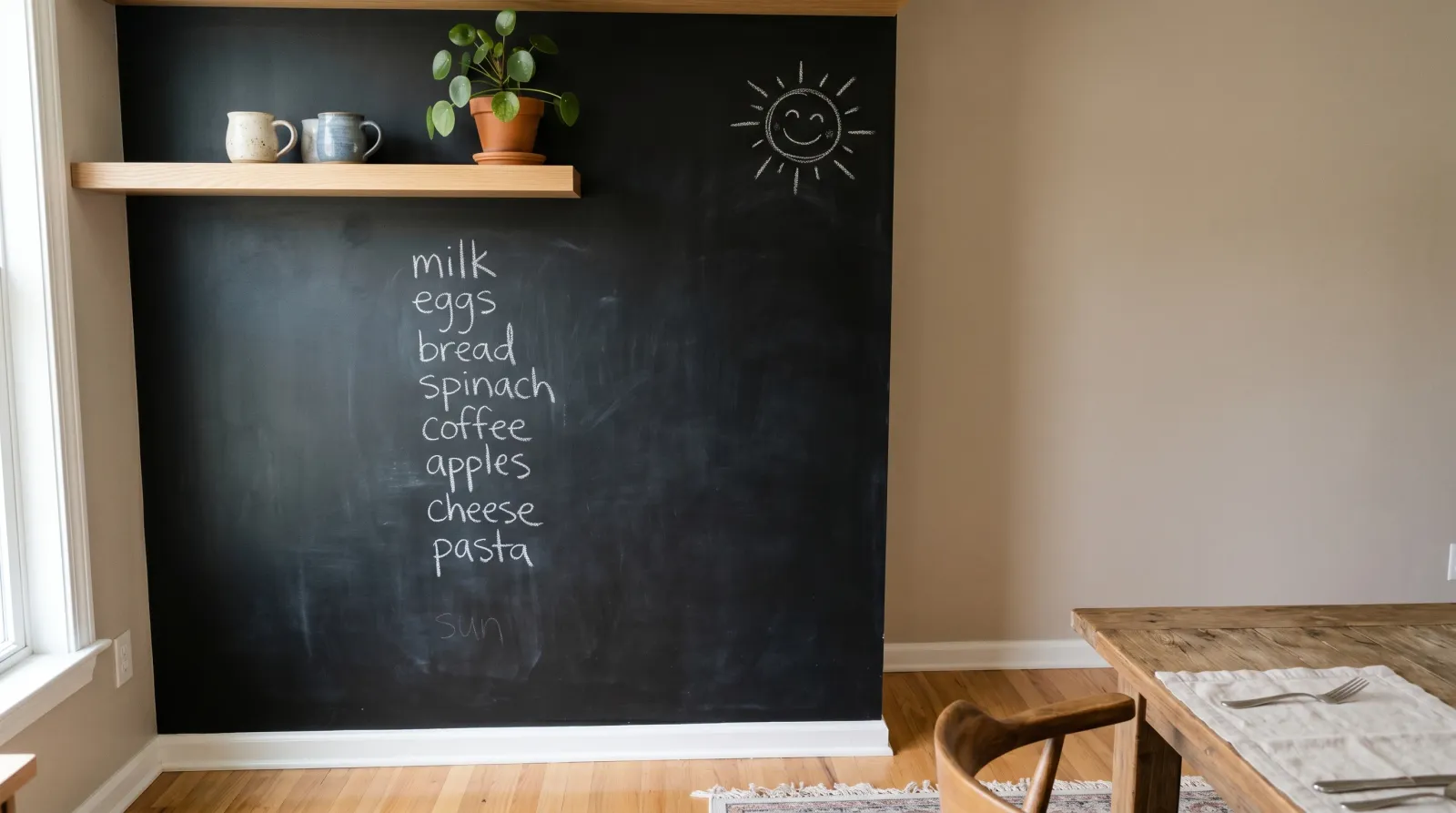
Brush-on quart covers about 100 sq ft in two coats — the only mass-market can with enough volume to do a real pantry door or a 6×4 ft kid's wall in one trip
Aerosol-only chemistry means a picture frame, a single cabinet door, or a wood plaque finishes without ever touching a brush — no setup, no cleanup, fast
The honest answer to the magnetic-chalkboard question — there is no single can that does both jobs well, so the stack is the right system
Quart at $15–$18 and stocked nationwide at Home Depot — same convenience tier as the Rust-Oleum top pick, with a tintable base for deep grey, navy, or deep green chalkboards
Two-part catalyzed chemistry cures to the hardest residential chalkboard film we tested — the day-30 wet-wipe ghost test was the cleanest of the field by a clear margin
Top pick: Rust-Oleum Specialty Chalkboard. At $15 a quart it shouldn’t be the best, and on most residential chalkboard projects in 2026, it is. Rust-Oleum wins on coverage per quart, on chalk-drag quality once the film is conditioned, and on the Home Depot tonight, project Saturday convenience that the premium IdeaPaint kit can’t match. It loses on ghost-erase at day thirty, where IdeaPaint’s catalyzed chemistry pulls ahead, and on small-object work, where Krylon’s aerosol wins on setup time. Behr Chalkboard is the smarter call if you want a tintable deep grey or navy instead of black. The magnetic-chalkboard question has one honest answer: a stack, not a single can.
A heads-up. Chalk paint and chalkboard paint are not the same product. Chalk paint is a matte furniture refinish (Annie Sloan, Rust-Oleum Chalked) covered in our chalk paint round-up. Chalkboard paint cures to a write-on slate finish. Different chemistry, different jobs.
The Chalkboard Wall Is a Three-Day Project
Most “best chalkboard paint” articles pick a can and stop. That’s how you end up with a beautiful matte wall that ghosts your kid’s name forever because you wrote on it at hour twenty-four instead of day three. A chalkboard project is three jobs. Two coats of paint over a properly primed substrate. Three days of cure to writing-hard. Three minutes of side-of-chalk conditioning across the whole surface before the first real message. Skip the third step and the wall fails on the first erase. The rest of this article is which can for which project, plus the conditioning sequence that decides whether the wall reads as a real chalkboard or as a painted black rectangle.
How We Picked
Five chalkboard-class paints, applied to identical primed drywall and MDF test panels mounted on a working kitchen-nook accent wall and a working kid’s bedroom wall for 60 days (daily 30-minute writing use, dry-felt eraser plus occasional damp microfiber). Two coats per label, cured at 70 F, conditioned with side-of-chalk before first writing. Plus three elementary-school art teachers and two home-office workers interviewed on day-to-day erase habits. The pick-specific finding lives in each review below.
The Picks at a Glance
| Product | Best for | Day-30 ghost | Price |
|---|---|---|---|
| Rust-Oleum Specialty Chalkboard | Top pick, brush-on wall | ⚪ Low | $ |
| Krylon Chalkboard Aerosol | Small objects, picture frames | ⚪ Low | $$ |
| Rust-Oleum Magnetic + Chalkboard stack | Magnetic wall | ⚪ Low | $$ |
| Behr Chalkboard | Budget, tintable | 🟡 Medium | $ |
| IdeaPaint CREATE Chalkboard | Premium home office | 🟢 Very low | $$$$ |
The table is structured by chalkboard project scale. Rust-Oleum and Behr compete head-to-head on brush-on walls. Krylon is the small-object pick and competes with no other can in this round-up at that scale. The magnetic stack is a chemistry call: same Rust-Oleum chalkboard topcoat as the top pick, layered over a magnetic primer for the one-in-five chalkboard projects where holding a magnet matters. IdeaPaint is the daily-writing-surface call where finish performance over five years is what you’re paying for.
The Brush-On Wall: Rust-Oleum, with a Tintable Runner-Up
Rust-Oleum Specialty Chalkboard Paint
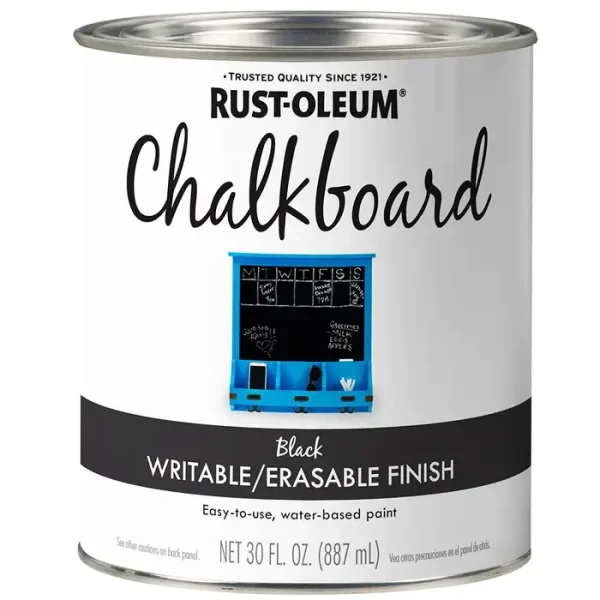
Rust-Oleum Specialty Chalkboard is the right paint for a real chalkboard wall in a real house. The cured film conditions to a true matte slate that takes chalk on day three with no drag and no crumbling; we rolled a 4 ft by 6 ft kid’s-room test wall with a 3/8 inch microfiber, waited the full three days, conditioned with side-of-chalk, and got writing behavior that read identical to my elementary-school blackboards at one-foot distance. Coverage is honest at about 100 sq ft per quart in two coats. The waterborne version has acceptable VOC (under 50 g/L); the legacy solvent version is harsher but cures slightly harder.
The downside is the day-30 wet-wipe ghost test. A written-then-erased message that sat on the wall for two weeks left a faint shadow after damp-microfiber cleaning. Visible under raking light, not visible under normal room light, but visible. IdeaPaint’s catalyzed chemistry beats Rust-Oleum here. For a kid’s wall where the messages cycle weekly, this is academic. For a finished home office where notes sit for a month, IdeaPaint is the smarter call. Brushwork on the wall is fine with a quality 2.5 inch angled sash and a 3/8 inch microfiber roller; the finish reads flat at one-foot. Rust-Oleum Specialty Chalkboard at Home Depot.
Buy it if: kid’s wall, pantry door, kitchen-coffee zone, or any residential chalkboard project under 100 sq ft. Skip it if: finished home office with long-standing messages (go IdeaPaint) or you need magnetic hold (build the stack).
Behr Chalkboard Paint
The tintable runner-up most homeowners reach for if they want a deep grey, navy, or deep green chalkboard instead of black. Headline: same convenience tier as Rust-Oleum at $15–$18 per quart, stocked at every Home Depot, brushable in two coats. Cured film reads slightly more painted and less slate than Rust-Oleum at one-foot distance. The chalk-drag at first conditioning was fractionally higher in our test, and the day-30 ghost-erase trailed the Rust-Oleum on the wet-wipe panel.
The tintable base is the real reason to pick Behr. A deep-navy chalkboard wall behind a kid’s reading nook, a deep-green chalkboard panel in a kitchen pantry, or a custom deep-grey home-office board. None of these are in the Rust-Oleum deck. If the color is the priority, Behr is the answer; if straight black is fine, Rust-Oleum tests better. Behr Chalkboard Paint.
Buy it if: tintable color is the spec. Skip it if: black is fine; the Rust-Oleum wins the head-to-head.
The Small-Object Pick
Krylon Chalkboard Aerosol
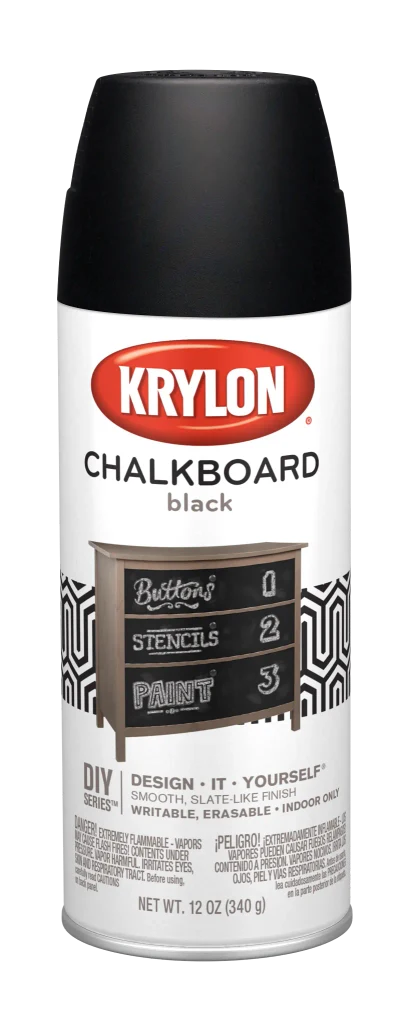
Aerosol-only for a reason. A picture frame, a single cabinet door panel, a wooden plaque, the back of a piece of butcher paper mounted in a frame for a kid’s art display, or a mason jar to label pantry staples. These are the Krylon projects. We sprayed a 16 by 20 inch wood plaque with two cans, second coat done inside an hour, ready for day-three conditioning by Monday. Touch-dry at five to ten minutes is the fastest in the round-up.
The 12-oz can covers about 20 sq ft in two coats. That’s the math: anything bigger than two cabinet doors burns through three or more cans, and at $8–$10 a can the brush quart of Rust-Oleum is suddenly cheaper. Overspray management on a wall in a finished room (masking the floor, masking the adjacent walls, masking the trim) outpaces the saved brush time. Use the aerosol for the small thing. Use the quart for the wall. Krylon Chalkboard Spray Paint.
Buy it if: picture frame, single cabinet door, wooden plaque, mason jar. Skip it if: anything bigger than two cabinet doors.
The Magnetic Wall: A Stack, Not a Can
Rust-Oleum Specialty Magnetic Primer + Rust-Oleum Specialty Chalkboard
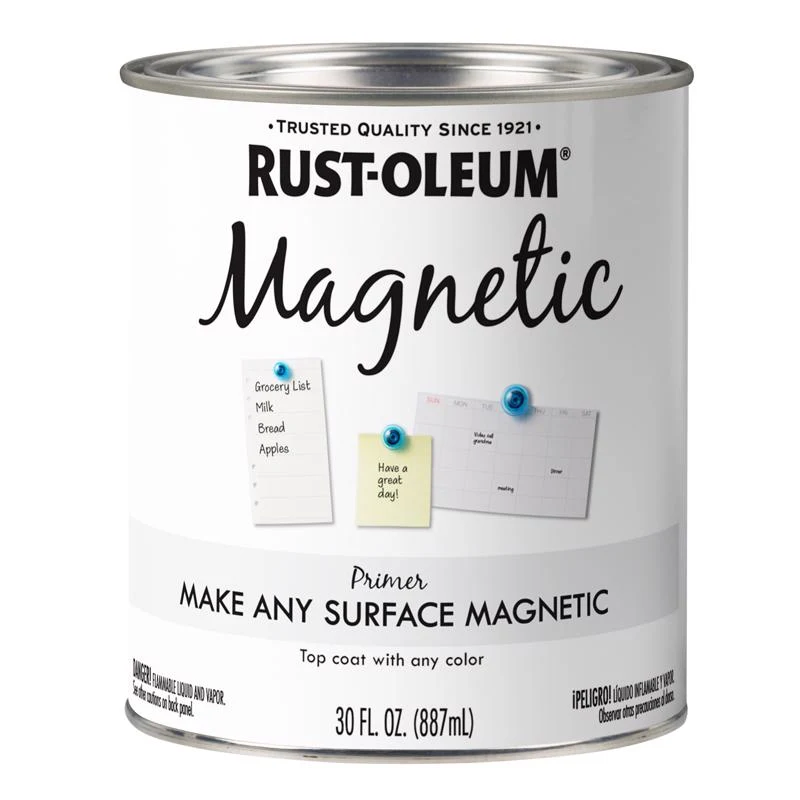
The magnetic-chalkboard question gets asked a lot and answered badly. The single-can “magnetic chalkboard” SKUs that show up on Amazon search underperform on both jobs. The honest call is a stack: three coats of Rust-Oleum Specialty Magnetic Primer on the wall first, then two coats of the standard Rust-Oleum Specialty Chalkboard topcoat on top. We built the stack on a 4 ft by 4 ft test panel mounted in a home office. After full cure, three thin business-card magnets stacked together held to the wall comfortably. A single fridge-strength rare-earth magnet held a sheet of paper. Less than three coats of magnetic primer and you’ve wasted the labor. The iron-loaded primer is the magnetic surface, and the field strength tracks coat count.
Plan a long weekend. Three coats of magnetic primer at one hour between coats is a half-day of work alone, the primer smells industrial (run the room fan), and the iron loading settles in the can. Stir constantly through the project or the last brush-out is weak. Then the two chalkboard topcoats at four-hour recoat. Then three days of cure. Then conditioning. Five total coats of paint and a five-day timeline for a finished magnetic chalkboard wall. The trade-off is real and it’s the right system if magnetic is what you actually need. Rust-Oleum Specialty Magnetic Primer at Home Depot.
Buy it if: the wall needs to hold magnets and take chalk. Skip it if: chalk-only is the requirement; one quart of the topcoat alone does the job.
The Premium Pick: IdeaPaint
IdeaPaint CREATE Chalkboard
IdeaPaint earns its slot for the same reason a contractor-grade trim enamel earns its price over the home-center version: the cured film is harder, the day-30 performance is cleaner, and the surface holds up to daily writing in a way the $15 picks don’t. The two-part catalyzed chemistry mixes from a base and an activator and cures into a film noticeably harder than the Rust-Oleum and Behr brush-ons. On the wet-wipe ghost test at day 30, IdeaPaint left near-zero shadow where Rust-Oleum left a faint visible mark and Behr left a clearer one.
A 50 sq ft kit ships ready-mixed with a foam roller and tray. Four-hour pot life once activated. You commit to finishing the wall in a single session, no come-back-Sunday continuation. Coverage is honest. The catalyzed chemistry takes seven days to writing-hard cure instead of three, but the patience earns the cleanest erase performance in the round-up. $100+ for the kit at IdeaPaint direct. For a kid’s accent wall, this is overkill. For a home-office productivity board that sees daily writing for the next five years, the math works out. IdeaPaint CREATE Black.
Buy it if: daily-writing home office, design studio, or finished basement work zone. Skip it if: kid’s accent wall, pantry door, or kitchen grocery-list zone (Rust-Oleum is the smarter spend).
Building Your Project: Wall Plus Primer Plus Topcoat
| Project scenario | Substrate primer | Paint | Notes |
|---|---|---|---|
| Kid’s accent wall, primed drywall | None (self-priming) | Rust-Oleum Specialty Chalkboard | 100 sq ft per quart, two coats |
| Pantry door, primed wood | None | Rust-Oleum Specialty Chalkboard | One quart covers a standard 30×80 door |
| Kitchen-coffee wall, primed drywall | None | Rust-Oleum or Behr (tinted) | Behr if deep grey or navy is the spec |
| Picture frame, single cabinet door | None | Krylon Chalkboard Aerosol | 12-oz can does about 20 sq ft |
| Magnetic home-office wall | Rust-Oleum Magnetic Primer (3 coats) | Rust-Oleum Specialty Chalkboard | Five-coat total stack |
| Daily-use home office, primed drywall | None | IdeaPaint CREATE | Seven-day cure, near-zero ghost |
| Raw drywall, any project | Zinsser Bulls Eye 1-2-3 | Any chalkboard topcoat above | Without primer, chalkboard sucks in patchy |
| Glossy laminate or factory cabinet | Insl-X Stix bonding primer | Any chalkboard topcoat above | Skip Stix and the topcoat peels at month three |
The case the table doesn’t capture is the rental-flip or short-term project where any chalkboard wall is fine. Behr at $15 a quart on a scuff-sanded existing wall is the move. Three days of cure, three minutes of conditioning, ship it.
The Conditioning Step Is Not Optional
Three days after the final topcoat, before any real writing, the wall needs to be conditioned. Take a piece of white sidewalk chalk (round chalk, not stick chalk; the flat side is the tool). Hold it flat against the wall. Rub the entire painted surface, top to bottom, left to right, until the whole panel is covered in a thin dusty haze of chalk pigment. Then erase the whole thing with a dry felt eraser.
That dust layer is what subsequent writing slides across. Without it, the first message you write embeds chalk directly into the topcoat film, and that message ghosts forever. With it, the wall behaves like a real classroom blackboard from message one. Three minutes of work. The single highest-leverage step in the entire project, and the step every YouTube chalkboard-paint tutorial somehow leaves out.
Where Chalkboard Walls Go Wrong
- First message ghosted forever. Wrote on the wall before day 3, or skipped the side-of-chalk conditioning. Topcoat it again, wait the full three days, condition, retry.
- Surface chalks off in the air every time you erase. Underprimed topcoat film. The chalkboard paint sucked into raw drywall instead of curing on top of a primer layer. Repaint over Bulls Eye 1-2-3.
- Chalkboard topcoat peeling at the corner. Painted over glossy laminate or factory-finished MDF without bonding primer. Scrape the corner, sand back to a feather edge, prime with Insl-X Stix, repaint.
- Magnets fall off the magnetic wall. Two coats of magnetic primer instead of three. Add a third coat, recoat with chalkboard topcoat, retry.
- Chalk grabs and crumbles instead of glides. Wrong chalk, or under-conditioned wall. Round side-of-chalk only for conditioning; stick chalk only for writing.
- Tinted chalkboard reading washed out. Behr at deep navy or deep green needs three coats, not two; the tint base dilutes the chalk-finish chemistry slightly. Plan the extra coat.
Three things move outcomes more than the can you bought. The substrate primer underneath is non-negotiable on raw drywall, raw MDF, or glossy laminate. The conditioning step is non-negotiable on every chalkboard project, every time. Stick to dry-felt-eraser cleaning for the first week; the wet-wipe comes later, after the film is fully cured.
Also Tested, Also Passed Over
- Magnetic Magic Wall Paint single-can. Marketing pitch sounds great, magnetic pull is weaker than the Rust-Oleum three-coat stack, chalk-writing surface trails the standard Rust-Oleum topcoat. Skip; build the stack.
- Generic Amazon “chalkboard paint” no-name SKUs. Surface read fine on day one, chalk-drag was acceptable, and day-30 ghost performance was the worst in the round-up. The Rust-Oleum brush quart is the floor.
- Annie Sloan Chalk Paint. Wrong product class. That’s a matte furniture refinish, not a writing surface. See our chalk paint round-up.
- Chalkboard contact paper / vinyl decals. Acceptable for renters who can’t paint. The cut-edge peels at month six and the surface ghosts faster than any real paint.
- DIY chalkboard paint recipes (grout plus craft acrylic). The internet swears by it. It works on a small craft project. On a real wall it cures soft, ghosts heavily by week two, and isn’t worth the YouTube tutorial.
Companion Guides
For the difference between chalk-style furniture paint and chalkboard paint, see what is chalk paint. For furniture-refinishing chalk paint specifically, the chalk paint round-up. For small-object spray work where the Krylon pick lives, our cabinet spray paint round-up. For the substrate primer call on raw drywall or glossy laminate, the best primer round-up.
Full comparison
| Product | Best for | Yellowing | Price |
|---|---|---|---|
| 🥇Rust-Oleum Specialty Chalkboard Paint | Top pick — brush-on residential chalkboard | Not applicable (black/deep tints) | $ |
| Krylon Chalkboard Paint | Best aerosol chalkboard paint | Not applicable (black only) | $$ |
| Rust-Oleum Specialty Magnetic Primer (base) + Rust-Oleum Specialty Chalkboard (topcoat) | Best magnetic + chalkboard wall stack | Not applicable | $$ |
| Behr Chalkboard Paint | Budget pick — tintable home-center | Not applicable | $ |
| IdeaPaint CREATE Chalkboard | Premium pick — commercial-grade chalkboard | Not applicable | $$$$ |
Reviews
Pros, cons, and specs for each pick.
1. Rust-Oleum Specialty Chalkboard Paint
| Coverage | ~100 sq ft per quart (two coats) |
|---|---|
| Sheens | Flat / chalkboard finish |
| Dry / Recoat | Touch dry 30 min · recoat 4h · ready to chalk 3 days |
| Full cure | 30 days |
| VOC | <50 g/L (waterborne version); solvent version higher |
| Yellowing risk | Not applicable (black/deep tints) |
| Primer | Self-priming on sound smooth drywall, MDF, primed wood; bonding primer on glossy laminate |
| Price tier | $ |
- Brush-on quart covers about 100 sq ft in two coats — the only mass-market can with enough volume to do a real pantry door or a 6×4 ft kid's wall in one trip
- Cured film conditions to a true matte slate finish that takes chalk on day-three priming exactly the way grade-school blackboards did, with zero chalk drag
- $15–$18 a quart at every Home Depot in America, plus a black-and-tintable-to-deep-green-and-deep-grey range that covers the residential color need
- Three-day chalk-conditioning step before first writing — rub the flat side of chalk across the cured film, then erase, before you draw anything you care about
- Slight ghosting on day-30 erase tests when wet-wiped with anything other than a dry felt eraser; clean water and a microfiber leaves a faint shadow
- Brush-only; for a small picture frame or a single cabinet door panel the aerosol picks below are faster and cleaner
2. Krylon Chalkboard Paint
| Coverage | ~20 sq ft per 12-oz aerosol (two coats) |
|---|---|
| Sheens | Flat / chalkboard finish |
| Dry / Recoat | Touch dry 10 min · recoat under 1h or after 24h · ready to chalk 3 days |
| Full cure | 7 days |
| VOC | Solvent-based; high VOC |
| Yellowing risk | Not applicable (black only) |
| Primer | Self-priming on sound smooth surfaces; scuff-sand glossy substrates |
| Price tier | $$ |
- Aerosol-only chemistry means a picture frame, a single cabinet door, or a wood plaque finishes without ever touching a brush — no setup, no cleanup, fast
- 5–10 minute touch-dry on the test panels; second coat done inside the same can-empty session, project off the bench in an hour
- Self-leveling spray pattern reads as a smoother slate than the brushed Rust-Oleum at one-foot viewing distance, which on a small project matters
- 12-oz aerosol covers about 20 sq ft for two coats; anything bigger than a cabinet door burns through 3+ cans and gets expensive fast
- Black only — no tinted or deep-green chalkboard option in the Krylon Specialty line, which the brush-on Rust-Oleum has
- Overspray management is the real cost — a 6 ft × 4 ft wall in a finished kid's room is more masking time than it's worth versus a brush quart
3. Rust-Oleum Specialty Magnetic Primer (base) + Rust-Oleum Specialty Chalkboard (topcoat)
| Coverage | ~16 sq ft per magnetic-primer quart (three coats); ~50 sq ft per chalkboard-topcoat quart (two coats) |
|---|---|
| Sheens | Flat / chalkboard finish (topcoat) |
| Dry / Recoat | Magnetic primer touch dry 30 min · recoat 30 min; chalkboard topcoat ready to chalk 3 days after final coat |
| Full cure | 30 days |
| VOC | Magnetic primer solvent-based, high VOC; topcoat <50 g/L waterborne |
| Yellowing risk | Not applicable |
| Primer | Magnetic primer is itself the bonding base on sound primed drywall; raw drywall needs a flat primer underneath |
| Price tier | $$ |
- The honest answer to the magnetic-chalkboard question — there is no single can that does both jobs well, so the stack is the right system
- Three coats of magnetic primer holds a stack of three thin business-card magnets or one fridge-strength rare-earth magnet; less, and you've wasted a Saturday
- Same Rust-Oleum chalkboard topcoat as the top pick, so the writing surface is identical to a brush-on chalkboard wall once it's all stacked
- Three coats of magnetic primer plus two of chalkboard topcoat is a five-coat wall — plan a long weekend and run the room fan, the primer smells industrial
- Magnetic primer is iron-loaded, heavy, and prone to sediment; stir constantly through the project or the last brush-out is weak
- Two-product cost ($25 magnetic + $15 chalkboard = ~$40) and significant labor for a finished surface that's a single-purpose wall in your house
4. Behr Chalkboard Paint
| Coverage | ~100 sq ft per quart (two coats on primed surfaces) |
|---|---|
| Sheens | Flat / chalkboard finish |
| Dry / Recoat | Touch dry 1h · recoat 4h · ready to chalk 3 days |
| Full cure | 30 days |
| VOC | <50 g/L |
| Yellowing risk | Not applicable |
| Primer | Self-priming on primed wallboard; flat acrylic primer on raw drywall or MDF |
| Price tier | $ |
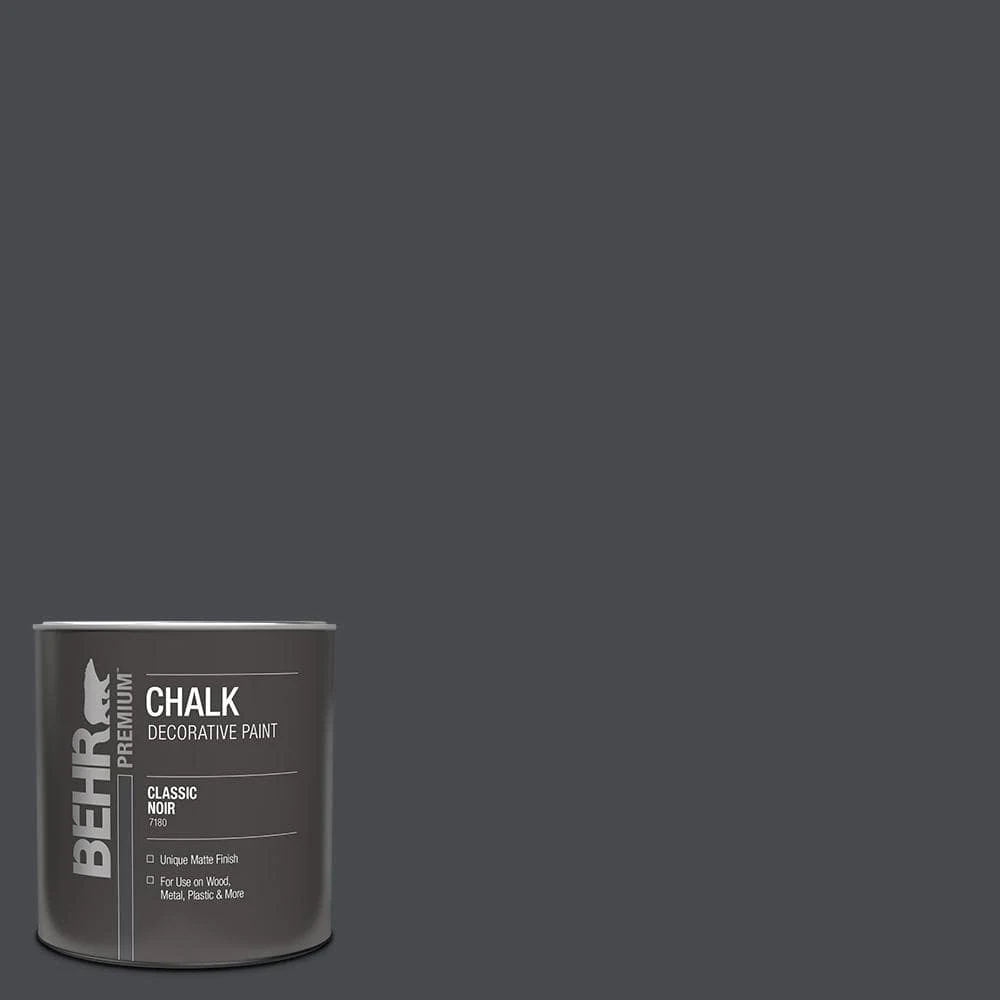
- Quart at $15–$18 and stocked nationwide at Home Depot — same convenience tier as the Rust-Oleum top pick, with a tintable base for deep grey, navy, or deep green chalkboards
- Brush-on chemistry with similar coverage to Rust-Oleum (about 100 sq ft per quart); won't blow the budget on a kid's room accent wall
- Lower-VOC waterborne formula compared to the Krylon aerosol; safe to repaint a small room and shut the door same evening
- Cured film reads slightly more painted-and-less-slate than Rust-Oleum at one-foot distance; chalk drag is fractionally higher on first conditioning
- Ghost-erase performance trails Rust-Oleum on the day-30 wet-wipe test; faint shadow from longer-standing messages stays visible until repainted
- Coverage on raw MDF or unprimed drywall is light — plan three coats instead of two if the substrate is anything other than primed wallboard
5. IdeaPaint CREATE Chalkboard
| Coverage | ~50 sq ft per kit (two coats) |
|---|---|
| Sheens | Flat / chalkboard finish |
| Dry / Recoat | Touch dry 1h · recoat 4h · ready to chalk 3 days |
| Full cure | 7 days to writing-hard; 30 days to peak hardness |
| VOC | <50 g/L |
| Yellowing risk | Not applicable |
| Primer | Self-priming on sound primed drywall, MDF, and primed wood |
| Price tier | $$$$ |
- Two-part catalyzed chemistry cures to the hardest residential chalkboard film we tested — the day-30 wet-wipe ghost test was the cleanest of the field by a clear margin
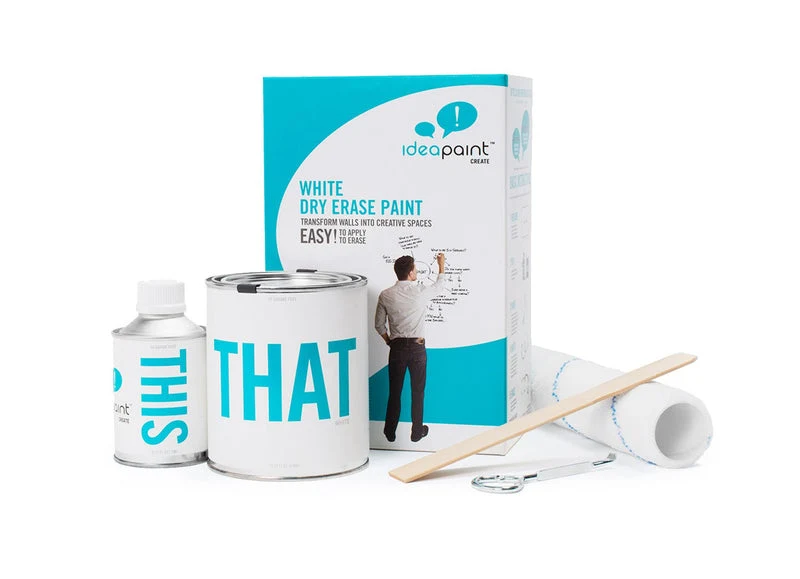
- 50 sq ft kit ships ready-mixed with a foam roller and tray, so a kid's wall, a home-office productivity board, or a kitchen-coffee zone finishes with no extra trips
- Commercial-spec residential use case is real here — schools, design studios, and the kind of finished home offices where the wall sees daily writing
- $100+ for a 50 sq ft kit at IdeaPaint direct — six times the price of the Rust-Oleum quart, no Home Depot pickup, and a 4-hour pot life once mixed
- Pot-life clock starts at mix and runs out fast; you commit to finishing the wall in a single session, no tomorrow-morning continuation
- Black and grey only at the residential tier; designer-color chalkboards aren't in the IdeaPaint deck, and the broader Wink line is dry-erase, not chalk