Best Work Lights for Painting
Five work lights tested across a full-house repaint, a cabinet job, and a dark basement. Top pick: Milwaukee M18 ROCKET Dual Power Tower Light — plus where each one falls short.

Disclosure: Some links below are affiliate links. We earn a commission if you buy through them, at no extra cost to you.
Top pick: the Milwaukee M18 ROCKET Dual Power Tower Light (2131-20). It runs off an M18 battery or a plain extension cord, opens in about five seconds, and puts 2,500 neutral-white lumens up at seven feet where light belongs. It wins on two things nothing else in the test did together: the head sits above your eye line instead of glaring into it, and dual power means the light does not die at hour six with a wall half cut in. It falls short on raw output. 4,000 lumens from the DEWALT DCL079B tripod lights a basement better. For hunting roller holidays on a wall you already painted, the M18 ROVER Flood Light is the one I grab, because you want that light low and raking, not high and flat.
Bright is the easy part. Placement is the whole job.
A Work Light Is a Defect Finder, Not a Color Judge
I want to get this out of the way before the picks, because it is the mistake I see most and it costs people real money.
Nobody should approve a paint color under a work light. A 5,000K LED head is cooler and flatter than any bulb the room will actually live under. A warm greige reads gray. A soft white reads like a dentist’s office. People stand in a half-lit room at 8 p.m., look at a sample under a tripod light, and decide the color is wrong, then buy two more gallons of something they like less. Judge color under the room’s own fixtures at the hour you use the room, and against the room’s own daylight. Turn the work light off first.
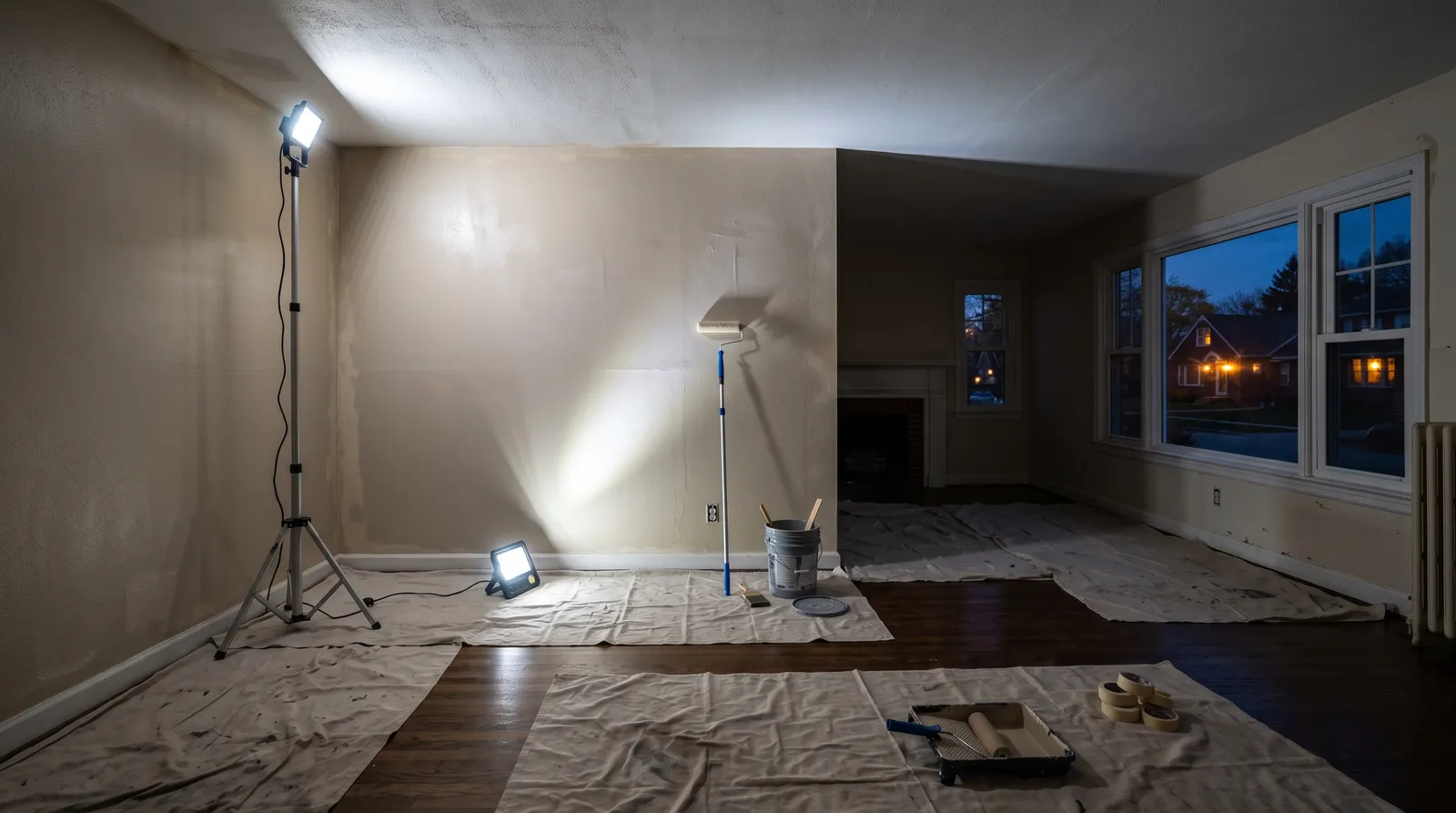
What the work light is for is finding what your roller missed. Thin spots, skipped passes, the sanded patch that flashes through because nobody primed it, the lap mark where you rolled into a section that had already set. Those are shadow problems, and shadows only show up when the light comes in at a low angle. That is the whole trick, and it is why a $70 flood on the floor often beats a $250 tower in the corner.
Color rendering is the spec the listings bury. A cheap CRI-70 LED washes joint compound, tinted primer, and topcoat toward the same gray, and once those three read the same you cannot tell a defect from a shadow. Milwaukee’s TRUEVIEW and DEWALT’s natural-white heads both hold those surfaces apart. If a product page will not say what its CRI is, assume the answer is low and the silence is deliberate.
What Actually Breaks on a Paint Job
Five weeks with these lights, and the failures were never about brightness.
Glare. A bare LED array at 4 feet is roughly at the height of your face when you are cutting in a ceiling line from a step ladder. Every time you turn toward it you lose your dark adaptation for the next thirty seconds, which is exactly when you are trying to see whether your cut line is straight. Any light whose head can get above 6 feet, or that you can bounce off a ceiling, solves this. The ones that cannot, don’t.
Overspray. Two days of waterborne enamel on cabinet doors put a haze on every lens in the test. The Milwaukee ROVER is the only one with a replaceable lens as a stated feature, which means the cheap consumable is the lens instead of the whole light. The Bayco’s tempered glass wiped clean with denatured alcohol. Polycarbonate diffusers do not, and they cloud permanently.
Heat. This one has an easy answer now. Old 500-watt halogen work lights push enough radiant heat at 3 feet to skin over a paint film ahead of the rest of the wall, and that shows up as flashing and lap marks after cure. Every light here is LED and stays cool. If you still have a pair of yellow halogen heads on a stand in the garage, they are a liability on a paint job, not an asset. Retire them.
Cords. A 6-foot cord means an extension cord across a canvas drop cloth on every single job. That cord catches a heel, the heel catches a ladder, and the ladder goes into a wet wall. I have watched it happen. It is the strongest argument for cordless that exists, and it is not about convenience.
Footprint. Tripod legs take a 3-foot circle out of a room you are trying to work in. In a bathroom or on a stair landing, there is nowhere to put them. See the ladders for painting round-up for the same problem in a different tool.
How We Ran These
Three real jobs, then one controlled comparison.
A full-house interior repaint, four bedrooms plus a hallway and stairwell, with every ceiling fixture pulled down for the ceiling coat. That put the work lights in charge of about forty hours of work with no other light in the room. A kitchen cabinet refinish on a garage bench with no windows, twenty-two doors and drawer fronts in waterborne enamel, which is what put every lens through two days of atomized overspray. And an unfinished basement with 7-foot joists and dark masonry, which is the worst lighting condition most homeowners will ever paint in.
Then the controlled run. Same 12 by 14 foot bedroom, same freshly rolled wall, each light placed at three positions: on the floor 12 inches off the baseboard for raking, at waist height 6 feet back for fill, and at head height aimed at the ceiling for bounce. Before rolling, we left three deliberate defects in the wall: two skipped roller passes and two sanded patches with no primer over them.
The ROVER on the floor found all five defects from both directions. The ROCKET tower aimed at the ceiling found none of them, which is not a knock on the ROCKET. Bounce light is designed to eliminate shadows, and shadows are how you see stipple. That is the trade-off, and it is why the honest answer for most people is two lights, not one.
Lumen figures below are the manufacturers’ published numbers. We did not measure output. What we compared is how each light performed against the others in the same room, at the same distances, on the same wall.
Comparison at a Glance
| Model | Power | Max lumens | Reach / mount | Best for | Price tier |
|---|---|---|---|---|---|
| Milwaukee M18 ROCKET 2131-20 | M18 battery or AC | 2,500 | Tower, 4 to 7 ft | Whole-room fill, all-day interior work | $$$ |
| DEWALT DCL079B Tripod Light | 20V MAX battery | 4,000 | Tripod, to 7 ft | Garages, basements, big open rooms | $$$ |
| Milwaukee M18 ROVER 2361-20 | M18 battery | 1,500 | Floor / hook / magnet | Raking light, finding holidays | $$ |
| DEWALT DCL077B Compact | 12V / 20V MAX / FlexVolt | 2,000 | Bench, 5/8-in or 1/4-in tripod thread | Cabinet doors, trim, bench spraying | $$ |
| Bayco SL-1512 | Corded AC | 2,200 | Floor, tilt and swivel base | Budget corded fill, long garage days | $ |
1. Milwaukee M18 ROCKET Dual Power Tower Light, Top Pick
The ROCKET is the light that stays in the room all day.
Dual power is why. Drop an M18 pack in and it goes anywhere for up to thirteen hours on an XC 5.0. Plug it into an extension cord and it never stops. On the full-house repaint, that meant carrying it into a bedroom on battery, then plugging it in once we settled and worked that room for six hours. No swapping, no watching a fuel gauge while balancing a cut bucket. Nothing else in this test does both.
The 7-foot extension is the second reason, and it is more important than the lumen figure. At full height the head is above eye level for anyone under about six foot four, so you can aim it at a ceiling and flood the room with bounce light that has no hot spot and no glare. Rolling a ceiling under that setup is the most comfortable ceiling work I have done. The five-second setup claim is real; the legs kick open one-handed and the pole telescopes with a single collar, which matters when your other hand has a roller in it.
TRUEVIEW output is neutral white with real color rendering behind it. Tinted primer looked tinted. Unprimed patch compound looked like unprimed patch compound instead of a gray smudge.
Now the misses. 2,500 lumens is a modest number in this company, and in the basement it was not enough on its own. The DEWALT tripod covered that space from one corner; the ROCKET needed to move twice. The legs take a real footprint, so in a bathroom or on a stair landing there is nowhere to set it. And bare tool it is roughly $200 to $250 before you own a single M18 battery, which is a serious ask if you are not already in the Milwaukee system.
| Spec | Value |
|---|---|
| Output | 2,500 / 1,100 / 700 lumens |
| Power | M18 REDLITHIUM battery or AC extension cord |
| Reach | Telescoping head, 4 to 7 feet |
| Runtime | Up to 13 hours on an XC 5.0 pack |
| Approx. price | $200–$250 bare tool |
Buy it if: you paint interiors, you already own M18 batteries, and you want one light that handles a whole room without babysitting. Skip it if: your work is garages and basements, where you want the DEWALT’s extra 1,500 lumens more than you want the AC input.
2. DEWALT DCL079B 20V MAX Cordless Tripod Light, Best for Big Dark Spaces
4,000 lumens is a different category of light.
In the unfinished basement, one DCL079B in a corner with the head angled at the joists lit the whole space well enough to cut in a foundation wall without moving anything. The ROCKET could not do that. The pole reaches 7 feet, the head rotates and pivots independently, and the leg latch on the handle means you collapse it without wrestling three separate legs. IP55 handled the drywall dust in that basement and the overspray in the garage without complaint. Runtime is quietly the best number here: over eleven hours on low with a DCB206, which is a full paint day plus cleanup.
Cordless-only is the real limitation. There is no AC input, so if you run it on high in a dark basement you will be swapping packs before lunch, and a dead battery on a light is worse than a dead battery on a drill. You can stop drilling. You cannot stop seeing.
At full output it is also punishing to look at. Aiming this thing takes a couple of minutes of standing behind it and nudging, where the ROCKET at ceiling-bounce height you just point up and forget.
Buy it if: you’re lighting a garage, a basement, or an open first floor, and you’re already carrying 20V MAX packs. Skip it if: you paint one bedroom at a time and would rather have an AC cord than 1,500 extra lumens. Roughly $180 to $230 bare.
3. Milwaukee M18 ROVER Flood Light, Best Raking Light
This is the cheapest light here that changes the quality of your work.
Set it on the floor a foot off the baseboard, angle the face up the wall, and every ridge of roller stipple throws a shadow half an inch long. Skipped passes go from invisible to obvious. An unprimed patch that flashes through the topcoat stops being a “maybe” and becomes a thing you can point at. In the controlled run it found all five deliberate defects from both directions of the wall. The ceiling-bounce setups found none.
The roll cage and the replaceable lens are what make it a paint tool rather than a general work light. After the cabinet job the lens was hazed; a replacement lens is a consumable, not a new light. IP54 keeps sanding dust out, and Milwaukee rates it for a 12-foot drop, which covers being kicked across a garage floor.
1,500 lumens is not a room light and Milwaukee does not pretend otherwise. Buy this as the second light. Battery-only, no AC. And the magnets are close to useless in painting, because drywall is not steel. You will use the hook or the floor.
Verdict: if you only add one light to a kit you already have, add this one. About $120 to $150 bare. Pair it with the orbital sander round-up advice about checking sanded patches under raking light before you prime; it is the same technique one step earlier.
4. DEWALT DCL077B Compact Work Light, Best for Cabinets and Trim
Small light, narrow job, does it well.
2,000 lumens out of 2.8 pounds means you can set it on a bench three feet from a cabinet door and see the enamel level out as you spray it. Both tripod threads are there (5/8-inch and 1/4-inch), so it climbs onto a photo tripod or a light stand and gives you a raking angle across a horizontal door, which is where the runs and dry spray show up first. It takes 12V MAX, 20V MAX, and FlexVolt packs, so whatever is in the bag will run it.
No AC, and on a small 12V pack at full output the runtime is short enough to notice. The handle detents are coarse, so fine aiming means moving the whole light rather than clicking one notch. It will not light a room, and it is not sold as though it will.
If you’re refinishing cabinets, this and a bench are most of the lighting problem solved. See the kitchen cabinet paint round-up for what you’re actually spraying under it. Around $80 to $110 bare.
5. Bayco SL-1512, Best Budget Corded
The light I recommend to people who own no cordless tools at all.
2,200 lumens from a 20-watt LED, a cast aluminum housing, tempered glass over the face, and a base that tilts and swivels. Under $70 in most places. It runs forever because it plugs in, which for a ten-hour garage day is worth more than any battery spec. The glass lens is the underrated part: after the cabinet job it wiped clean with denatured alcohol and lost nothing, while polycarbonate diffusers cloud and stay clouded.
The 6-foot cord is the problem, and it is a real one. You will be running an extension cord across a covered floor on every job, and that is the trip hazard I complained about three sections ago. Tape the cord down at the doorway with painter’s tape and route it along a baseboard, not across the room.
There is no diffuser. Look at the face once and you have a purple blob in your vision for a minute. Keep it on the floor pointed away from where you stand, use it as raking light or as bounce off a ceiling, and it behaves.
Lights We Passed On
- 500-watt halogen work lights on a stand. Still sold, still cheap, still wrong for paint. Radiant heat skins the film and the head will melt a plastic drop sheet it touches.
- Clamp lights with a screw-in LED bulb. Fine for a closet, hopeless for a wall. The bulb geometry throws a cone, not a wash, and clamps have nothing to grip on drywall.
- Streamlight Portable Scene Light II. Genuinely excellent 10,000-lumen light, built for fire and rescue, and priced accordingly. Overkill for interior repaint work.
- Under-$25 rechargeable COB flood lights. They read bright and render color terribly. Under one, an unprimed patch and cured topcoat looked identical.
- Headlamps. Useful in a crawlspace, actively bad on a wall. The light travels with your eye, which cancels every shadow you are trying to see.
Where to Put the Light
Three positions cover almost everything.
Bounce, for working. Head at 6 to 7 feet, aimed at the ceiling, one corner of the room. Even fill, no hot spot, no glare when you turn around. This is how the room should be lit while you cut and roll. The ROCKET and the DEWALT tripod both do it.
Raking, for inspecting. Light on the floor, 10 to 14 inches off the baseboard, face angled up the wall. Then walk the wall from the opposite corner. Every stipple ridge, skip, and flashing patch throws a shadow. Swap ends and walk it again, because some defects only show from one direction. Anything visible from both gets another pass. The ROVER and the Bayco live here.
Task, for detail. Small light on the bench or clamped to a stand, close to the surface, aimed across it. Cabinet doors, door slabs, trim on sawhorses. The DCL077B.
The inspection pass matters more than people think. A wall that looks flawless under a bounce setup at 9 p.m. shows three lap marks at 10 a.m. under window light, and by then the paint has cured. Do the raking pass before the second coat, not after.
Mistakes We Still See
- One light in the corner and nothing else. Even fill hides defects by design. Every job needs a second, lower light for the inspection pass, even if it is a $70 corded flood.
- Aiming the light at the wall you’re painting. Direct light straight at a wet wall washes out the very texture you’re checking and puts glare back in your face. Aim at the ceiling to work, along the wall to inspect.
- Judging color at night under 5,000K. The single most expensive mistake here. Colors come back different in daylight and you have already bought the paint.
- Running an extension cord across the middle of a covered floor. Route along baseboards, tape it at the doorway. A cord under canvas is invisible and a ladder tipping into a wet wall costs you a full recoat.
- Halogen too close to fresh paint. Radiant heat flashes the film. If you must use halogen, keep it 6 feet back, or better, stop using it.
- Skipping the raking pass because the wall “looks fine.” It looks fine because you lit it to look fine. Turn the fill light off, put a light on the floor, and walk it. See the texture mismatch after patch fix for what happens when you find it too late.
The Kit I’d Actually Buy
If you paint a few weekends a year and own no batteries: the Bayco SL-1512 at under $70, plus a second one if the room is big. Two corded floods, one bounced off the ceiling and one low against the wall, cover both jobs for less than the price of one battery.
If you already own M18: the ROCKET tower plus the ROVER flood. That pair handles every interior condition I ran into, and it is the combination I’d put in a truck. Roughly $350 bare, and you already have the packs.
If you already own 20V MAX: the DCL079B tripod for the room and the DCL077B for the bench.
Get the light low against the wall before you commit to the second coat. That five-minute walk is the cheapest quality control in painting, and it is the reason to own a work light at all. Check the sheen guide too, because higher sheens broadcast every defect the raking pass finds, and a flat wall forgives what a semi-gloss will not.
Ask a Question