Best Step Stools for Painting
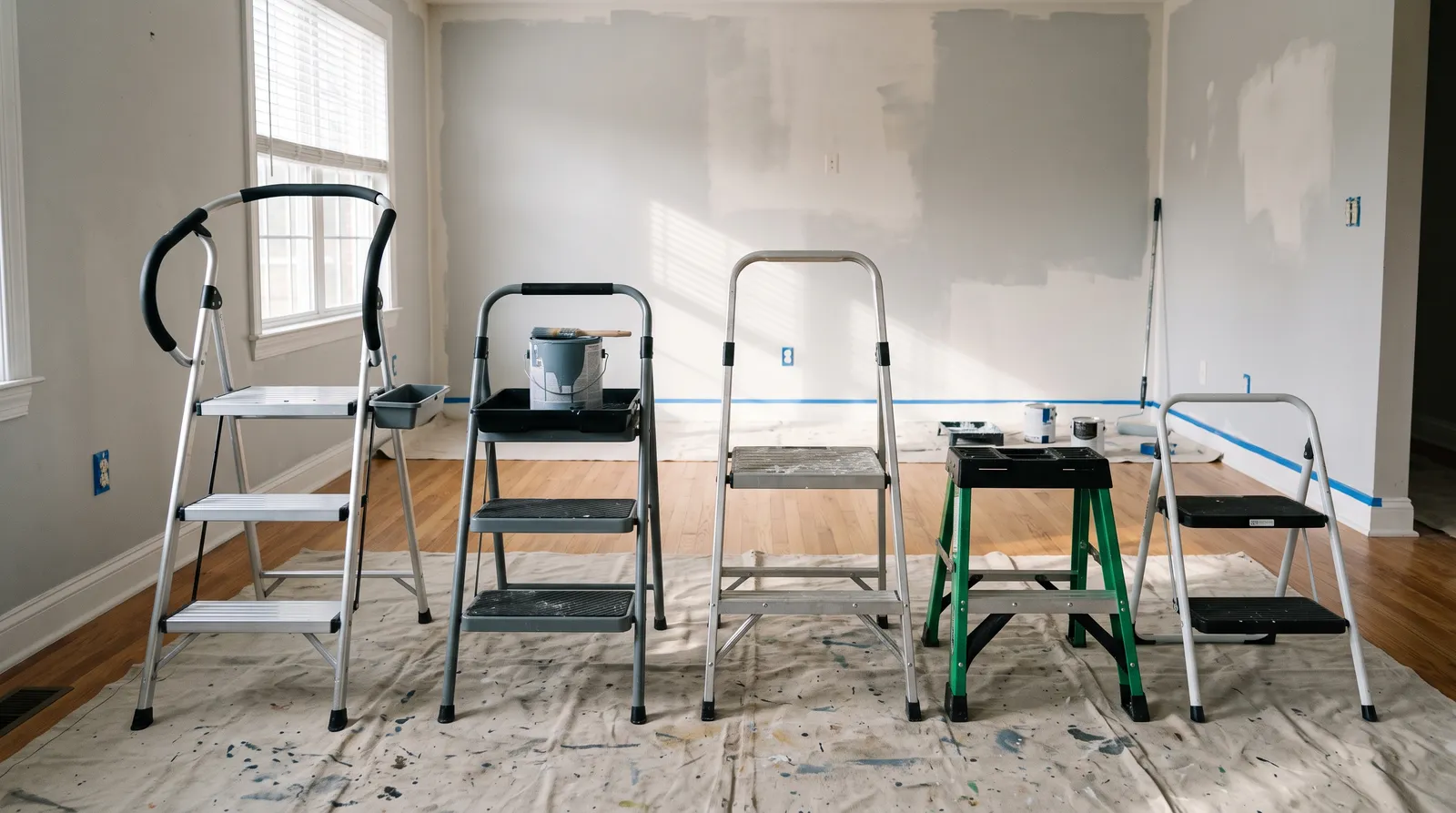
Five step stools tested on real interior paint jobs: cutting in ceiling lines, trim, closets, and cabinet tops. Top pick: Little Giant Jumbo Step 3-Step, plus where each one falls short.

Disclosure: Some links below are affiliate links. We earn a commission if you buy through them, at no extra cost to you.
Top pick: the Little Giant Jumbo Step 3-Step. About $180, Type IAA at 375 pounds, and a rotating handrail with a tool tray built into it, which is the part that matters when one hand already holds a cut bucket. It wins on standing comfort. The treads are 8-1/2 inches deep and rise like a staircase, so you can cut a full ceiling line without your arches cramping. It falls short on price and on weight, both of which you feel by the fortieth reposition. For most of that at a third of the money, the Gorilla Ladders GLHD-3T Project Ladder is the buy. For 9-foot ceilings and crown returns, the Little Giant Flip-N-Lite 4-foot gives you a real platform. For anything near an open ceiling box, the Louisville FS1502 is fiberglass. For a closet stool you use twice a year, the Cosco Big Step is $40.
The step stool is the most-used tool on an interior paint job and the least-considered purchase.
Why the Stool Matters More Than the Ladder
Count the time on your next room repaint. You are on something for the ceiling cut, the top of the door casing, the closet shelf, the return above the cabinets, the switch plates you took off and now have to put back. Almost none of that is ladder height. It is 18 to 30 inches off the floor, held for fifteen or twenty minutes at a stretch, with a brush in one hand and a pot in the other.
That profile is not the one step stools are designed around. Household stools are built for grabbing a bowl off a high shelf: three seconds up, three seconds down, one hand free. Painting is the opposite. You go up once, stand still, and work a line for as long as your legs hold out.
Which is why tread depth outranks height on my scorecard.
A 3-inch rung under the ball of your foot is fine for three seconds and miserable at minute twelve. Your heel hangs, your calf loads, and the first thing that goes is the steadiness of your cut hand. I can tell from a photograph of a wavy ceiling line whether the painter was standing on a rung or a platform. So can any pro who has cut a hundred rooms.
The second thing that separates a painting stool from a household stool is a place to put the paint. A stool with no tray forces you into one of two bad habits: brush in the back pocket (paint on the pants, paint on the wall when you turn), or pot on the floor (down, dip, up, forty times an hour, and eventually a boot in the pot). Both are the reason for the drips you find on the baseboard next morning.
What We Bought and How We Worked Them
Five stools, bought retail, worked through four real interiors over five weeks. All occupied houses. All finished floors.
The living room was 14 by 16 with 9-foot ceilings, cut top and bottom in Benjamin Moore Regal Select eggshell. That job is the standing-comfort test, because a 9-foot ceiling line is about 60 linear feet of continuous overhead cutting and there is nowhere to hide a bad stool.
The kitchen was a 12-door cabinet refinish. Cabinet work is where stools earn their keep: the crown return, the top of the upper boxes, the soffit gap. Everything happens at chest-to-eye height for hours. If you are heading into that job, the best kitchen cabinet paint round-up covers the coating side of it.
The 1962 ranch was hallway plus two bedrooms, 8-foot ceilings, original oak floors refinished the year before. That was the floor test, and it decides whether a homeowner ever forgives a tool. The stairwell landing was the test nothing passes; I ran it because half the emails we get about step stools are from people trying to make one work on stairs.
Each stool carried the same load. Me, a 1-quart Bercom Handy Paint Pot with a 2-1/2 inch angled sash brush, and on ceiling days a 4-foot extension pole. Scoring, in weight order: standing comfort across a continuous 20-minute cut, whether the stool holds a container in reach without tipping when you step off, reposition speed (measured honestly, by how often I skipped moving the stool and stretched instead), footprint stability on oak over a canvas drop cloth, folded depth, and marks left on the floor after the cloth came up.
That last axis surprised me. Two of five left marks. Neither was the stool’s fault.
The Specs That Actually Matter
Tread Depth and the Top Surface
The Jumbo Step’s 8-1/2 inch treads and the Gorilla’s 15 by 12 inch top platform are on one end. The Cosco’s narrow steps are on the other. Between them sits every household stool sold at a grocery store, and none of them are built for a painter standing still.
Rule of thumb: if you cannot turn your feet on the top surface, you will be repositioning the stool instead of pivoting, and you will skip the reposition more often than you should.
Duty Rating
ANSI Type III is 200 pounds, Type II 225, Type I 250, Type IA 300, Type IAA 375. That number is total load, not body weight. Add your boots, a full gallon, and a pole and a 190-pound painter is over 220 before doing anything unusual.
Buy Type IA at minimum. The rating doubles as a stiffness proxy, since a frame engineered to pass 300 pounds flexes less underfoot than one that scrapes past 200. Flex under the ball of your foot reads as instability whether it is dangerous or not, and instability slows your cut hand down.
Folded Depth
Three inches lives in a hall closet. Four and a half lives in a hall closet on its end. Six inches lives in the garage, and a stool that lives in the garage does not get carried upstairs for two switch plates. So it doesn’t get used, and you stand on a dining chair instead.
The Gorilla folds to 3 inches, the slimmest here. The Jumbo Step is 4-1/2.
Feet
Non-marring tips are a checkbox on the spec sheet and a real thing on refinished oak. Every stool in this test has them except in the sense that matters: a rubber tip with a chip of dried joint compound embedded in it is a scraper. Wipe the feet at the door. Use canvas under the stool, never plastic, because plastic lets the stool slide and a sliding stool grinds whatever it is carrying into the finish. The drop cloth round-up has the full argument on canvas versus plastic.
Comparison at a Glance
| Model | Steps / top height | Material | Capacity | Folded depth | Weight | Price tier |
|---|---|---|---|---|---|---|
| Little Giant Jumbo Step 3-Step | 3-step, 8 ft 8 in reach | Aluminum | 375 lb (Type IAA) | 4.5 in | 18 lb | $$$ |
| Gorilla Ladders GLHD-3T | 3-step, 2 ft 5 in platform | Steel + poly | 300 lb (Type IA) | 3 in | 18 lb | $$ |
| Little Giant Flip-N-Lite 4 ft | 4 ft, platform top | Aluminum | 300 lb (Type IA) | Flat fold | Under 15 lb | $$$ |
| Louisville FS1502 | 2 ft, top step 1 ft | Fiberglass | 300 lb (Type IA) | Flat fold | 8 lb | $$ |
| Cosco Two-Step Big Step | 2-step | Steel + resin | 200 lb (Type III) | ~3 in | 9 lb | $ |
1. Little Giant Jumbo Step 3-Step, Top Pick
The Jumbo Step is the only stool in this test I would stand on for an hour without thinking about it.
The treads are the reason. At 8-1/2 inches deep with a stair-like rise, your whole foot lands, your heel is supported, and the fatigue that normally ends a long ceiling cut never arrives. On the 9-foot living room I cut roughly 60 feet of ceiling line in three sittings and my legs were the last thing on my mind. On the Cosco, doing the same wall, I came down twice to shake out a calf.
The rotating handrail is the second reason, and it does two jobs. It gives you something to hold when you turn, which most people underrate until they are standing 30 inches up facing sideways with a loaded brush. And it carries an integrated tool tray at hand height. A quart Handy Pot sits in it. A sash brush lies across it. When you step off, nothing tips, because the tray is on the rail rather than on the top cap where your knee hits it.
Type IAA at 375 pounds gives you the headroom nothing else here does. I am not going to pretend I tested the limit. What I can say is that the frame does not flex underfoot the way the 200-pound stools do, and that stiffness is what you feel through your boot.
Three real complaints. It costs about $180, which is a serious number for a stool. It weighs 18 pounds, and while that is fine for a kitchen where you set it down once, it is a lot for a hallway where you move it every four feet. And the handrail gets in your way when you want to stand sideways in a corner. It rotates out of the path. You have to remember to rotate it, and in practice you remember the third time it catches your elbow.
| Spec | Value |
|---|---|
| Steps | 3 (also sold as 2-step and 4-step) |
| Duty rating | Type IAA, 375 lb |
| Reach height | About 8 ft 8 in |
| Storage depth | 4.5 in |
| Product weight | 18 lb |
| Approx. price | $180–$235 |
Buy it if: you paint more than one room a year and you spend real time standing still on the thing. Skip it if: you need it twice a year for switch plates, or you are carrying it up and down stairs all day.
2. Gorilla Ladders GLHD-3T, Best Value
This is the stool I recommend to most people, and it is not the top pick.
The GLHD-3T does 80% of what the Jumbo Step does for roughly a third of the price. The top platform is 15 by 12 inches, which is the largest standing surface per dollar in this test, and large enough to turn your feet on without stepping down. The folding project tray takes a quart can and a brush and stays put when you step off. Type IA, 300 pounds. It folds to 3 inches, slimmer than anything else here, which is why the test unit ended up living in a hall closet rather than the garage.
It is steel, so it is 18 pounds with none of the aluminum payoff. You are carrying Jumbo Step weight without Jumbo Step treads.
The other catch is distribution. It is a Home Depot exclusive. No Amazon listing, no Lowe’s, no ordering it at 11pm the night before the job starts. If you are the kind of buyer who plans a paint weekend on Thursday, that is a real constraint.
One durability note from the ranch job: the powder coat chipped at the tray hinge where I folded it with a dried drip on the metal. The chip is small and it will rust if the stool overwinters on a damp garage floor. Wipe the hinge, store it inside.
Buy it if: you want a platform stool with a tray and you would rather spend the difference on paint.
3. Little Giant Flip-N-Lite 4 Ft, Best for Ceiling Lines and Crown
Strictly, this is a 4-foot stepladder. I am including it because it is the thing painters actually reach for when the ceiling is 9 feet and the stool is not enough, and because it behaves like a stool in the ways that count.
Under 15 pounds. Opens and closes one-handed, which means you can carry it and a paint pot in the same trip, and you will make that trip a dozen times in a kitchen. The top is a square standing platform rather than a rung, so you get the same stand-still comfort the Jumbo Step gives you, at a foot and a half more height. The top cap tray holds a cut bucket, a brush, and a rag.
On the cabinet job this was the tool that did the crown return above the uppers. Nothing shorter reaches it; a 6-foot ladder is too much ladder for a kitchen with an island in it.
Two things it is not. It is not compact. At 4 feet it will not tuck under a counter overhang or fit a coat closet, and if your only storage is a closet, that decides it. And the A-frame footprint is narrower than the stools here, so it wants a flat floor. On the carpet-to-tile transition strip in the ranch hallway it rocked, and I moved it rather than shim it. Never shim a ladder.
At about $130 it is close enough to the 5-foot version that people buy up. Don’t, unless your ceilings are over 9 feet. More ladder in a furnished room is not a favor. If you are working ceilings regularly, the better spend is a pole; see the extension pole round-up and the full ladder comparison.
Buy it if: your ceilings are 9 feet or you have crown, soffits, or upper cabinets to cut.
4. Louisville FS1502, Best Fiberglass
Different problem, different tool. The FS1502 is a 2-foot fiberglass step stool with a top step 1 foot off the floor, Type IA at 300 pounds, and it weighs 8 pounds.
Fiberglass rails do not conduct. That is the entire argument, and it is a good one exactly once: when you are cutting around a ceiling box with the trim off, painting a panel wall, or working a bathroom fixture you did not fully de-energize because you could not find the right breaker. Most interior repaints never come near live wiring. Fixture and cabinet work does.
The weight is the surprise benefit. At 8 pounds you carry it in one hand with a brush in the other, and you move it every three feet instead of stretching. The number of times I stretched instead of moving the stool was lowest with this one, by a wide margin, and stretching is where cut lines go bad.
The top step is 14 by 9-1/4 inches and only a foot up. This is a trim, outlet, and lower-cabinet stool. It does nothing for a ceiling. And a bare fiberglass rail leaves a dark scuff on fresh paint if you swing it into a wall, which I did, on the second bedroom, on a wall that was four hours old.
Verdict: the specialist. Buy it second, after your main stool, not instead of one.
5. Cosco Two-Step Big Step, Budget
$40, 9 pounds, folds to about 3 inches, hangs on a garage hook and disappears. For a homeowner who paints one room every few years, this is a defensible buy.
It is 200-pound capacity, Type III, the lowest here. Subtract a gallon and boots and the margin is thin for a lot of adults. There is no tray, so the brush goes in a pocket or the pot goes on the floor. And the steps are narrow front to back, so you stand flat-footed with your heels hanging and you feel it inside fifteen minutes.
The rubber hand grip is genuinely useful and the non-marring leg tips did not mark the refinished oak. For what it is, it does not pretend.
Skip this if you are painting more than one room. The upgrade to the Gorilla is $25 and it changes the job.
Stools We Passed On
- Rubbermaid RM-3W. Fine 3-step household stool, 200-pound rating, folds thin. No tray, and the platform is smaller than the Gorilla’s for similar money.
- Werner 2-step aluminum stools. Solid, widely stocked, and the Louisville does the same job lighter with the fiberglass advantage.
- Plastic folding step stools. The 2-step resin stools sold near the cleaning aisle flex enough underfoot that you brace instead of painting. No.
- Bucket-and-plank rigs. Painters do this. It works right up until it doesn’t, and the failure is a fall onto a hard floor with a full gallon in your hand.
- Dining chairs. Every year. Chair seats are not rated, chair legs are not braced for edge loading, and the chair is not yours to break.
Living With a Step Stool
Step stools last decades if nothing bends. What wears out first is the feet.
Feet. Rubber tips harden and crack, usually after four or five years in an unheated garage. When they crack, grit gets in and the tip becomes a scraper on hardwood. Little Giant and Werner both sell replacement tips. A $6 set of tips saves you the whole stool, and it saves a floor.
Hinges and spreaders. Wipe dried paint out of the spreader arms before it builds. A spreader that will not lock flat is a stool that folds under you sideways. This is the one maintenance item worth doing after every job.
Cleaning. Wet paint comes off aluminum and steel with a damp rag. Dried latex comes off with a plastic scraper and patience; do not go at a fiberglass rail with a metal blade, because the scratch exposes fibers and the rail starts shedding glass splinters into your hand.
Storage. Inside, dry, hung or stood on end. Steel stools stored flat on a concrete floor rust at every contact point, and rust at a rivet is the one failure mode on a steel stool that actually matters.
How long. Aluminum stools outlive their owners if the feet get replaced. Steel stools go 10 to 20 years depending on storage. Fiberglass rails degrade in sunlight, so a fiberglass stool that lives on a truck bed uncovered will chalk and lose strength in about five years. Keep it inside.
Mistakes That Put Painters on the Floor
- Standing on the top step of a stool that is not platform-rated. If the top surface is a rung, it is not a standing surface, no matter how it looks. The Gorilla, Flip-N-Lite, and Jumbo Step tops are platforms. A folding 2-step’s top is a step.
- Using a stool on stairs. Four feet, one plane. There is no shim, no board, no clever angle. Get a stair ladder.
- Setting the stool on plastic sheeting. Plastic slides, and it slides worst when there is paint on it. Canvas under the stool, always.
- Skipping the reposition. Nearly every fall I have seen came from someone leaning to reach one more foot of trim rather than climbing down and moving over. Move the stool. It takes four seconds.
- Carrying a full 9 by 13 roller tray up a stool. Use a quart cut bucket with a handle, or put the tray on the stool’s tray. A roller tray on a top step tips the first time you set a loaded roller in the wrong end.
- Buying tall. People buy a 4-step for an 8-foot ceiling and then work from step two forever, carrying an extra six pounds and a bigger footprint through every doorway for no gain.
- Leaving it set up in a doorway. Fold it or move it. Somebody walks through with a full gallon.
What to Buy, by Job
One room, 8-foot ceilings, once every few years: the Cosco Big Step at $40. Add a quart cut bucket and skip the tray problem entirely.
Whole-house interior repaint: the Gorilla GLHD-3T. Platform, tray, 3-inch fold, Type IA, and money left for good brushes. Pair it with the picks in the paint brush round-up.
Kitchen cabinets, crown, or 9-foot ceilings: the Flip-N-Lite 4 ft, and a second short stool for the lower boxes.
You paint constantly and your legs have opinions: the Jumbo Step 3-Step. It is $180 and it is the one you will still be standing on in fifteen years.
Fixture work, panel walls, anything with a cover plate off: the Louisville FS1502 alongside whatever your main stool is.
If you are buying exactly one and you do not know yet what kind of painter you are, buy the Gorilla. Then go read the coverage and gallons calculator before you buy paint, and patch the walls first; the drywall hole repair guide covers what you will find behind the furniture.
Ask a Question