Best Sprayer Cleaning Kits and Fluids
Six sprayer cleaning kits and storage fluids tested across airless and HVLP flush cycles. Top pick: Graco Pump Armor, plus the brush kit and solvents that actually earn a spot on the shelf.

Disclosure: Some links below are affiliate links. We earn a commission if you buy through them, at no extra cost to you.
Top pick: Graco Pump Armor. About $20 a quart, it goes into the fluid section after the flush water runs clear, and it is the cheapest insurance in the sprayer aisle. It wins on the thing that matters most, which is what your pump looks like six weeks later when you pull the trigger again. It falls short on price against a jug of RV antifreeze, which is what half the internet will tell you to use instead, and which is not the same fluid. If you run a Titan, the LS-10 Liquid Shield Plus does the identical job and is the fluid Titan’s own manuals name. For the physical scrubbing, buy the Titan 17 Piece Cleaning Kit. Graco TSL keeps throat packings alive. Krud Kutter Original speeds up a waterborne flush; Klean-Strip Odorless Mineral Spirits handles anything oil.
A sprayer almost never dies from spraying.
It dies in the twenty minutes afterward, when someone decides the stream at the gun is close enough to clear and puts the machine on the shelf.
Why This Category Is Two Products, Not One
Search “paint sprayer cleaning kit” and you get two unrelated things sitting under the same words.
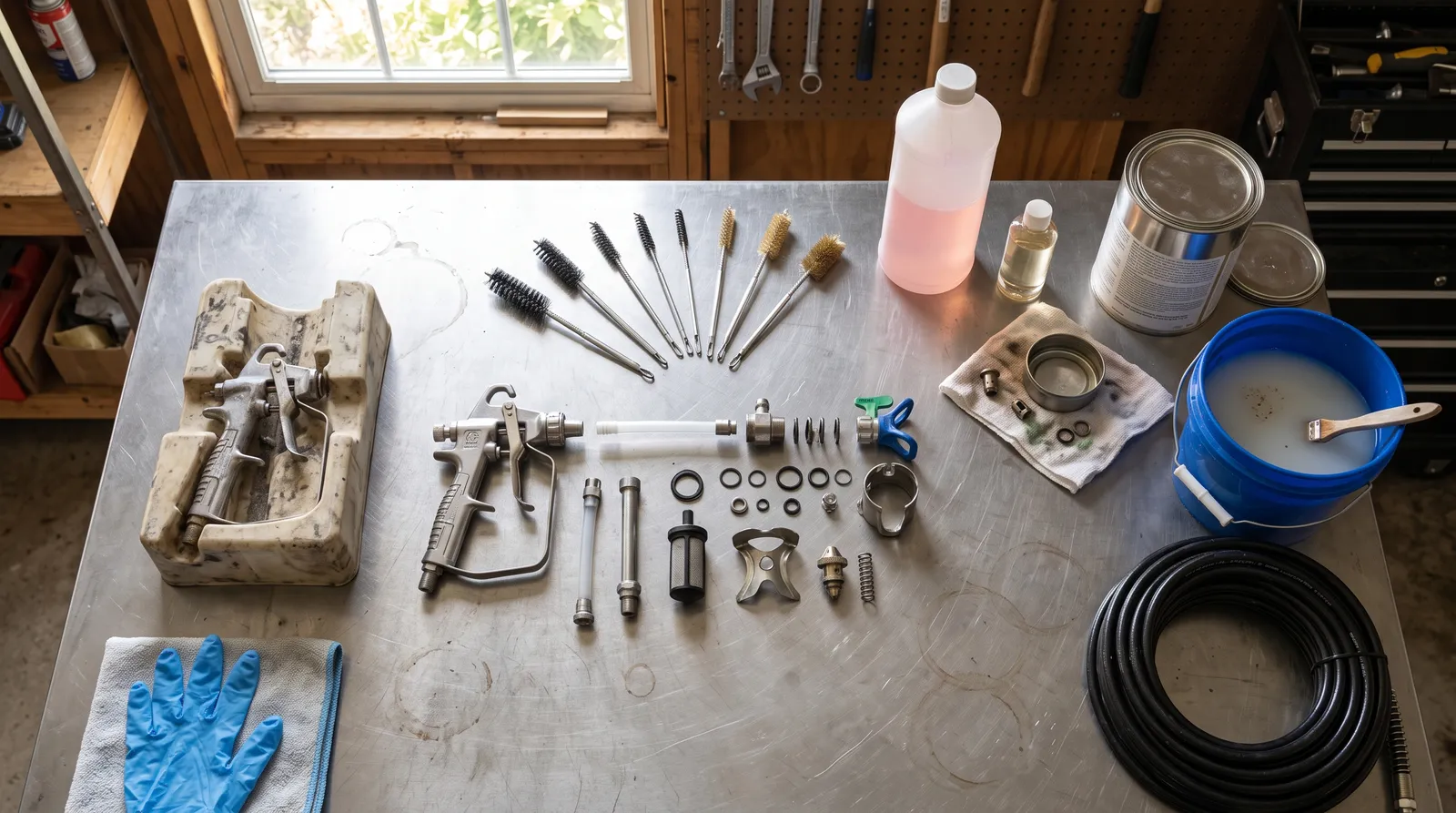
One is a bag of brushes. Graduated nylon and brass bristles on wire handles, a pick or two, sometimes a tip needle. That set exists because a spray gun has passages a rag cannot reach: the fluid channel behind the seat, the cage the filter sits in, the manifold port where the hose threads on. Paint skins over in those places within an hour and no amount of flushing pushes it out.
The other is a bottle of fluid, and it is not a cleaner. Pump storage fluid goes into a pump that is already clean. Its job is the six weeks between now and the next time you spray: no rust on the steel, no freeze damage at 20 degrees, no packings drying hard and weeping the second you build pressure.
Owning one without the other is the standard mistake. A scrubbed gun on a pump full of tap water still corrodes. A pump full of Pump Armor with a plug of dried latex in the inlet strainer still won’t prime.
You need one of each. That is the actual answer, and it costs about $60 total.
How We Ran the Flush Tests
Three machines, one season, the same procedure every time.
A Graco Magnum-class electric airless carried the bulk of it, about 14 gallons of waterborne wall paint and exterior acrylic across a stairwell, a bedroom, and one south-facing garage wall. A Titan cart airless ran an alkyd trim and door package, which is the ugly cleanup nobody volunteers for. A turbine HVLP gun sprayed waterborne cabinet enamel over three weekends.
The procedure never changed. Paint out of the siphon, siphon into the bucket, clean water or solvent through until the stream at the gun ran clear. Tip and guard off, gun filter and manifold filter out, all of it scrubbed by hand. Then storage fluid pumped through until it showed pink or amber at the gun.
We scored on four things you can see without instruments. How many bucket changes it took to get a clear stream. Whether the pump primed on the first pull after two weeks idle, then again after six. Whether the packings wept at startup. And what actually came out of the fluid section the next time it was apart.
One extra check: the Graco sat in an unheated garage through a late-season overnight freeze with Pump Armor in it. It primed the next afternoon without complaint.
We did not bench-test anything with instruments. There are no lab numbers in this article because we didn’t take any. These are field observations from one season of normal use, which is the same information you would collect yourself over three years.
Comparison at a Glance
| Product | Type | Use it for | Applies to | Approx. price | Price tier |
|---|---|---|---|---|---|
| Graco Pump Armor | Storage fluid | Post-flush storage, freeze and rust protection | Any airless or HVLP pump | $18–22 / qt | $$ |
| Titan LS-10 Liquid Shield Plus | Storage fluid | Same, named in Titan manuals | Titan airless and fine-finish pumps | $18–25 / qt | $$ |
| Titan 17 Piece Cleaning Kit | Brush set | Gun passages, filter cages, fittings | All sprayers and guns | $40–55 | $$ |
| Graco TSL Throat Seal Liquid | Packing oil | Displacement rod film, before and after every session | Piston-pump airless only | $12–16 / 8 oz | $ |
| Krud Kutter Original | Water-based cleaner | Speeding up a latex flush, surface prep | Waterborne coatings only | $18–25 / gal | $ |
| Klean-Strip Odorless Mineral Spirits | Solvent | Flushing oil enamel, alkyd, varnish | Oil-based coatings only | $18–24 / gal | $ |
1. Graco Pump Armor, Top Pick
The bottle you should already own and probably don’t.
Pump Armor is a storage fluid, which means it goes in last, after the rinse water comes out of the gun clean. It does three jobs at once: it keeps water out of the fluid section so steel parts don’t rust, it protects against freeze damage in an unheated garage, and it keeps a wet film on the packings so they don’t dry hard and start weeping the moment you build pressure.
The freeze test is the one I care about. Graco sat outside through an overnight drop with Pump Armor in the fluid section. Primed the next afternoon on the first pull, no stumble, no drip at the packing nut. A pump left full of plain water in that same garage is a coin flip, and the failure mode is a cracked fluid section, not an inconvenience.
Where the value shows up is on the six-week idle test. Two machines, both flushed the same, one stored with water and one with Pump Armor. The water machine primed, but it primed rough, and the first thirty seconds of spray carried rust-colored specks that ended up on a finished wall. The Pump Armor machine came up clean.
A quart runs about $20 and covers six to eight storage fills on a homeowner-size airless. That is two or three seasons.
The trade-off is price against RV antifreeze, and this is where every forum thread goes sideways. RV antifreeze is glycol formulated for plumbing lines. It has the freeze protection and none of the corrosion package or the packing conditioning. The substitution appears to work for one winter, which is exactly why people recommend it, and it is a bad bet on a $400 machine. The pink dye also tints your first few ounces of spray next time, so you flush it out before loading paint.
| Spec | Value |
|---|---|
| Type | Pump storage fluid with corrosion inhibitor and antifreeze |
| Sizes | 1 qt, 1 gal |
| Applies to | Any airless, air-assisted, or HVLP pump |
| Storage fills per quart | Roughly 6 to 8 on a homeowner airless |
| Approx. price | $18–22 (1 qt) |
Buy it if: you own any sprayer with a pump and you store it for more than a week at a time. Skip it if: you spray weekly year-round in a heated shop and never let the machine sit, which describes almost nobody reading this.
2. Titan LS-10 Liquid Shield Plus, Runner-Up
Same category, different badge, and the reason it earns its own entry is warranty language.
Titan’s Impact and ControlMax manuals name Liquid Shield by name for storage. If a fluid section fails inside the warranty window and the machine was stored with something else, you have handed the claim a reason to stall. That is not a performance argument, it’s a paperwork one, and it’s real.
On performance, LS-10 was slightly slicker than Pump Armor on first prime after the six-week idle. The Titan cart came up to pressure with less stumble. That’s a soft observation, not a measurement, and I wouldn’t switch a Graco over to it on that basis alone.
It falls short on availability. Pump Armor is on the shelf at most home centers next to the sprayers. LS-10 is more often an online order, and the price swings by ten dollars between sellers for the same quart. There’s also no bulk size to speak of, so if you’re storing several rigs the per-fill cost adds up.
Buy it if: you run a Titan and want the fluid the manual names. Otherwise Pump Armor is easier to find and does the same work.
3. Titan 17 Piece Cleaning Kit, Best Brush Set
This is the brush set that reaches the places flushing doesn’t.
Seventeen pieces, graduated diameters, mixed nylon and brass bristles on wire handles. Part number 10-500 if you’re matching it at a dealer. The three sizes that matter are the tiny one that fits a gun fluid passage, the mid-size one that scrubs a filter cage, and the fat one that clears a hose fitting or an inlet strainer.
I’ll be blunt about the rest of the set. You will use three brushes constantly and ignore eleven of them. That’s true of every multi-piece kit in this category, and it’s still worth buying, because assembling those three brushes individually costs more than the kit.
What makes it better than a generic bag off a marketplace listing is bristle retention. Twenty cleanings in, the working brushes hadn’t splayed, and the wire handles hold a bend. Being able to hook a wire and drag a plug of skinned latex out of an inlet fitting is a real capability. The cheap sets shed bristles into the gun, which is a spectacular way to create a defect you’ll spend an hour chasing on a cabinet door.
Careful with the brass. Brass on a hardened steel fluid passage is fine. Brass leaned on an anodized aluminum gun body leaves scars, and once the anodizing is gone that spot corrodes forever. Nylon for anything soft.
Most packaging has no case, so the set is loose in a drawer within a month. Put it in a zip bag on day one.
| Spec | Value |
|---|---|
| Pieces | 17 |
| Bristles | Mixed nylon and brass |
| Part number | 10-500 |
| Applies to | Airless guns, HVLP guns, filters, hose fittings |
| Approx. price | $40–55 |
Buy it if: you own a spray gun. There is no version of proper gun cleaning that skips hand-scrubbing the passages.
4. Graco TSL Throat Seal Liquid, Best for Packing Life
Small bottle, narrow audience, outsized effect.
TSL is a thick oil that lives in the packing nut cup on a piston-pump airless. Its only job is to keep a wet film on the displacement rod so paint can’t dry on it. Dried paint on that rod is an abrasive, and it saws through throat packings until the pump starts dripping down its own face. That drip is the single most common airless repair on a homeowner machine, and it is almost entirely preventable with a few drops before each session.
Procedure is trivial. Fill the cup a third full before you start spraying, top it before you store. An 8 oz bottle lasts years at that rate.
It’s easy to overfill. Excess drools down the pump housing, collects grit, and turns into a grinding paste at exactly the place you didn’t want one. A third of the cup, not to the brim.
And it’s irrelevant to a lot of readers. Handheld sprayers and HVLP turbine guns have no packing nut. If that’s what you own, skip this line entirely and spend the money on the brush kit.
One ordering note: TSL comes in three sizes with near-identical labels, and the part numbers are the only reliable difference. 206994 is the 8 oz.
Verdict: if you own a piston-pump airless, this is a $14 bottle that prevents a $120 repair. Nothing else in this round-up has that ratio.
5. Krud Kutter Original, Best Water-Based Flush Additive
Plain water flushes latex out of an airless. It just takes a lot of water.
A capful of Krud Kutter Original in the rinse bucket cut the number of bucket changes on our waterborne jobs, consistently. Where a plain-water flush on a full stairwell’s worth of wall paint took four buckets to reach a clear stream at the gun, the same job with cleaner in the water took three, sometimes two. In February, in a garage, with the door half down, one fewer bucket of cold rinse water is not a small thing.
The other reason the jug earns shelf space is that it’s the same cleaner you should have used on the surface before you sprayed. Degreasing cabinet doors, wiping down chalky siding, cutting the hand-oil off a stair rail. If you want the deeper version of that conversation, the piece on TSP substitutes covers what these cleaners actually replace and where they don’t.
Two limits, both hard. It does nothing to oil-based enamel, lacquer, or shellac. And it is not a storage fluid. Leaving a soapy dilution in a fluid section will foam your next prime and gives you zero corrosion protection. Rinse it out with clean water, then push in Pump Armor.
Over-dosing the concentrate is the common error. Follow the label dilution. More is not faster.
Buy it if: you spray waterborne coatings and you’d like your flush to take twenty minutes instead of thirty-five.
6. Klean-Strip Odorless Mineral Spirits, Best Solvent Flush
Oil-based work is a different cleanup and a different chemistry.
Alkyd enamel, oil primer, varnish, oil stain: none of it comes out with water, and pushing water into a pump full of alkyd creates a curdled mess that’s worse than either component alone. Odorless mineral spirits is the right first flush. It’s gentler on gun seals than lacquer thinner or acetone, both of which will chew O-rings over a season of use, and it’s the solvent most alkyd manufacturers name for equipment cleaning on the back of the can.
Two to three quarts does a full airless flush plus a gun teardown on a homeowner machine. A gallon covers several jobs, because used spirits are reusable if you handle them right. Pour the dirty solvent into a sealed glass jar and leave it a week. Pigment settles into a sludge layer at the bottom. Decant the clear liquid off the top into a clean container and it becomes the first flush on your next oil job. The sludge goes to a household hazardous waste drop-off.
“Odorless” is doing some work in that product name. It’s less aggressive than straight paint thinner, and you still want the door open and a fan moving air. Wear a proper cartridge respirator when you’re spraying anyway; there’s a full respirator round-up if you don’t have one yet.
Fire risk is the thing people get careless about. A solvent-soaked rag balled up in a trash bag can self-heat. Spread rags flat outdoors to dry, or drop them in a sealed metal can.
Skip this if: everything you spray is waterborne. Solvent in the shop is a liability you don’t need.
Things We Bought and Didn’t Keep
- RV antifreeze as a storage fluid. Cheapest option in this category and the one I keep arguing about. It has freeze protection and no corrosion package. Works until it doesn’t.
- Lacquer thinner as a general-purpose flush. Fast, aggressive, and it degrades gun seals and O-rings over a season. Use it for lacquer. Don’t make it your default.
- Ultrasonic cleaner for spray tips. Genuinely good at what it does. Also a $90 machine to solve a problem that a $6 brush and thirty seconds already solves.
- Generic marketplace 20-piece brush kits. Two of ours shed brass bristles into a gun during the first cleaning. A shed bristle in a fluid passage is a defect on a finished door.
- Drill bits and hardware-store wire for clearing air cap holes. Never. Enlarging one hole in an HVLP air cap by a fraction changes the fan pattern permanently, and the cap is the expensive part.
The Flush That Actually Works
Order matters more than product choice here.
Step one, before anything else: relieve the pressure. Trigger the gun into the bucket with the prime valve open. An airless holds 2,000 PSI after shutdown and that pressure is what puts paint through a hand in the emergency room.
Step two: get the paint back. Siphon tube out of the can and into the bucket, run the pump until it draws air. On a waterborne job that recovers most of a quart of usable paint. On alkyd, less, because it skins.
Step three: flush to clear. Water with a capful of Krud Kutter for waterborne, odorless mineral spirits for oil. Run it through the pump, through the hose, and out of the gun with the tip removed until the stream at the gun is genuinely clear. Not almost clear. Change buckets rather than recirculating dirty rinse.
Step four: the hand work. Tip and guard off. Gun filter and manifold filter out. Scrub every one of them with the brushes. This is the step people skip, and the tip and filters are exactly where a partial clog turns into tails and fingers on your next fan pattern. If your last job left ridges you’re trying to fix by hand, the brush marks repair guide covers the sanding side of that problem.
Step five: storage fluid in. Siphon into the Pump Armor or LS-10, pump until it shows at the gun, close it up. Wet, not empty.
Step six: TSL in the packing cup. A third full. Sixty seconds of work.
Six steps, about twenty-five minutes on an airless once you’ve done it a few times. The whole point is step five, and it’s the one that gets dropped when you’re tired.
Mistakes That Kill Pumps
- Storing a pump wet with plain water. Rust on the steel, freeze cracks in an unheated garage, packings that dry stiff. This is the number one cause of dead homeowner airless machines.
- Calling the flush done when the stream is “basically clear.” Basically clear means pigment still in the hose. It skins overnight and comes out as specks on your next finished wall.
- Reassembling a gun with the filter still dirty. A partly clogged filter reads as a pressure problem. People turn the pressure up, blow a tip, and buy a new one for a problem that was a $6 filter and a brush.
- Mixing water and solvent in the same pump. Curdled alkyd in a fluid section is a teardown, not a flush.
- Brass brushes on anodized aluminum. Once the anodizing is scarred, that spot corrodes for the life of the gun. Nylon on soft parts.
- Skipping TSL because the pump isn’t leaking yet. By the time it drips, the packings are already cut. The oil is preventive only.
- Cleaning a sprayer without a respirator during a solvent flush. Spraying gets the safety gear and cleanup somehow doesn’t, even though you’re standing over an open bucket of mineral spirits.
What to Buy If You Own One Sprayer
A quart of Graco Pump Armor, the Titan 17 Piece Cleaning Kit, and an 8 oz bottle of Graco TSL. Call it $80, and it covers two or three seasons of storage for any piston-pump airless.
Add a gallon of Krud Kutter if you spray waterborne, which is most people. Add a gallon of odorless mineral spirits only when an oil job actually shows up, because solvent sitting in a garage is a hazard you don’t need year-round.
Titan owners swap Pump Armor for LS-10 and stop there.
If you’re still shopping for the machine itself, the airless sprayer round-up and the HVLP picks for fine finish work cover what to buy, and the cabinet spraying project guide walks through the job where all of this cleanup discipline pays for itself.
Buy the storage fluid before you need it. The machine you didn’t flush properly always fails on a Saturday morning with a room already masked off.
Ask a Question