Best Safety Glasses for Painting
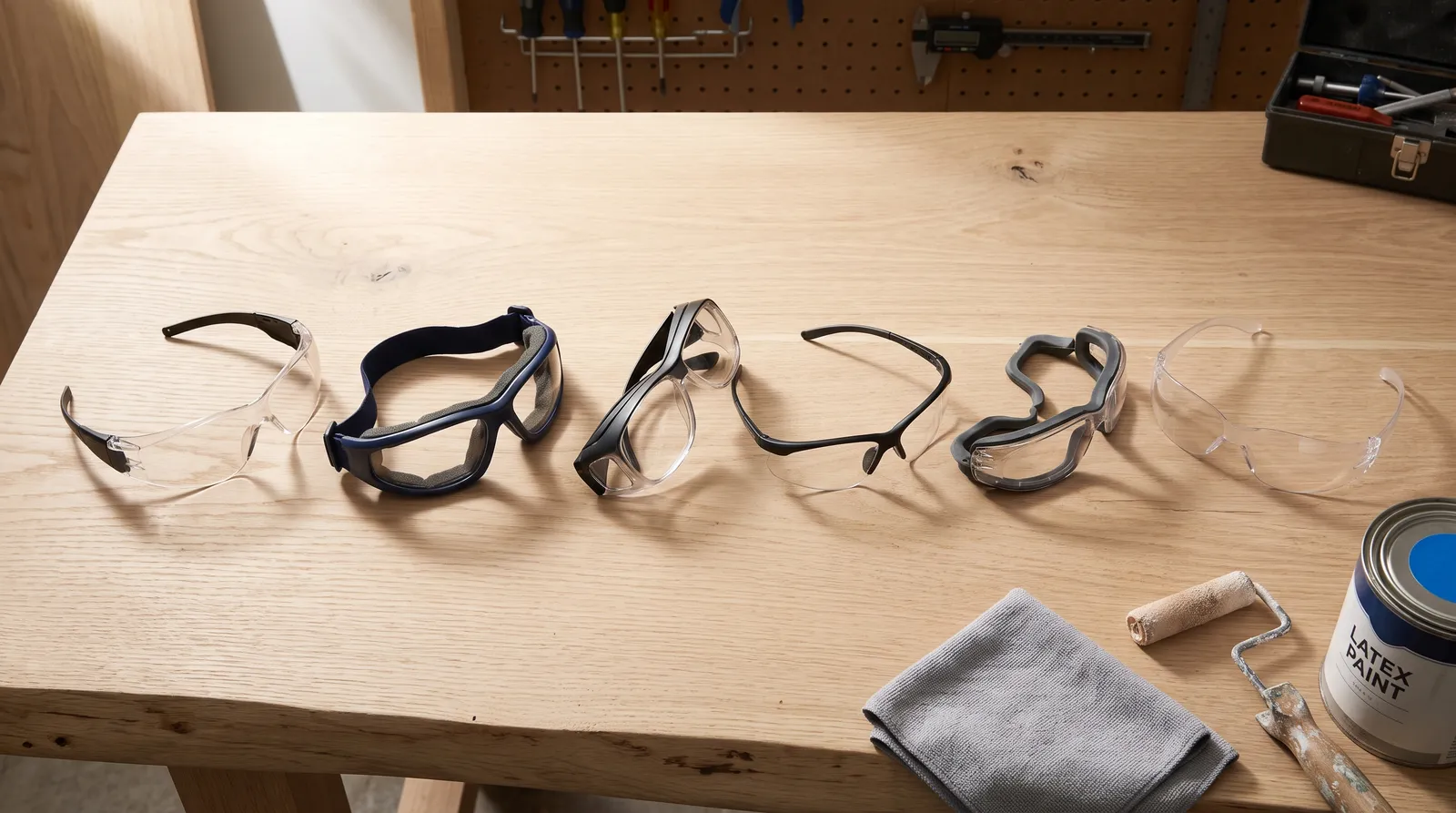
Six pairs of safety glasses tested through ceiling rolling, sprayer work, sanding dust, and stripper splash. Top pick: Milwaukee 48-73-2020 Clear Performance.

Disclosure: Some links below are affiliate links. We earn a commission if you buy through them, at no extra cost to you.
Top pick: the Milwaukee Clear Performance Safety Glasses (48-73-2020). About $13, ANSI Z87+ rated, and the only pair in this test I forgot I was wearing while rolling a ceiling with a respirator strapped on. It wins on fog resistance under a mask, which is the spec that decides whether safety glasses live on your face or on your forehead. It falls short on dust, because the open top vent lets sanding grit drift straight in. For overhead rolling and sprayer work, the sealed Pyramex I-Force Slim is the better pick. If you wear prescription glasses, the Pyramex Cappture is the only pair here with real clearance built in. For long trim days where weight matters more than sealing, the featherweight Pyramex Ever-Lite. For prep and sanding, Milwaukee’s gasketed 48-73-2040. And the Pyramex Intruder at roughly $3 a pair is what you buy by the dozen so there’s always one in the room you’re working in.
Most people own zero pairs and paint anyway.
That’s the actual problem this article is trying to fix, so I’ll say the useful part first: buy two pairs, one open and one sealed. Total cost is under $30.
What Actually Goes into a Painter’s Eye
The hazard isn’t a can tipping off a ladder. It’s four smaller things that happen constantly.
Roller spin-off. A 3/4 inch nap cover on an extension pole throws a fine mist along the axis of the pole every time you change direction on a ceiling. Your eye is directly under that axis. It’s the single most common way paint gets into an eye on a residential job, and it happens on the first ceiling coat, not the last.
Sanding and scraping dust. Joint compound dust is fine, alkaline, and it doesn’t wash out easily. Scraping a popcorn ceiling is worse because the debris comes down in chunks. If you’re doing prep with a random orbital sander, the dust plume rises to eye level and stays there.
Spray mist. An airless at 2,000 PSI atomizes paint into a cloud that fills an enclosed bay. Open safety glasses do very little here. The mist arrives from every angle including behind the lens.
Chemicals. This is the one that actually blinds people. Caustic strippers, TSP substitutes, deglosser, mildew wash. They spit when a finish lifts and they run down vertical surfaces faster than you’d guess. Read the paint stripper round-up for the products themselves; the eye protection question is separate and the answer is a sealed lens, never an open one.
Different hazards, different eyewear. That’s the whole reason this article has six picks instead of one.
How I Tested Six Pairs
Five weeks, four real jobs, two bench tests.
The living room repaint gave every pair a ceiling coat with a 3/4 inch nap on a pole. The garage door spray job put each pair under a half-mask respirator in an enclosed bay, which is the hardest fog condition in residential painting. Two days of drywall repair sanding and popcorn scraping supplied the dust test. A caustic gel strip on an oak stair rail supplied the splash test.
The bench tests were simple. For fog, each pair went on with a half-mask fitted, then ten minutes of overhead work on a 6 ft stepladder in a 74-degree room. I logged the moment the lens stopped being usable without a wipe. The Intruder gave up first at about ninety seconds. The Ever-Lite with the H2MAX coating never did.
For dust, five minutes of sanding joint compound at head height with a 220-grit sponge, then off with the glasses and a photo of the inside lens surface. The open pairs all showed a visible band of settled dust along the lower lens. The sealed pairs showed none.
Comfort was scored the only way that means anything: hours until I took them off because I wanted to, on a real job, with nobody watching.
Scratch resistance came after twenty wash-and-wipe cycles with water and a cotton shop rag, which is how people actually clean safety glasses and how lenses actually die.
The Six at a Glance
| Brand / Model | Seal type | Anti-fog grade | Best for | Z87 rating | Price tier |
|---|---|---|---|---|---|
| Milwaukee 48-73-2020 Clear Performance | Open wraparound | Fog-free coating | Everyday rolling, brushing, cut-in | Z87+ | $$ |
| Pyramex I-Force Slim SB7010SDNT | Bonded foam seal | H2X | Ceilings, airless and HVLP spray | Z87+ | $$ |
| Pyramex Cappture S9910ST | Sealed, over-the-glasses | H2X | Eyeglass wearers, sanding, stripping | Z87+ | $$ |
| Pyramex Ever-Lite SB8610DTM | Open half-frame | H2MAX | Long trim days, cut-in work | Z87+ | $ |
| Milwaukee 48-73-2040 with Gasket | Removable gasket | Fog-free coating | Drywall sanding, scraping, prep | Z87+ | $$ |
| Pyramex Intruder S4110ST | Open frameless | Standard | Spares, short jobs, helpers | Z87+ | $ |
1. Milwaukee 48-73-2020 Clear Performance, Top Pick
The pair I reach for without thinking about it.
The case for the Milwaukee is fog. Every pair here is Z87+ and every pair stops paint. The difference between eyewear you wear and eyewear you push up onto your forehead is whether the lens clouds over the moment you exhale under a mask. On the garage spray job, with a half-mask fitted and my breath escaping over the bridge of the nose, the Milwaukee was still clear at the ten-minute mark. The Intruder fogged in ninety seconds. The Cappture, with two lens surfaces working against it, held out about four minutes before the outer face hazed.
Fit is the second reason. The temple arms are slim enough to slide under a respirator strap without lifting the face seal, which sounds like a small thing until you’ve tried to run a half-mask respirator with fat temple arms breaking the seal at the cheek. The soft grips hold on a ladder without clamping. Six hours of cut-in work, no pressure headache, no red mark on the bridge.
The wraparound lens is the right geometry for roller spin-off. Mist that comes down along the pole hits the top edge of the lens and runs off. Mist that comes in sideways off a wet roller hits the wrap. What it doesn’t stop is dust, because the top vent that keeps the lens clear is also an open door for anything airborne and fine. Two days of drywall sanding put a visible band of joint-compound dust on the inside of the lower lens. Milwaukee sells the answer to that as a separate model, the gasketed 48-73-2040, and if your job is mostly prep you should buy that one instead.
The other knock is the lens coating. Throw these bare into a tool bag next to a putty knife and they’ll be hazy within a season. The Pyramex H2MAX pairs took the same twenty wash cycles and came out clearer.
| Spec | Value |
|---|---|
| Lens | Clear polycarbonate, wraparound, fog-free coating |
| Rating | ANSI Z87+ high impact |
| Seal | None (open top and side vents) |
| Respirator friendly | Yes, slim temples |
| Approx. price | $12 to $15 |
Buy it if: you want one pair that covers rolling, brushing, and cut-in work and you’ll be wearing a mask part of the time. Skip this if: your project is mostly sanding and scraping. Get the gasketed version.
2. Pyramex I-Force Slim, Best for Ceilings and Spray
Sealed changes the math completely.
The I-Force Slim has a foam carrier bonded around the inside edge of the lens, so the gap between the frame and your face closes. On the ceiling coat, that’s the difference between catching spin-off on the lens and catching it on the eyelid. On the airless job it’s the difference between finishing the door and stopping to rinse your eyes. Ninety minutes of spraying in an enclosed bay with a respirator on, and the H2X coating never clouded.
It also sits flatter against the face than any other sealed pair I tested, which is why it works under a half-mask strap. Sealed eyewear usually means bulk, and bulk means the strap rides over the temple arm and breaks the mask seal. This one doesn’t do that.
The trade-off is the foam. It absorbs sweat, it absorbs overspray, and it can’t be removed or replaced. Mine went grey along the top edge after the garage job and no amount of rinsing brought it back. Sealed frames also run hot; on a July exterior day I was pulling them off between sections in a way I never did with the Ever-Lite.
Buy it if: you roll ceilings or run a sprayer. About $10 to $14, and it’s the pair I’d put beside the airless sprayer in a kit.
3. Pyramex Cappture, Best over Prescription Glasses
If you wear glasses, this is the section that matters and the rest of the article is theory.
Standard wraparound safety glasses don’t go over Rx frames. People try anyway, and what happens is the safety glasses push the prescription frames down the nose, the temple arms splay, and there’s a finger-wide gap at each side where mist comes in. The Cappture is built with the clearance in the frame, and it has a sealed foam edge, which most over-the-glasses models skip.
I ran it through the popcorn scraping day over a pair of thin wire Rx frames. No contact, no sliding, and the inside lens photo showed no settled dust. The sealed edge is doing real work there.
Two honest cons. It’s bulky, visibly so, and it looks like goggles rather than glasses. And two lens surfaces means twice the cleaning and twice the fogging opportunity, which showed up in the bench test at around the four-minute mark on the outer face.
If your Rx frames are wide, measure before you buy. Past about 5.5 inches temple to temple, the frames start touching the inside of the safety lens and you’ll feel it.
Verdict: the only pair here I’d hand to someone in glasses. Roughly $12 to $16.
4. Pyramex Ever-Lite, Best for All-Day Comfort
Weight is a spec nobody checks until hour four.
The Ever-Lite is a half-frame design with no rim along the bottom of the lens, and it’s noticeably lighter than everything else in the test. On a full day of baseboard and casing work it left no mark on the bridge of my nose and no pressure at the temples. That open lower edge also means your downward field of view is genuinely unobstructed, which is what you want when you’re cutting a line against a floor.
The H2MAX anti-fog is the best coating here, and the most durable of the six. After twenty wash-and-wipe cycles it still beaded water rather than sheeting it, which is how you can tell the coating is intact. The Milwaukee pairs were sheeting by cycle twelve.
What it can’t do is seal. Point a sander up, and dust goes right past the lens. Same with a sprayer. The half frame also leaves the bottom lens edge exposed, and a drop onto a concrete floor lens-down will chip it.
Buy it if: your painting is trim, brushwork, and long interior days. About $7 to $10. Skip this if: you’re doing prep or spraying. Wrong tool.
5. Milwaukee 48-73-2040 with Gasket, Best for Sanding Dust
Same glasses as the top pick, plus a removable rubber gasket that clips into the frame and closes the top and side gaps.
That’s the whole pitch, and it’s a good one. Sanding drywall repairs or scraping a popcorn ceiling is the condition where open glasses fail most visibly. With the gasket seated, the five-minute joint-compound bench test left nothing on the inside lens. With it pulled, you’re back to the 48-73-2020, and you get the airflow back for brushwork.
Heat is the cost. The gasket traps it fast, and on the second afternoon of sanding I pulled it off within an hour. The clip tabs also loosen with repeated removal, and after a dozen cycles mine started sagging at the outer corner where the gasket meets the temple. It still seals; it just doesn’t sit as crisply.
You will also lose the gasket. Everyone does. Put it in the sleeve with the glasses.
Verdict: the right buy if prep work is most of what you do, and worth the extra few dollars if you’re already buying the Milwaukee.
6. Pyramex Intruder, Budget Pick
Around $3 a pair in a twelve-pack, frameless, Z87+ rated. The impact protection is the same standard the $13 pairs meet, which is the part people get wrong about cheap safety glasses.
Everything else is worse. The anti-fog is standard grade and quit at ninety seconds under a mask. The thin temples clamp and ache after two hours. The lens scratches if you look at it wrong.
Buy them anyway, by the box, and leave a pair in every room of a repaint. The glasses that protect your eyes are the ones within arm’s reach.
Reading the Stamp on the Temple
Every claim on the box is marketing. The stamp on the frame is the standard.
Z87 means the lens passed basic impact. Z87+ means it passed the high-velocity and high-mass tests, which is what you want and what all six picks here carry. The mark is printed on the temple arm and on the lens itself. If you can’t find it, the glasses aren’t rated, whatever the packaging says.
Sealed eyewear can carry extra codes. D3 covers droplets and splash, D4 covers dust, D5 covers fine dust. For stripper work, D3 is the code that matters. For drywall sanding, D4.
One opinion, stated plainly: the “safety glasses” sold on general marketplaces with no Z87 stamp and a stock photo of a construction worker are sunglasses. They stop nothing. If the listing doesn’t show the stamp on the temple, don’t buy it.
Fog Is the Spec That Decides Everything
Every pair of safety glasses works if you’re wearing them. So the only question that matters is whether you keep them on.
Fog is why people don’t. Warm breath escapes over the bridge of the nose, rises, hits a lens that’s a few degrees cooler, and condenses. Under a respirator it’s worse because the mask concentrates the leak into a jet aimed straight up. Once the lens clouds, the glasses go up on the forehead, and now you’re painting a ceiling with bare eyes.
Three fixes, in order of how much they help.
Get a real anti-fog coating. H2MAX, H2X, and the Milwaukee fog-free treatment are hydrophilic coatings that spread condensation into a thin film instead of letting it bead. The difference is not marginal. It’s ninety seconds versus never in my bench test.
Fit the respirator properly. Most of the leaked air is a bad seal at the nose bridge. Pinch the wire, do the negative-pressure check, and half the fog problem disappears.
Stop dry-wiping the lens. This is the one nobody knows. A shop rag drags grit across the coating and strips it, and once the anti-fog is gone it never comes back. Rinse with cool water, shake, air dry.
Pairs I Bought and Cut
- Generic tinted “safety sunglasses” from a marketplace multipack. No Z87 stamp anywhere on the frame. Tinted lenses also hide the color you’re cutting to.
- A full indirect-vent chemical splash goggle. Correct for stripping a tabletop, overkill for everything else, and it fogged badly under a mask. Buy one for a furniture strip, not for painting.
- Face shield alone. A shield is splash protection, not impact protection, and Z87 treats it as secondary. Wear glasses under it.
- Foam-lined models with a fixed head strap. The strap fights every respirator I own and pulls hair. The bonded-foam glasses do the same job without it.
Keeping a Lens Clear
Rinse first, always. Grit on a lens plus a dry rag equals scratches, and scratches on a safety lens are a hazard on a ladder, not a cosmetic issue.
After a latex job. Warm water, a drop of dish soap, fingertips only. Shake off, air dry face-up. Don’t use paper towel; wood fiber is abrasive enough to matter on a soft polycarbonate coating.
After sanding. Rinse before you touch the lens with anything. Joint-compound dust is the worst scratch source on a painting job because it’s everywhere and it’s hard.
After a solvent or stripper job. Water and soap only. Acetone, lacquer thinner, and alcohol wipes all attack polycarbonate coatings, and some cloud the lens outright. If stripper gel lands on the lens, rinse it immediately and check for hazing before the next job.
Storage. In a sleeve, in the same box as the respirator. Loose in a tool bag is how a $13 pair becomes a $13 pair you don’t want to wear.
Realistic life for weekend use: the H2MAX Ever-Lite ran 18 months and counting, the Milwaukee pairs about a year before hazing, the sealed I-Force retired at eight months on the foam rather than the lens, and the Intruder is a consumable measured in jobs.
Mistakes I Still See
- Painting a ceiling in reading glasses or nothing. The one job where eye protection is not optional, and the one where people skip it most.
- Pushing safety glasses onto the forehead “for a second.” That second is always the second you look up at the roller. If they fog, fix the fog, don’t take them off.
- Wearing standard wraparounds over prescription frames. They don’t fit, they gap at the temple, and they push your Rx down your nose. Buy an over-the-glasses model.
- Open glasses for chemical stripper. The splash path runs along your cheekbone into the lower lid. Sealed lens or goggle, every time.
- Dry-wiping with a shop rag. Kills the anti-fog coating and scratches the lens. Rinse first.
- Buying one pair for a whole-house repaint. You’ll leave it in the room you finished yesterday. Buy a multipack of Intruders as spares.
- Trusting a lens with no Z87 stamp. Not eye protection. Decoration.
What I’d Actually Buy
For a homeowner painting a few weekends a year: one Milwaukee 48-73-2020 at about $13 and one Pyramex I-Force Slim at about $12. The Milwaukee for walls, trim, and brushwork; the sealed Pyramex for ceilings, spraying, and anything chemical. Under $30 for the pair, and it covers every job in a house.
If you wear prescription glasses, swap the Milwaukee for the Cappture and keep the I-Force for spray.
If you’re about to sand a house worth of drywall repairs before a repaint, buy the gasketed 48-73-2040 instead of the plain one and add a twelve-pack of Intruders for the helpers. Then go read the cabinet painting project guide and see how much of that job is prep, because the eyewear you need is decided by the prep, not the paint.
Ask a Question