Best Peel-and-Stick Paint Swatch Services
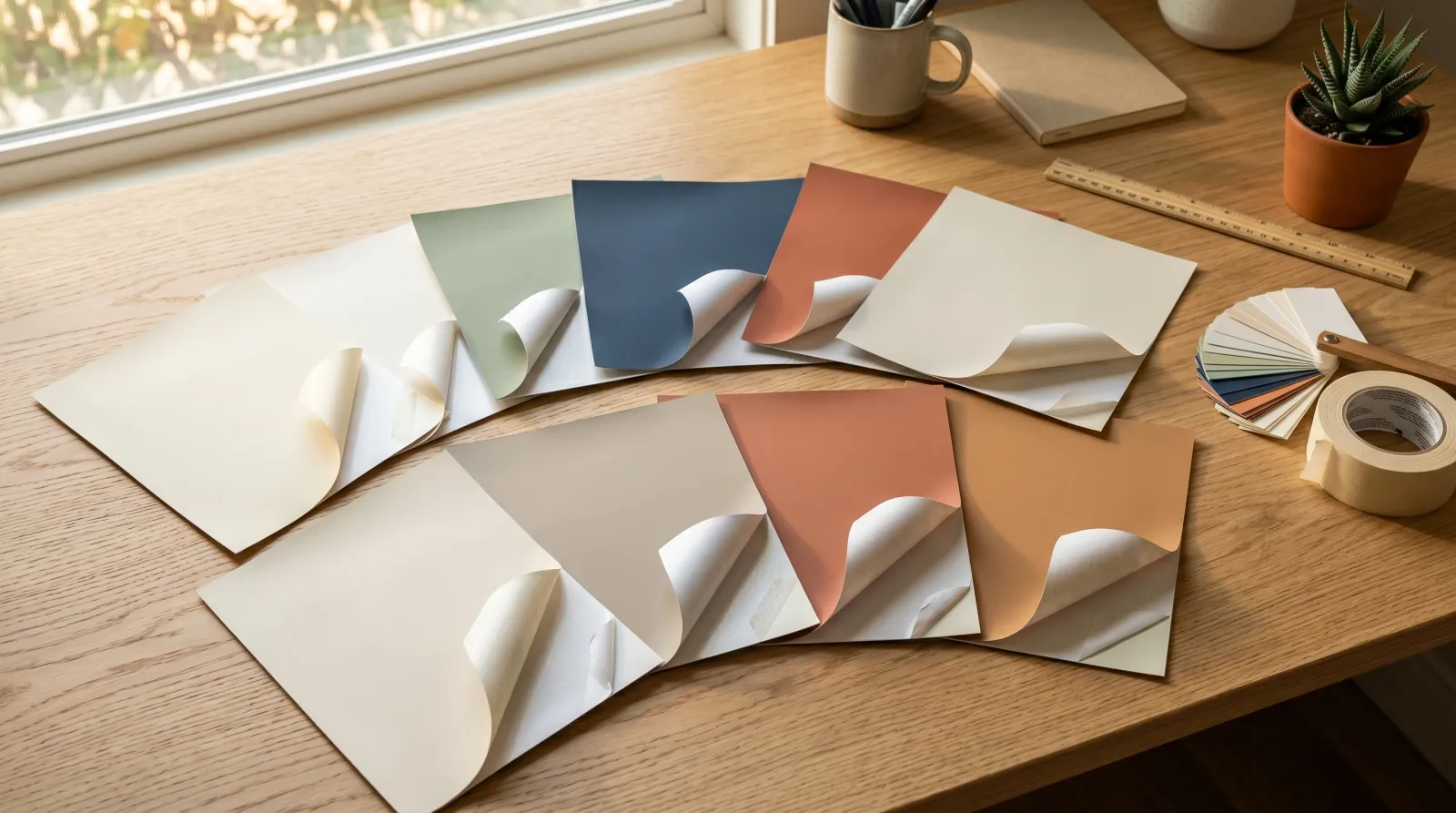
Six peel-and-stick paint sample services tested on real walls. Top pick: Samplize for two coats of real paint, 9-inch by 15-inch sheets, and overnight shipping.

Disclosure: Some links below are affiliate links. We earn a commission if you buy through them, at no extra cost to you.
Top pick: Samplize. It costs $6.95 a sheet, the most of anything here, and it earns it. Each sample is painted with two real coats of the actual brand color, the sheets run 9 by 15 inches, and one cart holds Benjamin Moore, Sherwin-Williams, and Farrow and Ball side by side. It wins on real-paint accuracy and on cross-brand comparison. It falls short on price, where Backdrop’s $2 printed swatch is a third the cost. For Sherwin-Williams colors specifically, order direct from SW at $3.95 and skip the markup. For a grab-it-with-your-cart run, Behr’s swatches at Home Depot are the convenience pick. For people who don’t know where to start, Clare sells curated color-family kits that do the narrowing for you.
There is no single right service.
Most people do best with two: a cheap printed swatch to cull ten colors down to three, and a real-paint Samplize sheet to settle the final call.
The Shortlist and Why These Six
I ordered the same five colors from each service where the color existed, and stuck them on three walls over two weeks: a north-facing bedroom that runs cold and blue in the afternoon, an east-facing kitchen that goes warm by 8 a.m., and a windowless hallway lit only by a warm LED can light. Those three walls are where paint colors lie to you. A greige that reads soft and warm on the chip turns gray and dead under the hallway LED. The whole reason peel-and-stick exists is to catch that before you’ve bought three gallons.
Five axes, weighted in this order: real-paint accuracy against a brushed-out control, sheet size, adhesive reuse across moves, shipping speed, and price per usable sample. Use case anchors the role.
I also kept a brushed-out control for each color, a real two-coat sample painted on white poster board, to check the sheets against. The real-paint services matched it. The printed swatch came close and read slightly flatter. That gap is the one thing separating the top of this list from the budget pick.
How These Services Actually Work
You order a flat adhesive sheet of a paint color online or off a store shelf, peel the backing, and press it to your wall. No brush, no foam roller, no dry time, no second coat. You judge the color in the actual room, move the sheet to another wall, and peel it off when you’re done with no mark left behind. Two things separate a good service from a bad one.
Real Paint vs Printed Ink
This is the whole game. The accurate services (Samplize, Sherwin-Williams, Behr, Benjamin Moore) coat each sheet with two coats of the real paint color in a real sheen. What hits your wall is the same pigment that would hit it from a can. Printed services run the color as ink on adhesive vinyl. Ink reflects light differently than paint, so a printed swatch reads a hair flatter and can miss the faint sheen-driven shift a real eggshell shows. Backdrop’s printed swatch is the best of the printed bunch and still came up a touch short of the brushed control under the hallway LED.
If you’re choosing between two grays that are 90% alike, get real paint. If you’re culling a field of ten very different colors, a printed swatch is plenty.
Sheet Size
A 2-inch fan-deck chip is useless for a wall decision. It’s too small to read undertone, and the white card around it throws the color off by contrast. Peel-and-stick fixes that by going big. Backdrop and the Samplize Benjamin Moore sheets run a full 12 inches; Samplize’s standard sheet is 9 by 15 inches; Sherwin-Williams is 8 inches square; Behr’s own swatches are the smallest at 6.5 inches. Bigger is better, especially for tricky grays and greiges. On the hallway wall, the 6.5-inch Behr swatch was genuinely harder to read than the 12-inch Backdrop next to it.
Repositionable Adhesive
A good sheet moves. You stick it on the cold north wall, look at it at 4 p.m., peel it, and move it to the warm south wall to see the same color in different light. Every service here uses a low-tack repositionable adhesive that lifts off a clean cured wall without pulling paint. The cheap printed swatches reposition just as well as the premium painted ones. The limit is how many peels before the corners fuzz, and that’s a dozen-plus moves for all of them.
Comparison at a Glance
| Service | Real paint or printed | Sheet size | Price each | Best for |
|---|---|---|---|---|
| Samplize | Real paint, 2 coats | 9-inch by 15-inch | $6.95 | Cross-brand final decisions |
| Sherwin-Williams | Real paint, satin | 8-inch square | $3.95 | SW colors, brand-direct |
| Behr | Real paint, matte | 6.5-inch | ~$3–$5 | Grab-with-cart at Home Depot |
| Clare | Real paint | Large sheet | Kit pricing | People who don’t know where to start |
| Benjamin Moore | Real paint, eggshell | 12-inch | ~$7 | BM loyalists ordering direct |
| Backdrop | Printed adhesive | 12-inch | $2 | Cheapest way to cull a field |
1. Samplize, Best Overall
Samplize is the sheet you order when the decision actually matters. Each sample is painted with two real coats of the brand color, so what you tape to the wall is what you’ll roll on later. The standard sheet is 9 by 15 inches, big enough that the surrounding wall, not a white card border, sets the contrast, which is the only way to read a color honestly. The catalog is the reason it wins, though. Benjamin Moore, Sherwin-Williams, and Farrow and Ball live in one cart, so you can put Chantilly Lace next to Pure White next to a Farrow and Ball off-white on the same wall and watch which one goes pink and which stays clean. No other service here lets you cross brands.
Shipping is the quiet advantage. Order before early afternoon and it ships overnight; the sheet lands days before a sample pot would. I ordered five colors on a Tuesday and stuck them on the wall Wednesday evening.
The price is the catch. At $6.95 a sheet, ten colors is a $70 decision, and every sale is final. A color you rule out in two seconds is money gone. The fix is to cull hard with a cheap printed swatch first, then spend the Samplize money on the three or four colors you’re seriously weighing.
| Spec | Value |
|---|---|
| Sample type | Real paint, two coats |
| Sheet size | 9-inch by 15-inch (extra-large 15-inch by 18-inch available) |
| Brands carried | Benjamin Moore, Sherwin-Williams, Farrow and Ball |
| Approx. price | $6.95 per sheet |
Buy it if: you’re weighing colors across brands and want the truest read before you buy gallons. Skip it if: you’re loyal to one brand that sells its own peel-and-stick cheaper, or you’re still at the cull-ten-colors stage.
2. Sherwin-Williams Peel-and-Stick, Best for SW Colors
If the color you want is a Sherwin-Williams color, buy the sheet straight from Sherwin-Williams. It’s the same real paint, finished in satin, at $3.95, which is about half what the third-party version of the same SW color runs. The ordering flows right out of the SW color site, so you build a sample list while you browse Repose Gray and Agreeable Gray and Alabaster, and the colors land in the same cart. For the most-searched neutrals, this is the smart-money buy.
The limit is the catalog. Only the popular colors are stocked as peel-and-stick. Reach for an off-list color and you’re pushed to a Color to Go quart, which means a brush and dry time again. The 8-inch square is also smaller than a Samplize sheet, and every order is final sale.
Buy it if: you’ve narrowed to Sherwin-Williams colors and want real paint at the lowest price. $3.95 a sheet.
3. Behr Peel-and-Stick, Best for Big-Box Convenience
The pick for the person who’s already at Home Depot. Behr sells real-paint matte swatches you can grab off the rack and stick straight to the wall, no waiting on shipping. The color you test is the color stocked one aisle over, which closes the loop fast: see it on your wall, buy the gallon the same trip. For a quick weekend decision where you don’t want to order online and wait, that’s the whole value.
Two trade-offs. The Behr-branded swatches run small at 6.5 inches, the hardest size in this test to read undertone in dim light. And they’re matte only, so a glossier line like Marquee in semi-gloss reads slightly off the sheet. For a flat or matte wall, the swatch is honest. For a satin or semi-gloss room, brush a real sample to confirm sheen.
Buy it if: you’re a Behr-and-Home-Depot painter and want the color in hand today. Cheap, in-store, no wait.
4. Clare Swatch Kits, Best Curated Kits
Clare solves a different problem. Most paint-color paralysis isn’t choosing between two finalists, it’s staring at 3,000 colors with no idea where to start. Clare sells real-paint peel-and-stick sheets in pre-built kits, neutrals, grays, greens, and a designer has already cut the field to a handful that work together. You buy the No-Fail Neutrals kit and you’re sampling eight sane colors instead of drowning in a fan deck.
The sheets are large and reposition cleanly. The catch is that it’s Clare’s own color line only, so you can’t drop a Benjamin Moore color into the comparison, and a kit means paying for swatches you may not end up wanting. For someone overwhelmed at the start of a project, the narrowing is worth it.
Verdict: the on-ramp for people who don’t know where to begin. Buy the kit that matches your room’s direction, not individual sheets.
5. Benjamin Moore Peel-and-Stick, Best for BM Loyalists
Benjamin Moore sells its own peel-and-stick sheet (product PLST12) in eggshell, the brand’s most-painted interior sheen, ordered straight from benjaminmoore.com with the full BM color library behind it. For someone committed to colors like White Dove, Chantilly Lace, or Hale Navy, it’s real paint in the right finish from the source. The 12-inch sheet is large enough to read undertone honestly, and it repositions from a cold room to a warm one like the rest.
Worth knowing: the program is fulfilled through the Samplize partnership, so the price lands near the premium tier, not the brand-direct bargain Sherwin-Williams offers on its own sheets. You’re paying Samplize-level money for a single brand’s colors. If you only ever paint Benjamin Moore, the convenience of ordering from BM with the brand’s color tools is worth it. If you want to compare across brands at that price, just use Samplize and add the BM colors to a mixed cart.
Buy it if: you paint Benjamin Moore and want to order from the brand’s own site in eggshell.
6. Backdrop Adhesive Swatches, Best Budget
The cheapest honest way to narrow a field. Backdrop’s adhesive swatches are $2 each and a full 12 inches square, the best size-per-dollar in the test. They stick and re-stick cleanly, so a single swatch tours every wall in the house. Backdrop’s color line is tight and well-edited, so you’re not scrolling past forty near-identical greiges. For culling ten candidates down to the two or three you’ll spend real money confirming, this is the tool.
The honest limit: it’s a printed adhesive swatch, not real paint. Under the windowless hallway LED, the Backdrop swatch read a touch flatter than the brushed control next to it. Close, not exact. And it’s Backdrop colors only, so no cross-brand comparison. For the cull stage, none of that matters. For the final call on a tricky color, step up to a real-paint sheet.
Verdict: the budget workhorse. Buy a stack, cull hard, then confirm the finalist with real paint.
Services I Tried and Dropped
- Generic Amazon peel-and-stick “paint” swatches. Printed vinyl, off-brand colors that don’t match any real paint you can buy. The color you test isn’t a color you can purchase. Skip.
- Fan-deck chips alone. Too small to read a wall, white border throws the contrast. Fine for a first pass on your phone, useless for a final decision.
- Sample pots without a swatch service. Still the gold standard for a genuinely hard color, but the foam brush, the poster board, the two coats, and the dry time are why peel-and-stick exists. I use a pot only to settle a final between two near-identical colors.
How to Use These Sheets So You Don’t Repaint
The sheet is only as good as where you stick it. Three rules.
Test on every wall, not one. Light changes by exposure and by hour. A color that looks warm and soft on the south wall at noon can go gray and cold on the north wall at 4 p.m. Move the sheet around the room across a full day before you decide. This is the whole reason repositionable adhesive matters.
Kill the white. A color reads differently against bright white trim than against a beige existing wall. If you can, put the sheet on a wall away from white trim, or tape a second sheet of the same color next to white to see the contrast you’ll actually live with. Undertone shows up against neighbors, not in isolation.
Check it after dark. The windowless hallway under warm LED is where neutrals go to die. A greige that’s lovely in daylight can read dingy under a 2700K bulb. Look at the sheet at night under your actual bulbs before you commit, especially in a room without windows.
For why a satin sheet and an eggshell sheet of the same color don’t read identically, see the sheen guide. It’s the same pigment reflecting light differently, which is exactly why Behr’s matte-only swatch reads off for a semi-gloss room.
Mistakes I Still See
- Deciding from one wall. A single sheet on one wall at one hour tells you almost nothing. Move it. The color lies under different light, and catching that is the entire point.
- Buying real-paint sheets for the whole field. Ten Samplize sheets is $70. Cull ten down to three with $2 Backdrop swatches first, then spend the real-paint money on the finalists.
- Judging undertone against white. A sheet against bright white trim reads warmer than the same color against an existing beige wall. Test against what’s actually next to it.
- Skipping the after-dark look. Daylight forgives. Warm LED at night does not. Check every neutral under your real bulbs before you buy gallons.
- Trusting a tiny chip. A 2-inch fan-deck chip can’t show undertone. If you’re not going to use a real sheet, at least get the biggest one you can, not the smallest.
A Sampling Routine That Saves a Repaint
For a single room with a clear color direction: order three or four real-paint sheets from Samplize or, if they’re all one brand, from the brand direct. About $12 to $28. Move them around the room over two days, check after dark, decide.
For a whole-house repaint where you’re starting from scratch: buy a stack of $2 Backdrop swatches or a Clare kit to cull the field, narrow each room to two or three, then confirm the finalists with real-paint Samplize sheets. You’ll spend $30 to $50 on samples and save yourself a $300 mistake in gallons.
The samples are the cheap part. Don’t economize on the sample and repaint the room.
FAQ
Are peel and stick paint samples accurate? The real-paint ones are. Samplize, Sherwin-Williams, Behr, and Benjamin Moore sheets carry two coats of the actual color. Printed swatches like Backdrop’s come close but read slightly flatter. For a final call on a hard color, brush a real sample; for narrowing a field, the sheet is faster.
How much do they cost? Roughly $2 to $7 a sheet. Backdrop is $2, Sherwin-Williams and Behr around $4, Samplize and Benjamin Moore around $7. Cheaper than a sample pot plus brush plus dry time.
Can you reuse them? Yes. Every service uses low-tack repositionable adhesive. One sheet moves around the whole house without tearing or marking a clean cured wall.
Do they damage the wall? No, on a clean cured flat or eggshell wall. The adhesive lifts off without pulling paint. Avoid fresh uncured paint, wallpaper, and chalky or textured surfaces.
Ask a Question