Best Paint Storage Containers
Five leftover paint storage containers tested over fourteen months in a real garage. Top pick: empty 1-quart unlined metal paint cans, plus where every other option earns or wastes your money.

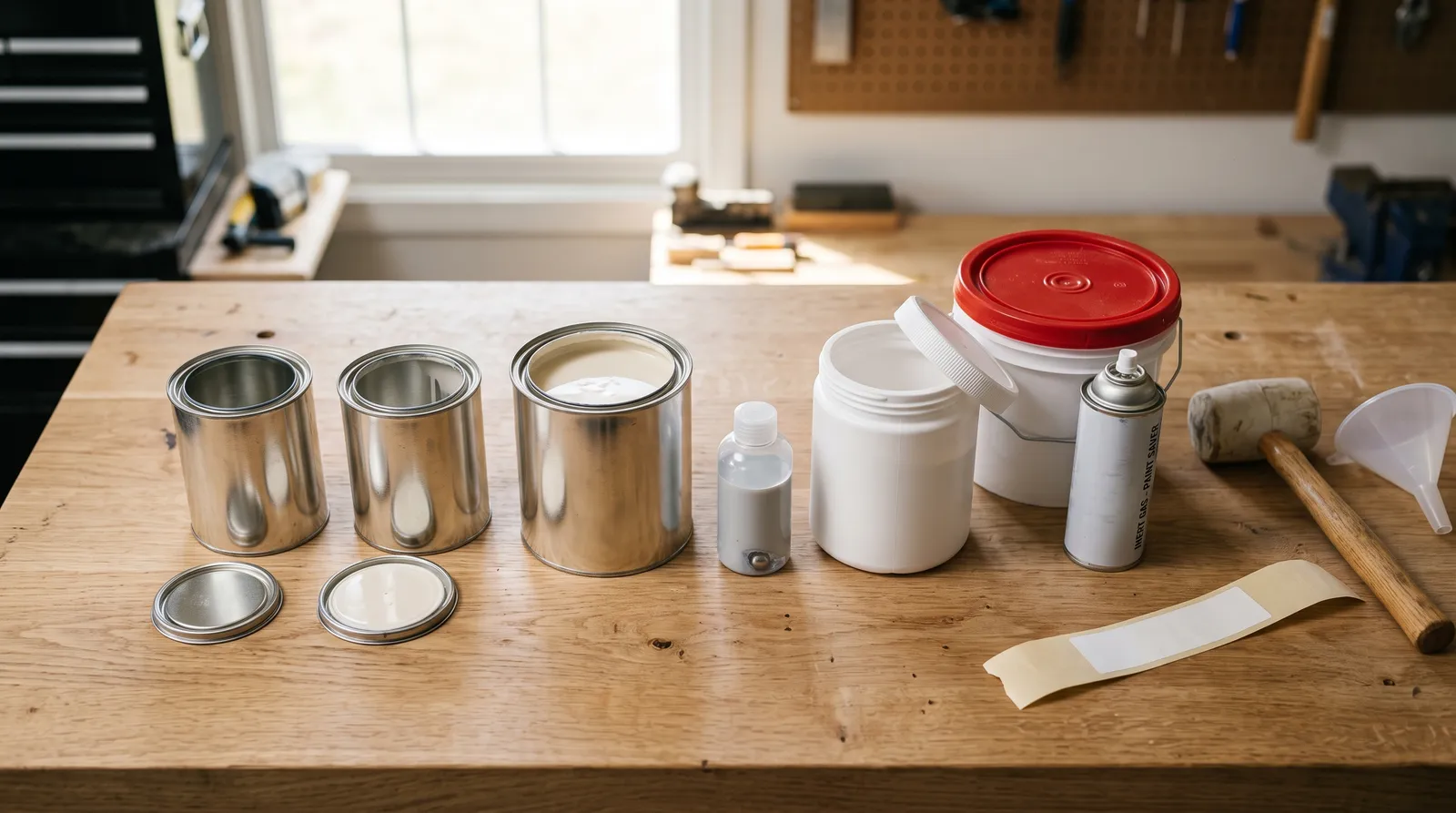
Disclosure: Some links below are affiliate links. We earn a commission if you buy through them, at no extra cost to you.
Top pick: a three-pack of empty 1-quart unlined metal paint cans, about $4 apiece. Not a gadget, and that is the point. Leftover paint dies from the air sitting on top of it in a half-empty gallon, so the fix is to pour what is left into a container it fills to the shoulder. Repacked paint from our test brushed out clean at fourteen months. The identical paint left in its original half-full gallon had a skin like a rubber pancake and a rust ring at the waterline. For touch-ups, the Touch Up Cup wins on the one thing quart cans cannot do, which is show you the color through the wall of the container. For bulk leftovers already living in a 5-gallon pail, a Gamma Seal Lid ends the pry-bar ritual that wrecks pail rims. For oil-based stain and polyurethane, Bloxygen is the only thing here that addresses how those finishes actually fail. For a damp garage where steel rusts, the Life Latch threaded pail is the plastic answer.
The container matters less than the headspace.
That is the whole finding, and everything below is the argument for it.
Why Leftover Paint Goes Bad
Three failure modes, and they are not the same across paint types.
Air. A gallon can holds 128 ounces. Leave 40 ounces of latex in it and you have stored 88 ounces of oxygen directly against the surface of your paint. Waterborne paint skins because the top layer dries; solvent finishes oxidize and cure, which is a chemical reaction rather than evaporation, and it does not stop just because you put the lid on. Reduce the air and you slow both. This is why the cheap can beats the expensive gadget. A quart can full to the shoulder holds maybe two ounces of air.
Freezing. Latex is an emulsion, and an emulsion is a truce between water and binder. Freeze it once and the truce usually holds. Freeze it four times and the binder coagulates, the paint goes stringy, and it will never lay flat again. Our unheated garage cans went through two January freeze cycles. The repacked quarts came back fine. The Behr flat ceiling white came back slightly grainy and left a faint stipple on the test board, which is what a partially broken emulsion looks like on a wall.
Rust and contamination. Steel cans on a concrete floor wick moisture and rust at the base. Rust flakes off the rim into the paint every time you pry the lid. Then you brush that flake across a wall and spend twenty minutes fixing it. Store cans on a shelf, wipe the chime before you seat the lid, and this problem mostly disappears.
A fourth one nobody warns about: paint goes bad biologically. Latex has preservatives, and after a few years in a warm garage they lose the fight. You will know because the can smells sour, almost like spoiled milk. That paint is finished. No straining, no stirring, no rescue.
The Test: Fourteen Months in a Real Garage
Same protocol per container, four real paints, three locations.
The paints came off actual 2025 jobs: Benjamin Moore Regal Select eggshell in a warm white, Behr Premium Plus flat ceiling white, a waterborne alkyd trim enamel in semi-gloss, and Minwax oil-based polyurethane in satin. Each got split across all five storage methods so the same batch aged five ways simultaneously. That split matters. Comparing your leftover Behr to somebody’s leftover Sherwin tells you nothing.
Three locations ran in parallel. An unheated attached garage in a zone 5 climate, which went below freezing in January and into the high 90s in July. A conditioned basement holding around 62 degrees. A heated interior utility closet, the best-case scenario almost nobody actually uses.
Openings at 3, 8, and 14 months. Four scoring axes: skin formation, re-mix effort, rust and rim contamination, and brush-out quality on a primed drywall board against a fresh-can control.
The gallon controls stayed in their original cans, half full, sealed the way most people seal them. Lid tapped down with a claw hammer around the rim. That is the baseline every storage container in this round-up has to beat, and four of the five beat it comfortably.
Results in one paragraph: repacked quart cans and the Touch Up Cup finished nearly tied on brush-out at 14 months, with the Touch Up Cup easier to re-mix because of the blending sphere. The Life Latch pail matched them and won on rust, having none. The Gamma Seal pail protected the paint well but could not fix the headspace problem when only two gallons sat in a 5-gallon body. Bloxygen was the only thing that kept the Minwax poly liquid and pourable in a half-empty quart; the ungassed control had gelled at the shoulder by month eight.
At a Glance
| Product | Type | Best size range | Works with | Reusable | Price tier |
|---|---|---|---|---|---|
| 1 qt unlined metal can | Empty repack can | 8 oz to 1 gal | Latex, alkyd, stain, primer | Yes, several fills | $ |
| Touch Up Cup | Sealed touch-up cup | 13 fl oz | Waterborne only | Yes | $$ |
| Gamma Seal Lid | Screw-on pail lid | 3.5 to 7 gal | Any bulk coating | Yes, years | $$ |
| Bloxygen | Argon preserver | Any opened can | Oil-based finishes only | 37–75 uses per can | $$ |
| Life Latch 2 gal pail | Threaded plastic pail | 0.6 to 5 gal | Latex, alkyd, coatings | Yes, indefinitely | $$$ |
1. Empty 1-Quart Unlined Metal Cans, Top Pick
On paper this is the least interesting product in the round-up. In practice it beat every purpose-built container on the axis that decides whether stored paint survives.
The Regal Select eggshell went into a quart can filled to about a quarter inch below the chime. At three months: no skin, no settling worth stirring. At eight: a faint film you could lift with a stir stick in one piece. At fourteen: same film, paint underneath uniform, brush-out on the test board indistinguishable from the fresh-can control under raking light. The half-gallon control in its original can had a skin at three months thick enough to peel like a membrane, and by fourteen months the paint under it needed straining before it would lay flat.
Cost is the second argument. Three or four dollars a can. You can repack every leftover in a normal house for under twenty dollars and have money left for a funnel.
Two real weaknesses. Steel rusts, and if you store these on a concrete garage floor they will rust at the base and eventually at the rim. Put them on a wood shelf. And you cannot see through them, so an unlabeled quart is a mystery in two years. Write the room, the brand, the color name, the sheen, and the date on the lid and the side in permanent marker before you pour, not after.
The pouring is genuinely messy. Use a funnel, keep the chime clean, and lay a rag across the top before you seat the lid with a rubber mallet, tapping in a circle rather than hammering one spot flat. A lid driven down unevenly never seals.
| Spec | Value |
|---|---|
| Size | 1 quart, 4.92 in tall; also 1/2 pint, pint, gallon |
| Material | Unlined steel with friction lid |
| Works with | Latex, alkyd, oil-based paint, primer, most stains |
| Reusable | Yes, several fills if the chime stays clean |
| Approx. price | $3–$5 per can |
Buy it if: you have leftover paint from any job and you want the single cheapest thing that makes it last. Skip this if: every leftover you own is oil-based polyurethane, in which case the can is fine and Bloxygen is the product doing the work.
2. Touch Up Cup, Best for Touch-Ups
The Touch Up Cup is 13 fluid ounces of clear PP5 plastic with a mixing sphere inside and a screw-down airtight cap. It solves the problem quart cans do not: identification.
Two years after a repaint, the average homeowner has four quart cans on a shelf and no confidence about which one is the hallway. The Touch Up Cup shows the color through the wall. Shake it for fifteen seconds and the blending sphere breaks the settled pigment back into suspension, no stir stick, no rust flakes, no prying.
Our warm-white eggshell in a Touch Up Cup came out of fourteen months in the conditioned basement essentially unchanged. Same in the garage sample, including through both freezes. Re-mix effort was the lowest of anything tested, because shaking a sealed cup takes fifteen seconds and stirring a quart can takes two minutes.
The trade-off is scope. This is a waterborne-paint product. The maker builds it for latex and acrylic, and solvent finishes do not belong in it. At roughly $6 a cup it is also the priciest per ounce of storage here, which stops mattering once you accept that 13 ounces is all the touch-up paint you will ever use.
Buy it if: you want touch-up paint you will actually find and actually use. Cabinet doors take the most abuse in any house, so if you have just finished a cabinet repaint, fill one of these before you clean the brushes. Skip this if: you are storing gallons rather than ounces, or the finish is oil-based.
3. Gamma Seal Lid, Best for 5-Gallon Leftovers
Anyone who has pried a 5-gallon pail lid off three times knows why this exists. The plain lid bends out of round on the second opening and never seals again, and after that the pail is a bucket with a hat on it.
The Gamma Seal is a two-piece system. An adapter ring snaps permanently onto the pail rim, and a gasketed lid screws into the ring. Open it with one hand, reseal it airtight in three seconds. The ring lives on the bucket through several batches of paint, and the lid outlasts the bucket.
For a contractor with two gallons of a house color left over, or a homeowner who bought a 5-gallon of ceiling white, this is the right answer. Our test pail sat in the unheated garage through the full fourteen months and the paint at the top surface was in better condition than any half-full gallon can we opened.
Its limit is arithmetic. A 5-gallon pail holding two gallons of paint is a pail holding three gallons of air, and the best gasket in the world does not fix that. The Gamma Seal keeps outside air out; it cannot remove the air already inside. If the leftover is small, repack down rather than sealing up.
Seating the adapter ring takes a rubber mallet and about two minutes of patience. Drive it on crooked and it never seals square, and there is no undoing it.
Verdict: the right lid for bulk paint you will keep dipping into. About $9 to $12.
4. Bloxygen, Best for Stain, Varnish, and Poly
Different failure mode, different fix. Oil-based finishes do not skin because they dry out. They cure because they react with oxygen, and that reaction runs inside a sealed can just as happily as it runs on your trim.
Bloxygen is a can of pure argon. Argon is heavier than air, so a two-second spray into a half-empty quart of polyurethane settles as a blanket on the surface and displaces the oxygen sitting there. Cap the can, and the finish stops curing.
This was the clearest result in the whole test. The Minwax satin poly stored without argon had a gelled ring at the shoulder by month eight and a solid skin by fourteen, with maybe half the can salvageable. The gassed sample in the same location poured clean at fourteen months. Same can, same shelf, same paint.
One can does up to 75 quart-sized uses. The per-use cost is pennies.
It does nothing for latex. Waterborne paint fails from freezing and surface drying, not oxidation, so argon on wall paint is money set on fire. And you have to re-gas after every use, which means one forgotten reseal undoes the whole program. It is also not a home center item; it lives in woodworking shops and online. If you are finishing furniture or a refinished piece of stained wood and you keep opening the same quart of poly over a season, this pays for itself on the first can you do not throw out.
5. Life Latch 2-Gallon Screw-Top Pail, Best for a Damp Garage
The awkward leftover is the one between a quart and a bucket. Two gallons of exterior body color after a siding job. A gallon and a half of deck stain. Too much for quart cans, not enough to justify a 5-gallon pail.
The Life Latch line is a threaded plastic pail with a screw-on lid. Hand-tight seals it, and it reseals the same way a hundred times, with no pry bar and no bent rim. The plastic body cannot rust, which is the one failure that kills metal cans stored on damp concrete. Ours lived on the garage floor for fourteen months specifically to see whether anything would go wrong. Nothing did.
It is opaque white, so you are opening it to find out what is inside and how much is left. Label the lid and the side. It also costs several times a metal gallon can, and shipping a pail is not cheap.
Buy it if: your leftovers are gallon-scale, your storage is a damp garage or a basement that floods, and you want to stop fighting friction lids. Skip this if: everything you own fits in two quart cans.
Containers That Didn’t Make the Cut
- Mason jars. They work for small latex amounts and they are free if you have them. Glass on a garage shelf near a ladder is a bad bet, and clear glass exposes pigment to light for years. Fine for a jar of touch-up trim white in a cabinet. Not a system.
- Deli containers and yogurt tubs. The snap lid is not airtight, the plastic is thin, and solvent finishes attack some of them. Skinned over inside three months in our informal side test.
- Plastic wrap under the original lid. A real trick with a real limit. It reduces air contact at the surface but does nothing about the 88 ounces of oxygen in a half-empty gallon, and the wrap traps a wet layer that dries into a peel you then have to fish out.
- Vacuum-sealed bags. Tempting and wrong. Paint bags puncture, they will not stand up, and you cannot pour from one without a funnel and regret.
- Paint hardener packets. These are disposal products, not storage. They turn leftover latex into a solid you can throw in household trash where local rules permit. Good product, different job.
- The original gallon can, half full. The default. It is also the worst performer we tested, by a margin that surprised nobody on the team and surprises most homeowners.
How Much Paint to Keep, and For How Long
Keep one quart per wall or ceiling color, and about 13 ounces per trim or cabinet color. That covers scuffs, nail holes, a patched drywall section, a door edge that got scraped by a dog. Past a quart you are betting you will repaint the same room the same color, and most people do not.
Realistic life for correctly stored paint: latex two to five years, waterborne alkyd enamel two to three, oil-based stain and polyurethane one to two once opened unless you are gassing them. Unopened cans in a conditioned space go around ten years for latex and roughly fifteen for solvent-based products.
Everything past what you will keep goes to a PaintCare drop-off if your state runs the program, or to a household hazardous waste day. Do not pour it down a drain, and do not put liquid paint in the trash.
If you are still buying for the job, get the quantity right in the first place. Our paint coverage calculator will keep you from ending up with three gallons of leftover you now have to store.
Where You Store It Beats What You Store It In
A conditioned basement around 60 degrees is the best free storage in most houses. Second best is an interior closet on an inside wall. Worst is the attic, which cooks paint every summer, and second worst is an unheated garage in a cold climate, which freezes it every winter.
Concrete floors are the quiet killer. Concrete wicks moisture and steel cans rust at the base. Put a scrap of plywood or a shelf under everything.
Two more habits that cost nothing. Store cans upright, not upside down; the upside-down trick relies on a seal that was never seated square in the first place and leaks onto whatever is below. And wipe the chime with a rag before you seat any lid. Paint dried in the chime is what glues a lid on so hard you deform the rim getting it off.
Labeling: Ten Seconds That Saves the Can
Write four things on the lid and repeat them on the side: room, brand and color name, sheen, date. “Hallway, BM Revere Pewter HC-172, eggshell, 5/2025.” Add the store that mixed it if it was a custom match.
The sheen line is the one people skip and regret. Touching up a satin wall with leftover eggshell leaves a patch you can see from the doorway at the wrong hour, and it is invisible when the paint is wet. If you are unsure what you have, the sheen guide sorts out what each level looks like once it dries.
A photo of the can label on your phone, filed in an album called Paint, does the same job for the can that gets thrown out.
Mistakes We Still See
- Storing a half-empty gallon and calling it done. The most common one and the most expensive. Repack into a quart. It takes four minutes.
- Hammering the lid with a claw hammer. Flattens the lid at each strike point and leaves gaps between. Rubber mallet, rag over the rim, tap in a circle.
- Cans on the concrete. Rust at the base, rust flakes in the paint, ruined touch-up. Shelf or plywood.
- Keeping every leftover. Twelve cans nobody can identify is not a paint collection, it is a disposal project you are postponing. Keep a quart per color and take the rest to PaintCare.
- Reusing a can that held a different color. Traces of the old paint tint the new one, and the shift only shows on the wall. Dedicate a can per color or use a fresh one.
- Skipping the strain on old paint. A dollar cone strainer stops you from dragging a rust flake across a finished wall with a good brush. Worth it every time, and while you are at it, check the condition of your brushes and roller covers before you start the touch-up.
- Storing oil-based finish without displacing the air. A half-empty quart of poly gels from the top down. Gas it or decant it into a smaller can.
A Storage Kit for About $35
Three empty quart cans ($12), two Touch Up Cups ($13), a funnel and a cone strainer ($4), a Sharpie, and a rubber mallet you probably already own. That handles a whole-house repaint’s worth of leftovers and it fits on one shelf.
Add a Gamma Seal Lid if you bought paint in a 5-gallon pail. Add Bloxygen if you finish furniture. Add a Life Latch pail if your garage floods and you have gallons to keep.
Repack the paint the day you finish the job, while the cans are still open and you still remember which color went where. Nobody has ever done it two weeks later.
Ask a Question