Best Ladder Stabilizers and Standoffs
Five ladder stabilizers and standoffs tested on siding, eaves, gutters, and brick corners. Top pick: Werner AC78 QuickClick — plus where each one fits and where it doesn't.

Disclosure: Some links below are affiliate links. We earn a commission if you buy through them, at no extra cost to you.
Top pick: the Werner AC78 QuickClick Stabilizer. Roughly $55 to $70, a 44-inch span, a 10-inch standoff, and a spring-loaded latch that clips onto the rungs of a Werner extension ladder in under a minute with no wrench and nothing to drop in the grass. It wins on setup speed and on the fact that it includes a paint can hook. It falls short on fit, because Werner excludes it from Type III aluminum and Type II fiberglass ladders, and on depth, because 10 inches is the shallowest standoff here.
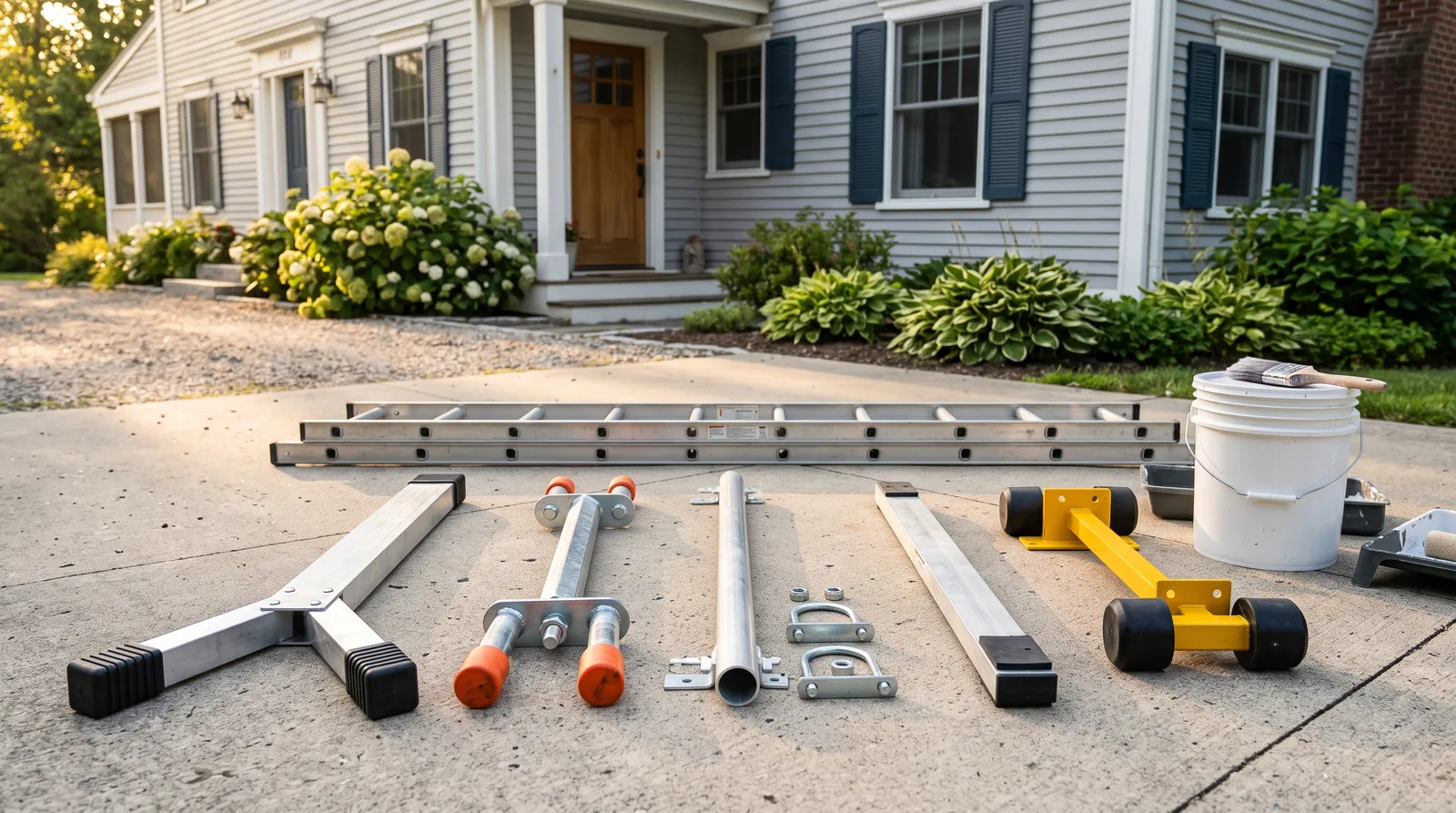
If you need to work under a deep eave or set the arms on a roof, the Ladder-Max Original Stand-Off gets you 19 inches off the wall and is ANSI tested for direct roof placement. If your ladder is not a Werner, the Louisville LP-2200-00 bolts to almost anything with a rail under 3.5 inches. On a Little Giant articulating ladder, the WingSpan is the only clean answer. For outside corners and porch columns, the little Guardian Corner Buddy does something none of the wide bars can.
One tool, five different geometry problems.
Why the Ladder Moves in the First Place
A bare extension ladder touches the wall at two points, and those points are about 14 inches apart. Everything above that is a lever. When you reach sideways to cut in the far side of a window casing, your body weight moves outside that 14-inch base and the ladder wants to pivot on one rail. Most people feel this and describe it as the ladder being “wobbly.” It isn’t wobbly. It’s a narrow base doing exactly what physics says it will do.
A stabilizer widens that base to 36, 44, or 50 inches. The pivot force that felt alarming at 14 inches becomes almost nothing at 44.
The second problem is what the ladder is leaning on. On most American houses the top of a ladder lands on one of three things: siding, a gutter, or nothing at all if there’s a soffit overhang in the way. Leaning on painted siding leaves two dents and two rail marks. Leaning on an aluminum K-style gutter deforms it, and a deformed gutter runs water behind the fascia board, which is a rot problem two years later. Leaning on nothing means the ladder is set at a bad angle and you’re already in trouble.
Standoff depth solves that one. Ten inches puts you in front of a standard 5-inch gutter. Twelve inches clears a 6-inch gutter and most shutters. Nineteen inches gets you out from under a 2-foot soffit overhang so you can actually paint the fascia and the frieze board, which is the exact place exterior paint fails first. If you’ve read our guide to painting exterior wood, you already know the eave line is where the work is.
Stabilizer, Standoff, or Leveler
Three names get used for three different tools, and stores shelve them together.
Stabilizer. A wing bar at the top of the ladder. Widens the contact patch, pushes you 10 to 12 inches off the wall. Werner AC78, Louisville LP-2200-00, Little Giant WingSpan. This is what most painters need most of the time.
Standoff. Same idea, much deeper, usually built heavier because the manufacturer expects the arms to carry load on a roof surface. Ladder-Max is the one here. Buy this if roof edges and deep eaves are part of your normal work.
Leveler. Attaches at the feet, not the top. Fixes sloped ground, a stair landing, a flower bed on one side. Different problem entirely. On a real exterior repaint you often want both, because the ground around a house is almost never flat.
There’s a fourth category that only matters in one situation: corner stabilizers like the Corner Buddy, which are shaped to grab an outside corner or a round column instead of a flat wall. Put a 44-inch wing bar on a house corner and only one arm touches. That is the single worst position you can put a ladder in.
How I Tested These Five
One house, five weeks, one full exterior repaint. A 1978 two-story colonial in zone 5, painted cedar lap on three elevations and vinyl on the fourth, a brick chimney chase, a live aluminum K-style gutter run, and two porch columns.
Three ladders, so each unit sat on something it was designed for: a Werner D6228-2 28-foot Type IA aluminum extension, a Louisville FE3228 fiberglass extension, and a Little Giant Velocity M22 articulating ladder.
Setup time. Stabilizer on the ground to ladder standing and loaded, timed three times per unit. I logged first setup separately from third setup, because the learning curve is real and it’s the number nobody publishes. The Werner went from 3 minutes 40 seconds on the first try to 48 seconds on the third. The Louisville went from 11 minutes to 3 minutes 20 seconds, and it never got faster than that because U-bolts are U-bolts.
Sway. A 190-pound tester shifting weight side to side at the fourth rung from the top and again at working height, measured against a taped reference line on the wall. Bare ladder as the control.
Marring. Each unit pressed against Benjamin Moore Aura Exterior on cedar lap, cured seven days, and against white vinyl at 80 degrees ambient. Wiped and inspected in raking light, which shows a scuff that a straight-on look misses.
Gutter clearance. Set against a live K-style gutter run. Simple pass or fail: did the arms clear the gutter face, or did I end up loading a gutter that was never engineered to take it.
Corners. Two outside 90-degree corners and one 8-inch round porch column.
Every unit went on and off at least six times over the job, which is where the mounting-method differences stopped being theoretical.
Side by Side
| Brand / Model | Type | Span | Standoff | Mount | Weight | Price tier |
|---|---|---|---|---|---|---|
| Werner AC78 QuickClick | Stabilizer | 44 in | 10 in | Rung clip, tool-free | 6.5 lb | $$ |
| Ladder-Max Original Stand-Off | Standoff (roof-rated) | 36 in | 19 in | Bolt-through | 7.5 lb | $$$ |
| Louisville LP-2200-00 | Stabilizer | 45 in | 12 in | Two U-bolts | 6 lb | $$ |
| Little Giant WingSpan 10111 | Standoff | 50 in | 12 in | Tool-free | 5.35 lb | $$$ |
| Guardian Corner Buddy 2470 | Corner stabilizer | 38 in | Shallow | Tool-free | 4.5 lb | $ |
1. Werner AC78 QuickClick, Top Pick
The AC78 is the stabilizer I reached for without thinking about it for most of five weeks, and the reason is boring: it goes on fast and comes off faster.
The mount is a spring-loaded locking latch with quick-release pins that engage the rungs. No tools, no hardware to lose, no wrench in your back pocket. Third-attempt setup averaged 48 seconds from ground to loaded ladder. Removal was about fifteen. On a job where you move the ladder eleven times before lunch and have to fold it into a truck bed at the end of the day, that difference compounds into real time.
Forty-four inches of span killed the sway. Bare ladder at working height, the tester’s side-to-side shift moved the rails visibly against the reference line. With the AC78 on, the movement was hard to see. Ten inches of standoff cleared the 5-inch K-style gutter face with a couple of inches to spare and let me paint the full window casing on a standard double-hung from one position.
The rubber end caps behaved. No marks on Aura Exterior at seven days, no marks on white vinyl at 80 degrees, which is the condition where soft tips gloss the surface and leave a shine you can see from the driveway.
Now the part that disqualifies it for some readers. Werner does not approve the AC78 on Type III 200-pound aluminum extension ladders, on Type II 225-pound fiberglass extension ladders, or on the MT multi-ladder series. If the ladder in your garage is a homeowner-grade 200-pound model, this is not your stabilizer, and ignoring that exclusion means loading a rail the ladder was not rated for. Get the Louisville instead.
The other limit is depth. Ten inches is enough for gutters and window trim, and it is not enough for a 2-foot soffit overhang. On the eave line of this house I swapped to the Ladder-Max every time.
One small thing worth mentioning: the rung channel has to be clean for the latch to seat. Dried mud makes the click sound right when it isn’t. Wipe the rung.
| Spec | Value |
|---|---|
| Span | 44 inches |
| Standoff | 10 inches |
| Weight | About 6.5 pounds |
| Mount | Rung clip, spring-loaded latch, tool-free |
| Fits | Werner aluminum and fiberglass extension ladders (excludes Type III aluminum, Type II fiberglass, MT series) |
| Approx. price | $55–$70 |
Buy it if: you own a Werner Type IA or IAA extension ladder and you move it a lot. Skip it if: your ladder is a 200-pound Type III, or your work is at the eave line.
2. Ladder-Max Original Stand-Off, Best for Roof Access and Deep Eaves
Different tool for a different problem. The Ladder-Max pushes you 19 inches off the wall, which is roughly double everything else here, and it’s the only pick that’s ANSI tested and OSHA compliant for setting the arms directly on a roof surface.
That last part is what you’re paying for. On this house the front elevation has a 22-inch soffit overhang. With the AC78 or the Louisville, the ladder top hits the underside of the soffit and you can’t reach the fascia without leaning out, which is exactly the move that ends careers. With the Ladder-Max, the arms went past the gutter and onto the shingles, the ladder sat at a working angle, and I painted the fascia and frieze from a stable position.
It’s 16-gauge galvanized steel with a Type IAA 375-pound duty rating and bright orange non-marring plastic tips. Four points of contact. It is the only unit in this test that felt overbuilt rather than adequate, and on a ladder accessory that’s the right side to err on.
Two real costs. It’s the heaviest at about 7.5 pounds, and that weight sits at the top of the ladder, which you feel walking the ladder up on a windy day. And it’s about $100, more than the Werner and the Louisville put together.
The span is narrower than you might expect. Thirty-six inches tip to tip is less than the 44 on the Werner and the 50 on the Little Giant, so on a wide picture window you still reposition. The Ladder-Max buys depth, not width.
Buy it if: your house has deep eaves, or you get on the roof, or you clean gutters. About $100. Skip it if: your work is siding and window trim on a house with a shallow overhang. You’re paying for reach you won’t use.
3. Louisville LP-2200-00, Best Universal Fit
The Louisville is the answer to “my ladder isn’t a Werner.”
Two U-bolts clamp it to any rail up to 3.5 by 1.75 inches, which covers nearly every extension and single ladder sold in the US. Brand doesn’t matter. Duty rating doesn’t matter, within reason. If the rail fits between the bolts, the stabilizer fits.
The specs are good: 45 inches of span, the widest fixed bar in the group, and a 12-inch standoff that clears a 6-inch gutter and most shutters. Sway performance matched the Werner. The rubber tips are replaceable, which is a small thing that matters on a tool living on a truck rack losing caps.
The trade-off is setup. U-bolts mean a wrench and real time. My first install ran eleven minutes with the ladder flat on the driveway. Third install was 3 minutes 20 seconds, and it never got faster, because there’s a floor on how quickly you can run four nuts. In practice this stabilizer goes on one ladder in the spring and lives there.
The 150-pound load rating is the other limit. That’s the stabilizer’s own rating, not the ladder’s, and it’s the lowest here. It’s fine for what it does, which is steady a ladder against a wall. It rules out anything resembling roof placement.
| Spec | Value |
|---|---|
| Span | 45 inches |
| Standoff | 12 inches |
| Load rating | 150 pounds |
| Mount | Two U-bolts, wrench required |
| Fits | Extension and single ladders with rails up to 3.5 by 1.75 inches |
| Approx. price | $60–$75 |
Buy it if: your ladder is a Louisville, a Gorilla, an off-brand, or anything the Werner excludes, and you’re willing to bolt it on once and leave it.
4. Little Giant WingSpan, Best for Articulating Ladders
Articulating ladders are a mounting problem. The rails are shaped differently, the rungs are different, and most stabilizers have no clean place to grab. If you own a Little Giant, the WingSpan is the accessory built for it.
Fifty inches of fixed width, the widest in this test. That’s enough to bracket an entire window and cut in both sides of the casing without repositioning, and on the front bay of this house it saved four setups in one afternoon. The 12-inch standoff kept the ladder out from under the eave so nothing touched the gutter.
At 5.35 pounds it’s the lightest here, which you notice on the third setup of the morning. Tool-free mount, seconds to attach.
Its virtue is also its limit. The 50-inch width is fixed, so it won’t go into a corner or between two downspouts, and it’s brand-locked in practice. On a conventional extension ladder it’s a bad fit. Stock is also unreliable; the Little Giant site has it listed as sold out for long stretches.
Verdict: if you own a Little Giant Velocity, Revolution, Classic, Xtreme, or Dark Horse, this is the standoff to buy. If you don’t, ignore it.
5. Guardian Corner Buddy 2470, Best for Corners and Columns
The cheapest thing here and the only one that solves a problem the others make worse.
Put a 44-inch wing bar against the outside corner of a house and one arm contacts, the other hangs in air, and the ladder is on two points at an angle. Every painter has done this and every painter has felt it. The Corner Buddy’s angled arms wrap the corner instead, so both sides land and the load path is symmetrical. Same story on a round porch column, where the arms cradle rather than skid.
Thirty-eight inches wide, 4.5 pounds, powder-coated steel with rubber bumpers, tool-free mount on most standard extension ladders. It came off a brick corner and a painted column with no witness marks.
On a flat wall it does less for you than any of the wide bars, and the standoff is shallow, so it’s not a way to get your body away from the surface. The yellow powder coat chips at the tips inside a season on a truck rack, which is cosmetic.
Verdict: not a primary stabilizer. It’s the $35 thing you keep in the truck for the four corners and two columns on every house, and on those you’ll be glad it’s there.
Two We Looked At and Passed On
- Generic 450-pound “heavy duty steel standoff” listings on Amazon. Several, all similar, all under $50, all with no manufacturer behind them and no ANSI reference in the listing. On a tool whose failure mode is a fall, an unnamed factory and a made-up load number is not a bargain.
- LeveLok-style combination stabilizer-and-leveler units. Real products and genuinely useful on sloped ground, but they solve the footing problem, not the sway-and-standoff problem. If uneven ground is your issue, buy a dedicated leveler and read up on ladder selection for painting work first.
Fitting It Without Wrecking Your Ladder
Read the exclusion list. This is the whole game. Werner prints theirs on the box and on the product page, and it exists because the AC78 puts load into the rung and rail in a way a 200-pound Type III ladder was never designed to carry. A stabilizer that voids your ladder’s rating is worse than no stabilizer, because it feels safer.
Mount it low, then extend. Fit the stabilizer with the ladder flat on the ground or against the wall at a low extension. Do not fit it at height.
Check clearance from the ground before you climb. Stand the ladder, look up, confirm the arms will land past the gutter face and not on it. Ten seconds of looking prevents a bent gutter.
Keep the rung channel clean. On rung-clip mounts, dried mud in the channel prevents the latch from seating while sounding like it seated.
Store it off the ladder in winter. Aluminum stabilizers bolted to a ladder outdoors through a freeze-thaw cycle seize at the U-bolt threads. Pull them in the fall, run a wire brush over the threads, and they go back on in the spring. If you’re painting in shoulder-season conditions, our notes on painting in cold weather cover the rest of the setup.
Mistakes That Still Put People on the Ground
- Leaning the bare ladder on the gutter. The gutter takes the dent, the fascia takes the water two years later, and you were never stable to begin with. This is the single most common exterior-painting habit worth breaking.
- Buying on span alone. A 50-inch bar looks like more stabilizer than a 36-inch one. If the job is a deep eave, the 36-inch Ladder-Max is the safer tool because depth, not width, is what you needed.
- Setting a wide wing bar on an outside corner. One arm contacts, the other doesn’t, and the ladder loads asymmetrically. Use a corner-specific unit or move the ladder to a flat run.
- Ignoring the ladder’s duty rating. Type III 200-pound ladders exist for light household use. Adding a stabilizer, a paint can, and a five-gallon bucket hook doesn’t change the rating.
- Fitting the stabilizer at height. Every install happens on the ground. No exceptions.
- Using the stabilizer as a handhold to get onto a roof. Only a roof-rated standoff is engineered for that load path, and even then you step through the ladder, not around it.
- Assuming the tips stay non-marring forever. Rubber caps harden and crack. A cracked cap has a steel edge behind it, and that edge finds fresh paint. Replace them.
What I’d Actually Buy
If you own a Werner extension ladder and you’re repainting your own house: the AC78, about $60, and skip everything else. It handles siding, window trim, shutters, and gutters, and it comes on and off fast enough that you’ll actually use it.
If your ladder is anything else: the Louisville LP-2200-00. Bolt it on in April, take it off in November.
If the house has deep eaves or you’re going anywhere near the roof edge, add the Ladder-Max. Two units on the truck, one for walls and one for the eave line, is what most exterior painters end up carrying anyway.
And throw the $35 Corner Buddy in the truck. Every house has corners, and that’s the one setup where the big bar makes things worse instead of better. Once you’ve reached the top of the ladder and found out, it’s too late to fix it from up there.
Ask a Question