What Is High-Gloss Paint?
High-gloss reads 70+ gloss units at 60°, cures into the hardest film on the shelf, and reflects light like furniture lacquer. Here's where it belongs.

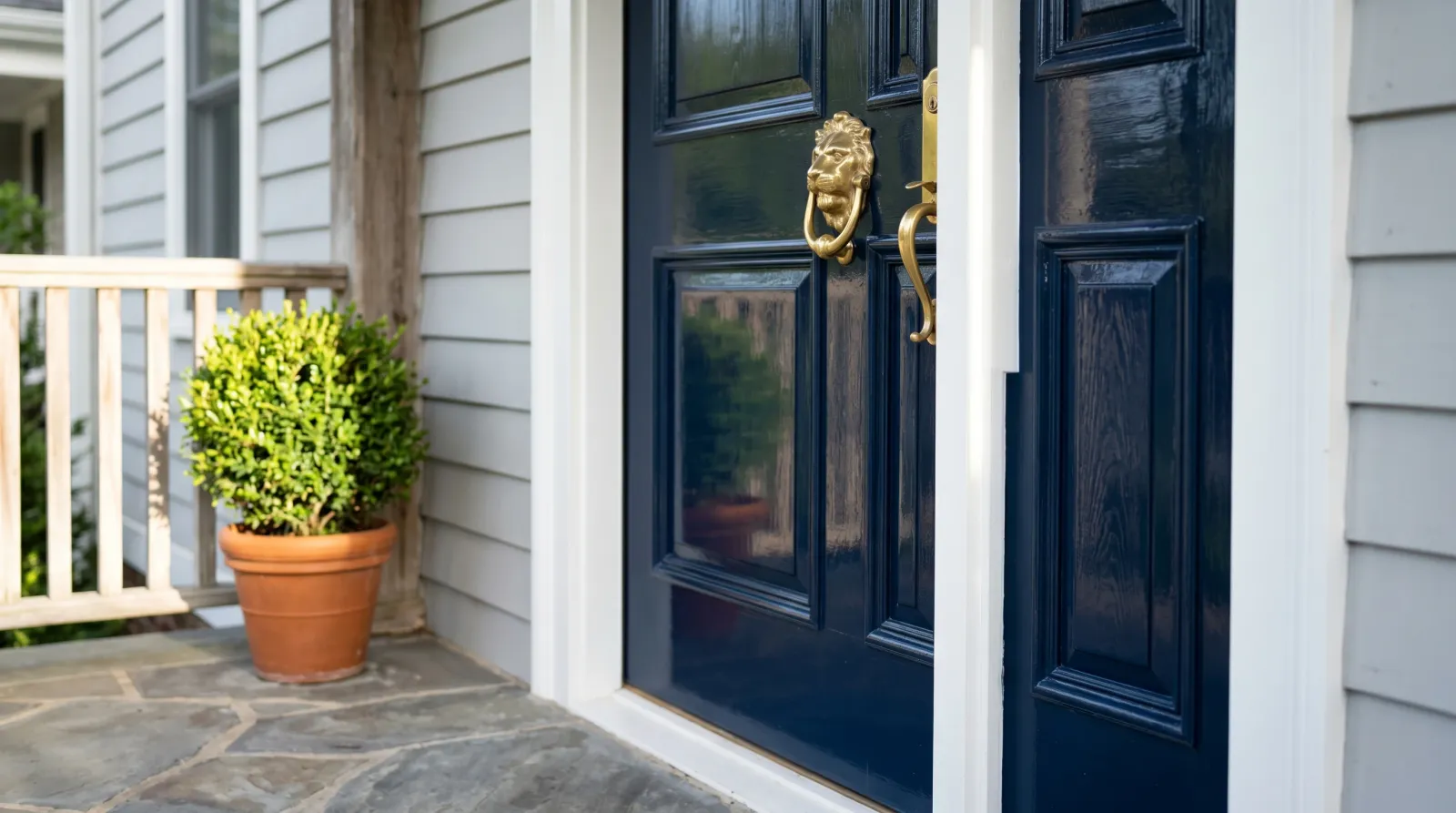
Stand in front of a painted front door at the right angle and you’ll see the porch railing reflected back at you, slightly blurred, like a fogged mirror. That’s high-gloss, and the reason it does this is that the dried film is closer to a sheet of glass than to a wall finish. High-gloss reads 70 gloss units and up at a 60° meter angle, carries the lowest pigment volume concentration of any common sheen (under 15%), and cures into the hardest interior coating you can buy off a paint-store shelf. Coverage drops with the gloss — figure 300 to 350 sq ft per gallon, not the 400 you get from wall paint — because there’s more binder doing the optical work and less pigment doing the hiding.
Where the Sheen Number Comes From
A gloss meter shines a beam at the painted surface at 60° and measures what bounces directly back at the same angle. A polished mirror reads 100. Flat ceiling paint reads under 10. Semi-gloss lives between 35 and 70. High-gloss starts at 70 and climbs into the 85–95 GU band on the best alkyd and waterborne urethane lines.
The number is a direct read on film flatness at the microscopic level. A high-gloss film cures with the binder dominating the surface, the pigment particles fully encapsulated, and almost no voids between them. Light entering at 60° leaves at 60° instead of scattering. Your eye picks up the coherent reflection as a mirror. Bump up the pigment a few percent or coarsen the resin, and that same beam scatters in a dozen directions and you’re back at semi-gloss.
Why the Chemistry Is Different
Two formulation variables decide where a paint lands on the sheen scale. The first is pigment volume concentration. The second is the binder resin and how tightly it cross-links during cure.
Semi-gloss sits at 15 to 25% PVC. High-gloss drops below 15%, sometimes as low as 10. That’s not a small move. It means every gallon carries proportionally more resin and less pigment, which is also why high-gloss covers poorly over a contrasting base coat. The film is built for optics first and hiding second.
The binder choice does the rest. Modern high-gloss is one of three things: a traditional alkyd that cures by oxidation (Benjamin Moore Advance and the old solvent-based trim enamels), a waterborne acrylic-alkyd hybrid (Sherwin-Williams Emerald Urethane Trim, BM Advance in its water-thinned form), or a true waterborne urethane. All three cross-link far more tightly than the latex on your wall. That cross-linking density is what gives high-gloss its hardness and chemical resistance. It’s also why the film takes 30 days to fully cure even though it feels dry in two hours — the chemistry is still building bonds long after the surface is solid.
Where High-Gloss Belongs
The combination of a glass-like reflection and the hardest cured film on the shelf points high-gloss at a narrow set of jobs. Use it where the substrate is genuinely flat and the surface needs to read as a finished object, not a wall.
Use it for:
- Front doors, especially deep colors. The reflection sells the depth of a navy or black far better than satin ever will, and the cured film survives sun, sprinklers, and the dog scratching to come in.
- Statement interior doors and double doors. Pocket doors into a study, lacquered bedroom doors in a modern build. Sprayed, not brushed.
- Cabinet shop work on doors and drawer fronts. Block-sanded to 220, sprayed in a booth, baked or air-cured. Factory cabinet finishes are the reference standard for high-gloss applied at home.
- Automotive and metal trim. Industrial urethane high-gloss on railings, gates, painted bike frames, restored vintage cars.
- Accent furniture and built-ins where the substrate is MDF. MDF sands to a near-perfect flat surface and primes well. It’s the ideal substrate for a sprayed high-gloss finish.
Where High-Gloss Does Not Belong
- Interior wall panels, paneled or flat. Even premium walls have skim-coat ridges and tape lines a meter would never detect but a high-gloss film will. The wall will read busy and tired in raking light.
- Standard interior trim and baseboard. Most homes don’t have trim flat or smooth enough to deserve gloss; the casing joins, the nail holes, the previous coats all show. Semi-gloss is the right step for residential trim.
- Ceilings. Anywhere on a ceiling. The reason should be obvious.
- Recoats over existing gloss without scuff-sanding. High-gloss has the lowest porosity of any sheen, so a fresh coat slides off a slick base. The film cracks at the next door slam. Sand to 220, prime with a bonding primer, then coat.
- Bathroom walls. People reach for high-gloss for moisture rooms thinking harder means better. It doesn’t. The reflection bounces off shower steam and reads as glare; semi-gloss is plenty for a humid bath and looks calmer.
How High-Gloss Compares
| Sheen | GU at 60° | Cured film hardness | Hides drywall flaws | Where it goes |
|---|---|---|---|---|
| Satin | 25–35 | Medium | Fair | Kitchen and bath walls |
| Semi-gloss | 35–70 | Hard | Poor | Trim, doors, cabinets |
| High-gloss | 70+ | Hardest available | Very poor | Front doors, furniture, accents |
| Furniture lacquer | 90+ | Hardest (sprayed only) | None | Factory cabinet work |
For the deep version with photos, see the sheen guide. For the direct head-to-head with the sheen one step down, see semi-gloss vs gloss.
Common Mistakes
- Brushing high-gloss onto a door without tipping off. The brush ridges set into the film as parallel stripes and read as a corduroy texture from across the room. Roll with a microfiber 1/4-inch nap, then drag a soft synthetic brush through the wet edge in long strokes before the film closes.
- Skipping the bonding primer over old semi-gloss. The reason the new coat peels in a year is that the old slick surface gave it nothing to grip. Scuff to 220, wipe with denatured alcohol, and prime with a bonding primer like INSL-X STIX or BM Fresh Start before topcoat.
- Using high-gloss to “make the color pop” on a wall. The wall will read busy, not luxe. If you want depth on a wall, go matte or eggshell in the saturated color. High-gloss is for finished objects.
- Recoating too soon. High-gloss alkyd and urethane lines feel dry in two hours and stay soft underneath for a week. Putting a second coat on a film that hasn’t gassed out yet traps solvent, and the surface stays tacky for months.
- Buying high-gloss because the can says “scrubbable” loudest. Semi-gloss scrubs almost as well, applies easier, and forgives the substrate. Reach for high-gloss when you want the reflection, not because you want a tougher film. Semi-gloss is plenty tough.
What It Looks Like
The fastest way to see the difference is to put three sample squares of the same color on a door — flat, semi-gloss, high-gloss — and tip the door so afternoon light rakes across at a shallow angle. The flat reads as paint. The semi-gloss reads as a glow. The high-gloss reads as a reflection of whatever’s across the room. Same color, three different surfaces, all because of how the binder and pigment are balanced.
Where to Buy
For the SKU picks on doors, see the best front door paint round-up. For interior trim and door applications where you’re choosing between semi-gloss and high-gloss, the best interior trim paint guide covers both sheens with notes on which one belongs where.
Ask a Question