Can You Paint Below Freezing? Winter-Formula Paints Explained
Painting below freezing fails because latex can't coalesce under 35°F. How winter-formula acrylics drop the minimum film-formation temperature, and when to wait.

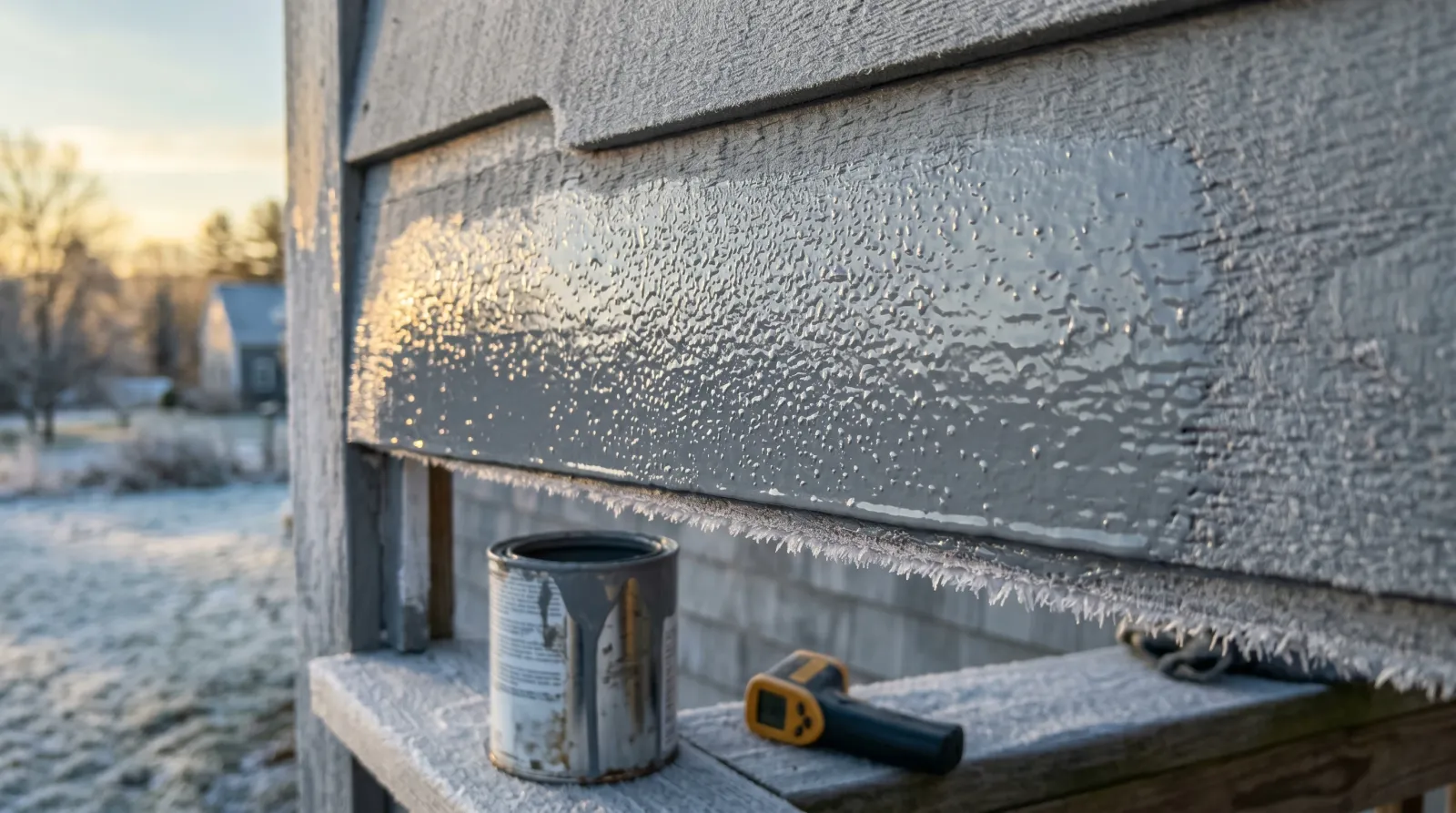
No, you cannot paint below freezing with ordinary latex, and the reason is chemistry, not caution. A waterborne paint forms its film in two steps: the water evaporates, and then the acrylic binder particles flow together into one continuous layer. That second step has a temperature floor called the minimum film-formation temperature (MFFT), and for most standard latex it sits around 50°F. Cold-weather acrylics push the floor down to about 35°F. Below 32°F the water still trapped in the wet film can freeze, and ice crystals tear the half-formed film apart. “Winter-formula” paints buy you 10 to 15 degrees of headroom, but freezing itself is still a wall for almost every can on the shelf.
That’s the short answer. The rest explains what’s actually happening in the film, where the winter formulas get their extra range, and the failure you’ll see in spring if you ignore the number.
What Stops a Paint Film Below Freezing
A latex film doesn’t dry the way a puddle dries. Water leaving is only the first stage. Once the water is gone, the binder particles sit packed together like a jar of soft marbles, and they have to deform and fuse into a solid sheet. That fusing is coalescence, and it only happens when the binder is above its glass-transition temperature, soft enough to flow. Paint chemists add a coalescing solvent to temporarily soften the binder so it fuses at a workable temperature. The MFFT is the lowest air-and-surface temperature where that fusing still completes.
Drop below the MFFT and the particles stay separate. You get a film that looks dry to the touch but is really a loose powder of unfused binder. It chalks, cracks into a mud-flat pattern, and lifts off under a fingernail. The pigment is fine. The binder simply never became a film. For the longer version of that two-stage process, see how a paint film forms.
Now add real freezing. Near the minimum, a film can hold residual water for hours while it slowly cures. If the surface crosses 32°F before that water is gone, the water freezes inside the partly-formed film. Expanding ice crystals push the binder particles apart and rupture whatever fusing had started. That damage is permanent. Warming the wall the next day doesn’t heal it.
When You Can Paint Near Freezing
There are real situations where painting in the 35°F to 45°F band works, as long as you use the right product and watch the surface temperature, not the air.
Use a cold-weather paint near freezing when:
- The product is explicitly rated to 35°F. Sherwin-Williams Resilience and Emerald exterior, Benjamin Moore Aura exterior, and a few Behr exterior lines carry a 35°F minimum.
- The surface temperature stays above the rated minimum through application and the first several hours of cure, not just at the moment you brush it on.
- The overnight low stays above the minimum too. A wall painted at 38°F that drops to 28°F at 2 a.m. is a failed wall.
- The surface is dry and at least 5°F above the dew point, so there’s no hidden condensation film under the paint.
- You’re using an oil-based or single-component alkyd, which cure by oxidation rather than coalescence and tolerate roughly 20°F at the surface if it’s dry.
When NOT to Paint Below Freezing
Some conditions are a hard no regardless of the product on the truck.
- Air or surface below 32°F with any waterborne paint. Water in the film will freeze. There is no winter latex that survives this.
- A masonry, brick, or concrete wall in winter shade. Those surfaces hold cold for days and sit 10 to 15°F below the air. The air can read 40°F while the block is still 28°F.
- Frost, ice, or condensation on the surface. Paint bridges over the moisture, then peels in sheets when it thaws. See the fix for peeling paint for what that looks like a season later.
- A clear, still night ahead. Surfaces radiate heat to a clear sky and can drop well below the air temperature after dark, dragging a curing film below freezing.
- Interior work in an unheated, just-built addition. Without heat the surface tracks the outdoor low overnight even though you painted it warm at noon.
How Winter-Formula Paints Compare
The differences come down to the binder chemistry and how it cures, not marketing labels.
| Standard latex | Cold-weather acrylic | Oil-based / alkyd | |
|---|---|---|---|
| How it cures | Coalescence | Coalescence (more solvent) | Oxidation |
| Minimum temperature | 50°F | 35°F | 45°F (≈20°F surface if dry) |
| Survives a hard frost mid-cure | No | No | More tolerant |
| Cure speed near minimum | Slow | Slow | Very slow |
| Best winter use | Wait for a warm spell | Shoulder-season exterior | Trim, doors, true cold |
A cold-weather acrylic gets its extra 15 degrees from a larger dose of coalescing solvent and a softer binder design, which lowers the MFFT. The trade-off is a longer cure and slightly more solvent off-gassing. Oil-based paint sidesteps coalescence entirely because it hardens by reacting with oxygen, so it tolerates colder surfaces, but it cures slowly and yellows on whites. For the full temperature-and-dew-point breakdown, see painting in cold weather.
Common Mistakes
- Reading the noon air temperature instead of the surface. Point an infrared thermometer at the actual wall. A shaded north face or a slab of concrete can sit 10 to 15°F below the air, and the paint cures against the wall, not the air.
- Ignoring the overnight low. The daytime number can clear 40°F while the 3 a.m. low drops to 25°F. The film is still curing all night, and freezing then ruins it as surely as freezing at application.
- Trusting “dry to the touch” near the minimum. Cold paint skins over while it’s still soft and full of water underneath. Recoat that and you trap solvent and water, giving a soft film that may never harden.
- Using paint that froze in the can without checking it. Most latex survives a freeze-thaw or two thanks to antifreeze additives, but stir it thoroughly first. If it’s grainy, stringy, or lumpy, the emulsion has broken and the can is finished.
- Painting under a clear night sky. Radiative cooling pulls the surface below the air after dark. A wall that read 36°F at dusk can be 28°F by midnight.
What It Looks Like When It Fails
Below-freezing failure has a signature. On a wall painted too cold, the surface looks dusty or frosted because the unfused binder scatters light. Run a finger across it and you lift chalk. Where actual water froze in the film you get a network of fine cracks, sometimes a scaly mud-flat texture, and the coat lifts off the substrate in flat flakes rather than tearing like a properly bonded film. Adhesion is poor everywhere, so the spring rains finish what the cold started.
Where to Buy and What to Look For
You’re shopping for a stated low-temperature rating on the back label, not a “winter” graphic on the front. Look for an exterior acrylic that lists a 35°F application minimum: Sherwin-Williams Resilience or Emerald exterior, Benjamin Moore Aura exterior, or a Behr exterior line that states the same. For trim and doors in genuine cold, a single-component alkyd or waterborne alkyd cures by oxidation and tolerates a colder, dry surface. Read the technical data sheet for the minimum application and substrate temperature; the front of the can rarely prints it.
For the full slate of cold-rated exterior options, see the best exterior paint round-up.