What Is Oil-Based Gloss Paint?
Oil-based gloss paint cures into a glassy, hand-brushed-but-looks-sprayed film at 70+ gloss units. The yellowing, the 16-hour recoat, and why shops still use it.

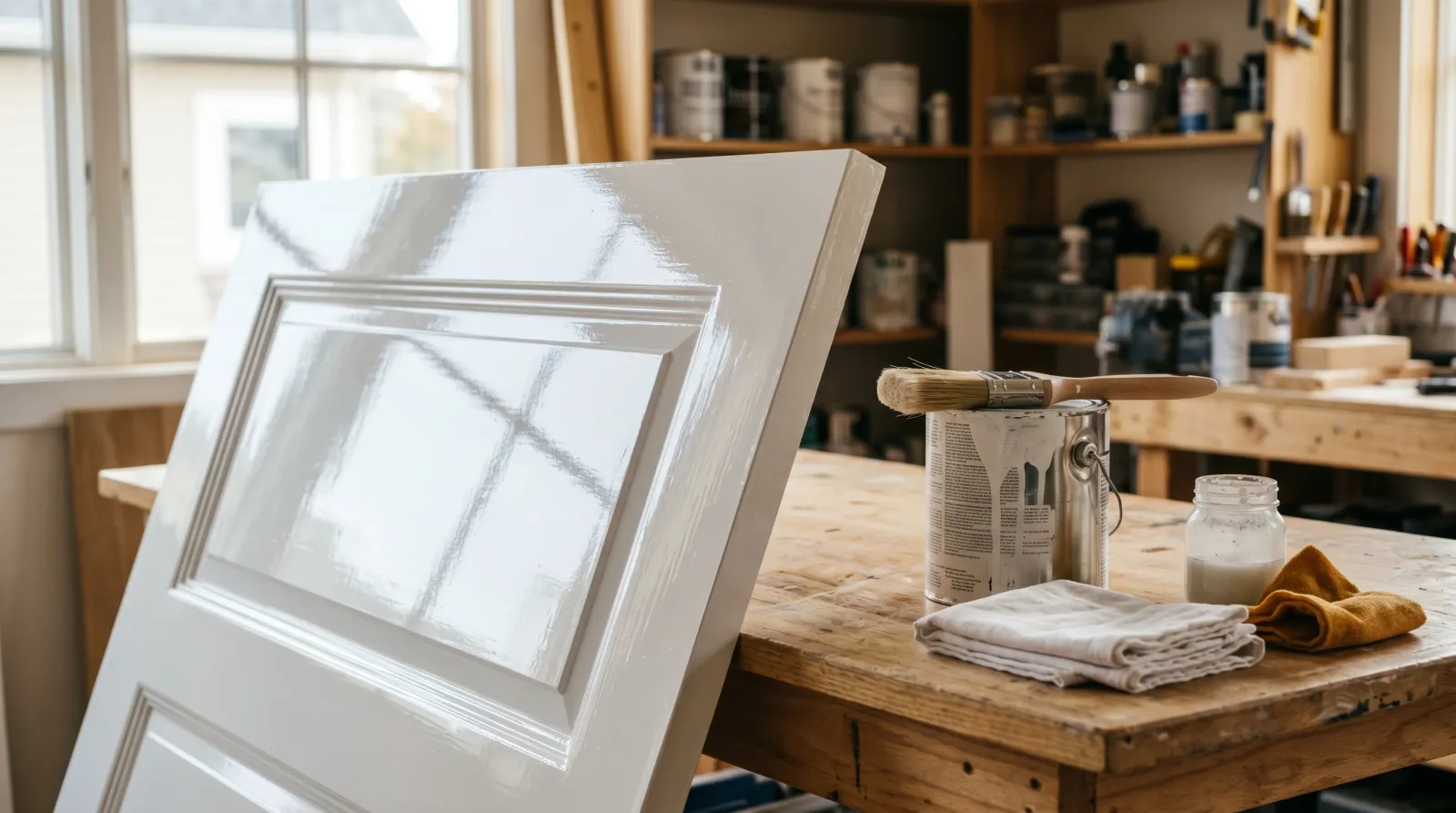
Stand in front of a freshly brushed interior door at the eight-hour mark and you can watch the brush marks disappear. The surface goes wet, then tacky, then glassy. The strokes that were visible at minute five are gone. That self-leveling is what oil-based gloss paint does, and it’s why custom shops still keep a quart of solvent-borne enamel on the bench in 2026.
Oil-based gloss paint is a high-sheen architectural coating built on an alkyd resin (a polyester chemically modified with vegetable oil) thinned in mineral spirits, formulated to a gloss reading of 70 or higher on a 60-degree gloss meter. It cures in two stages, solvent flash followed by oxygen-driven cross-linking, and the cure runs for two to four weeks after the surface feels dry. Touch-dry in 6 to 8 hours, recoat at 16, full cure in 14 to 30 days. Coverage runs 350 to 400 square feet per gallon.
What the Resin Is Actually Doing
The binder is the alkyd chemistry covered in the alkyd paint explainer, with one difference that matters for gloss. Gloss formulas run a higher resin-to-pigment ratio than satin. Pigment volume concentration in a quality oil-based gloss sits around 18 to 25%, against 30 to 40% for a satin. Less pigment means more resin per unit of cured film, and a resin-rich film levels flatter and reflects more light.
The mineral-spirits carrier does two jobs. It dissolves the alkyd resin so it can be applied, and it stays in the film long enough to let capillary forces pull the wet surface flat. Water-based formulas can’t do this. Water flashes off too fast. The wet alkyd film stays open for fifteen to twenty minutes after the brush leaves it, and brush marks that would set in a latex have time to flow out. By the time the solvent leaves, the surface is mirror-flat. Then the oxidative cure begins, and over the next two weeks oxygen stitches the oil tails of the resin into a three-dimensional cross-linked network.
The end state is a film harder and more chemically resistant than any acrylic latex on the market. A cured oil-based gloss panel will shrug off a fingernail, a cleaning solvent, and repeated wet-rag wiping in a way that a top-shelf waterborne enamel still doesn’t quite match.
Where the 16-Hour Recoat Window Comes From
A latex paint film is functionally finished as soon as the water leaves. A second coat at two hours behaves like a second coat at two days. Alkyd doesn’t work that way.
At six to eight hours the solvent has flashed and the surface feels dry. Underneath, the oxidative cross-linking has barely begun. A second coat at hour four wets the partial skin and the uncured resin below, and the result is a ropy, dragging mess that has to be sanded back. Sixteen hours is the window where the skin has set enough to accept a recoat but the underlying resin is still receptive to bonding. Twenty-four hours is safer in cold or humid conditions. After about 72 hours, scuff-sand to break the gloss or the second coat won’t grab.
This is the single biggest reason oil-based gloss lost the residential market. Most painters can’t sit on a kitchen for two days. Waterborne alkyd hybrids like Benjamin Moore Advance and SW ProClassic Waterborne cure with similar hardness but recoat in 6 to 8 hours, and that compressed schedule is what built their market share.
Why Custom Shops Haven’t Let Go
The shops still specifying solvent-borne oil-based gloss are doing high-end interior door work, museum and millwork restoration, and custom-cabinet jobs where the customer is paying for hand-brushed perfection. The reason isn’t sentiment. It’s three measurable things.
| Property | Solvent-Borne Oil Gloss | Waterborne Alkyd Hybrid |
|---|---|---|
| Self-leveling | Excellent (mirror) | Very good |
| Gloss retention at 12 months | 90%+ | 80–90% |
| Film hardness, fully cured | Highest | High (close) |
| Yellowing on white | Visible at 18–36 mo | Minimal |
| Recoat window | 16–24 h | 6–8 h |
The mirror leveling is the headline. A brushed panel door in solvent-borne oil-based gloss can be indistinguishable from a sprayed finish at six feet. The waterborne hybrids leave a faint brush texture a trained eye can spot. For a homeowner repainting trim it doesn’t matter. For a $40,000 custom-cabinet kitchen where the client was told the doors are hand-finished, it matters.
Sherwin-Williams ProClassic Interior Alkyd Enamel in High Gloss is the SKU most shops reach for. It’s the modern descendant of the trim enamels that painted American houses through the twentieth century, formulated under the 450 g/L Federal VOC limit, available in white-tinted bases. A 2026 quart runs $30 to $35 in markets where it’s legal to sell. Benjamin Moore Impervo covers the same use case in the Northeast.
When to Use Oil-Based Gloss
Use it for:
- Interior doors and jambs where you want a brushed-but-looks-sprayed finish
- Custom cabinet work in shops with the schedule and ventilation to handle solvent fumes
- Museum, theater, and high-end millwork restoration matching an existing oil finish
- Stair handrails, banisters, and built-in trim taking heavy hand contact
When NOT to Use Oil-Based Gloss
- Bedroom or living-room walls. The cure time slows the project, the hardness isn’t needed, and the smell lingers for days.
- Exterior siding or trim. Oil-based alkyd embrittles under UV and starts cracking in 3 to 5 years. Exteriors need 100% acrylic.
- Anything in California, New York City, or the OTC Northeast. The 250 g/L VOC cap kills the traditional formula; waterborne hybrid is the legal answer.
- White trim in a north-facing room you don’t plan to repaint for a decade. Yellowing will catch you.
- Any surface a child sleeps near for the first two weeks. Solvent off-gassing is real.
Common Mistakes With Oil-Based Gloss
Recoating at the touch-dry mark. The skin is set; the resin underneath isn’t. A second coat at hour six drags the first into ropes and the only fix is to sand the panel flat and start again. Sixteen hours, every time.
Brushing it like a latex. Oil-based gloss self-levels if you let it. Going back over a tacky stroke at minute eight to chase a brush mark drags the skin and leaves a worse one. Lay the paint down in one direction, tip off once, walk away.
Skipping the bonding primer over old latex. Oil-based gloss shrinks slightly as it cures, and that shrink force can pull a soft latex primer off the substrate. Scuff-sand to 220-grit, prime with an oil or shellac bonding primer, then topcoat. The failures I have seen on cabinet work in the last decade all traced back to oil gloss laid directly over a fresh latex.
Reinstalling hardware at day three. The film is touch-dry but nowhere near fully cross-linked. Hinges screwed back too early leave permanent compression rings. Two weeks before any hardware goes back, longer if the room is below 65F.
What It Looks Like Next to Other Sheens
For the deeper version on which sheen does what, see the sheen guide. A quick locator against its closest neighbors:
| Oil-Based Gloss | Waterborne Gloss | Semi-Gloss | |
|---|---|---|---|
| Gloss units (60°) | 70+ | 70+ | 35–70 |
| Self-leveling | Excellent | Good | Good |
| Yellowing | Visible | Minimal | Minimal |
| Recoat | 16 h | 4–6 h | 4–6 h |
| Best surface | Doors, custom millwork | Trim, cabinets | Trim, bath walls |
The two glosses look identical on a fresh coat. The differences show up over time. The oil yellows, the waterborne stays white. The oil holds its mirror leveling longer, the waterborne softens slightly.
Where to Buy
For SKU picks on doors, see the best interior door paint round-up. For the long comparison against the waterborne alternatives, see oil-based vs water-based paint. Sherwin-Williams ProClassic Interior Alkyd Enamel in high gloss is the most widely stocked solvent-borne option at SW company stores in non-restricted states. Skip it in California, New York metro, and the OTC Northeast. The waterborne hybrid is your legal and practical answer there.
Ask a Question