How to Match Paint Color to an Existing Wall
The reliable way to match paint is to cut a small chip of the dried film and have it read on a store spectrophotometer. Here is why that works, where it fails, and when to just repaint the wall.

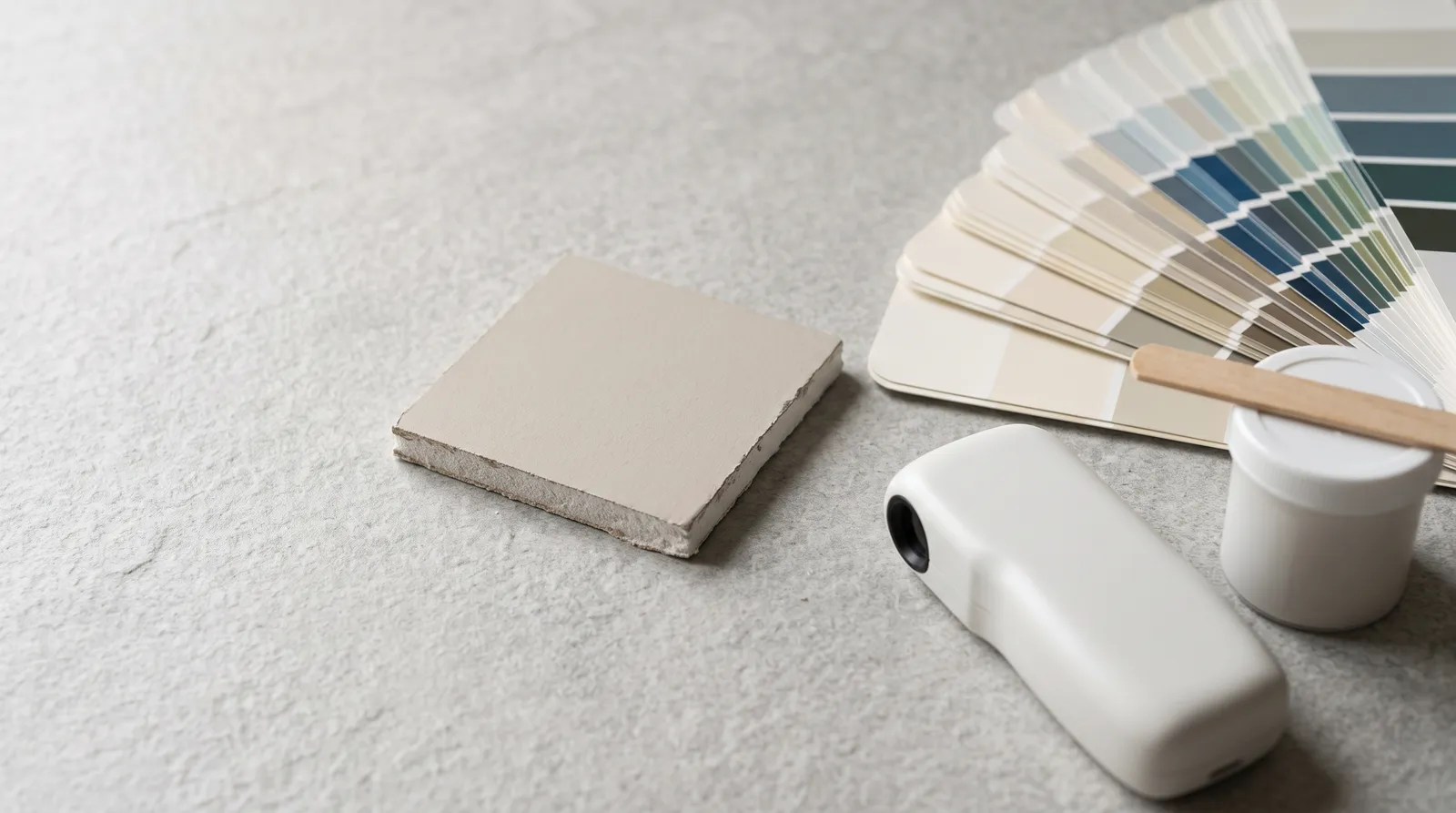
You patched a nail hole, dabbed on paint from the can that has been in the basement since the house was painted, and now there is a small pale coin on the wall that you cannot stop seeing. The paint is the same. The color is the same. It still does not match.
Here is the short answer to the actual question. To match an existing paint color, cut a chip of the dried film about 2 inches square from a hidden spot, take it to any paint counter, and have it read on a spectrophotometer. The machine returns a tint formula that is usually within a Delta E of about 1, which is close enough for a full wall and often not close enough for a touch-up. The reason for that gap is the rest of this article.
What the Store Machine Actually Measures
A spectrophotometer is not a camera. It does not decide what color something looks like. It shines a controlled, known light on a small circle of your chip, then measures how much light comes back at each wavelength across the visible spectrum, usually in 10-nanometer steps from about 400 to 700 nanometers.
What comes out is a reflectance curve. That curve is the fingerprint of the paint film — a physical description of which wavelengths the pigments absorb and which they scatter back. Because the instrument brings its own light and shuts out the room, the reading is the same in a bright store as in a dark one.
Then the software does the interesting part. It knows the tint strength of every colorant in that store’s dispenser and the reflectance behavior of each base. It solves backwards: which combination of colorants, at what load, in which base, produces a curve closest to yours? That is the formula printed on your can lid.
Two things follow from this that matter to you.
The machine matches the film in front of it, not the paint it came from. If your wall is ten years old, sun-faded, and carrying a thin layer of cooking film, the machine reads a faded, dirty color and reproduces it faithfully. That is often what you want for a patch. It is not what you want if you are painting a whole new room to match the hallway.
The machine is matching with a different pigment set. Your original paint may have been tinted at another chain with different colorants. Two different pigment mixes can produce nearly the same curve — nearly, not exactly. That small difference is where metamerism lives, and we will come back to it.
How to Cut a Chip That Reads Correctly
The quality of the reading is mostly the quality of the chip.
- Take it from a hidden, honest spot. Behind an outlet cover, inside a closet, behind the door stop, or the top edge of a baseboard. Kill the breaker before you pull an outlet cover.
- Avoid faded and handled areas. Direct-sun walls fade. The area around a light switch collects hand oils and reads darker and glossier.
- Get it flat. Score a square with a sharp utility knife and lift a piece of the paint film with a bit of the drywall paper or joint compound behind it, so it holds its shape. A curled chip lets stray light under the aperture.
- Clean it, gently. A damp cloth, then dry. No degreaser, no scrubbing. You are trying not to change the surface you are measuring.
- Do not wax, polish, or wet it at the counter. Water and oil fill surface micro-texture and temporarily raise apparent gloss, which changes what the instrument sees.
Better Than a Chip: Find the Original Formula
Before you cut anything, spend five minutes looking. The formula sticker is the single most accurate way to match, because it skips the measurement step entirely.
Check the lid or side of any leftover can. Check the garage, the basement shelf, the crawlspace. Check inside the electrical panel door and the back of a closet door, where painters sometimes write the color. Ask the builder or property manager. If the house was painted by a contractor, they usually kept a job record. And most chains keep purchase history tied to a phone number or loyalty account — Sherwin-Williams, Benjamin Moore dealers, Behr at Home Depot and Valspar at Lowe’s can all pull an old ticket if you bought it there.
A name and code beats a scan every time. A scan of a ten-year-old wall gives you a ten-year-old wall.
Where Machine Matching Falls Down
Five failure modes, in the order you are likely to meet them.
Metamerism. Two paints can share the same apparent color under store lighting and split apart under your window. This happens whenever the two paints reach that color by different pigment routes. A yellow-heavy formula and an iron-oxide-heavy formula can both land on the same beige at 4000K, then disagree under warm LEDs. There is no way to eliminate this from a cross-brand match. There is a way to catch it: look at your sample in the actual room, in daylight and at night.
Sheen. This is the one people underestimate. Perceived color is a function of how light leaves the surface, and sheen controls that directly. A gloss film has a smooth, continuous top surface that reflects a large fraction of light specularly — straight off, at the mirror angle, without ever entering the pigment layer. What reaches your eye from the body of the film is therefore more saturated and usually reads a shade deeper. A flat film is rough at the micro scale, scatters light in all directions, and mixes in white surface reflection from every angle. The same tint formula reads lighter and chalkier in flat than in satin. If you match a color to an eggshell wall and buy it in semi-gloss, the touch-up will be visibly wrong even though the formula is right. Our sheen guide covers the ladder in detail.
Base and colorant load. Every paint line has a set of bases — usually a white base, a light or pastel base, a medium base, and a deep or accent base — that differ in how much titanium dioxide they carry and how much colorant they can absorb. Deep, saturated colors are made in a base with almost no white, loaded with a large volume of colorant. That is fine, but the resulting film can be softer, slower to cure, and more sensitive to small dispensing errors. A deep color matched across brands is the hardest match there is.
Aging of the film you are matching. Latex films keep changing after they dry. Binders continue cross-linking for weeks, some organic pigments fade slowly under UV, and alkyd-based whites yellow. The wall you scan today is not the color that came out of the can. That is a feature for touch-ups and a problem for adjacent new work.
Substrate and porosity. A perfectly matched paint over a patched area still flashes if the patch is more porous than the wall. That is a film formation problem, not a color problem — the porous spot pulls water out of the wet paint before the binder particles fuse, so the dried film ends up duller. See what flashing is. Prime the patch first and the color match will finally show its real quality.
Matching Across Brands
Every store can match a competitor’s color, and every store’s match is an approximation. The formula you get is that store’s colorants doing their best impression of another company’s pigment mix. On a soft neutral it is usually excellent. On a saturated blue, a clean red, or a deep green it is often a near miss, because those colors depend on specific organic pigments that not every dispenser carries.
There is a second reason to think about it. A cross-brand match copies the color and nothing else. It does not copy the resin, the pigment volume concentration, the scrub resistance, or the way the film levels out under a brush. If you loved how the original paint applied, a color match from another line will not give you that back.
Textured Walls, Popcorn, and Exteriors
Textured surfaces make everything harder, and for a reason that is purely geometric. Knockdown, orange peel, and popcorn scatter light from thousands of small angled facets, so the surface reads lighter in some spots and darker in others. A spectrophotometer pressed against texture also reads badly, because the aperture cannot sit flush and stray light leaks in. Cut your chip from a smooth area if one exists — the edge of a closet, a window return, the back of a door casing.
Exterior matching adds fading. UV degrades organic pigments faster than inorganic ones, so a red or a deep blue on a south wall may have drifted a long way from its original formula while the north wall barely moved. If you are patching, match to the wall you are patching. If you are painting a whole elevation, match to a protected area like the underside of a soffit and accept that the new work will look slightly fresher until it weathers in.
Phone Apps and Handheld Scanners
People ask about this constantly, so let us be precise about the physics.
A phone camera cannot do it. Three steps in the imaging pipeline destroy the data a match needs. Automatic white balance guesses at the light source and shifts every channel. Auto exposure and tone mapping compress highlights and lift shadows non-linearly. Then the image is saved as 8-bit sRGB, a container that cannot represent a reflectance curve at all — only three numbers per pixel, already interpreted. You can go from that photo to a color family. You cannot go from it to a tint formula.
Handheld color readers are a real step up. Devices like the Nix color sensors and Datacolor’s ColorReader clamp against the surface, block ambient light, and fire their own calibrated LED. That removes the two biggest error sources at once. In practice they land within a Delta E of roughly 1 to 3 against a spectrophotometer on flat, matte, uniform surfaces. That is genuinely useful for identifying an unknown color, for shopping the same color across brands, and for checking whether the greige in the hall is the same greige as the bedroom. It is not accurate enough that I would tint five gallons off a handheld reading without a sample first.
Where a software matcher belongs. Our color matcher tool takes a hex value, a photo, or a color name and returns the nearest real paints across every major brand, ranked by Delta E 2000. That is the right tool for the question “what paint is closest to this color I found?” — a design question. It is the wrong tool for “what exactly is on my wall?” — a measurement question. Different jobs, different instruments.
Batch Variation: Why the Same Paint Does Not Match Itself
Even with the original formula in hand, two cans tinted a year apart will not be identical.
Colorant is dispensed volumetrically in fractions of a fluid ounce, and dispensers drift between calibrations. Base paint arrives in manufacturing lots with small differences in titanium dioxide dispersion and resin batch. Some colorants settle in the dispenser canister if the store is slow. Stack those together and two gallons of the same product from two stores can differ by around a Delta E of 1.
A Delta E of 1 is roughly the threshold where a trained eye sees a difference in a side-by-side edge. On two separate walls, nobody will ever notice. Down the middle of one wall, everybody will.
The fix is mechanical, not chemical: box your paint. Pour every can you plan to use for a given area into one 5-gallon bucket, stir it, and pour back. Now the variation is averaged across the whole job instead of showing up as a line where can one ended and can two began.
When to Stop Matching and Just Repaint
At some point, matching costs more time than repainting, and this is the judgment most articles skip.
The relevant unit is the plane — one continuous surface bounded by inside corners, trim, or an edge. Your eye compares within a plane and forgives across one. Two adjacent walls in slightly different shades of the same color look intentional. Two shades on one wall look like a mistake.
| Situation | Do this |
|---|---|
| Nail holes, small dings, same paint on hand | Touch up. Dab, do not brush wide. Feather the edge. |
| Patch under about 2 inches, sheen is flat or matte | Touch up after priming the patch |
| Patch on eggshell, satin, or gloss | Repaint the whole plane. Sheen difference always shows on sheened film. |
| Any patch larger than a dinner plate | Repaint the plane |
| Scanned match, color is close but not perfect | Repaint the plane. Never blend a matched color into an old one mid-wall. |
| Sun-faded wall, patching one area | Repaint the plane, or accept that the patch is now the honest color and the wall is not |
| Cannot find the original formula, deep saturated color | Repaint the room. Deep colors are the hardest to match and the most obvious when missed. |
That last row is worth saying plainly. A gallon of paint and an afternoon is cheaper than four trips to the counter chasing a match you will still notice from the doorway.
Common Mistakes
- Matching to a dirty or faded chip and then painting a whole new room with it. You will have faithfully reproduced ten years of aging.
- Matching the color and ignoring the sheen. The single most common cause of a visible touch-up.
- Brushing a touch-up over a rolled wall. Different applicator, different micro-texture, different reflection. Use a small roller or a dabbing motion with a stubby brush.
- Testing the match while it is wet. Latex dries darker than it looks wet and keeps shifting for a day or two. Judge at 24 hours minimum. More on that in why paint does not match the sample.
- Judging the sample only at the store or only at night. Check it in the room, in daylight and under your evening lights. Metamerism only shows up when the light changes.
- Rolling straight from two different cans. Box them.
The Practical Sequence
If you want one procedure to follow, this is it.
- Look for the original color name and formula before you look for anything else.
- If there is none, cut a flat 2-inch chip from a hidden, unfaded, unhandled spot.
- Have it read on a spectrophotometer at any paint counter. Note the sheen of the existing wall and buy that sheen.
- Buy a sample pot, not a gallon. Paint a piece of primed card, let it dry a full day, and hold it against the wall in daylight and at night.
- If it disappears against the wall in both lights, buy the gallon. If it does not, take the card back and let the tinter adjust it — they can bias the formula by eye, and a good one is very good at it.
- Prime any patched area so the film forms evenly.
- Box multiple cans, and repaint corner to corner rather than blending into old paint.
The underlying principle is simple even when the chemistry is not. A color match is not a property of the paint. It is a property of the paint, the film thickness, the sheen, the substrate under it, the age of the coating, and the light in the room. The spectrophotometer handles exactly one of those variables. You handle the rest.
Ask a Question