How to Estimate a Paint Job: The Working Method
How to estimate a paint job the way estimators actually do it: surface takeoff, production rates, burdened labor, materials, overhead and margin, with two worked examples.

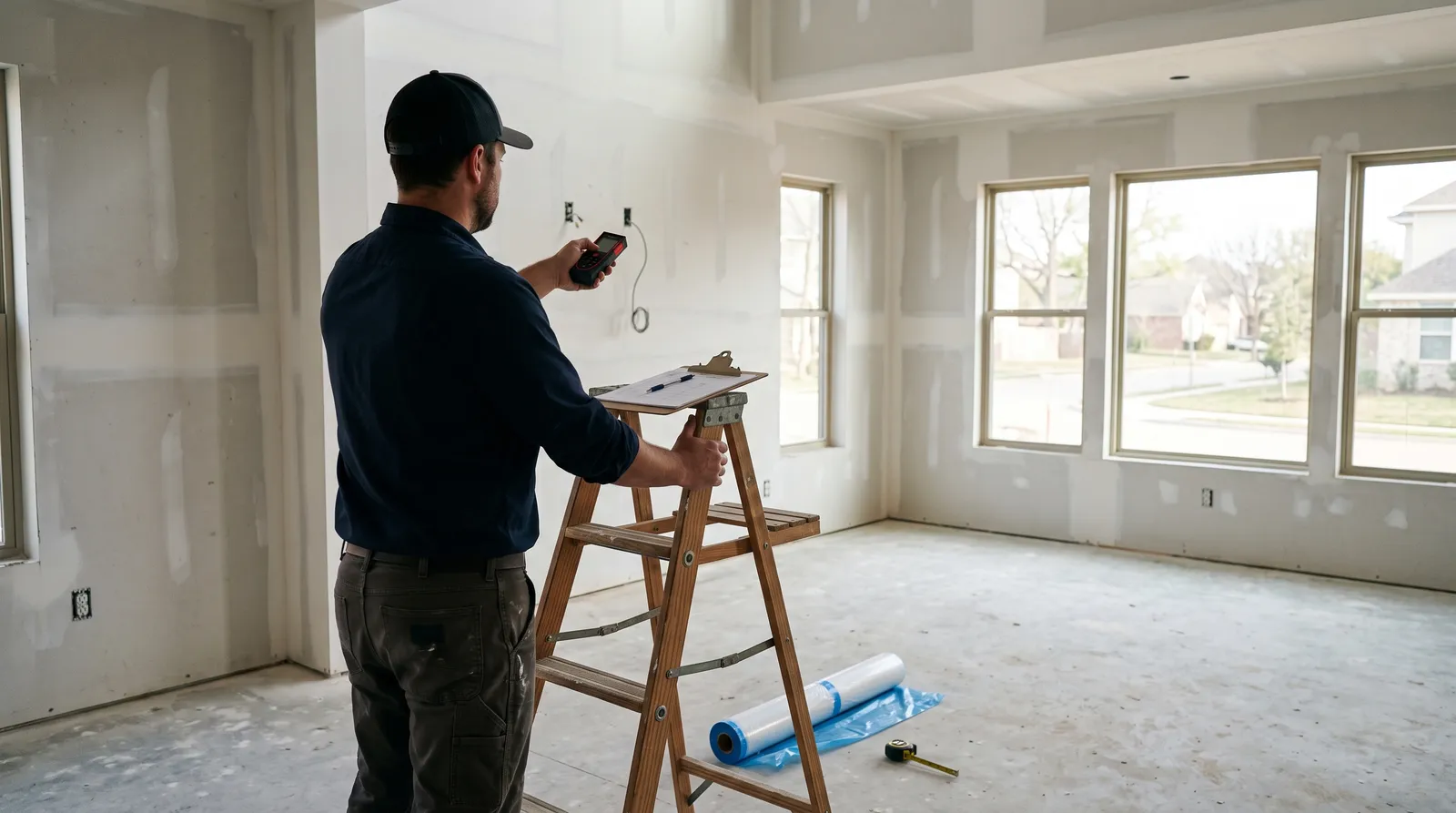
An estimate is not a price. It is a prediction of how many hours and gallons a defined scope of work will consume, converted into money at the end. Estimators who get that order right stay in business. Estimators who start with a number they think the customer will accept, then work backward, end up donating labor to strangers.
The method below is the one used to price residential repaint work, interior and exterior. It is equally useful from the other side of the table. A homeowner holding three quotes that differ by four thousand dollars can rebuild each bidder’s math in about twenty minutes and find out which one actually priced the job in front of them.
TL;DR
- Measure surface area, not floor area. Wall square footage is the unit; floor square footage is the fastest way to underbid a house with nine-foot ceilings.
- Convert area to hours with production rates. 150 to 200 sq ft per painter-hour per coat on smooth drywall is the anchor number.
- Price hours at burdened labor cost, not the wage on the paycheck. Burden adds 25 to 40 percent.
- Materials are 15 to 30 percent of the bill. Labor is the rest, which is why the cheap gallon usually loses.
- Add overhead and profit by dividing, not multiplying. Direct cost divided by (1 − OH% − profit%).
- Prep is the variable. Two bidders on the same house are usually pricing two different amounts of scraping.
How Do You Estimate a Paint Job?
Measure the actual coated surface area, divide it by a production rate to get labor hours, price those hours at your burdened labor cost, add materials with a 20 to 35 percent markup, then divide the direct cost by one minus your overhead and profit percentages. Those five steps, in that order, are the whole method.
Everything else is refinement. The steps are sequential because each one feeds the next, and skipping any of them removes a real cost from the sheet rather than saving time. The most common failure in residential estimating is not bad arithmetic. It is a takeoff that never happened, replaced by a per-room price carried over from a job that looked similar and was not.
The sections below run each step in order, then work two complete examples.
Step 1: Take Off the Surface Area
The takeoff is the measurement pass. It produces four quantities, and every one of them is priced differently.
- Wall area, in square feet. Room perimeter multiplied by ceiling height. A 12 by 14 bedroom at 9 feet is (12 + 14) × 2 × 9 = 468 sq ft.
- Ceiling area, in square feet. Length times width. Only count ceilings that are in the scope.
- Trim, in linear feet. Baseboard, casing, crown, chair rail, each tallied separately if the profiles differ in width.
- Units. Doors, windows, cabinet doors and drawers, shutters. These are counted, not measured.
Two rules on deductions. Deduct openings only when they are larger than roughly 50 square feet, meaning sliders, garage doors, and large picture windows. Do not deduct standard windows and doors, because the cut-in work around an opening costs more per square foot than the field it displaced. And measure the height you will actually coat, including the stairwell wall that runs two stories, not the height listed on the plan.
For the arithmetic, the paint calculator converts room dimensions into wall area and gallons directly, and the exterior paint calculator does the same for siding area with the opening deductions built in. Use them to check a hand takeoff; the two numbers should land within five percent of each other. If they do not, one of your ceiling heights is wrong.
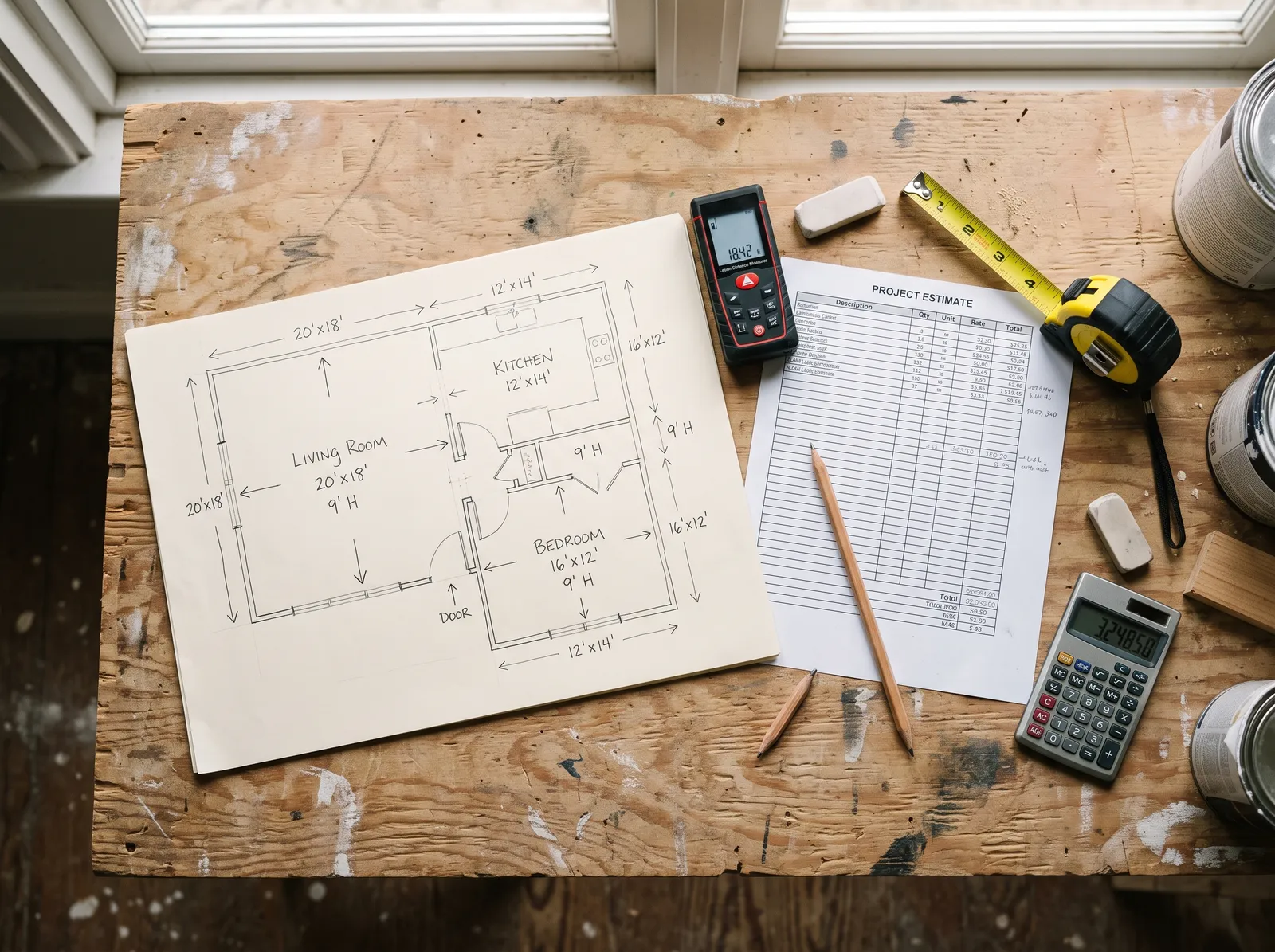 A takeoff is a document, not a memory. Sketch the plan, write the dimensions on it, and keep it attached to the estimate.
Step 2: Convert Area to Hours With Production Rates
A production rate is the square footage a single painter covers in one hour, for one coat, on a prepared surface. It is the pivot the entire estimate turns on, and it is the number you should be measuring on your own jobs rather than borrowing.
| Task | Rate per painter-hour, one coat |
|---|---|
| Roll and cut smooth drywall walls | 150–200 sq ft |
| Roll and cut textured or knockdown walls | 75–125 sq ft |
| Spray plus back-roll, empty room | 400–600 sq ft |
| Ceilings, roll, unobstructed | 175–225 sq ft |
| Baseboard, brush | 60–100 linear ft |
| Door and window casing, brush | 40–60 linear ft |
| Crown molding, brush | 50–80 linear ft |
| Interior door, both sides and edges | 30–45 min per door |
| Exterior siding, brush and roll | 100–150 sq ft |
| Exterior siding, spray plus back-brush | 300–500 sq ft |
| Pressure wash siding | 800–1,200 sq ft |
| Scrape and sand failing exterior paint | 40–80 sq ft |
| Patch, caulk, and sand interior | 50–100 sq ft |
Three adjustments apply on top of the raw rates:
- Prep. Add 20 to 40 percent of application hours for interior patching, caulking, sanding, and masking. Exterior prep is not a percentage; it is its own measured line item, because it swings from four hours to forty on identical-looking houses.
- Access. Add 15 percent to application hours for second-story ladder and staging moves, more for cut-up elevations or steep grade.
- Occupancy. Add 15 to 25 percent when the house is furnished and lived in. Moving and re-covering furniture every morning is real time that never appears on a takeoff.
Then add fixed hours that have nothing to do with area: setup and teardown, daily masking and unmasking, material runs, and the punch walk. On a multi-day residential job that block is rarely under eight hours. If you want a reality check on the room-level numbers, how long it takes to paint a room breaks a single bedroom down hour by hour.
Step 3: Price the Hours
Labor is priced at burdened cost, not wage. Burden is payroll tax, workers compensation, general liability, unemployment insurance, and paid time off. On residential painting it runs 25 to 40 percent on top of the hourly wage, and workers compensation rates for painting are high enough that guessing here is expensive.
A painter at 26 dollars an hour with 32 percent burden costs 34.30 dollars an hour to have on site. That is the number that goes in the estimate. Note that this is a cost, not a billing rate. Billing rates in most US markets land between 50 and 75 dollars per painter-hour, but the billing rate is an output of this method, not an input. You arrive at it after overhead and profit are applied in step 5.
If you are estimating your own labor on a house you own, price it at zero and be honest that you are trading roughly 145 hours for the savings. That comparison is what the paint cost calculator is built to run.
Step 4: Price the Materials
Materials break into coating, primer, and sundries.
Coating quantity comes from the takeoff divided by real spread rate, not the number on the label. Most quality interior latex is specified at 350 to 400 sq ft per gallon per coat, and that assumes a smooth, sealed, similarly colored substrate. Texture, porosity, and a color change all pull the real number down. Coverage math, explained covers why the label number and the jobsite number diverge.
Coating price depends on which shelf you buy from, and this is where estimators lose money quietly. Compare two honest ends of the market:
- Sherwin-Williams ProMar 200 is the contractor production standard: 350 to 400 sq ft per gallon per coat, a four-hour recoat, and 38 to 48 dollars per gallon at street price, with SW promo days knocking 30 to 40 percent off that. The four-hour recoat is a scheduling asset, not a marketing line. It is what lets a crew put two coats on a room in one day instead of two.
- Glidden Essentials sits at the bottom of the market at roughly 18 to 28 dollars per gallon. Our review is blunt about what that buys: a thin film with a realistic 200 to 300 sq ft per gallon on a color change, two coats minimum, and two to three plus a tinted primer on a deep color.
Run those numbers on 4,200 sq ft of wall, two coats. ProMar 200 at 375 sq ft per gallon needs 22.4 gallons, about 941 dollars at 42 dollars each. Essentials at 250 sq ft per gallon needs 33.6 gallons, about 773 dollars at 23 dollars each. The cheap paint saves 168 dollars. If the color change forces a third coat, you buy 17 more gallons at 390 dollars and burn roughly 24 additional painter-hours at 34.30, which is 823 dollars of labor. The 168-dollar saving becomes a 1,045-dollar loss. That is the whole argument against specifying by can price, and it is arithmetic rather than opinion.
None of this makes Essentials a bad product. On a same-color refresh in a low-traffic rental where no third coat is coming, its number is the right number. It is the wrong number the moment a color change is in the scope.
Sundries are tape, masking film, plastic, drop cloths, caulk, joint compound, sandpaper, roller covers, liners, and blades. Budget 10 to 15 percent of coating cost, or 200 to 350 dollars on a full interior. Markup on materials is 20 to 35 percent, standard across the trade, and it pays for pickup, storage, tinting errors, and the gallon you buy and do not use.
Step 5: Add Overhead and Margin
Overhead is everything that exists whether or not you are on a jobsite: vehicles, fuel, insurance, rent, software, phones, marketing, and the hours spent estimating jobs you do not win. For a small residential shop it runs 20 to 35 percent of revenue. Net profit target is 15 to 25 percent.
The step where estimates break is the markup arithmetic. Adding 40 percent to your direct cost does not give you a 40 percent margin. It gives you 28.6 percent, and the difference is your profit.
Use division:
Price = Direct cost ÷ (1 − overhead% − profit%)
At 25 percent overhead and 15 percent profit, the divisor is 0.60. A job with 6,580 dollars of direct cost prices at 10,967 dollars. Multiplying by 1.40 would have produced 9,212 dollars and quietly deleted 1,755 dollars of margin.
Rule-of-Thumb Ranges
These are for checking a number you already built, not for producing one. All figures are per square foot of coated wall or siding area, US average, 2026. The owner-performed column is materials and sundries only, with labor valued at zero.
| Scope | Owner-performed | Contractor total |
|---|---|---|
| Interior walls and ceilings, sound drywall | $0.50–1.50 | $2.00–4.00 |
| Interior including trim, doors, and casing | $0.75–1.75 | $3.00–6.00 |
| Exterior, sound substrate, light prep | $0.75–1.75 | $1.50–3.50 |
| Exterior, heavy scrape or two-story | $1.00–2.25 | $3.00–5.00 |
| Kitchen cabinets, per linear foot of run | $50–100 | $100–250 |
If your built-up estimate lands outside the contractor band, find out why before you send it. Sometimes there is a real reason: a vacant house with smooth walls and no furniture legitimately prices at the bottom of the range. Sometimes the reason is a missing line item.
Worked Example: Interior Repaint, Three-Bedroom
Vacant single-story house, 1,600 sq ft of floor area, smooth drywall, 9-foot ceilings. Scope is all walls, all ceilings, baseboard, casing, and 14 interior doors. One color change on walls, no deep colors.
Takeoff: 4,200 sq ft of wall, 1,200 sq ft of ceiling in scope, 620 linear ft of baseboard, 238 linear ft of casing, 14 doors.
Hours:
| Line | Math | Hours |
|---|---|---|
| Walls, 2 coats at 175 sq ft/hr | 8,400 ÷ 175 | 48.0 |
| Ceilings, 2 coats at 200 sq ft/hr | 2,400 ÷ 200 | 12.0 |
| Baseboard, 2 coats at 80 lf/hr | 1,240 ÷ 80 | 15.5 |
| Casing, 2 coats at 50 lf/hr | 476 ÷ 50 | 9.5 |
| Doors, 14 at 1.25 hr | — | 17.5 |
| Prep at 30% of application | 102.5 × 0.30 | 31.0 |
| Setup, masking, cleanup, punch | fixed | 10.0 |
| Total | 143.5 |
Labor: 145 hours × 34.30 = 4,974 dollars
Materials: 25 gallons of ProMar 200 Eg-Shel bought on a promo day at roughly 30 dollars = 750; 7 gallons of ceiling flat at 28 = 196; 6 gallons of trim enamel at 60 = 360; 2 gallons of spot primer = 70; sundries = 250. Subtotal 1,626, call it 1,650 dollars with markup carried in the per-gallon figures.
Direct cost: 4,974 + 1,650 = 6,624 dollars Price at 25% overhead and 15% profit: 6,624 ÷ 0.60 = 11,040 dollars
Check it: 11,040 ÷ 5,400 sq ft of coated wall and ceiling = 2.04 dollars per square foot, at the bottom of the 2 to 4 band. That is correct for this job. The house is vacant, the walls are smooth, and there is no furniture to move. Put the same scope in an occupied house with textured walls and the hours climb 40 percent, and so does the price.
Worked Example: Exterior Repaint, Two-Story
Two-story house, 200 linear ft of perimeter, 18-foot average wall height, lap siding. Roughly 25 percent of the surface has failing paint that needs scraping and spot priming. Scope is body, fascia, corner boards, 12 windows, and 2 doors.
Takeoff: 200 × 18 = 3,600 sq ft gross, less 15 percent for large openings = 3,060 sq ft of siding, call it 3,100. Trim 500 linear ft. Bare area to prime, 775 sq ft.
Hours:
| Line | Math | Hours |
|---|---|---|
| Pressure wash at 1,000 sq ft/hr | 3,600 ÷ 1,000 | 4.0 |
| Scrape and sand 775 sq ft at 60 sq ft/hr | 775 ÷ 60 | 13.0 |
| Caulk 400 lf at 100 lf/hr | — | 4.0 |
| Mask windows and landscaping | fixed | 8.0 |
| Spot prime 775 sq ft at 150 sq ft/hr | — | 5.0 |
| Body, spray and back-brush, 2 coats at 350 sq ft/hr | 6,200 ÷ 350 | 18.0 |
| Trim and fascia, 2 coats at 45 lf/hr | 1,000 ÷ 45 | 22.0 |
| Windows 12 at 0.75 hr, doors 2 at 1.5 hr | — | 12.0 |
| Two-story access penalty, 15% of application | — | 8.0 |
| Cleanup and punch | fixed | 6.0 |
| Total | 100.0 |
Labor: 100 × 34.30 = 3,430 dollars Materials: 20 gallons of exterior acrylic at 55 = 1,100; 4 gallons of trim enamel at 65 = 260; 3 gallons of exterior primer at 45 = 135; caulk, masking, film, and spray tips = 300. 1,795 dollars
Direct cost: 5,225 dollars Price at 25% overhead and 15% profit: 5,225 ÷ 0.60 = 8,708 dollars
Check it: 8,708 ÷ 3,100 = 2.81 dollars per square foot of siding, upper-middle of the 1.50 to 3.50 band. That tracks with 13 hours of scraping and a two-story ladder set.
Where Estimates Go Wrong
- Quoting off floor area. A 2,000 sq ft house with 8-foot ceilings and a 2,000 sq ft house with 10-foot ceilings differ by roughly 25 percent in wall area. Per-floor-foot pricing charges both the same.
- Multiplying instead of dividing for margin. Covered above, and it is the single most expensive arithmetic error in the trade.
- Pricing two coats and delivering three. Deep reds, yellows, and any move from dark to light need a tinted primer plus two finish coats. Write the coat count into the scope, and price the primer as a coat, because it consumes the same hours as one.
- Treating prep as a percentage on exteriors. It is not. Measure the failing area and price it at 40 to 80 sq ft per hour, or the scrape will eat the job.
- Forgetting recoat windows. A four-hour recoat lets a crew double-coat in one day. A 16-hour enamel does not, and the second mobilization is real money. Dry time vs cure time explains which number on the label actually governs your schedule.
- Ignoring the occupied-home penalty. Furniture, pets, restricted hours, and a homeowner who wants to talk are 15 to 25 percent of application time.
- No exclusions in writing. Wallpaper removal, drywall repair beyond nail pops, lead-safe work practices on pre-1978 housing, and rotten wood replacement are separate scopes. If they are not excluded, they are included.
A Quote Structure That Survives a Dispute
The estimate is internal. The quote is the document the customer signs, and it should be readable in two minutes and unambiguous in a disagreement six weeks later. Eight sections:
- Scope by location. Rooms listed by name, or exterior elevations listed by direction.
- Surfaces included, by type: walls, ceilings, baseboard, casing, doors, fascia. Anything not listed is not in.
- Preparation, described in verbs. “Scrape and sand all failing paint, spot prime bare wood, caulk gaps at trim to siding.”
- Products, by manufacturer, line, sheen, and number of coats. Not “quality paint.”
- Exclusions, listed explicitly.
- Schedule and access, including what you need the customer to move and when.
- Price and payment terms, with any change-order rate stated.
- Warranty, with its duration and what voids it.
The product line in section 4 is what makes two quotes comparable. A bid specifying two coats of a contractor-grade wall paint and a bid specifying two coats of a premium washable line are different products at different price points, and both can be the correct answer depending on whether a tenant moves in next month or the owner intends to wipe the walls for a decade. The quote should say which one it is.
Ask a Question