How Long Does It Take to Paint a Room?
How long to paint a room, start to finish. Real hour estimates for a 10-by-12 bedroom, plus what prep, cut-in, and dry time actually add to your day.

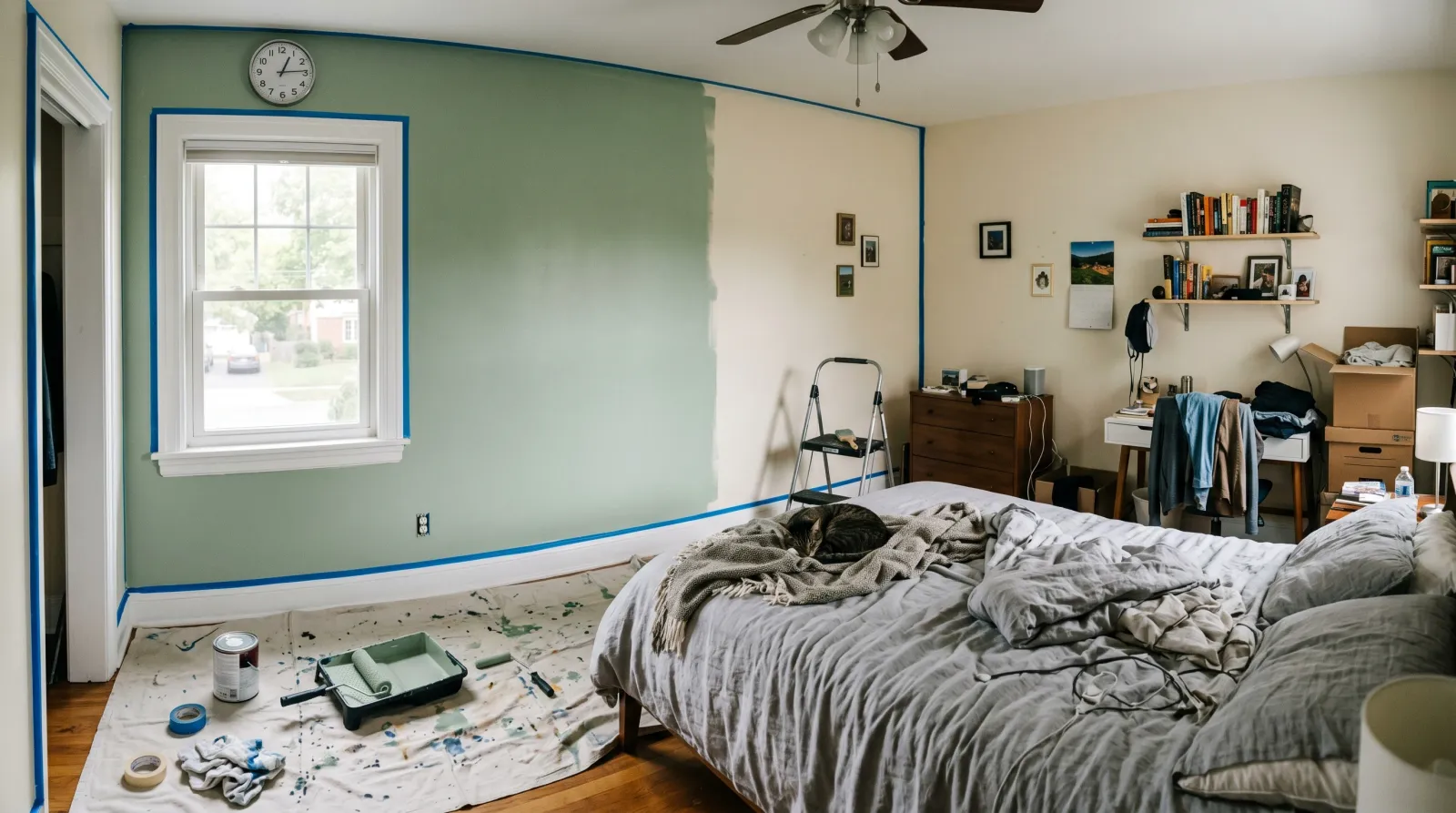
Okay, so you’ve decided to paint a room and the first thing you want to know is whether this eats your whole Saturday or just the morning. Honest answer: a standard 10-by-12 bedroom, walls only, runs about 5 to 7 hours of real work for one person. Add the ceiling and the trim and you’re looking at 9 to 12. The part that surprises everyone is how little of that is rolling paint. Most of your time goes to prep, taping off, cutting in the edges, and waiting for coat one to dry.
That waiting is the catch. The can says recoat in 2 to 4 hours, and you can’t skip it. So even a small room tends to spill into a long day or two short evenings, even though the actual painting is quick.
TL;DR
- Average bedroom (10x12), walls only: 5 to 7 hours of work for one person, usually one full day.
- Same room plus ceiling and trim: 9 to 12 hours, better split across two sessions.
- Dry time between coats: 2 to 4 hours for most water-based paint. This is waiting, not working.
- Two people: roughly 60 to 70 percent of the solo time, not half. The dry-time wait doesn’t shrink.
- Biggest time sinks: prep and taping off, then cutting in the edges by hand. Rolling is the fast part.
What Actually Takes the Time
Here’s the thing nobody tells you: rolling a wall is maybe 20 minutes of work per coat. It feels like the main event, but it’s the smallest piece. Let me break a walls-only bedroom into the real chunks.
| Task | Time (one person) | What it is |
|---|---|---|
| Prep (move furniture, drop cloths, patch, wipe walls) | 45–90 min | Clearing the room and fixing dings |
| Taping off | 30–45 min | Painter’s tape along trim, ceiling, outlets |
| Cutting in (coat 1) | 45–60 min | Brushing edges a roller can’t reach |
| Rolling walls (coat 1) | 20–30 min | The fast part |
| Dry time | 2–4 hours | Waiting, not working |
| Cutting in + rolling (coat 2) | 60–80 min | Faster the second time, you know the room |
| Cleanup | 30–45 min | Brushes, tray, pulling tape |
Cutting in is the term for brushing a clean line where the wall meets the ceiling, the trim, and the corners, because a fat roller can’t get into those spots. It’s slow and fiddly the first time. The trick is a decent angled brush and a steady hand, and it gets faster as you go.
If your walls are smooth and clean, prep is quick. If you’re patching nail holes, sanding glossy old paint, or washing a greasy kitchen wall, prep alone can swallow two hours. For more on getting a wall ready, the drywall painting guide walks through patching and priming.
How Long for Different Rooms
Room size matters less than what’s in the room. A big empty living room can paint faster than a small bathroom packed with fixtures, mirrors, and a toilet you have to cut around.
| Room | Walls only | Walls + ceiling + trim |
|---|---|---|
| Small bedroom / office (10x10) | 4–6 hrs | 8–10 hrs |
| Standard bedroom (10x12) | 5–7 hrs | 9–12 hrs |
| Living room (15x20) | 7–10 hrs | 13–16 hrs |
| Bathroom (5x8) | 4–6 hrs | 7–9 hrs |
| Kitchen (walls only, around cabinets) | 5–7 hrs | n/a |
A bathroom looks like it should be quick because it’s tiny. It isn’t. You’re cutting around a mirror, a vanity, a window, tile, and a toilet, and every one of those edges is slow handwork. Planning a bathroom? The bathroom painting project covers the moisture and sheen choices that come with it.
Why Dry Time Doubles the Calendar
The single biggest reason a “quick” room turns into an all-day job is the two-coat rule. Almost every color needs two coats to look even, and you have to wait between them.
Most water-based wall paint says recoat in 2 to 4 hours. That’s a minimum at ideal conditions: around 70°F and normal humidity. In a cold garage-bedroom in winter, or a humid bathroom with no fan, the paint stays cool and tacky longer and you wait more. Recoating too early is the most common rookie mistake, and it shows up as streaks, peeling, or roller marks pulling the wet first coat around.
Don’t worry about guessing. Touch the wall in a hidden corner. If it feels cool or sticky, it’s still letting go of water. Give it another hour. You’ll know it’s ready when it feels dry and room-temperature under your fingers.
This is also why two people doesn’t cut the time in half. Two of you can cut in and roll at the same time, which is great, but you both still stand around for the same 2 to 4 hours waiting on coat one.
How Long to Paint a Room With a Sprayer
A paint sprayer can lay down a coat in a fraction of roller time, so people assume it’s the shortcut. For a single furnished room, it usually isn’t. The masking takes longer than the spraying. You have to cover every surface you’re not painting, because overspray drifts everywhere, and that prep can eat an hour or more on top of normal taping.
Sprayers win on big empty rooms, whole houses, ceilings, and trim done off the wall. For one furnished bedroom, a brush and roller is often the faster total job. If you’re weighing it, the spray vs roll vs brush comparison lays out where each one actually saves time.
Common Mistakes That Add Hours
- Skipping prep to “save time.” Painting over dust, grease, or glossy old paint means the new coat won’t grip, and you redo it. Twenty minutes of wiping the walls saves a repaint.
- Buying too little paint and running out mid-wall. Stopping to drive to the store kills your momentum and leaves a visible dry edge. Figure your gallons first with the coverage and gallons guide.
- Recoating before the first coat is dry. It tears up the wet layer underneath. Wait the full window.
- Taping off at the very end when you’re tired. Tape goes on at the start, while you’re fresh and your line is steady. A rushed tape job bleeds.
- Pulling tape after the paint is fully dry. Pull it while the second coat is still slightly wet, at a low angle, so it doesn’t peel a strip of your fresh line off with it.
How to Actually Speed It Up
If you want the room done faster without it looking rushed, the wins are in planning, not in rolling harder.
- Tape and prep the night before. Then painting day is just paint and dry.
- Cut in and roll the same wall back-to-back, while the cut-in edge is still wet. That blends the brush and roller marks instead of leaving a frame around the wall.
- Use a good roller cover with the right nap for your wall texture, so one pass covers instead of two. Thicker walls need a thicker nap. The paint rollers guide explains which nap matches which surface.
- Pick a quality paint with real one-coat-ish coverage. A cheap paint that needs three coats is slower and more expensive than a good one that needs two.
What to Do if It Goes Sideways
If you run long, stop at a natural break, which is the end of a full coat on a full wall, never halfway across one. A wet edge that dries before you get back leaves a line you’ll see forever. Lay down a clean coat corner to corner, let it dry overnight, and finish the second coat fresh the next day. The paint doesn’t care that you split it across two days. It only cares that each coat went on even and dried fully.
And if the color looks patchy after two coats, that’s almost always coverage, not a mistake you made. A third thin coat fixes it. For the full start-to-finish walkthrough, see how to paint a whole room.
Ask a Question