What Are Paint Holidays? Finding the Spots You Missed
Paint holidays are the missed spots and bare patches in a finished film that hide in flat light and show under raking light. Here is the chemistry, the backlighting trick, the mil numbers behind them, and why they aren't flashing.

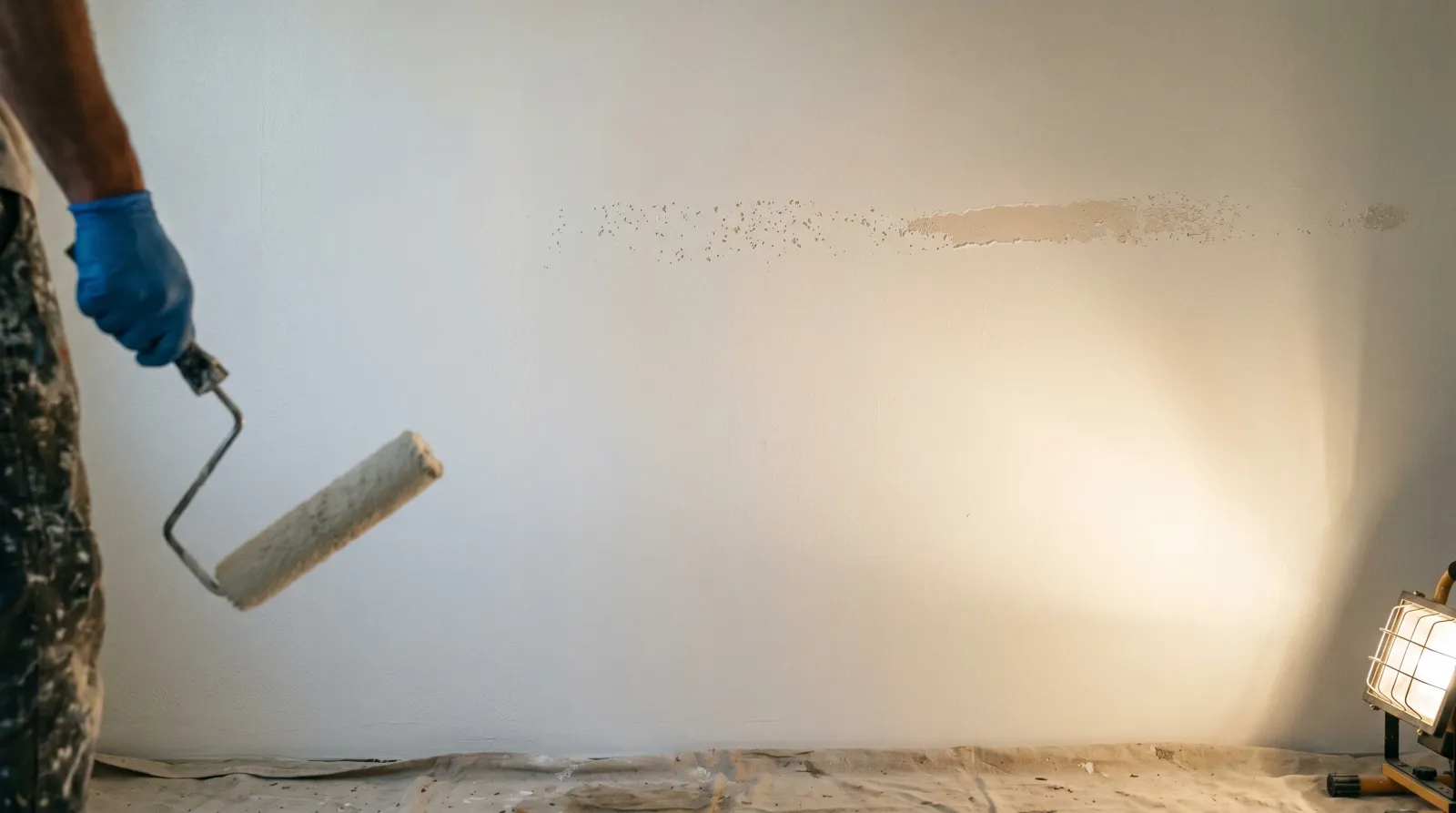
You finish a wall, the room reads fine under the ceiling fixture, then a side lamp goes on and a constellation of tiny lighter dots stares back at you near the baseboard. Those are holidays. The trade term is older than most painters working today, and it means exactly what it sounds like — places the roller went on vacation. Coverage looks complete in overhead light because the eye averages the sheen across the wall. The moment the light comes in at a low angle, the spots the film never landed on read brighter or duller than the topcoat around them, and you can count them.
The chemistry here is short, because there isn’t much chemistry to it. A holiday is not a film-formation problem the way flashing is. The substrate did nothing wrong. The binder did nothing wrong. The roller cover, working at a normal pace across a non-flat wall, simply skipped a patch — usually a divot from a drywall screw, a low spot near a corner, the edge of a cut-in line, or anywhere the nap of the roller bridged over instead of pressing into. The film thickness at that spot is zero, or close to it. The color you see is whatever was under the topcoat before you rolled.
Why You Only See Them Under Raking Light
Holidays hide in flat light for the same reason flashing hides in flat light: your eye averages reflectance across a few square inches and reports back a single tone. Drop a 9-foot floor lamp next to the wall and aim it parallel to the surface, and that averaging breaks down. Each thin spot or bare spot is now lit from the side, the surrounding film throws a micro-shadow around it, and the contrast jumps from invisible to obvious. This is the reason for that classic painter’s move where they walk a halogen work light along the baseboard at night and find every miss the morning crew left behind. The light isn’t revealing anything new. It is removing the averaging.
The angle matters more than the wattage. Below about 10 degrees off the wall plane, a 2-mil step in film height casts a shadow long enough for your eye to resolve at arm’s length. At 45 degrees the same step casts almost nothing. That is why a bright ceiling fixture directly above a wall is useless for inspection and a dim bulb sitting on the floor is excellent — and why the work lights painters actually buy are the ones with a low, movable stand rather than the big diffused panels that photographers like.
The other version of the trick is the backlight. If you can get a light source on the other side of the wall — a window during late afternoon, a hallway sconce, a bathroom sconce when the wall is between two rooms — the thin spots transmit a little more light than the field. A bare spot on a single coat over white primer will glow noticeably against the topcoat. This won’t work on every wall, but on partition walls and over older drywall it can find holidays that even raking light misses, especially the very thin ones where the roller laid down a fraction of a normal mil thickness rather than nothing at all.
The Word Comes From Industrial Coatings
The term didn’t start on drywall. In tank linings, pipeline coatings and structural steel, a holiday is a discontinuity in the film that exposes bare metal, and the industry does not go looking for it with a floor lamp — it goes looking with electricity. ASTM D5162, the standard practice for discontinuity testing of nonconductive coatings on metallic substrates, describes two methods. Below about 20 mils of total film thickness, a low-voltage wet sponge at roughly 9 to 90 volts DC is dragged across the coating, and any pinhole completes a circuit to the steel and triggers an alarm. Above 20 mils, a high-voltage spark tester at 900 to 20,000 volts is used instead, and the spark jumps wherever the film is missing.
That is worth knowing for one reason: it tells you how small a defect has to be before professionals stop trusting their eyes. The stakes differ enormously — a pinhole in a tank lining is a corrosion cell, a bare spot on a bedroom wall costs you nothing but the look — but the detection problem is identical. A continuous film and a film with a hole in it are almost impossible to tell apart in flat light, which is why every serious coatings discipline invented a special way of looking.
How Holidays Are Different From Flashing
Painters mix these up constantly, and the fix for one is wrong for the other.
| Holiday | Flashing | |
|---|---|---|
| What’s missing | Paint film itself | Nothing — film is continuous |
| Cause | Roller skipped, brush starved | Substrate porosity varied |
| Reveals under | Raking light, backlight | Raking light |
| Color shift | Different color showing through | Same color, different sheen |
| Fix | Re-roll the spots, in the wet pass if possible | Prime uniformly, then full topcoat |
The diagnostic test is whether you can see a color change or a sheen change. A holiday is a color event. The underlying primer or previous coat shows through. Flashing is a sheen event. The color is the same edge to edge; only the gloss reads different. For the long version on the sheen-side problem, the flashing explainer covers the film-formation chemistry in detail. Two more look-alikes are worth separating out while you’re at it: lap marks are darker overlap bands where a dried edge got re-rolled, and roller marks are raised stipple ridges. Both are too much paint. A holiday is too little.
Where Holidays Come From in Practice
Four places, in order of frequency:
- Cut-in to roller transitions. The roller doesn’t quite reach the brushed cut-in band, leaving a half-inch strip of thinner film right where the wall meets the ceiling. Walk that line under raking light an hour after the second coat and you’ll see it. Rolling as close into the brushed band as the frame allows is the whole point of good cut-in technique.
- Divots, screw heads, and low spots. A 9-mm nap roller bridges any depression smaller than the nap height. The dent stays bare, the field around it is fine, and you find the cluster only when the wall lights from the side. Nap length is the lever here — see how roller naps are chosen for the match between nap and surface texture.
- A starved roller at the end of a pass. The last 18 inches before reloading are always thinner than the first 18. On a darker color over a paler primer, that ending stretch is where the holidays cluster.
- Spraying without back-rolling. The fan pattern under-builds at inside corners and wherever the overlap dropped below 50 percent. Nothing looks missed on the day, and the film comes in at half spec. That trade-off is the main practical difference in rolling versus spraying.
Back-rolling solves the second, third and fourth versions almost entirely. The technique exists exactly so a primed or freshly sprayed surface gets a uniform pressed-in pass that fills divots and equalizes film thickness — see the back-rolling explainer for what it actually does at the binder level.
The Numbers Behind a Holiday
A holiday is a film thickness of roughly zero sitting inside a field of normal film. Knowing what “normal” is makes the whole problem quantitative rather than a matter of squinting.
| Measure | Typical interior wall paint |
|---|---|
| Wet film off the roller | 4 to 6 mils |
| Dry film per coat | 1.5 to 2 mils |
| Two-coat system, cured | about 4 mils, roughly one sheet of copy paper |
| Volume solids | 30 percent builder grade, 41 to 48 percent premium |
| Coverage on the can | 350 to 400 sq ft per gallon |
The coverage figure is not marketing. Theoretical coverage in square feet per gallon equals 1,604 multiplied by volume solids, where 1,604 is the number of square feet one gallon covers at a thickness of one mil. A 40 percent solids paint therefore has a theoretical ceiling of about 640 sq ft per gallon at 1 mil dry, and the can prints 350 to 400 because real application targets closer to 1.6 dry mils and real walls lose material to the tray, the nap and the texture.
Here is where holidays become predictable. Stretch one gallon across 500 square feet instead of 375, and you have cut the wet film from about 5 mils to about 3.7. The average film is still continuous, but the low points of the wall are now below the threshold where the nap can bridge them with paint, so the number of bare spots rises sharply rather than gradually. Holidays are usually not carelessness. They are the visible symptom of under-application, which is why working out gallons honestly before you start prevents more of them than any technique does. The full picture on film thickness lives in what a mil actually is, and the coalescence step that turns wet film into cured film is covered in how a paint film forms.
What This Means When You Buy Paint
Three things on a can change your holiday count before you open it.
Volume solids. More solids means more film left behind per pass, so the same roller stroke has more margin before a low spot reads bare. Published figures run from under 30 percent on builder-grade flats to around 41 percent for Sherwin-Williams Emerald Interior Matte, near 48 percent for Benjamin Moore Aura, and comparable premium numbers for Behr Marquee and Valspar Reserve. It is the most comparable single number on any technical data sheet, and it explains why a cheap gallon that costs half as much often needs a third coat that erases the saving. Our tested picks are in best wall paints.
Hide, meaning contrast ratio. A paint that hides in one coat turns a thin spot into a barely visible spot rather than a bare one. Hide comes from titanium dioxide loading and from how well the binder disperses it, and it is the reason a deep base color — which carries less white pigment by design — shows holidays that the same brand’s pastel would have swallowed.
A tinted primer. If the primer under the topcoat is tinted to roughly the topcoat’s value, a holiday still exists but its contrast drops to almost nothing. This is the cheapest insurance on the whole job and it costs one line on the paint store order. See primers worth buying for the picks, and what primer actually does for the mechanism.
And one thing that is not a paint decision at all: sheen. Flat and matte finishes scatter light in all directions and genuinely hide small holidays better than satin or semi-gloss, which return a specular highlight that a bare spot interrupts. If a wall is badly out of plane and you know your roller will bridge things, the lower sheen is doing real work, not just looking softer.
Common Mistakes
- Touching up dry holidays with a small brush. You leave a brushed patch with its own sheen and now you have a holiday-shaped flashing mark instead of a holiday. Re-roll the area with a mini roller and feather it in while the surrounding film is still wet enough to blend, or accept the second-coat option.
- Skipping the raking-light walkthrough. The drywaller’s halogen on the floor takes ninety seconds and finds everything the morning light hid. People skip this on residential repaints constantly and then get the callback two weeks later when the homeowner sets up a reading lamp.
- Calling thin spots holidays. A spot where the film is half thickness is a starvation, not a holiday. The fix is identical (re-roll), but the diagnosis matters for the next wall — starvation means your loaded roller is running dry too soon and you need to reload more often.
- Waiting for full cure before inspecting. Latex is touch dry in an hour and still moving for weeks. Inspect while the film is open, not after. The distinction between the two clocks is in dry time versus cure time, and the open window is the only period in which a repair is genuinely invisible.
The Practical Takeaway
Light the wall sideways before you call the job done. One work light on the floor, room lights out, walk the room. Mark holidays with a low-tack tape flag, then re-roll while the topcoat is still in its open time — usually 20 to 40 minutes for interior latex at normal temperature and humidity — so the touch-ups disappear into the field. If you missed the open time, roll the affected wall corner to corner rather than patching it; small brushed patches will telegraph through every side-lit hour the room ever sees. And if you’re finding holidays in clusters rather than singly, the honest diagnosis is usually not your technique. It is that the gallon was stretched too far, and the wall is telling you so one bare spot at a time.
Ask a Question