How to Paint Oak — Filling the Open Grain
Oak's open grain telegraphs through paint within a coat. Three finishes, three systems — leave the grain, fill it partway, or skim to glass. Plus the tannin block.

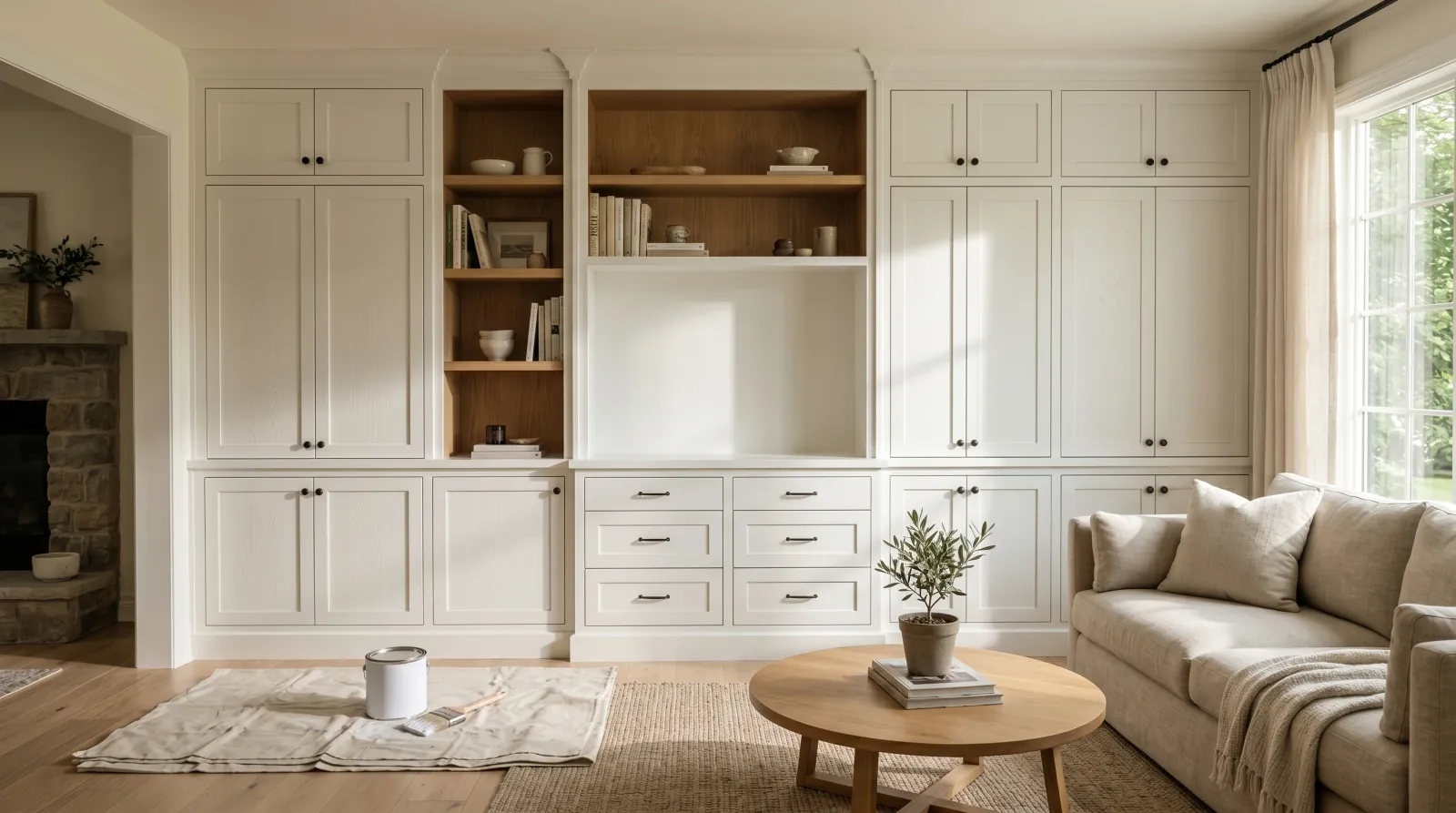
Oak takes paint. The question is whether you want oak to look like oak after, or whether you want the grain to vanish. Those are two different jobs, and the can you buy is the smaller decision.
TL;DR
- Clean: TSP wipe, fully dry
- Prep: fill nails, caulk, sand 120 then 220 with the grain
- Tannin block: Zinsser BIN over the whole surface, every time
- Grain treatment: leave it, fill it (Aqua Coat × 1–2 passes), or skim it (Aqua Coat × 3+ passes plus block-sand)
- Paint: waterborne urethane trim enamel, two coats
- Cure: 14 days before normal kitchen use
What Makes Oak Different
Oak is a ring-porous hardwood. The growth-ring vessels are wide, open, and run the length of the board like a million tiny straws. Stained, that’s the look people pay for. Painted, those pores are a problem you have to decide what to do with.
Two specific things bite you on oak.
Open grain telegraphs through paint. Roll one coat of latex on bare oak and you can still count every pore in raking light. Two coats, three coats, semi-gloss enamel — the pattern stays. The paint sits on the surface and dips into the pores. You can hide the grain only by filling the pores first, or by accepting that painted oak reads as painted oak.
Tannin bleeds under white. Oak is loaded with tannic acid. Waterborne primers and latex paints don’t block it. The tannin migrates up through the film and stains the surface yellow, pink, or brown along the grain lines. It’s worst on whites and pale greys and shows up within a week of paint going on, sometimes within hours. Shellac stops it. Almost nothing else does reliably.
The job’s not hard. The job is picking which finish you want and committing to the prep that gets you there.
The Three Finishes
Decide before you open a can. Each path is a different number of weekends.
Path A — leave the grain visible. The cottage look. The farmhouse look. Painted oak that still reads as oak. Sand, BIN, two coats. One weekend.
Path B — fill the grain partway. Most cabinet repaints land here. The pores recede but aren’t invisible. Up close you see them, from across the room you don’t. Sand, one or two passes of Aqua Coat, BIN, two coats. One long weekend or a weekend plus an evening.
Path C — full glass-smooth. Skim coat the grain like you’d skim coat drywall. Three or more passes of grain filler with block-sanding between, BIN, two coats of enamel. Two weekends, plus patience. This is the cabinet-magazine finish.
The picks for the topcoat on any of the three paths live in the kitchen cabinet paint round-up. The differences below are in the prep, not the can.
Step 1: Clean
Oak cabinets that have lived in a kitchen are coated in cooking film. You can’t see it; degreaser shows it instantly. Wipe everything down with a TSP solution or TSP substitute. Rinse with clean water on a damp rag. Let it dry overnight.
For new bare oak — trim, raw cabinet boxes, an unfinished board — just a tack cloth and a vacuum. New oak isn’t dirty so much as dusty.
Step 2: Fill, Caulk, Sand
Fill nail holes, screw recesses, and any damage with paintable latex wood filler. Two passes — overfill first, sand flat, fill the lows. Caulk the wall-to-trim joint and any open seams between face frames and end panels with paintable acrylic. Wet finger to smooth.
Sand in two passes. 120-grit to flatten filler and break the existing finish. 220-grit second to refine. Always with the grain. Oak is hard, so you can lean on the sponge harder than you’d lean on pine without rounding the edges, but ease off at the profile edges of a cabinet door — the bevel reads sharp from across the room and rounds off fast.
Vacuum everything. Tack-cloth pass after. The open grain holds dust the way a sponge holds water; you’ll see every speck under your topcoat if you skip the vacuum.
A safety note worth its own line. Pre-1978 oak trim in an older house can carry lead in the existing finish. Test before you sand. The RRP rule applies to anyone disturbing it for hire and the dust is dangerous either way. Wet-sand or strip chemically if the test is positive.
Step 3: Decide the Grain Path
Stop here and look at the wood. Cabinet doors, trim, a tabletop — they don’t all want the same finish.
For Path A (leave the grain visible), skip straight to Step 4. For Path B and C, this is the grain-filling step.
Path B — one or two passes of Aqua Coat. Squeegee Aqua Coat across the surface diagonally to the grain with a plastic spreader or a 3-inch flexible putty knife. Pack it into the pores. Wipe excess off the surface with the same spreader, perpendicular to the first pass. Let it dry two hours. Sand lightly with 220 to knock down the surface, vacuum, tack. If the pores still read deep, do it again.
Path C — three or more passes plus block-sanding. Same technique, more rounds. Between each pass, block-sand flat with 220 on a hard backer. The block matters. You’re knocking the high spots down to meet the level of the filled pores. A floppy sponge follows the grain back into the pores and wastes your work. Three passes is the minimum for glass; some pieces want four.
DuraFil is the alkyd alternative if you want a single thicker pass instead of two thin ones. It builds higher per coat but waits longer to recoat (8 hours vs 2) and smells stronger. For one cabinet refinish I’ll use DuraFil; for a whole kitchen of doors I want the Aqua Coat workflow and the two-hour turnaround.
Step 4: BIN, Always BIN
This is the step that holds the job together on every oak path. Zinsser BIN shellac primer, one full coat over the surface — filled, partially filled, or bare. The shellac locks the tannin in and gives the topcoat a smooth bite.
Foam roller the flats, brush the profile with a 2-inch angled sash. Don’t overwork it. BIN levels fast and dries in 45 minutes. The smell is sharp — alcohol carrier flashing off — so open a window and run a fan.
Substitute Cover Stain alkyd only if you can’t ventilate. Cover Stain blocks tannin pretty well, but BIN blocks it better and you can recoat in under an hour. On oak the marginal cost of using shellac is worth it.
If the grain raised after the BIN dried (and it sometimes does on bare oak), hit it with 220 lightly, vacuum, tack. One pass is enough.
Generic latex primers and “self-priming” paint claims do not block oak tannin. I see this every spring on white-painted oak baseboards in old houses where someone shortcut the primer call — yellow ghost flecks following the grain lines, six months in. Repainting over it without the BIN step gets you the same result on a faster clock.
For the no-sand workflow (Stix-based, no full sand), the same tannin-block rule applies — see the no-sand cabinet round-up for the variant primer system.
Step 5: Two Coats of Waterborne Urethane
Benjamin Moore Advance or Sherwin-Williams Emerald Urethane. Either one. Both level like sprayed lacquer under a quality brush and harden enough to take kitchen abuse a year in.
Two coats. Always two. Sixteen hours between on Advance, four on Emerald Urethane. Foam-roller the flats, brush the profile with a 2.5-inch angled sash, keep a wet edge across each door. Don’t stop in the middle of a long run of trim. That’s how you get lap marks, and lap marks show the second a sconce throws raking light across the surface.
Sheen for cabinets and trim: satin or semi-gloss. Wipes clean, hides shop dust nibs better than gloss, reads warm under kitchen LEDs. Eggshell on oak panel walls or wainscot where touch is minimal. Matte on oak is a refinishing trap; the open grain plus a low-sheen finish reads gritty in raking light.
For the SKU comparison on the topcoat see the kitchen cabinet paint round-up and, for trim specifically, the interior trim paint picks.
Common Failures on Oak
- Skipping the BIN on bare oak. Result: yellow or pink ghost flecks following the grain, usually within a month on whites. Fix: sand, BIN, repaint.
- Latex primer instead of shellac. Same result, slower onset. Same fix.
- One pass of grain filler when you wanted glass. Result: pores still read deep, finish looks unfinished. Fix: scuff-sand, fill again, BIN, repaint.
- Sponge-sanding instead of block-sanding the filled surface. Result: a hilly finish that’s not actually flat. Fix: re-block, prime, repaint.
- One coat of topcoat. Result: primer ghosts through, color reads thin, edges look dragged. Two coats fixes it; doing two the first time saves you a Saturday.
- Cleaning the painted oak with a Magic Eraser inside thirty days. Result: burnished dull spots in the cured film that don’t blend back. Use a damp cloth, period.
Maintenance and Longevity
Oak painted with this system holds 8–12 years on cabinets in a working kitchen, 12–18 on trim and wainscot, 6–10 on a frequently-used tabletop. The first failure point is always the cabinet door edge near the pull, where hand oil and pinch contact wear the film. Touch up annually from a saved quart. If a yellow ghost line appears along the grain after years (rare with a BIN base, but it happens on edges that got missed), scuff it, dab fresh BIN, touch up the topcoat from the same can.
What’ll Bite You in Two Years
Skip the shellac on tannin and you’ll see yellow grain ghosts within the first season — sooner on whites in sun. Skip the grain filler when you wanted glass and you’ll see every pore the day the cabinets go back on the wall, and you’ll see them every day after. Use one coat of finish instead of two and the primer ghosts through every place the brush worked thin. Oak is honest. Whatever you skipped, oak shows it the moment the light’s right.
Three paths. Pick one before you open the can. BIN under whichever one you pick. Two coats of urethane over the BIN. That’s the system. It works on every oak cabinet, baseboard, and built-in I’ve put a brush to.
Ask a Question