How to Seal Pet-Urine Odor Before Painting
Enzyme-clean the source, replace the porous layers urine soaked into, then seal the substrate with shellac primer. Why paint cover pet urine fails without the prep underneath.

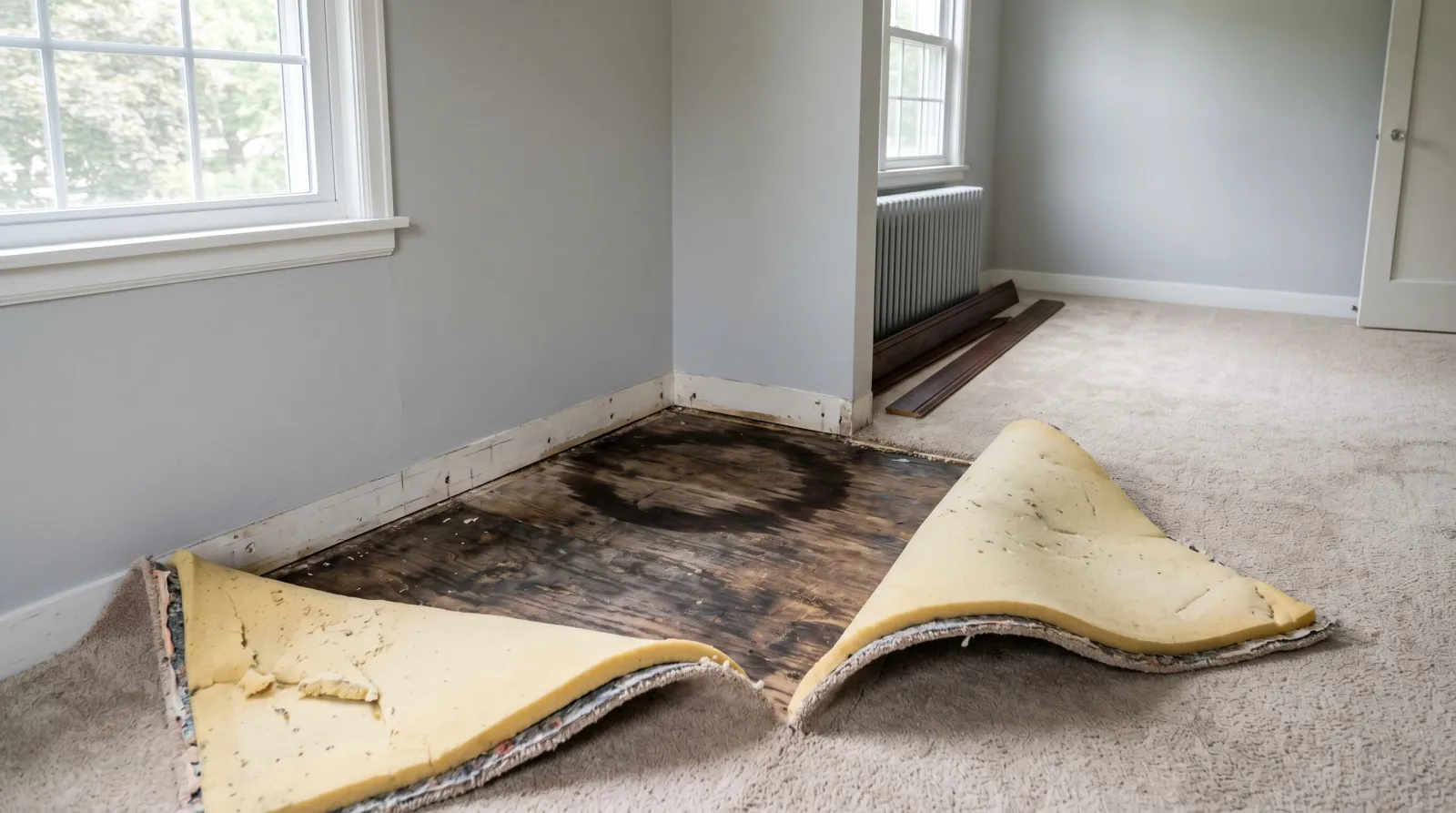
Pet urine isn’t a surface problem. It soaks into the carpet, the pad under it, the subfloor below that, the bottom of the baseboard, and the drywall behind it. Five layers deep on a bad spot. Paint the wall a dozen times and the smell still comes back the first humid week of summer, because the layer you can’t see is still wet with uric acid crystals. Pull the layers apart, treat what you keep, replace what you can’t save, seal the substrate with shellac. Anything short of that is masking.
Does This Match What You’re Seeing?
Confirm before you start ripping things up.
- Sharp ammonia hit when the room warms or gets humid: classic cured-urine off-gassing. Most common version.
- Dark stain on the subfloor at a corner, baseboard discolored at the bottom: dog or cat marked the wall, not just the floor.
- Yellow ring at the front of an interior door below knob height: a small dog marked the frame. The MDF or pine has wicked it up an inch or two.
- Whole-room sour smell with no visible stain: carpet pad is saturated under a stretch you can’t see. Pull a corner.
- Smell only at the HVAC return: urine in the duct boot. That’s a duct cleaning question, not a paint question.
If you’re buying a house with this problem, get the carpet up before close. The seller’s “deep cleaning” did nothing for what’s under the pad.
How Serious Is This?
Three tiers.
- Surface only, no soaked pad. Same-day fix. Enzyme-treat, dry, repaint any wall component.
- Soaked through to pad and subfloor, one spot. Weekend job. Cut the carpet section, replace the pad, treat the subfloor, prime, repaint baseboard and lower wall.
- Multiple rooms, years of accumulation, soaked stud bays. This is a tear-out, not a paint fix. Pull the carpet entirely, cut affected subfloor sections, replace what’s saturated, prime everything that stays.
Why This Is Happening (root Cause)
Fresh urine is mostly water with urea, salts, and creatinine. The water evaporates and the rest stays behind as crystals. Uric acid is the difficult one. It’s not water-soluble, which is why mopping doesn’t remove it. You spread it around, the water leaves, the crystals stay. Every time humidity rises, the crystals release ammonia gas. Dogs and cats read it the same way, which is why they re-mark spots that smell “claimed” to them.
Painting over it without treatment doesn’t help because most primer films breathe. Latex primer is designed to breathe so the wall can release moisture, and that same breathing lets ammonia compounds pass back through. Oil does better. Shellac is the one that actually seals. Alcohol-borne, dries to a non-porous film, locks down volatile compounds the way nothing else in a hardware store does. Every restoration contractor on a fire or smoke job reaches for Zinsser BIN. Urine off-gassing is the same problem in a smaller package.
The other half is mechanical. If the pad is saturated, that reservoir sits against the subfloor releasing ammonia for years. No primer on the wall fixes that. Remove the soaked porous material or you’re wasting your time.
The Fix
Step 1. Find Every Source
Walk the room with a UV blacklight after dark. Urine fluoresces yellow-green. Mark every spot with tape. Check the baseboards an inch up, the corners where carpet meets wall, the back of doors at dog height. The spots you miss are the ones that bring the smell back.
Step 2. Pull the Carpet and Pad Back
Roll the carpet back from the affected corner. Inspect the pad. Saturated pad is dark and smells when you bring your face close. Cut the affected section out with a utility knife, plus 6 inches of margin in every direction. Bag it and get it out of the house today. Pad is cheap. Don’t try to save it. If the carpet itself is saturated, the carpet is gone too.
Step 3. Enzyme-Treat the Substrate
This is where most DIY jobs fall apart. Use a true enzyme cleaner, not a deodorizer.
- Nature’s Miracle Advanced Stain and Odor Eliminator. Drugstore standby. Saturate the spot, same volume the dog put down, minimum.
- Rocco and Roxie Professional Strength Stain and Odor Eliminator. Stronger formulation, better for older or layered spots.
Pour it on. Don’t spray a mist and expect it to work. The enzymes are biological. They need contact time with the crystals at the same depth the urine reached. Cover with plastic to slow evaporation, dwell 24 hours.
Safety and Chemical Interactions
Never mix bleach with urine cleaners, ammonia products, or hydrogen peroxide. Cured urine already contains ammonia compounds. Adding bleach produces chloramine gas. Mask up (N95 minimum), ventilate hard, gloves and eye protection through every wet step.
Step 4. Dry Out Completely
Fan on the treated area for 48 to 72 hours. A dehumidifier helps. The substrate has to be bone dry before primer goes on, or the primer breaks bond and lifts. If the subfloor is plywood and feels soft when you press on it, that section is delaminated. Cut it out and patch with new plywood. A pinless moisture meter under 12% on the subfloor is the pro answer.
Step 5. Pull the Baseboard if the Wall Is Involved
If urine ran down the wall or splashed up at the bottom, the baseboard has wicked it and the drywall behind it has too. Pry the baseboard off. Inspect the bottom 4 inches of drywall. Dark, soft, or smelling, cut that section out and patch in fresh drywall. Cleaning soaked drywall is a fool’s errand. The gypsum core holds the compounds and re-releases them.
MDF baseboard that’s swollen at the bottom is replaced. MDF doesn’t recover.
Step 6. Shellac-Prime the Substrate
Zinsser B-I-N Shellac-Base Primer brushed or rolled across every surface that was contaminated and is staying. Subfloor, lower drywall, back of saved baseboard, framing inside any wall cavity you opened. One coat on smooth substrate, two on porous wood. Dries in 45 minutes, recoat in 60.
Zinsser Odor Killing Primer is the water-based version. More pleasant to apply, doesn’t seal quite as completely. Use it on lower wall where the smell is mild; use BIN where it’s heavy. Cleanup is denatured alcohol for BIN. Wear a respirator with organic-vapor cartridges, not just an N95. The fume is rough.
Step 7. Replace the Pad, Repaint the Wall
Drop in fresh pad cut to the patch, tape the seams, re-stretch the carpet section or install a new piece. A carpet installer does this in an hour for under $200 in most markets. A bad seam shows. Call one if you’ve never stretched carpet.
Two coats of wall paint across the affected wall, edge to edge. Don’t spot-paint over the shellac patch. Shellac levels differently than latex topcoat, and you’ll see a halo where the BIN bled past the patch line. Cut in the corners first, roll while the cut-in is still wet, don’t stop mid-wall. Reinstall the baseboard last.
For a bathroom or laundry where humidity stays high, a satin like Zinsser Perma-White on the lower wall buys extra moisture resistance. See the best bathroom paint round-up.
Common Mistakes
- Spraying enzyme cleaner instead of saturating. The enzymes have to reach the crystals. A mist sits on top.
- Using a latex stain-blocker over cured urine. Latex breathes. Smell back in a week.
- Skipping pad replacement because the carpet looks clean. The reservoir is under the carpet, not in it.
- Bleaching first. Damages the substrate and produces chloramine gas with cured urine.
- Spot-priming the wall and topcoating only the patch. Halo flashes through. Topcoat the whole wall.
Prevention
You can’t paint your way out of a pet that’s still marking. Two non-paint fixes that matter:
- Re-train the spot. Block access for a week after sealing, reintroduce supervised. If marking resumes, it’s behavior or medical (UTI, anxiety, new pet in the house). A vet visit beats another paint job.
- Pet-proof the high-risk surfaces. Vinyl plank with a sealed perimeter is harder to soak than carpet on pad on plywood. If you’ve done this twice, the next renovation pulls the carpet for good.
Senior pet with accidents you can’t stop, washable area rugs over a sealed hard floor is the realistic plan. Carpet plus pad plus subfloor is a system that holds urine indefinitely.
When to Call a Pro
- Smell throughout the house with no single source after a blacklight sweep. Needs a restoration company.
- Subfloor soft or sagging. Structural damage, not a paint problem.
- Stud bays smell when you open the baseboard. Framing is contaminated.
- Pre-1978 home with peeling paint near the work. Lead test first.
- Cat urine in an HVAC duct. Duct cleaning, not paint.
- Repeat failures. Fire and biohazard restoration crews have ozone and hydroxyl generators you don’t.
What’ll Bite You in Two Years
The job that fails is the one where someone shampooed the carpet and primed the baseboard and called it done. The pad is still soaked. The subfloor is still soaked. Smell comes back the first humid week of June and by August they’re calling me to redo the same wall they already paid to repaint. Pull the porous layers. Replace what’s saturated. Shellac what stays. No version of this fix skips the under-layer work and holds.
Ask a Question