Limewash vs Mineral Paint: What's the Difference?
Limewash penetrates masonry with slaked lime. Mineral paint fuses with silicate. Both breathe. Pick by substrate, climate, and how long you want it to last.

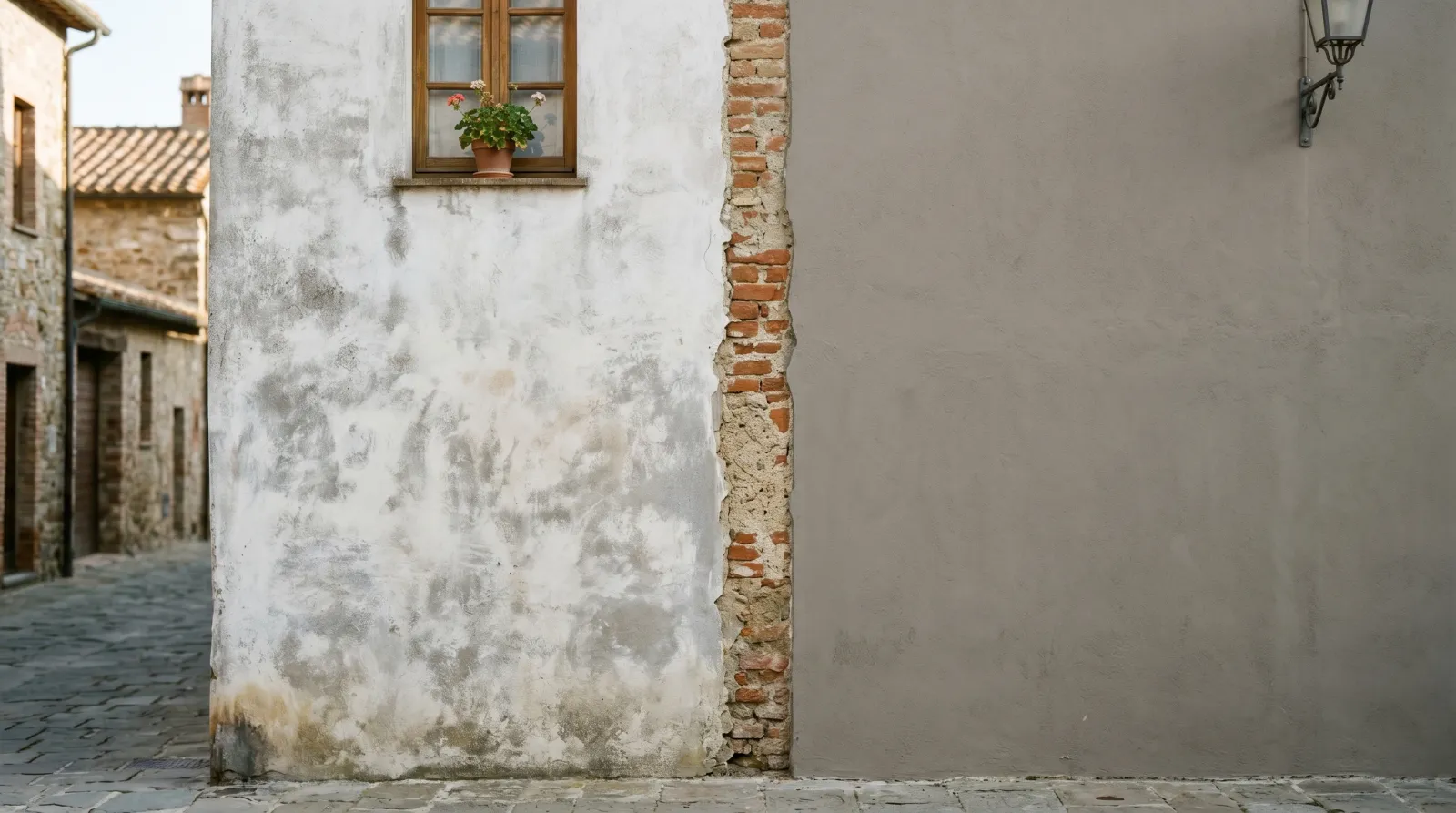
The 30-Second Answer
Limewash is slaked lime, water, and pigment. It soaks into porous masonry and carbonates into the wall itself. Cloudy, weathered, refreshes every few years. Mineral paint is potassium silicate that chemically fuses with mineral substrates and lasts 15–20 years. Pick limewash for old brick, lime plaster, and the historic look. Pick mineral paint for modern stucco, cement board, and color you want to hold for a decade-plus.
At a Glance
| Limewash | Mineral paint | |
|---|---|---|
| Binder | Slaked lime (calcium hydroxide) | Potassium silicate (water glass) |
| Bonds by | Carbonation — turns back to limestone | Silicification — chemical fusion with substrate |
| Substrate | Old brick, lime plaster, raw stone | Modern stucco, cement, cured lime, fiber cement |
| Breathability | ✓✓ (porous lime) | ✓✓ (microcrystalline matrix) |
| Lifespan outside | 2–7 years | 15–20 years |
| Look | Cloudy, mottled, brushy | Flat, uniform, matte |
| Cost per gallon | $40–80 | $80–140 |
How to Tell Which You’ve Got
If a wall is already coated, scratch a hidden spot with a fingernail. Limewash powders off easily — you’ll see white dust on the nail. Mineral paint doesn’t move. For a deeper check, dab a wet rag on the wall. Limewash darkens and softens as it rewets. Mineral paint stays put because it’s chemically part of the substrate now, not a film sitting on top.
Acrylic gives both away. If you can peel a sheet off anywhere, it’s an acrylic masonry paint and neither of these is a like-for-like overcoat.
Substrate Bond
Limewash works by soaking in. The slaked lime penetrates a porous wall, reacts with CO2 in the air, and turns back into limestone — that’s carbonation. The wall basically grows a thin layer of new stone. It only works if the substrate is mineral and porous enough to absorb the lime water. Old soft brick, lime plaster, cob, raw stone — perfect. Sealed brick, modern Portland stucco, cement board — limewash sits on top and washes off.
Mineral paint binds differently. Potassium silicate reacts with the silica in the substrate to form a silicate crystal network. The paint and the wall become one continuous mineral structure. It needs a mineral surface to silicify against, but it doesn’t need the porosity of raw lime — it’ll bond to modern stucco, fiber cement, sound mineral render, and cured lime.
Winner: Mineral paint on broader substrate range. Limewash wins on porous historic walls specifically.
Breathability
Both genuinely breathe. That’s the whole point of either over acrylic.
Limewash is porous lime. Water vapor moves through it like it isn’t there. SD value (vapor diffusion thickness) is essentially negligible — under 0.01 m. Mineral paint runs 0.02–0.05 m, which is still extremely vapor-open by paint standards. Acrylic masonry paints run 0.5–2.0 m. That’s the difference between a wall that can dry out after a storm and one that traps moisture under a plastic skin.
If you have an old solid-wall building — pre-1920s brick, stone, cob — vapor-tight paint is what spalls bricks and rots the inside of your walls. Both of these are safe choices. Acrylic isn’t.
Winner: Tie. Both vapor-open enough that the difference is academic.
Durability
Limewash erodes. That’s not a bug. The first coat fades to a soft mottled finish within a year, the look most people are buying it for. You re-coat every 3–7 years on a wall that sees weather. South and west elevations get hit harder. Sheltered north walls hold longer. Cost-per-coat is low; cost-over-decades is more refresh labor than a single mineral paint job.
Mineral paint doesn’t peel. The silicate bond means there’s no film to lift off — if it fails it erodes with the substrate, and that takes 15–20 years of sun and rain. Keim has documented mineral coatings still intact on European buildings past 70 years. The catch: a poor first coat over a chalky or unprimed substrate burns into the wall and gives you a blotchy finish you can’t easily recover from. Prep matters more than with limewash.
Winner: Mineral paint on raw years held. Limewash by design isn’t trying to compete here.
Appearance
Limewash looks like nothing else. Cloudy, mottled, with visible brushwork that lightens as it dries and carbonates. The pigment load is low, so colors stay soft and chalky. Whites, off-whites, ochres, burnt sienna, dusty pinks — anything in the natural pigment palette. Strong saturated colors don’t really exist in true limewash because the lime won’t carry that much pigment.
Mineral paint is flat, uniform, and matte. Modern formulas (Keim, Beeck) carry a wider pigment palette than limewash including stronger reds, blues, and greens — still mineral pigments, but a real color range. The finish reads more like a high-quality flat masonry paint than the brushy lime look. Some people read that as “less character.” Other people read it as “I want my wall to look like a wall, not a watercolor.”
Winner: Depends on what you want. Limewash for the historic, weathered, hand-applied look. Mineral paint for clean flat color that stays clean.
Cost & Coverage
Limewash runs $40–80 per gallon at the brand level (Bauwerk, Pure & Original, Romabio Classico). Coverage is 200–300 sq ft per gallon per coat, and you need 2–3 coats. So a 1,000 sq ft wall in three coats eats roughly 4 gallons. Material cost: $160–320 for the job. Refresh every 3–7 years.
Mineral paint runs $80–140 per gallon (Keim Soldalit, Beeck Maxil-Pro, Romabio Mineral Shield). Coverage is 150–250 sq ft per gallon per coat at two coats. Same 1,000 sq ft wall: 8–10 gallons, $640–1,400 in material. Higher upfront, but no refresh for 15–20 years.
Per-decade cost works out close. Per-job cash flow looks very different.
Winner: Tie. Limewash if you’d rather spread the spend over decades. Mineral if you want one job done.
What Each One Is Actually Good At
Limewash is a paint, but it’s also a finish system. The look is the point. People buy it because the wall develops character — soft cloudy variations, warm patina at the high spots, a gradual softening of color over years. If you paint a 1740 farmhouse in modern stucco-grade mineral paint, the building reads new. If you limewash it, it reads old in the right way.
Mineral paint is a paint, full stop. It’s solving the breathability problem on modern mineral substrates where the only other option is a vapor-trapping acrylic film. It’s the right choice for cementitious siding, modern lime renders that are fully carbonated, and any stucco wall built after about 1950. The look is uniform and clean, not historic.
The brand landscape splits along the same lines. Limewash brands (Bauwerk, Pure & Original, Romabio Classico) lean heritage and DIY. Mineral paint brands (Keim, Beeck, Sto, Romabio Mineral Shield) lean architectural and pro-applied.
Verdict by Use Case
- Pick limewash if: old soft brick (pre-1920), lime plaster, lime render, cob, raw stone, or any historic building where the wall has to keep breathing AND a cloudy weathered look is what you want. Also pick it for interior accent walls in modern homes where the limewash look is decorative — interior limewash holds longer than exterior because it never gets weathered.
- Pick mineral paint if: modern stucco, fiber cement (Hardie, Allura), cementitious render, cured-and-carbonated lime that’s at least a year old, or any masonry wall where you want 15–20 year color hold without the refresh cycle. Right answer for most exteriors built after 1950.
- It’s a tie when: you’re recoating a building that already has limewash and the budget supports converting to mineral. The existing lime is fine substrate for mineral paint once it’s sound. You buy 15 years of life on the wall and you’re done.
Top Picks by Side
Going with limewash? See the best limewash brands round-up for Bauwerk, Pure & Original, Romabio, and the rest.
Going with mineral paint? See the best masonry paint round-up for Keim, Beeck, and the modern silicate field.
Substrate questions? See the exterior brick painting guide for prep and the stucco guide for cementitious walls.
Related
What’ll bite you in two years: acrylic masonry paint over a solid-wall historic building. Limewash and mineral paint both let the wall breathe. Acrylic doesn’t, and you’ll see spalling brick and damp inside by year three. Pick one of these two and prep the substrate right.