Stair Anti-Slip Coatings: OSHA Specifier's Guide (2026)
Stair anti slip paint specified by DFT, slip resistance, and substrate. OSHA 1910.25 COF targets, aggregate grit systems, and the contractor path that passes a wet-test audit.

Disclosure: Affiliate links to retailers and manufacturer-direct programs. Recommendations are spec-driven, not commission-driven.
Use Case
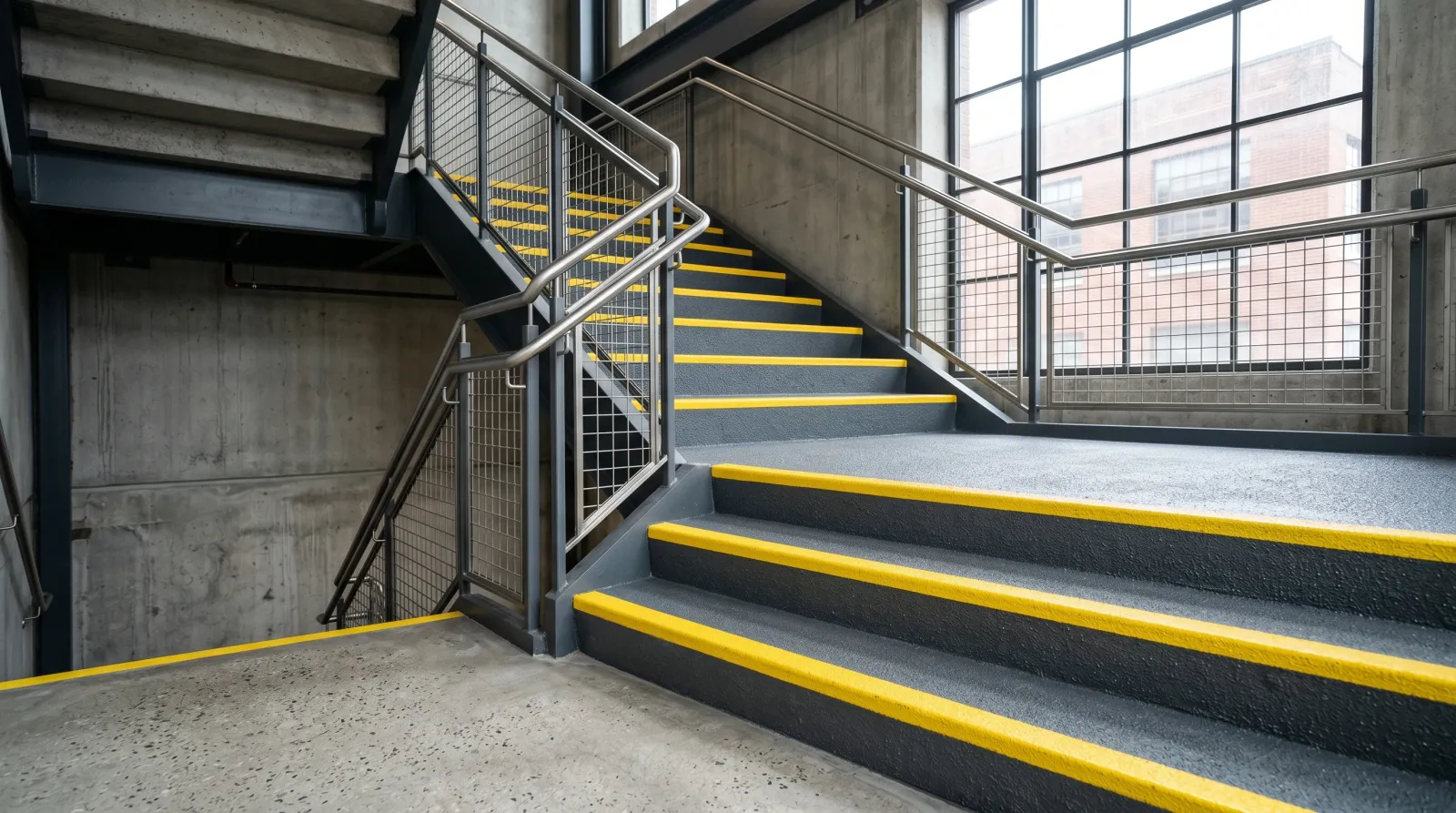
A stair anti-slip coating has one job the rest of a floor system never faces: it has to hold a wet shoe sole at the worst possible geometry, the nosing edge, where the user’s full weight lands on a 1-inch strip during descent. Specified across commercial stairwells, exterior steel fire escapes, loading-dock steps, transit and stadium stairs, parking-structure stairwells, food-plant access stairs, and ADA-required egress routes. The asset is small in square footage and large in liability. A slip-and-fall on a stair tread is among the most-litigated premises claims a property manager faces, and the discovery process will ask for the slip-resistance spec and the test record.
Service life splits by exposure. An interior office stairwell with an aggregated epoxy system runs 5–8 years before the grit polishes below target. Exterior steel stairs under UV, freeze-thaw, and de-icing salt run 2–4 years on the nosing, longer in the field of the tread. The wear is never uniform. Foot traffic concentrates on the leading 2 inches of each tread, so the nosing loses its slip profile years before the back of the step does. The spec writer plans for that: a heavier aggregate build at the nosing, or a coating system cheap enough to recoat the high-wear band on a 3-year cycle.
The coating choice is governed by substrate first. Bare or painted steel stairs, concrete-filled pan stairs, precast concrete treads, and fiberglass grating each call for a different primer and a different prep grade. Get the substrate-to-primer match wrong and the slip coating delaminates as a sheet, which is a worse hazard than a worn one because the loose film slides underfoot.
Zoned Recommendation Matrix
A stairwell is not monolithic. The tread field, the nosing, the landing, and the exterior approach each see different exposure:
| Zone | Recommended system | Why |
|---|---|---|
| Interior tread field | System B (mid-tier aggregated epoxy) | Steady foot traffic, dry, controlled climate |
| Nosing / leading edge | System A (premium, heavy aggregate broadcast) | Highest wear; the strip that holds the wet shoe |
| Landings / half-pace | System B with lighter grit | Pivot wear, less edge loading |
| Exterior steel stairs | System A or polyaspartic topcoat | UV, freeze-thaw, chloride; needs UV-stable resin |
| Fire-escape grating | Aggregated coating rated for open grating, not floor epoxy | Drainage and flex; floor epoxy cracks on grating |
| Wet-process / food-plant stairs | Urethane-cement or System C with coarse grit | Standing water, washdown, sanitizer chemistry |
The nosing is where most owners underspec. A single uniform coat across the whole tread gives the leading edge the same grit load as the back, and the edge wears out three times faster. Broadcast the heavier aggregate on the front 2 inches.
Spec Requirements
| Spec | Value |
|---|---|
| Dry film thickness (DFT) | 8–20 mils total system; 6–14 mils for the aggregated tread coat |
| Coverage @ DFT | 80–160 sq ft / gal before aggregate (aggregate reduces effective coverage) |
| VOC | under 100 g/L water-based; under 340 g/L solvent epoxy (restricted under SCAQMD Rule 1113 / CARB) |
| Slip resistance (dry) | Static COF ≥0.5 per ASTM D2047 (James Machine) |
| Slip resistance (wet) | DCOF ≥0.42 per ANSI A326.3; ASTM E303 British Pendulum for field verification |
| Standards | ASTM D4060 (abrasion), ASTM D4541 (pull-off adhesion), ASTM D6677 (knife adhesion) |
| Substrate prep (steel) | SSPC-SP6 commercial blast (interior); SSPC-SP10 near-white (exterior / immersion-prone) |
| Substrate prep (concrete) | ICRI CSP 3 profile (shotblast or diamond grind); CSP 4 for worn precast |
| Moisture (on-grade / exterior concrete) | ASTM F1869 ≤3 lb/1000 sq ft / 24h, or ASTM F2170 ≤75% RH |
| Service temp | -20°F to +200°F (system-dependent; polyaspartic topcoat for UV exterior) |
| Cure to service | Foot traffic 12–24h; full cure and slip rating 5–7 days |
| Dew point / humidity | Dew point ≥5°F below substrate temp; RH ≤85% during all coats |
| OSHA | 1910.25(b)(8) slip-resistant treads; 1910.22 walking-working surface condition |
Two of these earn the spec on their own. The wet DCOF number is what a liability defense rests on, because stair falls happen on wet treads, and a spec that names only the dry static COF leaves the wet condition undefined. Write both numbers. The second is the substrate prep grade. Anti-slip aggregate is heavy, the coating that carries it is under constant shear from foot scuff, and a sealed steel or concrete surface gives the system nothing to grip. SSPC-SP6 on steel and ICRI CSP 3 on concrete are the floors, not the targets.
System Chemistry Compared
Pick the chemistry to the exposure, then the brand.
| Class | Pot life | Recoat | Service temp | UV stable | $/sq ft installed | Best for |
|---|---|---|---|---|---|---|
| Epoxy + aggregate | 30–45 min | 8–24h | -20°F to 180°F | No (yellows, chalks in sun) | $4–8 | Interior stairwells, dry treads |
| Polyaspartic + aggregate | 15–30 min | 1–3h | -40°F to 200°F | Yes | $7–14 | Exterior steel, fast-turnaround |
| Urethane (aliphatic) topcoat | 4–8h | 12–24h | -20°F to 200°F | Yes | $6–11 | UV exterior over epoxy build |
| Urethane cement | 30 min | 12h | -40°F to 250°F | Yes | $10–20 | Wet-process, washdown stairs |
| MMA + aggregate | 5–15 min | 1h | -40°F to 200°F | Yes | $12–22 | Transit / continuous-use stairs |
Interior office and warehouse stairs take aggregated epoxy. It is the value answer and the chemistry that yellowing doesn’t reach indoors. The moment the stair sees sunlight, epoxy alone is wrong: it chalks and the chalk layer carries the aggregate off, dropping the COF. Exterior steel stairs want a polyaspartic aggregated coat, or an epoxy build coat with an aliphatic urethane topcoat locking the grit. Wet-process and food-plant access stairs that see washdown and sanitizer want urethane cement, which tolerates standing water and high-pH cleaners that delaminate epoxy. MMA earns its premium only where the stair cannot be closed for an overnight cure, since it returns to service in about an hour.
Recommended Systems
System a — Premium, Long-Life (Sherwin-Williams ProIndustrial)
Service life: 6–10 years interior, 3–5 years exterior nosing. Total DFT 10–17 mils. The aggregate is broadcast into the tread coat and locked under a second pass, which keeps the grit from shedding.
| Layer | Product | DFT |
|---|---|---|
| Primer | ArmorSeal 1K HS (concrete) / Macropoxy 646 (steel) | 2–4 mils |
| Aggregated tread coat | ArmorSeal Tread-Plex with broadcast aluminum oxide | 5–8 mils |
| Topcoat / lock-down | ArmorSeal Tread-Plex (second coat) | 3–5 mils |
Sherwin-Williams ProIndustrial product page →
Macropoxy 646 as the steel primer is the reason this system holds on exterior stairs. It is a surface-tolerant epoxy that bonds to SSPC-SP6 commercial-blast steel and carries the slip coat through freeze-thaw. On a UV-exposed run, add an aliphatic urethane lock-down over the aggregate instead of the second Tread-Plex pass; the urethane holds color and gloss the epoxy can’t.
System B — Mid-Tier, Value (Rust-Oleum Industrial)
Service life: 5–7 years interior. Total DFT 7–11 mils. The right answer for a dry interior stairwell where a maintenance crew can handle a kitted product.
| Layer | Product | DFT |
|---|---|---|
| Primer | Concrete Saver Epoxy Primer 9100 (concrete) / 769 Damp-Proof (steel) | 2–3 mils |
| Aggregated topcoat | Concrete Saver SafeStep with anti-slip aggregate | 5–8 mils |
Rust-Oleum Industrial product page →
The 769 Damp-Proof primer is the detail that saves this system on a marginal slab. It tolerates damp concrete and surface rust on steel better than a standard epoxy primer, which is what a back-stair landing on grade usually presents. SafeStep ships as a kit with the aggregate pre-blended or supplied for broadcast; verify which on the data sheet, because a pre-blended slurry gives a lighter slip profile than a broadcast-and-lock build.
System C — Heavy-Duty Wet / Washdown (Tnemec)
Service life: 10–15 years under washdown. Total DFT 11–19 mils. Specified for food-plant access stairs, wet-process platforms, and any stair that gets hosed.
| Layer | Product | DFT |
|---|---|---|
| Primer / build | Series 201 Epoxoline (concrete) or Series 90-97 Tneme-Zinc (steel) | 3–5 mils |
| Aggregated wear coat | Series 222 Deco-Tread broadcast system | 8–14 mils |
Tneme-Zinc under the build coat is what makes this survive on exterior or wet steel. It is a zinc-rich primer that protects the steel galvanically at any coating breach, so a chipped nosing doesn’t undercut into a rust bloom that lifts the whole tread. Overspec for a dry office stair, correctly spec’d for a plant.
Systems Compared
| System | Total DFT | $/sq ft installed | Service life | Best for |
|---|---|---|---|---|
| A | 10–17 mils | $6–8 | 6–10 yrs interior, 3–5 yrs exterior | Public stairwells, exterior steel |
| B | 7–11 mils | $4–6 | 5–7 yrs | Dry interior office / warehouse stairs |
| C | 11–19 mils | $9–14 | 10–15 yrs | Food-plant, wet-process, washdown stairs |
Cost includes prep (blast or grind), primer, aggregated coat, and contractor labor. Stairs cost more per square foot than flat floors at the same system because the geometry is slow to coat: edges, risers, and nosing detail are hand-work, and a flight of 14 treads is a day of cut-in that a 1,000-sq-ft floor never demands. Budget stair work at roughly 1.5x the equivalent floor rate.
Application & Contractor Path
This is not a single-product DIY job for any public or load-bearing stair. Specify a contractor with SSPC-QP1 certification (industrial coatings application) for steel work, and confirm they hold the NACE / AMPP Level 2 inspection credential if the stair is exterior or immersion-adjacent. The two parts that defeat in-house crews are prep and slip verification. Bare steel needs an SSPC-SP6 commercial blast, which means a portable blast pot and containment, not a wire wheel. The finished system has to be slip-tested to a number, and a James Machine (ASTM D2047) or a British Pendulum tester (ASTM E303) is not in a facility tool crib.
Small interior runs are the exception. A trained maintenance crew can coat an office back-stair or a few interior steps with a Rust-Oleum Concrete Saver SafeStep kit, provided the substrate is sound, dry, and properly ground to profile. Keep DIY off exterior, public-access, and egress stairs where the liability and the prep both escalate.
The manufacturer-rep path is worth using on any spec’d job. Sherwin-Williams ProIndustrial reps and Tnemec reps will do a substrate assessment, pull moisture readings, and write the system to the exposure. On a stair with a known slip claim history, get the rep’s recommended system in writing and keep it with the test record; it is part of the defensible package.
Failure Modes & How to Prevent Them
- Aggregate polish-out at the nosing. Foot traffic burnishes the grit on the leading edge smooth, the COF drops below target, and the stair fails a wet-slip audit while the rest of the tread still grips. Prevention: broadcast a heavier aggregate on the front 2 inches, schedule a nosing-only recoat on a 3-year cycle, and verify with a British Pendulum reading at the nosing, not the field.
- Sheet delamination from prep failure. The whole slip coat lifts as a film, which slides underfoot and is more dangerous than worn grit. Cause is a sealed substrate: steel below SSPC-SP6, concrete below ICRI CSP 3, or a cure-and-seal compound left on precast. Prevention: blast or grind to the spec profile, pull a pull-off adhesion test (ASTM D4541) on a sample tread, and reject any reading under 250 psi.
- Moisture blistering on on-grade stairs. Concrete poured on grade drives vapor up under the non-permeable coating and lifts disc-shaped blisters at the tread center. Prevention: ASTM F1869 moisture test, and a moisture-tolerant primer (Rust-Oleum 769, Sika barrier) if MVE exceeds 3 lb/1000 sq ft / 24h.
- UV chalking on exterior epoxy. Epoxy alone chalks in sun; the chalk layer releases the aggregate and the slip rating drops in one season. Prevention: lock the aggregate under an aliphatic urethane or use a UV-stable polyaspartic system on any exterior stair.
- Rust undercutting at chipped nosing. On steel, a chip at the high-wear edge lets rust creep under the coating and lift the surrounding film. Prevention: a zinc-rich primer (Tnemec Tneme-Zinc) that protects galvanically at the breach, and SSPC-SP10 near-white blast on exterior steel.
- Application below dew point. Moisture condenses between primer and tread coat and blisters the system. Prevention: dew point ≥5°F below substrate temperature through every coat, logged by the contractor’s QC sheet.
Where to Buy / Spec
| Channel | Best for | Link |
|---|---|---|
| Manufacturer-direct (S-W Industrial, Rust-Oleum, Tnemec) | Spec’d projects, rep substrate assessment, warranty | S-W ProIndustrial · Rust-Oleum Industrial · Tnemec |
| Industrial distributor (Sherwin Industrial, Rawlins US) | Bulk aggregate, primer, contractor accounts | (regional) |
| Pro retail (Sherwin-Williams stores, BM Pro) | Small interior runs, local pickup, contractor pricing | (S-W store locator) |
| Amazon Business | Kit-format SafeStep, aggregate, fleet stocking of touch-up | (search by manufacturer) |
For maintenance-managed interior stairs, the Rust-Oleum industrial line is the right starting point: kitted, widely stocked, and forgiving of the marginal substrate a building’s back-stair usually presents.