Anti-Slip Ramp Paint: OSHA 1910.22 Specifier's Guide (2026)
Anti slip ramp paint specified by static COF, DFT, and aggregate grade. SSPC-SP prep, ICRI CSP profiles, CARB VOC limits, and the contractor path that passes a slip-resistance audit.

Disclosure: Affiliate links to retailers and manufacturer-direct programs. Recommendations are spec-driven, not commission-driven.
Use Case
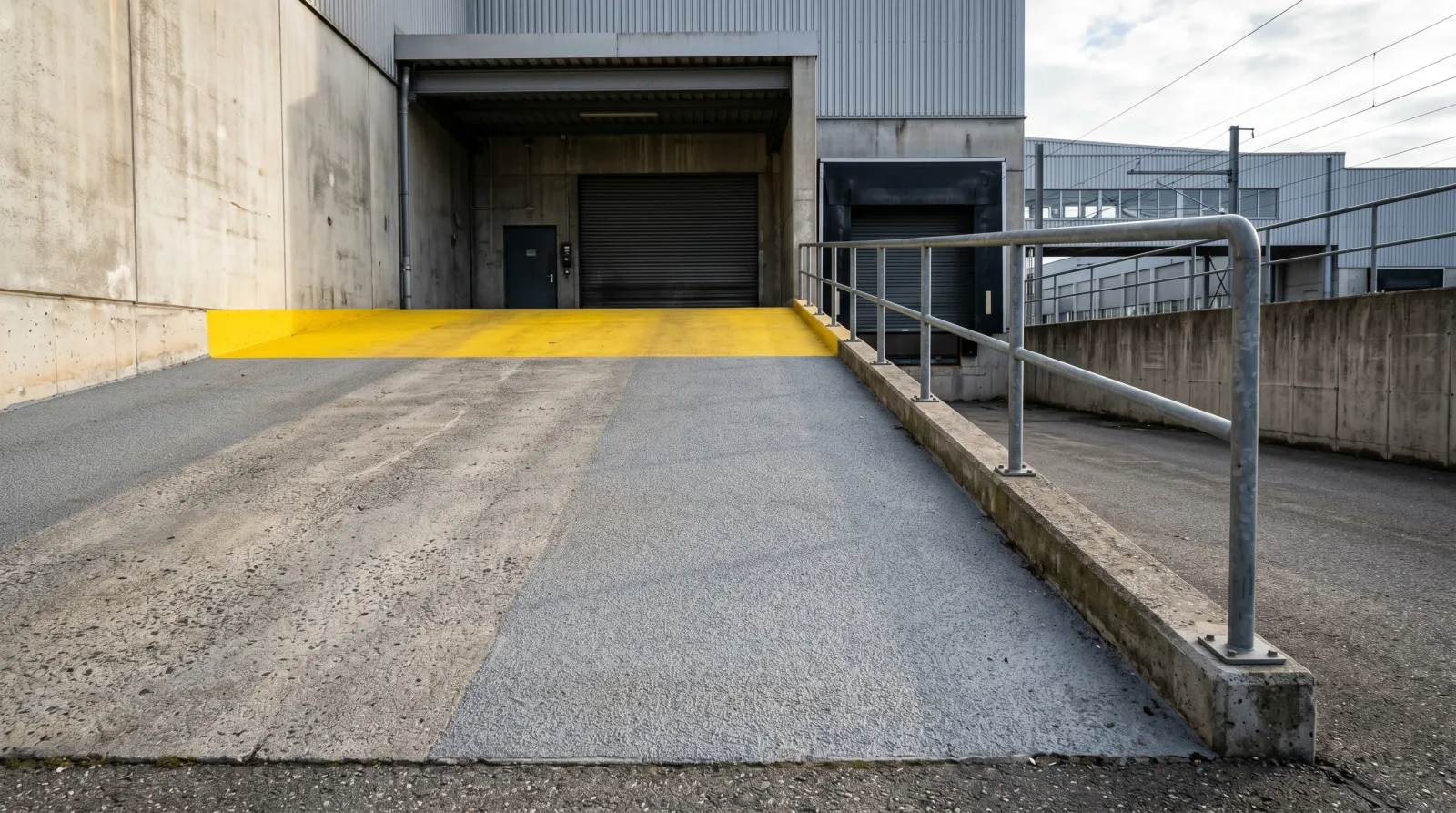
An anti-slip ramp coating has to do one job the rest of a floor system never has to do: hold a foot on an incline, wet, under load, for the full service life. The asset is a pedestrian or vehicle ramp. Loading-dock approaches, ADA accessible ramps at building entries, parking-deck spiral ramps, food-plant wash-down ramps, marine gangways, and the short interior grade between two floor levels. The environment runs from climate-controlled indoor to freeze-thaw exterior with chloride from de-icing salt, and the failure consequence is a fall, not a worn finish. A slip on an incline is the claim a facility manager defends in front of a workers-comp adjuster.
Slip resistance on a ramp is a measured property, not a product label. The governing number is a coefficient of friction, and it has to survive water. OSHA 1910.22(a)(2) requires walking-working surfaces be maintained free of recognized slip hazards. The agency does not publish a single COF in the rule, but the long-standing industry benchmark, carried from the 1990 proposed walking-working surfaces rule and used by most safety auditors, is a static COF of 0.50 on level walkways and 0.60 on ramps and inclines. ADA-governed public ramps add ANSI A326.3, which sets a wet dynamic COF of 0.42 minimum, and ADA 405.4, which requires the running surface be slip-resistant. The spec writer’s job is to pick a resin and an aggregate that hit those numbers wet, then prove it with a tribometer reading after cure.
Service life depends on aggregate retention more than resin chemistry. The grit wears smooth in the tread path before the resin film fails. A budget single-coat broadcast holds slip resistance 3–5 years under foot traffic. A primed two-coat epoxy with a locked aggregate broadcast holds 7–10 years. A urethane-cement or exterior polyurethane system on a salted dock ramp runs 10–15 years before the texture polishes out. The recoat is usually a refresh of the worn band, not a full strip.
Spec Requirements
| Spec | Value |
|---|---|
| Dry film thickness (DFT) | 8–20 mils total resin build (primer + body + lock coat); aggregate broadcast adds profile, not measured DFT |
| Aggregate | 16–30 mesh aluminum oxide for traffic ramps; 36–60 mesh for barefoot / wash-down; broadcast to refusal into wet body coat |
| Coverage @ DFT | 80–160 sq ft / gal resin; aggregate at 0.5–1.0 lb / sq ft broadcast |
| VOC | under 100 g/L water-based epoxy (CARB / OTC compliant); under 250 g/L solvent-borne PU, restricted under SCAQMD Rule 1113 |
| Slip resistance — OSHA | static COF 0.60 minimum on incline per ASTM D2047; verify wet with ASTM F2508 tribometer |
| Slip resistance — ADA / public | wet DCOF 0.42 minimum per ANSI A326.3; ADA 405.4 slip-resistant running surface |
| Standards | ASTM D2047 (static COF), F1679 / F2508 (tribometer), E303 (British Pendulum wet), D4060 (abrasion), D7234 (adhesion) |
| Substrate prep — concrete | ICRI CSP 3 (shotblast) standard; CSP 2 (grind) acceptable on smooth interior ramp under foot traffic only |
| Substrate prep — steel ramp / dock plate | SSPC-SP6 commercial blast minimum; SSPC-SP10 near-white for chloride / marine |
| Moisture ceiling (floors) | ASTM F1869 MVE under 3 lb / 1000 sq ft / 24h; F2170 under 75% RH |
| Service temp | -20°F to 180°F epoxy; -40°F to 250°F urethane cement; exterior PU full UV range |
| Cure to service | foot traffic 24h; vehicle / forklift 72h–7 days; full chemical and abrasion cure 7–14 days |
| Application window | substrate temp 50–90°F; RH under 85%; dew point 5°F below substrate temp through cure |
The slip numbers are the line items a generalist drops, and they are the reason this coating exists. ASTM D2047 is the James-machine static COF test on level laboratory panels; it is the number most product data sheets quote, and it is measured dry. A ramp is not level and rarely dry, so a 0.80 dry D2047 reading on a sell sheet tells you little about the surface a pallet jack rolls down in the rain. The wet incline value comes from a variable-incidence tribometer to ASTM F1679 / F2508 or a British Pendulum to ASTM E303, run on the finished floor after cure. Write the field test into the spec, not just the lab number, or the contractor will hand you a 0.80 D2047 cut sheet on a surface that reads 0.35 wet.
Substrate prep is where the bond lives. On concrete, shotblast to ICRI CSP 3 for any ramp under wheeled or heavy traffic; a diamond-grind to CSP 2 is acceptable only on a smooth interior ramp under foot traffic. Acid etch (CSP 1) is never the industrial spec on an incline. On a steel dock ramp or check-plate, blast to SSPC-SP6 commercial grade, or SSPC-SP10 near-white where chloride and marine salt are in play. The moisture ceiling applies to every exterior ramp because there is usually no vapor barrier under the slab. Skip the ASTM F1869 test and the coating blisters off the first wet spring.
System Chemistry Compared
Pick the chemistry to the ramp’s exposure, then the brand.
| Class | Pot life | Recoat | Service temp | UV stable | $/sq ft installed | Best for |
|---|---|---|---|---|---|---|
| Water-based epoxy + aggregate | 30–45 min | 8–24h | -20°F to 180°F | No (ambers in sun) | $4–8 | Interior ramps, docks under cover |
| Solvent / 100% solids epoxy | 20–40 min | 8–16h | -20°F to 200°F | No | $5–9 | Heavy chemical, interior industrial |
| Polyurethane (aliphatic) | 30–60 min | 4–12h | -40°F to 200°F | Yes | $7–12 | Exterior ramps, UV exposure |
| Polyaspartic | 15–30 min | 1–2h | -40°F to 200°F | Yes | $8–14 | Fast-turnaround, can’t close the ramp long |
| Urethane cement | 30 min | 12h | -40°F to 250°F | Yes | $12–22 | Wash-down, food plant, thermal shock |
| MMA (methyl methacrylate) | 5–15 min | 1h | -40°F to 200°F | Yes | $14–26 | Cold / damp substrate, freezer ramps |
For a covered interior ramp or a loading dock under a canopy, a water-based epoxy with an aluminum-oxide broadcast is the right answer and the cheapest path to a 0.60 incline COF. For an exterior ramp in sun, epoxy ambers and chalks within a year, so step up to an aliphatic polyurethane that holds color and gloss under UV. Polyaspartic earns its premium only when the ramp cannot be closed long; it cures to foot traffic in hours instead of a day. Urethane cement and MMA are for the hard cases: wash-down food ramps, freezer approaches, and damp slabs that will not dry enough for epoxy to bond.
VOC drives the indoor-versus-solvent call. Water-based epoxy sits under 100 g/L and clears CARB and OTC state limits. Solvent-borne polyurethane can run 250 g/L or higher and is restricted under SCAQMD Rule 1113 in the South Coast district and comparable rules in the thirteen OTC states. Spec the solvent grade only where state air rules allow it and ventilation is real.
Recommended Systems
System a — Sherwin-Williams ArmorSeal 1000 HS Epoxy, Aggregate Broadcast
The interior-ramp and covered-dock standard. Primed, two resin coats with aluminum oxide seeded into the body coat and locked under a grout coat. Service life 7–10 years under foot and pallet-jack traffic.
| Layer | Product | DFT |
|---|---|---|
| Primer / MVE control | ArmorSeal 1K HS waterborne primer | 2–3 mils |
| Body coat (aggregate seeded) | ArmorSeal 1000 HS, 16–30 mesh aluminum oxide broadcast to refusal | 6–8 mils |
| Lock / grout coat | ArmorSeal 1000 HS clear or pigmented, back-rolled over aggregate | 4–6 mils |
| Total resin | 12–17 mils |
Sherwin-Williams ProIndustrial ArmorSeal page
The lock coat is the line most installers shortcut, and it is what holds the aggregate. A broadcast left without a grout coat sheds grit in the tread path within a year and the incline COF drops below spec by the second wet season. ArmorSeal ambers in direct sun, so keep System a under cover. On an exposed ramp, move to System C.
System B — Rust-Oleum Concrete Saver Anti-Slip Epoxy
Factory-blended grit in the topcoat. Right for a short interior ramp, a back-of-house service ramp, or a budget job where a separate broadcast-and-lock sequence is not justified. Service life 3–5 years.
| Layer | Product | DFT |
|---|---|---|
| Primer | Concrete Saver 5000 System epoxy primer | 2 mils |
| Anti-slip topcoat | Concrete Saver Anti-Slip Floor Coating (factory grit) | 6–10 mils |
| Total resin | 8–12 mils |
Rust-Oleum Concrete Saver / industrial floors
Factory-blended grit is more uniform than a hand broadcast but coarser-textured and lower in peak slip resistance than a 16-mesh aluminum-oxide seed. It clears 0.50 dry comfortably; verify it hits 0.60 wet on the incline before signing off. A barefoot or wash-down ramp wants the finer 36–60 mesh option, not the standard blend, which is harsh on bare feet and traps soil.
System C — Sika Sikafloor Polyurethane, Exterior Ramp
Aliphatic PU body and seal coat over a damp-tolerant primer, with quartz or aluminum-oxide broadcast. UV-stable, holds color and texture on a salted dock ramp. Service life 10–15 years.
| Layer | Product | DFT |
|---|---|---|
| Primer | Sikafloor primer for damp-tolerant concrete | 2–4 mils |
| Body coat (aggregate seeded) | Sikafloor PU, quartz / aluminum oxide broadcast to refusal | 6–10 mils |
| Seal coat | Sikafloor PU seal, UV-stable | 3–5 mils |
| Total resin | 11–19 mils |
The PU seal is what survives the UV that destroys an epoxy on an exterior ramp. Sika’s damp-tolerant primer also buys margin on a slab that will not fully dry, which is most exterior ramps in the Northeast and Pacific Northwest. Verify the specific Sikafloor product against the data sheet for chloride and freeze-thaw exposure; the line has several PU grades and they are not interchangeable.
Systems Compared
| System | Total DFT | $/sq ft installed | Service life | Best for |
|---|---|---|---|---|
| A — ArmorSeal epoxy + broadcast | 12–17 mils | $5–8 | 7–10 yrs | Interior ramps, covered docks |
| B — Concrete Saver anti-slip | 8–12 mils | $3–5 | 3–5 yrs | Short / budget interior ramps |
| C — Sikafloor PU, exterior | 11–19 mils | $8–14 | 10–15 yrs | Exterior, UV, salted dock ramps |
Installed cost covers prep (shotblast to CSP 3), primer, body and lock coats, aggregate, and labor. Self-performing a small dry interior ramp with an in-house crew drops cost roughly 40 percent. It also drops the odds the finished incline reads 0.60 wet, because the broadcast rate and the lock coat are where untrained crews cut corners.
Application & Contractor Path
This is a documented-safety surface, not a finish coat, and the contractor path follows from that. A short interior ramp under 200 square feet on sound, dry, moisture-tested concrete is within reach of a trained maintenance crew running a roll-and-broadcast kit. Anything that has to pass a slip-resistance audit (exterior ramp, dock ramp with vehicle traffic, ADA entry ramp, any insurer-flagged fall location) should go to an SSPC-QP1 certified industrial-coatings contractor or a NACE / AMPP Level 2 inspector-supervised crew. Surface prep alone, shotblasting concrete to ICRI CSP 3 or blasting a steel dock plate to SSPC-SP6, takes equipment most facility crews do not own.
The manufacturer rep path is the cheapest insurance on this spec. Sherwin-Williams ProIndustrial reps, Rust-Oleum Industrial distributors, and Sika flooring reps will walk the ramp, run a moisture test, recommend the aggregate mesh for the foot or vehicle traffic, and put the COF target in writing. Get the rep on the pre-bid walk. The aggregate call (16 mesh for a forklift dock, 60 mesh for a barefoot pool ramp) is the one most generalists guess wrong, and the rep fixes it before it is poured.
Require a post-cure tribometer reading as a closeout deliverable. An ASTM F2508 wet reading on the finished incline, logged and filed, is the document that defends the surface when someone slips. A contractor who will not produce it has not built the surface you specified.
Failure Modes & How to Prevent Them
Aggregate sheds and slip resistance drops. The grit pulls out of the tread path within a year and the wet COF falls below 0.60 while the resin still looks intact. Cause is a missing or thin lock / grout coat over the broadcast. Prevention is the full sequence: broadcast to refusal into the wet body coat, then back-roll a lock coat that wets out and encapsulates the grit. Verify with a wet tribometer reading at cure, not a dry lab cut sheet.
Delamination from moisture vapor. Exterior ramps and dock approaches pull ground moisture with no vapor barrier under the slab. The epoxy lifts in disc blisters or peels at the leading edge the first wet spring. Prevention is ASTM F1869 or F2170 before coating; if MVE reads above 3 lb / 1000 sq ft / 24h, install an MVE-tolerant primer or switch to a breathable PU or MMA system. The concrete floor efflorescence diagnosis page covers the related salt-and-moisture failure on slabs.
Amber and chalk on exterior epoxy. An epoxy spec’d on a sun-exposed ramp yellows and chalks within a season, and the chalk surface itself reads slick when wet. Cause is UV on an aromatic epoxy resin. Prevention is an aliphatic polyurethane (System C) or a UV-stable polyaspartic on any ramp that sees direct sun.
Edge ravel and chipping at the leading edge. The top lip of the ramp, where wheels and feet first land, chips and ravels because film is thin over a sharp arris. Prevention is to ease the leading edge, detail-coat the lip to full build before the body coat, and carry a safety-yellow stripe across it. The stripe is both a trip-hazard marker and a wear sacrifice.
Applied below dew point. Moisture condenses between coats on a cool ramp poured early in the day, and the body coat blisters or the lock coat fish-eyes. Prevention is the dew-point rule: substrate temp at least 5°F above dew point through the full cure window, logged by the contractor. Exterior ramps in spring and fall fail this constantly because the slab is cold at the 7 AM start.
Failed slip audit on a passing-looking floor. The ramp looks textured and the data sheet says 0.80, but the field tribometer reads 0.40 wet and the audit fails. Cause is quoting a dry ASTM D2047 lab number instead of testing the wet incline. Prevention is writing the wet F2508 field test into the spec and running it at closeout.
Where to Buy / Spec
| Channel | Best for |
|---|---|
| Manufacturer-direct (SW ProIndustrial, Rust-Oleum Industrial, Sika) | Spec’d ramps, rep walk, moisture test, COF target in writing |
| Industrial distributor (Sherwin Industrial, Rawlins US dealers) | Bulk resin and aggregate, contractor accounts |
| Pro retail (Sherwin-Williams stores, BM Pro) | Small interior ramp, local pickup, contractor pricing |
| Amazon Business | Roll-and-broadcast kits, anti-slip additive for short interior ramps |
FAQ
See the frontmatter for the full Q&A on OSHA compliance, the COF and DCOF numbers to write into the spec, moisture testing, the DIY-versus-contractor call, and recoat intervals.