Intumescent Wood Paint for Timber Beams: Specifier's Guide (2026)
Intumescent wood paint compared for exposed timber beams and glulam. ASTM E84 Class A flame spread, fire-resistance ratings, DFT in mils, topcoat compatibility, and contractor path.

Disclosure: Affiliate links to retailers and manufacturer-direct programs. Recommendations are spec-driven, not commission-driven.
Use Case
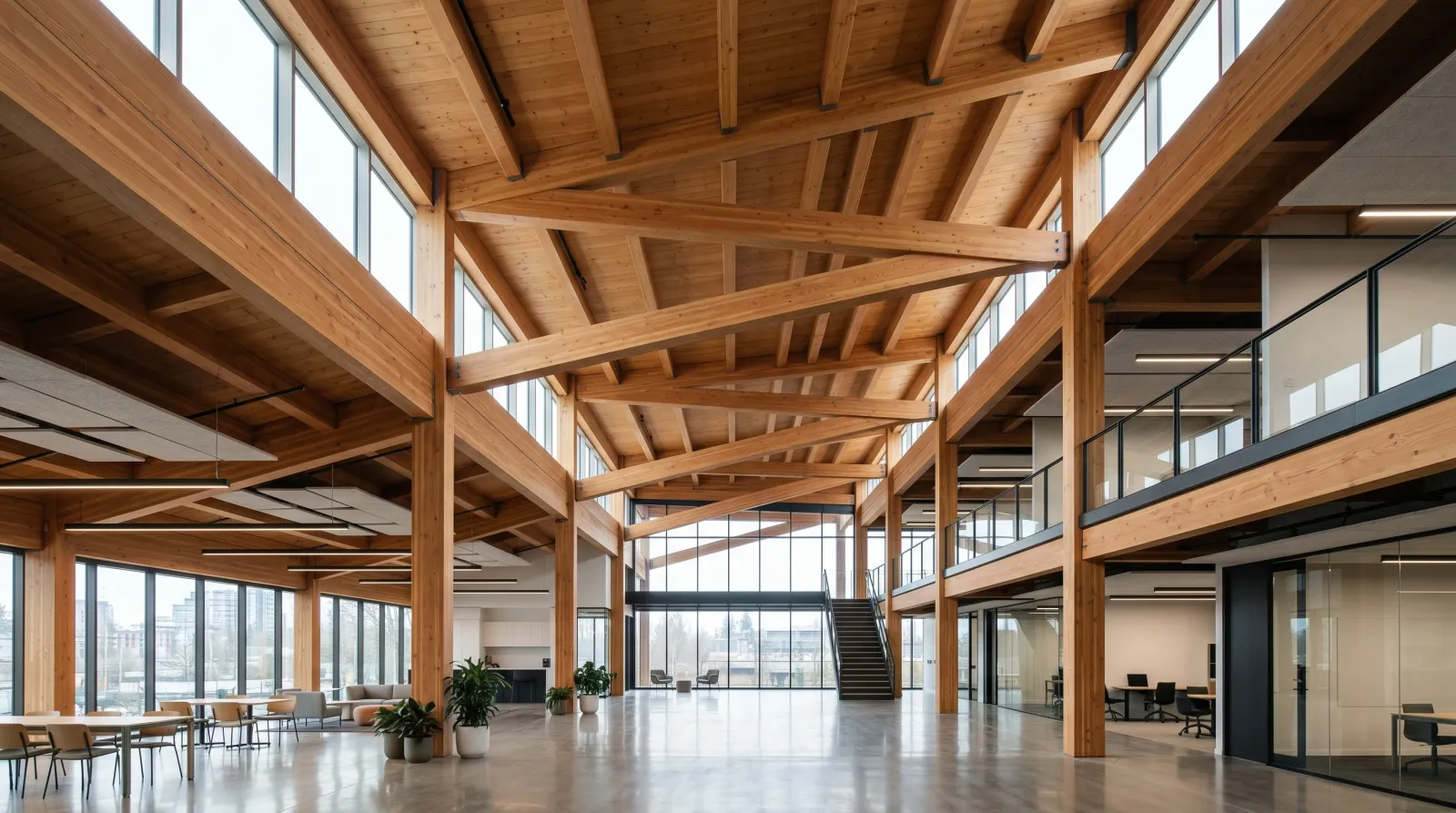
Intumescent wood paint is the interior finish that lets an architect leave timber structure exposed without failing the flame-spread requirement the building code writes into the occupancy. The asset is exposed wood: glulam beams in a church or library, heavy-timber columns and decking in a mass-timber office, reclaimed barn beams in a restaurant ceiling, tongue-and-groove wood paneling in a corridor, or a cross-laminated timber (CLT) ceiling in a multifamily building. In each case the design intent is visible wood, and the code is the reason a coating gets specified at all.
The chemistry is the same family used on steel. The film carries an acid catalyst, a carbon donor, a blowing agent, and a binder. Heat from a fire softens the binder, the catalyst attacks the carbon donor, and the blowing agent expands the film into an insulating carbonaceous char many times the dry thickness. On wood the char does a specific job: it slows the surface from igniting and reaching flashover, which is what ASTM E84 measures as flame spread. The IBC (Chapter 8) sets the interior finish class by occupancy and location. Exit corridors and exit enclosures usually demand Class A: flame spread index of 25 or less, smoke developed 450 or less. Untreated softwood and many hardwoods test Class C or worse, so the coating is what closes the gap.
There is a second, narrower job: contributing to a tested fire-resistance rating on a timber assembly under ASTM E119. Most wood intumescents are not the path to an hourly rating. Heavy-timber members carry their rating through cross-section and the NDS char-rate method. The coating’s role on exposed timber is overwhelmingly the Class A surface-burning rating, not an hourly number. The spec language tells you which one is in play.
Service life for an interior waterborne intumescent on conditioned, dry timber is 10 to 20 years before recoat. The coating fails early from moisture, from poor adhesion over an old finish, or from field film applied below the labeled spread rate that the Class A listing depends on.
Spec Requirements
The spec block before any product name. Numbers vary by manufacturer and by which job the spec calls for: Class A surface burning or a rated assembly. The categories hold across the class.
| Spec | Value |
|---|---|
| Surface-burning rating | ASTM E84 Class A: flame spread index ≤25, smoke developed ≤450 |
| Dry film thickness (Class A) | 6–14 mils dry, applied to the manufacturer’s labeled spread rate (sq ft per gallon) |
| Dry film thickness (rated assembly) | 20–45 mils dry per the specific tested ASTM E119 assembly |
| Coverage @ labeled DFT | Typically 75–150 sq ft per gallon per coat; the spread rate, not the mil count, is the field control |
| VOC limit | <100 g/L waterborne; <250 g/L solvent-borne wood grades under SCAQMD Rule 1113 |
| Substrate | Bare or compatibly finished wood at ≤19% moisture content; clean, dry, sound |
| Substrate prep — bare wood | Sand to remove mill glaze; remove dust, oil, and wax; no sanding sealer unless listed |
| Substrate prep — finished wood | Scuff-sand glossy coatings; confirm old finish on the manufacturer compatibility list; adhesion test |
| Mold / humidity resistance | ASTM D3273, ASTM D2247 for damp-prone interiors |
| Ambient at application | 50°F to 90°F; relative humidity <85%; surface ≥5°F above dew point |
| Recoat window between coats | 2–24 hours per the product data sheet; varies with temperature and humidity |
| Cure to service | 24–72 hours to handle; full cure 7 days before topcoat or occupancy |
| Field verification | Documented wet film thickness readings and coverage log keyed to the labeled spread rate |
Three numbers govern the Class A rating: the dry film thickness relative to the labeled spread rate, the bond to a sound substrate, and the moisture state of the wood. The coverage log is the document an inspector or insurer asks for. A Class A coating applied at half the labeled spread rate is a Class C coating that nobody can prove.
System Chemistry Compared
Three coating families cover almost every wood-protection spec. Only the first is a true intumescent. The other two get specified for wood and get confused with it, so the comparison earns its place.
| Chemistry | What it does on wood | Substrate exposure | UV / weather | $/sq ft material | Best for |
|---|---|---|---|---|---|
| Waterborne intumescent | Expands to insulating char; Class A flame spread, slows ignition | 🟢 Interior, conditioned, dry timber | 🔴 Interior only without an exterior-rated grade and sealer | $1.50–4.00 | Exposed glulam, heavy timber, paneling, CLT ceilings |
| Fire-retardant topcoat (non-intumescent) | Chemically suppresses flame spread without forming a char | 🟢 Interior; some clear grades | 🟡 Limited; check the data sheet | $1.00–2.50 | Light-duty Class A on trim, paneling, decorative wood |
| Pressure-impregnated FRT wood | Fire retardant forced into the cell structure at the mill, not a coating | 🟢 Interior; exterior FRT grades exist | 🟢 Exterior FRT grades available | Mill-applied; priced into the lumber | Framing, sheathing, plywood where the rating ships with the board |
Waterborne intumescent is the answer when the wood is already in place and visible and the spec calls for Class A on the exposed surface. A non-intumescent fire-retardant coating is lighter-build and cheaper but does not form the insulating char, so read the test report for what it actually claims. Pressure-impregnated FRT lumber is the cleanest path when the rating can be designed in at the mill before the wood ships, and it is the wrong answer for an existing exposed beam that you cannot send back through a treatment plant.
Recommended Systems
Three full systems at different price-performance points. All three are waterborne intumescents carrying Class A surface-burning classifications on wood substrate under ASTM E84. Verify the specific test report against your wood species and substrate before bid. Spread rate is the field control on every one of them.
System A — Contego Reactive Fire Barrier Latex (clear And Pigmented, Architectural)
| Layer | Product | DFT |
|---|---|---|
| Substrate prep | Clean, dry, sanded bare or compatibly primed wood | n/a |
| Intumescent (Class A) | Contego Reactive Fire Barrier Latex | 8–14 mils dry, two coats at the labeled spread rate |
| Topcoat (optional, decorative) | Contego-listed waterborne clear or pigmented topcoat | 1.5–2.5 mils |
| Total | 9.5–16.5 mils |
Service life 12–20 years interior. Contego’s clear grade is the differentiator: it keeps the timber grain visible, which is the reason exposed glulam gets specified in the first place. The clear system needs its full labeled build, so the finished beam reads as a satin coated surface rather than raw wood. Specify Contego when the architect wants natural exposed timber and the spec calls for Class A. Contego International product page.
System B — Flame Control No. 10-10 Intumescent (pigmented, Value Class A)
| Layer | Product | DFT |
|---|---|---|
| Primer (if a pigmented finish is required) | Flame Control listed alkyd or latex primer | 1.5–2 mils |
| Intumescent (Class A) | Flame Control No. 10-10 intumescent fire-retardant paint | 6–12 mils dry at the labeled spread rate |
| Topcoat (optional) | Flame Control listed compatible enamel | 1.5–2.5 mils |
| Total | 7.5–16.5 mils |
Service life 10–15 years interior. Flame Control 10-10 is a long-track pigmented intumescent that hits Class A at lower film build and lower cost than the clear systems. It is the value choice when the beams are painted anyway and the design does not need visible grain. The decorative color holds in the topcoat, not the intumescent, so confirm the topcoat against the compatibility list before adding color. Flame Control Coatings product page.
System C — No-Burn Plus ThB (waterborne, Low-VOC Interior)
| Layer | Product | DFT |
|---|---|---|
| Substrate prep | Bare, sound, dry wood; sand sealed or finished surfaces to bare | n/a |
| Intumescent (Class A) | No-Burn Plus ThB waterborne intumescent | 7–12 mils dry, two coats per label |
| Topcoat (optional) | No-Burn-listed waterborne clear topcoat for wear or damp areas | 1.5–2 mils |
| Total | 8.5–14 mils |
Service life 10–18 years interior. No-Burn Plus ThB ships at very low VOC and adds mold-resistance to the same Class A flame-spread job, which matters in a humidity-prone interior like a natatorium soffit or a basement-level timber ceiling. The mold claim is in addition to the rating, not a substitute for it. Confirm the moisture-resistant topcoat for any space that runs above 60 percent relative humidity. No-Burn product page.
Systems Compared
| System | Total DFT range | $/sq ft installed | Service life | Best for |
|---|---|---|---|---|
| A — Contego Reactive Fire Barrier | 9.5–16.5 mils | $2.50–5.50 | 12–20 years | Exposed natural timber, clear grain visible, architectural |
| B — Flame Control 10-10 | 7.5–16.5 mils | $1.75–4.00 | 10–15 years | Painted beams, value Class A, lower film build |
| C — No-Burn Plus ThB | 8.5–14 mils | $2.00–4.50 | 10–18 years | Damp-prone interiors, low-VOC, added mold resistance |
Pricing assumes interior conditioned timber, spray or back-roll application, primer and topcoat where noted, on a scope above 2,000 sq ft of wood surface. Small-scope retrofits and hard-to-reach beam work run 40–100 percent higher per square foot, since the labor to mask, scaffold, and spray exposed structure dominates the cost, not the coating.
Application and Contractor Path
Class A intumescent wood paint can be field-applied by a qualified commercial painting crew on accessible interior work. It is closer to a high-build architectural coating than to the per-member calibration that structural-steel intumescent demands. The constraint that turns it from a paint job into a spec’d scope is the labeled spread rate: the Class A rating is only valid at the dry film thickness the manufacturer tested, which means a documented coverage log per gallon and wet film thickness readings during application. A crew that rolls it thin to stretch the bucket has bought a rating they cannot prove.
For any project an inspector, an authority having jurisdiction (AHJ), or an insurer will review, specify a contractor who can deliver three things:
- The manufacturer’s ASTM E84 Class A test report keyed to a wood substrate and, where possible, the project’s wood species. A steel test report does not transfer to timber.
- A coverage log: gallons applied, square feet covered, calculated spread rate per coat, against the manufacturer’s labeled rate for Class A.
- Wet film thickness readings taken during application, since dry film is hard to read non-destructively on a porous wood substrate.
Manufacturer-rep support on Contego, Flame Control, and No-Burn includes a pre-bid review of the spec language to confirm whether the job is Class A surface burning or a rated assembly, the right product grade for the substrate and exposure, and the coverage rate the crew has to hit. Use it. A spec that calls for an hourly rating cannot be satisfied by a Class A coating, and catching that mismatch at the submittal stage costs a phone call. Catching it at final inspection costs a re-scope.
Failure Modes and How to Prevent Them
Five failures cover the bulk of intumescent wood-coating rejections and warranty claims.
- Film applied below the labeled spread rate. Cause: the crew stretched coverage or skipped the second coat. The Class A rating is only valid at the tested dry film thickness, so under-application silently downgrades the coating to Class C. Prevention: a documented coverage log per gallon, wet film gauge readings during application, and a coverage rate confirmed against the manufacturer’s labeled Class A rate before sign-off.
- Moisture intrusion. Cause: wood applied above 19 percent moisture content, condensation during cure, or an interior coating used in a damp or exterior location. The intumescent salts are water-sensitive; moisture swells or leaches them and the char chemistry stops working. Prevention: moisture-meter the timber before coating, hold relative humidity below 85 percent during application and cure, and use an exterior-rated grade with a moisture-resistant topcoat for any damp space.
- Adhesion failure over an old finish. Cause: intumescent applied over a glossy varnish, stain, or paint without scuff-sanding or a compatibility check. The coating peels and takes the rating with it. Prevention: sand glossy finishes, confirm the old coating on the manufacturer’s compatibility list, and run an adhesion test on a sample section before committing the scope.
- Topcoat incompatibility. Cause: a decorative clear or color topcoat outside the manufacturer’s listed chart was applied, sealing or interfering with the char reaction. Prevention: use only the manufacturer-listed topcoat at the listed film thickness. Architect-driven color and sheen choices route through the rep, not around the data sheet.
- Wrong product for the rating the spec wants. Cause: a Class A surface-burning coating bought to satisfy a spec that actually called for an hourly fire-resistance rating, or vice versa. Prevention: read the spec language. Flame-spread index means Class A coating; an hourly rating means a tested ASTM E119 assembly or a sized heavy-timber section, which the coating alone does not deliver.
Spread-rate failures and wrong-product-for-the-spec are the two I see most. The first is a field-control problem solved by a coverage log. The second is a reading-comprehension problem solved at submittal, and it is the expensive one, because the fix is a re-spec after the wood is already coated.
Where to Buy / Spec
| Channel | Best for | Path |
|---|---|---|
| Manufacturer-direct (Contego, Flame Control, No-Burn) | Spec’d commercial projects, Class A test reports, rep support | Contego · Flame Control · No-Burn |
| Fire-protection distributor | Multi-product bids, mixed steel-and-timber scopes | Distributor account with project-specific pricing |
| Amazon Business | Small interior touch-up and single-room scopes | Business account; verify the listing ships the Class A grade |
| Pro paint retail (S-W, BM commercial desk) | Local pickup of stocked fire-retardant grades, contractor pricing | Commercial counter; confirm the can carries the ASTM E84 Class A listing |
Manufacturer-direct is the recommended channel on any project above 2,000 sq ft of coated timber or any project an AHJ reviews. The rep delivers the wood-substrate test report, the spread-rate confirmation, and the spec read that separates a Class A surface treatment from a rated assembly. Those services outweigh any retail discount on the bucket.
FAQ
Is intumescent wood paint the same product as intumescent fire paint for steel? Same chemistry family, different formulation and different test report. A coating tested to ASTM E84 on a steel substrate does not carry to wood, and a Class A wood listing does not deliver the hourly ASTM E119 ratings that the structural-steel intumescent systems provide. Spec the grade tested on the substrate you are coating, for the rating the project actually requires.
What’s the warranty? Manufacturer product warranties run 5 to 10 years on interior waterborne wood intumescents. The Class A rating itself is conditional on the documented spread rate at application, so the warranty that matters is the installed-system coverage backed by the coverage log. A bucket warranty means nothing if the field film came in below the tested thickness.
Does the wood need a specific moisture level before coating? Yes. Coat dry timber at or below 19 percent moisture content. Wetter wood traps moisture under the film, which both fails adhesion and degrades the water-sensitive intumescent salts. Moisture-meter the beams before application and address the source of any high reading first.
Is intumescent wood paint OSHA-compliant for an exit corridor? OSHA does not rate the coating; the building code does. The IBC sets the interior finish class by occupancy and location, and an exit corridor in most occupancies requires Class A interior finish. A Class A intumescent on the exposed timber, applied at the labeled spread rate and documented, is the compliance path. The AHJ verifies against the code-required class, not against an OSHA number.
Can I get a clear finish, or does the beam have to be painted? Clear intumescent systems keep the grain visible (Contego and several others list clear grades), at the cost of full film build and a satin coated look rather than raw wood. Pigmented grades hit Class A at lower mils and lower cost. Choose based on whether the design intent is visible natural timber or painted structure.